
North America Robotic Manipulation Market Size by Robot Type, Component, Technology, Application and Enduser
Overview
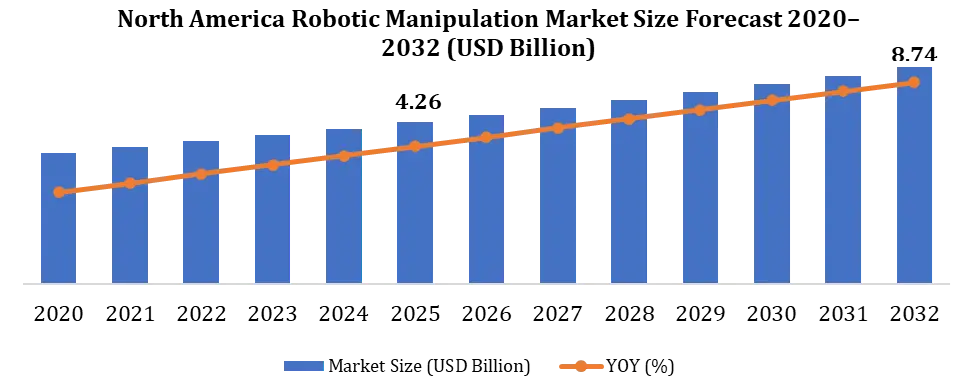
The North America Robotic Manipulation Market was valued at USD 4.26 Billion in 2025 and is projected to reach around USD 8.74 Billion by 2032, growing at a CAGR of 10.8% during 2026–2032. Growth is driven by rising adoption of industrial automation, AI-powered robotic systems, warehouse robotics, and increasing investments in advanced manufacturing across the United States and Canada.
To know about the Research Methodology :- Request Free Sample Report
North America Robotic Manipulation Market Overview
The North America robotic manipulation market is witnessing significant growth due to rapid industrial automation and increasing deployment of intelligent robotic systems across manufacturing, logistics, healthcare, retail, and defense sectors. Robotic manipulation technologies are widely used for material handling, assembly, packaging, welding, inspection, palletizing, and warehouse operations to improve productivity, precision, and operational efficiency.
Growth is supported by strong technological advancements in AI vision systems, machine learning, collaborative robots, and autonomous mobile robots. Rising labor shortages, increasing labor costs, and growing e-commerce activities are accelerating the adoption of robotic automation solutions across the United States and Canada. In addition, investments in Industry 4.0, smart factories, and robotics-as-a-service (RaaS) platforms are further strengthening regional market expansion.
North America Robotic Manipulation Market Key Highlights
| Market Parameter | Value / Insight | Trend |
| Market Size (2025) | USD 4.26 Billion | Strong Growth |
| Forecast Size (2032) | USD 8.74 Billion | Rapid Expansion |
| CAGR (2026–2032) | 10.8% | High Growth |
| Dominant Segment | Industrial Robotic Arms | Market Leader |
| Fastest Growing Segment | Warehouse Manipulation Robots | Rapid Adoption |
| Leading Application | Manufacturing Automation | High Demand |
| Emerging Trend | AI-Powered Collaborative Robots | Future Opportunity |
North America Robotic Manipulation Market Drivers
The North America robotic manipulation market is primarily driven by rising industrial automation adoption across automotive, logistics, electronics, semiconductor, healthcare, and e-commerce industries. Increasing deployment of AI-powered robotic systems, collaborative robots (cobots), autonomous mobile robots (AMRs), and machine vision technologies is significantly improving manufacturing efficiency, precision handling, and warehouse automation capabilities. Strong investments in Industry 4.0, smart factories, and AI-enabled production systems across the United States and Canada are further accelerating robotic manipulation demand. In addition, labor shortages, rising labor costs, and growing demand for flexible automation solutions continue to support market expansion across industrial and commercial sectors.
North America Robotic Manipulation Market Restraints
High initial deployment costs, integration complexity, and cybersecurity concerns associated with connected robotic systems continue to restrain market growth, particularly among small and medium-sized enterprises.
North America Robotic Manipulation Market Opportunities
Rapid expansion of warehouse automation, semiconductor manufacturing, AI-enabled robotics, and healthcare automation is creating significant growth opportunities across North America. Increasing adoption of Robotics-as-a-Service (RaaS), edge AI robotics, and intelligent robotic manipulation systems is enabling businesses to improve scalability and operational flexibility. Rising investments in autonomous fulfillment centers, robotic surgical systems, EV manufacturing automation, and smart logistics infrastructure are expected to further strengthen long-term market growth opportunities across the region.
Impact of Semiconductor Manufacturing on the North America Robotic Manipulation Market
The rapid expansion of semiconductor manufacturing across North America is significantly accelerating demand for robotic manipulation systems due to increasing automation requirements in chip fabrication, wafer handling, cleanroom operations, and precision electronics assembly. Semiconductor manufacturing facilities require highly accurate, contamination-free, and high-speed robotic systems capable of handling delicate wafers, microchips, and advanced electronic components with micron-level precision. Rising investments in semiconductor fabrication plants across the United States, particularly through initiatives such as the U.S. CHIPS and Science Act, are creating strong growth opportunities for robotic manipulation technologies.
Companies including NVIDIA, Intel, TSMC Arizona, Samsung Electronics, and Micron Technology are expanding semiconductor production capacity and increasing deployment of AI-powered robotic handling systems, autonomous material transport robots, and precision robotic arms across fabrication facilities. Robotic manipulation technologies are increasingly being integrated with machine vision systems, AI-based defect detection, edge computing, and automated cleanroom handling solutions to improve operational efficiency, yield optimization, and manufacturing precision.
In addition, growing demand for AI chips, advanced processors, EV semiconductors, and high-performance computing components is accelerating automation investments across semiconductor supply chains in North America. The semiconductor industry is expected to remain one of the fastest-growing end users of robotic manipulation systems during the forecast period due to rising production complexity, labor shortages, and increasing demand for fully automated smart manufacturing environments.
North America Robotic Manipulation Market Segment Analysis
By Application – Manufacturing dominated the North America robotic manipulation market in 2025 due to widespread adoption of robotic arms for assembly, welding, material handling, and quality inspection across automotive and industrial facilities. Logistics & Warehousing was the fastest-growing segment, supported by rising e-commerce automation and warehouse robotics demand, while healthcare, defense, retail, and electronics showed steady adoption.
By End User – Automotive held the largest market share in 2025, driven by extensive automation in vehicle production and EV manufacturing. E-commerce grew rapidly due to increasing use of robotic picking and sorting systems, while healthcare providers, defense organizations, and industrial manufacturers continued expanding robotic deployment.
North America Robotic Manipulation Market Competitive Landscape
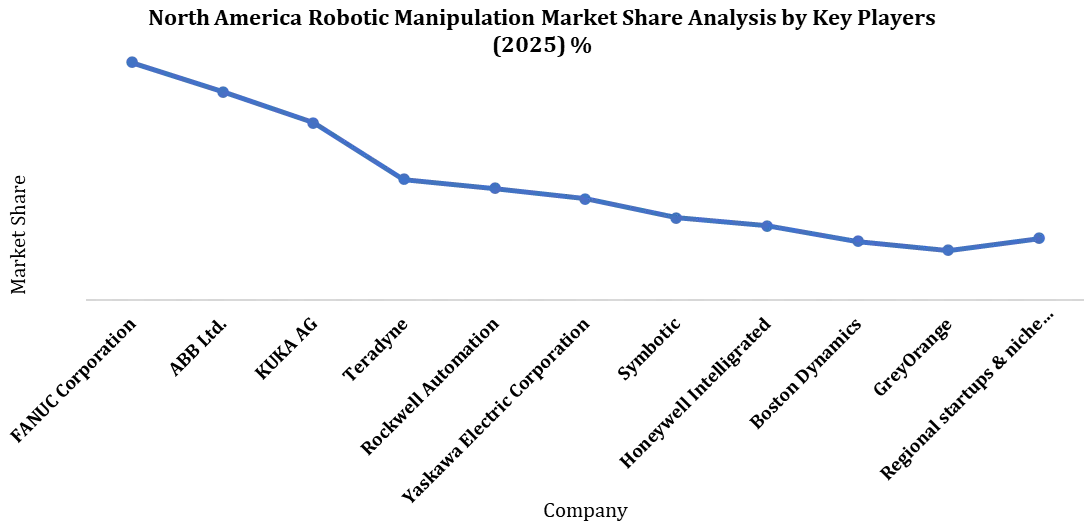
The North America robotic manipulation market is highly competitive with the presence of global robotics manufacturers, industrial automation providers, AI technology companies, and warehouse automation specialists. Key players include ABB Ltd., FANUC Corporation, KUKA AG, Rockwell Automation, and Teradyne.
Competition is driven by advancements in AI-enabled robotics, collaborative robots, warehouse automation systems, industrial IoT integration, and intelligent robotic software platforms. Companies are focusing on partnerships, technological innovation, cloud-connected robotics solutions, and expansion of smart manufacturing capabilities.
North America Robotic Manipulation Market Recent Developments
| Date | Company | Development | Impact |
| Sep-25 | ABB Ltd. | Expanded AI-powered robotic automation solutions for smart manufacturing facilities across North America. | Strengthened industrial automation capabilities and accelerated adoption of intelligent robotic manipulation systems. |
| Nov-25 | Amazon Robotics | Expanded autonomous warehouse robotics and AI-driven fulfillment center operations in the U.S. and Canada. | Increased deployment of robotic manipulation technologies in logistics and e-commerce sectors. |
North America Robotic Manipulation Market Country-Level Analysis (2025)
The United States dominated the North America Robotic Manipulation Market in 2025 and accounted for the largest regional share due to strong adoption of industrial automation, AI-powered robotics, warehouse automation systems, and smart manufacturing technologies across automotive, logistics, healthcare, semiconductor, and defense industries. The U.S. witnessed the highest penetration of robotic manipulation systems, supported by large-scale investments in Industry 4.0, e-commerce fulfillment automation, and AI-enabled warehouse robotics. Growing deployment of collaborative robots, autonomous mobile robots (AMRs), and machine vision systems across manufacturing and logistics facilities continues to strengthen market demand.
Canada demonstrated steady market growth driven by increasing automation adoption in food processing, healthcare robotics, warehousing, and industrial manufacturing sectors. Government support for advanced manufacturing and AI innovation is further accelerating robotics integration across Canadian industries.
Mexico emerged as the fastest-growing country due to rising investments in automotive manufacturing, electronics assembly, nearshoring trends, and industrial automation expansion. Increasing demand for robotic welding, material handling, and packaging automation systems across automotive production facilities is supporting strong market penetration in Mexico. Rising labor shortages, increasing operational efficiency requirements, growth in e-commerce logistics, and expansion of smart factory infrastructure continue to drive robotic manipulation demand across North America.
North America Robotic Manipulation Market Scope: Inquire before buying
| North America Robotic Manipulation Market | |||
|---|---|---|---|
| Report Coverage | Details | ||
| Base Year: | 2025 | Forecast Period: | 2026-2032 |
| Historical Data: | 2020 to 2025 | Market Size in 2025: | USD 4.26 Bn. |
| Forecast Period 2026 to 2032 CAGR: | 10.8% | Market Size in 2032: | USD 8.74 Bn. |
| Segments Covered: | by Robot Type | Industrial Robotic Arms Collaborative Robots Mobile Manipulation Robots Autonomous Mobile Robots (AMRs) Humanoid Manipulation Robots |
|
| by Component | Sensors Controllers Actuators End Effectors Software Others |
||
| by Technology | AI Vision Systems Machine Learning & Reinforcement Learning Force Torque Sensing Motion Control Systems Digital Twin & Simulation Edge AI Robotics |
||
| by Application | Manufacturing Logistics & Warehousing Healthcare Defense Retail Electronics |
||
| by End User | Automotive E-commerce Healthcare Providers Defense Organizations Industrial Manufacturers |
||
North America Robotic Manipulation Market Key Players
1. ABB Ltd.
2. FANUC Corporation
3. KUKA AG
4. Rockwell Automation
5. Teradyne
6. Universal Robots
7. Yaskawa Electric Corporation
8. NVIDIA Corporation
9. Amazon Robotics
10. Zebra Technologies
11. Honeywell International
12. Omron Corporation
13. Siemens AG
14. Boston Dynamics
15. Teradyne Robotics
16. DENSO Robotics
17. GreyOrange
18. Fetch Robotics
19. Locus Robotics
20. Kawasaki Robotics
North America Robotic Manipulation Market – FAQs
1. How AI is improving robotic manipulation?
AI improves robotic manipulation by enabling intelligent object recognition, adaptive motion control, predictive maintenance, autonomous handling, and real-time decision-making across industrial and warehouse automation systems.
2. Which North American country dominates robotic manipulation adoption?
The United States dominated the North America robotic manipulation market in 2025 due to strong investments in industrial automation, AI-powered robotics, smart factories, and warehouse automation infrastructure.
3. What role do cobots play in smart factories?
Collaborative robots (cobots) improve flexible automation by safely working alongside human workers in assembly, packaging, inspection, and material handling operations while reducing labor dependency and improving productivity.
4. How semiconductor demand impacts robotic manipulation?
Growing semiconductor demand increases the need for robotic manipulation systems in wafer handling, cleanroom automation, precision assembly, and high-accuracy manufacturing processes across semiconductor fabrication facilities.
5. What industries are adopting robotic manipulation fastest?
Logistics & warehousing, automotive, semiconductor manufacturing, healthcare, e-commerce, and electronics industries are adopting robotic manipulation technologies fastest due to rising automation demand and smart manufacturing expansion.