
Molecular Beam Epitaxy System Market Size by Product, Epitaxy Type, Application, End User Industry and Region – Revenue Pool Analysis, Margin Structure Assessment, Capital Flow Trends, Competitive Benchmarking & Forecast to 2032
Overview
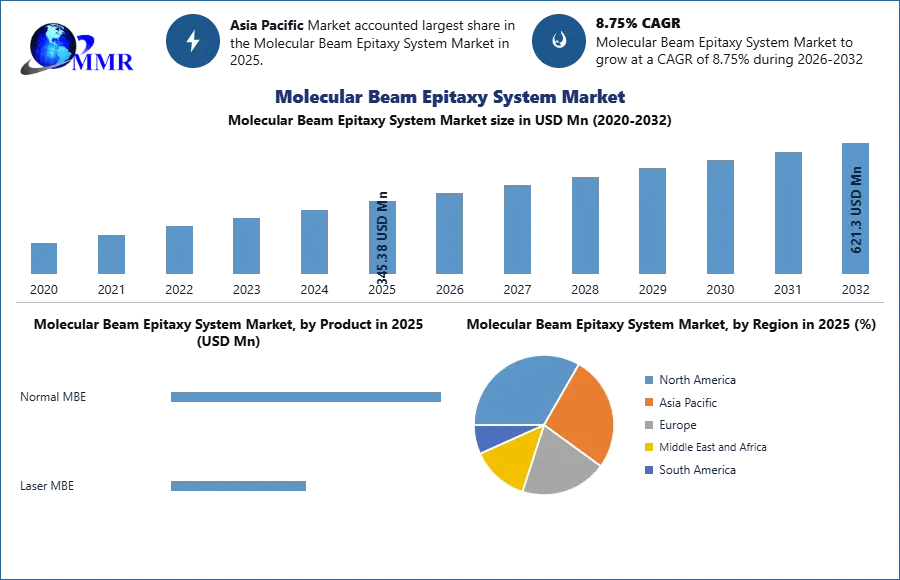
Global Molecular Beam Epitaxy System Market was valued at US$ 345.38 million in 2025 and the total market is forecasted to grow at a CAGR of 8.75% from 2026 to 2032, reaching nearly US$ 621.3 million by 2032.
Overview and Scope
Molecular Beam Epitaxy (MBE) is a precision technology that has found various applications in the semiconductor industry for producing thin films at the atomic level. These are widely used for manufacturing electronic and optoelectronic devices such as transistors, solar cells, and LEDs. Various types of MBE systems are prevalent in the market which caters to different applications and end-use like research and development, academia, and industrial production.
The Molecular Beam Epitaxy System Market growth is driven by factors such as the growing demand for high-performance electronic and optoelectronic devices, advancements in semiconductor technology, and increasing focus on renewable energy sources. The increasing adoption of MBE technology in emerging markets such as China and India drive the potential growth. However, with extensive studies conducted by Maximize Market Research, it is speculated that the high cost of MBE systems and the complexity of the technology pose a challenge to the market. North America is currently the largest market for MBE systems and is expected to grow over the forecast period.
To know about the Research Methodology :- Request Free Sample Report
Molecular Beam Epitaxy System Market Research Methodology
Both primary and secondary data sources have been utilized for studying the Molecular Beam Epitaxy System Market. The research includes a thorough examination of all factors that may affect the market, validated through primary research and evaluated to provide valuable conclusions. Variables such as inflation, economic downturns, regulatory and policy changes, and others in the market forecasts for top-level markets and sub-segments have also been factored in. To estimate Molecular Beam Epitaxy System Market size and forecasts, the bottom-up approach has been employed and multiple data triangulation methodologies have been utilized. Weights have been assigned to each segment based on their utilization rate and average sale price to derive percentage splits, market shares, and breakdowns. The country-wise analysis of the market and its sub-segments is based on the percentage adoption or utilization of the given market size in the respective region or country.
To identify the major players in the market, secondary research was conducted based on indicators like market revenue, price, applications, advancements, mergers and acquisitions, and joint ventures. Also, extensive primary research has been conducted to verify and confirm crucial numbers arrived at, after comprehensive market engineering and calculations for market statistics, market size estimations, market forecasts, market breakdown, and data triangulation. Furthermore, the report offers a clear representation of competitive analysis of key players by price, financial position, growth strategies, and regional presence in the market, making it an investor’s guide.
The secondary research phase involved a thorough synthesis of existing publications across the web to gather meaningful insights on the current situation of the market, technology developments, and any other market-related information. Information has been gathered from various sources including industry and government websites, blogs, magazines, and other publications, scientific papers, journals, and publications, trade information, conference proceedings, and association publications, among others. Critical insights obtained from primary research have been used to ascertain critical market dynamics, market distribution across various segments, market entry for new companies, and insights into the competitive landscape.
Molecular Beam Epitaxy System Market Dynamics
Market Drivers
The global Molecular Beam Epitaxy (MBE) system industry is driven by various factors, including the growing demand for high-performance electronic and optoelectronic devices, advancements in semiconductor technology, and increasing focus on renewable energy sources. The increasing demand for high-performance electronic and optoelectronic devices such as solar cells, LEDs, and transistors has significantly driven the growth of the Molecular Beam Epitaxy System Market. Additionally, the increasing demand for energy-efficient devices, such as LEDs and solar cells, has boosted the demand for MBE systems in recent years. The high-precision manufacturing capabilities of MBE systems are well-suited for manufacturing high-performance devices, leading to increased adoption of MBE technology in the semiconductor industry.
Furthermore, advancements in semiconductor technology, such as the development of new materials and increasing research activities, have also contributed to the growth potential of the MBE system market. The semiconductor industry is continually evolving, and new materials and manufacturing processes are being developed to meet the growing demand for high-performance devices. MBE technology is widely used in the research and development of new materials, making it a crucial technology in the semiconductor industry. Additionally, the increasing focus on renewable energy sources such as solar power has also driven the growth of the MBE system market, as MBE systems are used in manufacturing of solar cells.
Restraints: The high cost of Molecular Beam Epitaxy (MBE) system in the global market is a major restraint, hindering its growth. MBE systems are expensive and require significant investment, making them less accessible to small and medium-sized enterprises (SMEs) and start-ups. Moreover, the complexity of the technology and the need for skilled personnel for the operation and maintenance of MBE systems is also a significant restraint for the Molecular Beam Epitaxy System Market. The lack of skilled personnel can result in a longer turnaround time, thereby increasing the production cost. Additionally, the availability of alternative technologies such as chemical vapor deposition (CVD) is another restraint for the MBE system market. CVD is a widely used technology for producing thin films and is relatively less expensive than MBE systems.
Opportunities: The global MBE system industry offers several opportunities for growth in the coming years. For the Asia Pacific region, the increasing adoption of MBE technology in emerging markets such as China and India are expected to drive the growth of the Molecular Beam Epitaxy System Market. The rapid growth of the semiconductor industry in these regions, coupled with government initiatives to promote local manufacturing, is expected to boost the demand for MBE systems.
The development of new applications for MBE technology, such as the growth of two-dimensional materials, is also expected to create new opportunities for the market. The development of new materials for use in advanced electronic and optoelectronic devices, such as graphene and gallium nitride, is also expected to drive the demand for MBE systems in the coming years. The increasing use of MBE technology in research and development activities is expected to create new opportunities for the market, particularly in the field of quantum computing.
Challenges: One of the significant challenges for the market is the need for continuous innovation and development. The semiconductor industry is evolving at a rapid pace, and there is a constant need to develop new and advanced technologies to meet the ever-increasing demand for high-performance electronic and optoelectronic devices. Moreover, the MBE system market is highly dependent on the semiconductor industry, which is vulnerable to economic downturns, such as the current COVID-19 pandemic. The pandemic has disrupted the global supply chain and led to a decline in demand for electronic and optoelectronic devices, thereby affecting the MBE system market. Another challenge faced by the market is the stringent government regulations and policies related to the production and use of electronic and optoelectronic devices. The regulations and policies can increase the production cost and make it difficult for manufacturers to comply with the standards.
Molecular Beam Epitaxy System Market Trends
The global molecular beam epitaxy (MBE) system industry is witnessing several trends that are expected to shape its growth trajectory over the forecast period. A significant Molecular Beam Epitaxy System Market trend is the increasing adoption of MBE technology in emerging markets such as China and India. These countries are investing heavily in research and development of semiconductor technologies, and their governments are promoting the potential growth of their semiconductor industries. As a result, the demand for MBE systems is expected to rise in the region.
Another notable trend in the global molecular beam epitaxy (MBE) system industry is the increasing focus on renewable energy sources. The demand for solar cells and other optoelectronic devices is expected to rise in the coming years, and MBE technology is well-suited for producing high-quality thin films required for manufacturing these devices. Additionally, the development of new materials such as graphene and other two-dimensional materials is expected to boost the demand for Molecular Beam Epitaxy System Market.
These materials have unique electronic and optical properties that make them ideal for use in next-generation electronic devices. Moreover, technological advancements in MBE systems are leading to the development of more efficient and high-performance systems. For instance, the introduction of hybrid MBE systems that combine the benefits of MBE and chemical vapor deposition (CVD) technologies is expected to drive the potential market growth. These systems enable the production of more complex and high-quality materials while reducing costs and improving production efficiency.
Molecular Beam Epitaxy System Market Segment Analysis
The global molecular beam epitaxy system market is segmented based on type, application, and region. By type, the market is classified into single wafer and multi-wafer systems, as well as molecular beam epitaxy reactors. The single-wafer systems segment is expected to hold the largest share of the Molecular Beam Epitaxy System Market during the forecast period due to their ability to provide high-quality and uniform thin films. Additionally, the multi-wafer systems segment is expected to grow at a significant rate during the forecast period due to their high throughput capabilities.
By application, the market is segmented into research and development, academia, and industrial production. The research and development segment is expected to hold the largest share of the market during the forecast period due to the increasing demand for high-performance electronic and optoelectronic devices. Moreover, the industrial production segment is expected to grow at a significant rate due to the increasing demand for thin films in manufacturing electronic and optoelectronic devices such as transistors, solar cells, and LEDs.
Molecular Beam Epitaxy System Market Regional Analysis
North America held the largest Molecular Beam Epitaxy System Market share in 2025, owing to the presence of leading manufacturers, research institutions, and academic centres in the region. In addition, the increasing adoption of advanced technologies in the semiconductor industry and the growing demand for high-performance electronic devices is expected to drive the growth of the molecular beam epitaxy system market in this region.
Asia-Pacific is expected to witness significant growth in the molecular beam epitaxy system market during the forecast period. The increasing focus on renewable energy sources, coupled with the growth of the semiconductor industry in the region, is expected to drive the demand for molecular beam epitaxy systems. Countries such as China, Japan, South Korea, and India are major contributors to the growth of the molecular beam epitaxy system market in the Asia-Pacific region. Europe is another important market for molecular beam epitaxy systems, owing to the presence of leading semiconductor manufacturers and research institutions in the region. The increasing demand for high-performance electronic devices and the growth of the renewable energy sector are expected to drive the growth of the molecular beam epitaxy system market in this region. The Middle East & Africa and South America are expected to witness moderate growth in the molecular beam epitaxy system market during the forecast period due to the growing focus on renewable energy sources and the increasing demand for high-performance electronic devices in these regions.
The detailed regional analysis in the report provides a comprehensive understanding of the Molecular Beam Epitaxy System market, enabling investors to identify potential growth opportunities in different regions and develop region-specific strategies to enhance their market presence.
Competitive Analysis of Global Molecular Beam Epitaxy (MBE) System Industry
The global molecular beam epitaxy (MBE) system market is highly competitive with several key players. Major companies include Riber S.A., Veeco Instruments, Inc., SVTA Technologies, Inc., Applied Materials, Inc., and Scienta Omicron GmbH. These players aim to develop innovative and cost-effective MBE systems to meet the growing demand for high-performance electronic and optoelectronic devices. To achieve this, companies invest significantly in research and development and adopt strategies such as mergers and acquisitions, partnerships, and collaborations to expand their product portfolio and strengthen their Molecular Beam Epitaxy System Market position.
Key players in the MBE system market are engaged in numerous collaborations and partnerships. In March 2021, Riber S.A. announced a collaboration with CompoundTek Group to develop new MBE systems for the production of compound semiconductor wafers. Similarly, in October 2020, Scienta Omicron GmbH announced a collaboration with the Max Planck Institute to develop a new MBE system for the growth of complex oxide thin films.
The high cost associated with MBE systems has led to a consolidated market with a few key players dominating the industry. The requirement of high initial investment, technical expertise, and a significant amount of time for research and development create high entry barriers for new entrants. Established players have established relationships with customers and have a well-developed distribution network, making it difficult for new entrants to gain a foothold in the Market. However, the growing demand for high-performance electronic and optoelectronic devices and the growth of the semiconductor industry creates opportunities for Molecular Beam Epitaxy System Market key players. The emergence of new application areas such as quantum computing and nanotechnology is expected to create further opportunities, while the increasing adoption of MBE technology in emerging markets such as China and India present growth potential for new players.
Molecular Beam Epitaxy System Market Scope: Inquire before buying
| Molecular Beam Epitaxy System Market | |||
|---|---|---|---|
| Report Coverage | Details | ||
| Base Year: | 2025 | Forecast Period: | 2026-2032 |
| Historical Data: | 2020 to 2025 | Market Size in 2025: | 345.38 USD Mn |
| Forecast Period 2026-2032 CAGR: | 8.75% | Market Size in 2032: | 621.3 USD Mn |
| Segments Covered: | by Product | Normal MBE Laser MBE |
|
| by Epitaxy Type | Homoepitaxy Heteroepitaxy |
||
| by Application | Electronic Optics Others |
||
| by End User Industry | Electronics Aeronautics Energy and Power Others |
||
Molecular Beam Epitaxy System Market, by Region
North America (United States, Canada and Mexico)
Europe (UK, France, Germany, Italy, Spain, Sweden, Austria and Rest of Europe)
Asia Pacific (China, South Korea, Japan, India, Australia, Indonesia, Malaysia, Vietnam, Taiwan, and Rest of APAC)
Middle East and Africa (South Africa, GCC, Egypt, Nigeria and Rest of ME&A)
South America (Brazil, Argentina Rest of South America)
Molecular Beam Epitaxy System Key Players
1.Veeco Instruments Inc. (USA)
2.Applied Materials Inc. (USA)
3.SVTA Technologies Inc. (USA)
4.Molecular Vista (USA)
5.Cree Inc. (USA)
6.Luminex Corporation (USA)
7.Riber S.A. (Canada)
8.Angstrom Engineering Inc. (Canada)
9.Scienta Omicron GmbH (Germany)
10.Omicron NanoTechnology GmbH (Germany)
11.DCA Instruments BV (Netherlands)
12. SFI-MS (France)
13. Bede Scientific Instruments Ltd. (UK)
14.Moorfield Nanotechnology Limited (UK)
15.El-Mul Technologies Ltd. (Israel)
16.Attolight AG (Switzerland)
17.Kimmon Electric Co. Ltd. (Japan)
18.Yamamoto-MS Co. Ltd. (Japan)
19.Nissin Ion Equipment Co. Ltd. (Japan)
20.Ohtsuka Electronics Co. Ltd. (Japan)
21.Innotec Corporation (Japan)
22.Intlvac Thin Film Corporation (Taiwan)
23.Suzhou A-Link Technology Co. Ltd. (China)
24.Beijing Kewei Tianshi Technology Development Co. Ltd. (China)
25.Magneti Marelli Sistemas Automotivos Ltda. (Brazil)
26.Emona Instruments S.A. (Argentina)
27.Altec Electronic S.A. (Brazil)
28. Analytical Solutions and Products S.A. de C.V. (Mexico)
29. TerniTech S.A.S. (Colombia)
30. Naizak Global Engineering Systems (UAE)
31.Gulf Scientific Corporation (UAE)
32.Mirtec SA (South Africa)