
Military Laser Systems Market Size by Technology, Application, Platform, End-User, Region – Segment-Level Market Assessment, Growth Opportunity Analysis, Competitive Mapping & Forecast to 2030
Overview
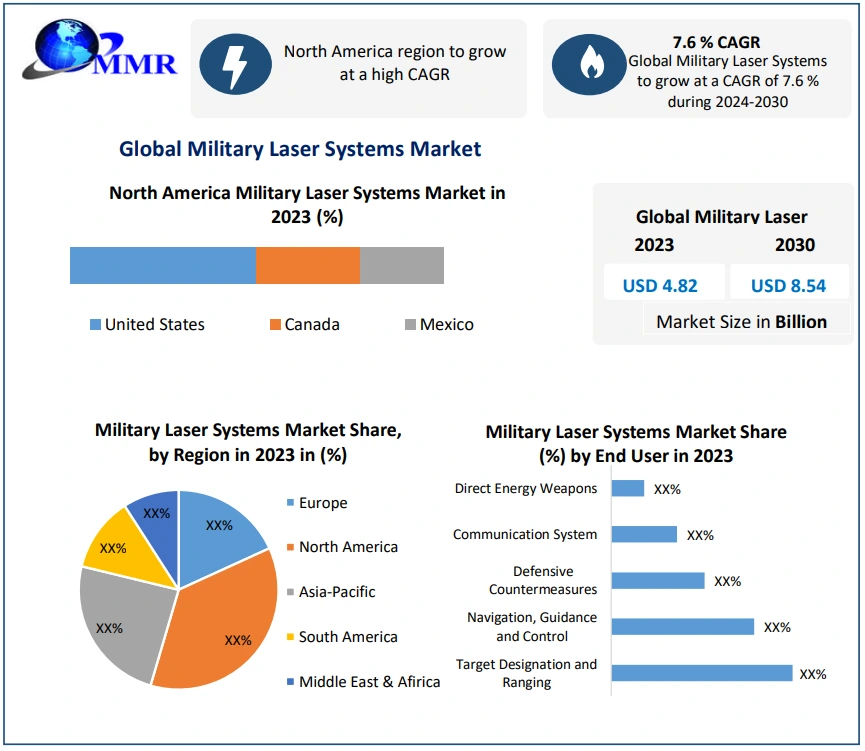
The Global Military Laser Systems Market size was valued at USD 4.82 Bn in 2023 and is expected to reach USD 8.54 Bn by 2030, at a CAGR of 7.6 %
Military Laser Systems Market: Overview
The military laser systems market refers to the global market for laser-based technologies and systems used in military applications. These systems utilize laser technology for various purposes, including target acquisition, tracking, range finding, dazzling, communication, and weapon systems. The worldwide growing focus and investment in defense have witnessed growth in the global Military Laser Systems Market. Due to the multiple advantages the laser systems are used in the military such as high precision, long-range, speed of light operation, and versatility. They can use in various domains, including land, air, and naval warfare.
 To know about the Research Methodology :- Request Free Sample Report
Military Laser Systems Market Dynamics
Military Laser Systems Market Drivers:
Increasing need for precision weapons boosts the market growth
The increasing need for precision weapons driving the global Military Laser Systems Market Growth. Precision weapons are used to destroy exact targets with minimal collateral damage. Laser technology is important in precision-guided systems. It is an important component of modern warfare Laser systems. Which offer high-precision tracking capabilities. Laser Systems can accurately identify and track targets, from long distances. This allows military forces to involve targets with precision, which helps to reduce the risk of collateral damage.
Laser systems are used against enemies such as sensors, cameras, and guidance systems. By discharging high-intensity laser beams, these systems can damage the optics of enemy platforms, laser systems are able to acquire and engage targets accurately. Increasing demand is driving military laser systems due to advantages such as superior accuracy, range, and versatility. Also, investments in research and development led to advancements in laser technology and the expansion of the Military Laser Systems Market.
Advancements in laser technology drive the market growth
Advancements in laser technology play an important role in driving the Military Laser Systems Market Growth. The advancement helps to improve the performance and capabilities of laser-based Systems. Due to its reliability, the laser systems are more attractive for military applications. Advancements in laser technology help the development of higher-power and more energy-efficient laser systems.
Higher-power lasers allow longer ranges, improved target engagement capabilities, and increased effectiveness against various threats. Energy-efficient lasers reduce power consumption, making them more suitable for portable and mobile military applications. Laser technology has expanded to offer a wide range of wavelengths. Laser technology advancements have offered improvements in the reliability and durability of military laser systems. These systems are subjected to harsh operational conditions, including vibrations, shock, temperature variations, and electromagnetic interference.
Military Laser Systems Market Restrain
High Development and Integration Cost Restrains Market Growth
High development and integration restraining factors for the growth of the Military Laser Systems Market. Developing advanced military laser systems needs investments in research and development. The costs related to conducting R&D activities, including skilled researchers, specialized equipment, and conducting extensive testing, can be expensive. These expenses can limit the pace of innovation and the introduction of new laser system capabilities. Additionally, manufacturing high-quality laser systems with the required specifications and performance characteristics can be costly.
The production of laser components, including high-power lasers, beam control systems, and power systems, often involves precision manufacturing processes and the use of expensive materials. Military Laser Systems Market quality control measures and compliance with rigorous military standards further increase manufacturing costs. The high development and integration costs of military laser systems require a combination of factors, including economies of scale, technological advancements, streamlined manufacturing processes, and increased budget allocations for defense R&D. This all factor limits the market growth.
Military Laser Systems Market Opportunity:
Growing Adoption of UAVs for military applications creates lucrative growth opportunities for the market growth.
The rise of UAV threats on the battlefield, there is a growing need for effective counter-UAV systems. Laser-based systems offer a promising solution for countering hostile UAVs. High-energy lasers can quickly and accurately disable or destroy UAVs, providing a precise and rapid response to potential threats. The versatility of laser systems allows for engagement at various distances, including long ranges, ensuring a robust defense against UAVs.
Military Laser Systems Market can be integrated with and used to support UAV operations by providing precision targeting capabilities. Laser designators can mark targets for laser-guided guns enhancing the accuracy and effectiveness of UAV attacks. This precision targeting capability minimizes collateral damage and reduces the risk to friendly forces, making UAVs more efficient and reliable in combat situations. The convergence of these technologies allows capabilities and continuous integration, creating new possibilities and opportunities for military operations.
Military Laser Systems Market Competitive landscape
The Military Laser Systems Market is competitive, with several major players competing for market share. Some of the key players in the market include BAE Systems, L3Harris Technologies, Inc., Elbit Systems Ltd, Northrop Grumman, Lockheed Martin, Boeing, Raytheon Technologies, NUBURU Inc., Thales Group, MBDA, Textron Systems, Safran SA, and Newport Corporation.
Raytheon Technologies: The Company did contract with the US Air Force to produce 1500 smart weapons Strom Breaker. For that company received USD 230 Million in March 2023.
BAE Systems: the company introduced compact laser weapon systems that are used in unmanned aerial vehicles.
The key players are majorly focused on product innovation and the expansion of the product portfolio. The companies also focused on acquisitions and strategic partnerships.
The increasing demand for Military Laser Systems from the industry, residential, and other sectors of the market is expected to grow and continue during the forecast period
Military Laser Systems Market Segment Analysis:
Based on Technology
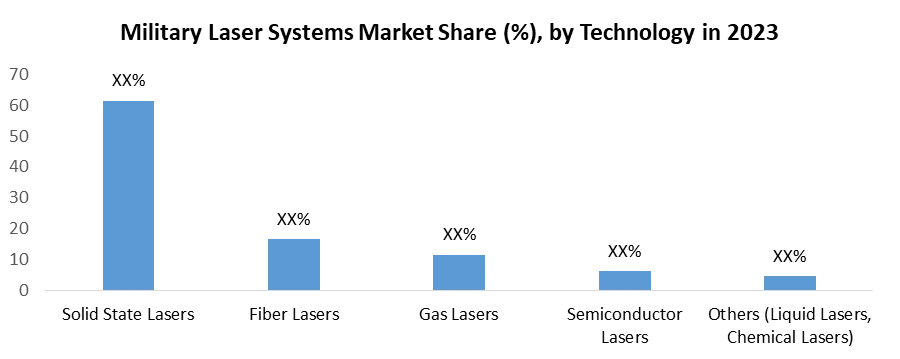
In the dynamic landscape of the Military Laser Systems Market, solid-state lasers assert their dominance, capturing a substantial 61.43% market share. This pre-eminence stems from their remarkable efficiency, converting electrical energy into laser light with superior efficacy, resulting in lower operational costs and extended range. The solid-state design's compactness and scalability make these lasers ideal for integration into diverse military platforms, including aircraft, ships, and land vehicles. Renowned for their reliability and durability in harsh environments, solid-state lasers benefit from a mature and affordable development history, outshining competitors like gas lasers, fiber lasers, semiconductor lasers, and liquid lasers.
While solid-state lasers hold a firm grip on the Military Laser Systems Market, the future may witness a paradigm shift as advancements in fiber lasers and emerging technologies challenge their dominance. Although solid-state lasers excel in efficiency, compactness, and affordability, ongoing developments in fiber lasers, along with other innovative technologies, may pave the way for a more diversified market landscape. As these alternatives mature and address their inherent limitations, the Military Laser Systems Market could see a transformation, ushering in a new era of diverse and efficient laser systems tailored for military applications.
Based on Platform, Land-based Military Laser Systems dominate the platform segment of the Military Laser Systems Market. Due to the advancement in laser technology, the laser has increased power levels and extended ranges. These developments help laser systems to target at greater distances and provide flexibility. The development of high-energy laser systems that are now capable of effectively engaging targets on the battlefield. These technological improvements have made land military laser systems increasingly attractive to defense organizations. The increase of unmanned aerial systems, such as drones, has significantly increased the demand for land-based military laser systems Traditional guns, such as missiles or artillery shells, need to be continually replenished, whereas land-based military radars are needed. Those all factors significantly boost the land platform segment growth.
Military Laser Systems Market Regional Analysis
North America dominates the global Military Laser Systems Market in the year 2023. The United States is a significant market for military laser systems. The U.S. Department of Defense is actively exploring laser technologies for various applications, such as missile defense, as well as counter-drone systems. Several companies are actively involved in the North American military laser market. These include defense contractors and technology firms such as Lockheed Martin, Northrop Grumman, Raytheon Technologies, Boeing, and L3Harris Technologies. These companies specialize in developing laser-based systems and integrating them into various military platforms. Additionally, the increasing importance of unmanned and autonomous systems in modern warfare drives the growth of laser technologies into these platforms.
Military Laser Systems Industry Ecosystem
Military Laser Systems Market Scope: Inquire before buying
| Global Military Laser Systems Market | |||
|---|---|---|---|
| Report Coverage | Details | ||
| Base Year: | 2023 | Forecast Period: | 2024-2030 |
| Historical Data: | 2018 to 2023 | Market Size in 2023: | US $ 4.82 Bn. |
| Forecast Period 2024 to 2030 CAGR: | 7.6% | Market Size in 2030: | US $ 8.54 Bn. |
| Segments Covered: | by Technology | Solid State Lasers Gas Lasers Fiber Laser Semiconductor Laser Liquid Laser Others |
|
| by Application | Weapon Non-Weapons |
||
| by Platform | Land Airborne Naval Space |
||
| by End-User | Target Designation and Ranging Navigation, Guidance and Control Defensive Countermeasures Communication System Direct Energy Weapons |
||
Military Laser Systems Market, by Region
North America (United States, Canada and Mexico)
Europe (UK, France, Germany, Italy, Spain, Sweden, Austria and Rest of Europe)
Asia Pacific (China, South Korea, Japan, India, Australia, Indonesia, Malaysia, Vietnam, Taiwan, Bangladesh, Pakistan and Rest of APAC)
Middle East and Africa (South Africa, GCC, Egypt, Nigeria and Rest of ME&A)
South America (Brazil, Argentina Rest of South America)
Military Laser Systems Market Key Players are:
1. BAE Systems
2. L3Harris Technologies, Inc.
3. Elbit Systems Ltd
4. Northrop Grumman
5. Lockheed Martin
6. Boeing
7. Raytheon Technologies
8. NUBURU Inc.
9. Thales Group
10. MBDA
11. Textron Systems
12. Safran SA
13. Newport Corporation
FAQs
1] What is the growth rate of the Market?
Ans. The Global Market is growing at a significant rate of 7.6 % over the forecast period.
2] What segments are covered in the Global Market report?
Ans. The segments covered in the Market report are based on, Application, Product Type, Platform Technology, End Use, and Region.
3] What is the expected Global Market size by 2030?
Ans. The market size of the Market is expected to reach USD 8.54 Billion by 2030.
4] What is the forecast period for the Global Market?
Ans. The forecast period for the Market is 2023-2029.
5] Which region is expected to hold the highest share in the Global Market?
Ans. The North American region is expected to hold the highest share of the Market.