
Military Generator Market Size – Industry Structure Evaluation, Demand Drivers Analysis, Regional Growth Analysis and Identification, Competitive Positioning Review & Global Market Size Forecast to 2032
Overview
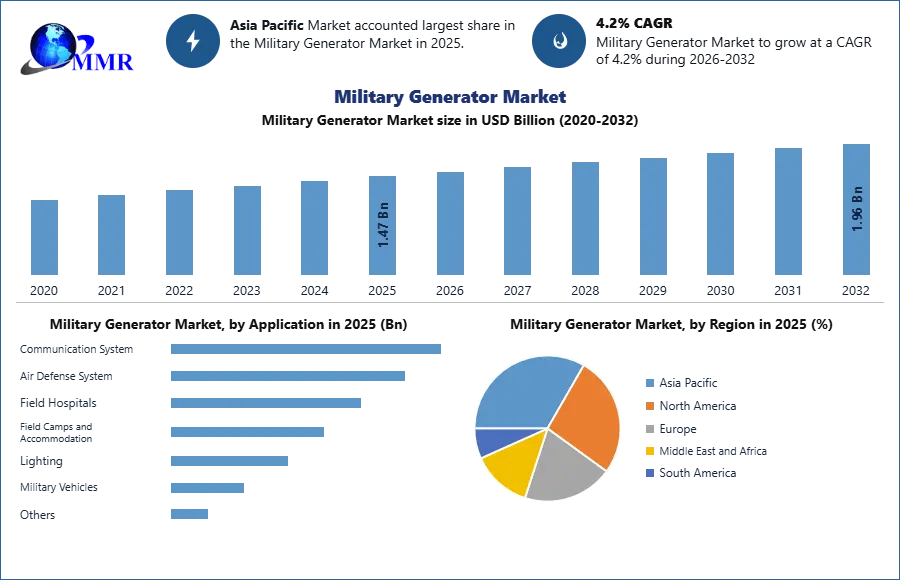
The Military Generator Market size was valued at USD 1.47 Billion in 2025 and the total Military Generator Market revenue is expected to grow at a CAGR of 4.2% from 2026 to 2032, reaching nearly USD 1.96 Billion.
A military generator is a power generator specifically designed for use by military personnel in the field or in remote locations where access to traditional power sources is limited or non-existent. These generators are typically rugged, portable, and capable of providing reliable and consistent power for a variety of military applications, such as powering field hospitals, communication equipment, lighting, and other essential equipment.
The Military Generator Market is high in demand thanks to these generators coming in different sizes and power capacities, ranging from small, portable units that can be carried by a single person to large trailer-mounted units capable of producing thousands of watts of power. They may run on various fuels such as gasoline, diesel, propane, or natural gas, and some may have specialized features such as electromagnetic pulse (EMP) hardening or noise reduction to reduce their detectability by the enemy. The Military Generator Market is also driven by the growing defence budget of various countries, particularly in developing regions such as the Asia-Pacific and the Middle East. The rise in the number of military operations and peacekeeping missions worldwide also fuels the demand for military generators.
Some of the key players in the Military Generator Market include Caterpillar Inc., Cummins Inc., Honeywell International Inc., Kohler Co., and MTU Onsite Energy. These companies offer a wide range of military generators, including diesel generators, gas generators, and hybrid generators, among others. The report covered detailed analyses of local as well as key Military Generator Market players with micro details of developments, and strategies adopted by market players to become competitive in the Military Generator Market.
To know about the Research Methodology:- Request Free Sample Report
Military Generator Market Dynamics:
A Deep Dive into the Supply Chain and Pricing of Military Generators
The supply chain for military generators typically includes manufacturers, distributors, and end-users, such as military organizations, government agencies, and defence contractors. The manufacturers produce military generators, which are then sold to distributors who supply them to the end users. The distributors may also provide value-added services such as installation, maintenance, and repair of the generators. In terms of pricing, military generators are typically priced higher than commercial generators due to their specialized features and requirements.
The Military Generator Market pricing may vary depending on various factors such as the type of generator, power capacity, fuel type, and manufacturer. Diesel generators are commonly used in military operations, and their prices range from $5,000 to $50,000 depending on the power capacity and other features. Gas generators are typically more expensive than diesel generators due to the cost of the fuel and the specialized components required for operation.
Factors that can affect the price of the Military Generator Market include raw material costs, manufacturing costs, transportation costs, and tariffs. The prices may also vary depending on the region and the supplier's pricing strategy. The Military Generator Market is expected to grow during the forecast period, driven by the increasing demand for reliable power supply in military operations. However, the Military Generator Market is also expected to face challenges in terms of government regulations and the availability of alternative power sources.
The Rise in EV Adoption Drives Demand for Military Generators
The adoption of electric vehicles (EVs) in the defence industry is expected to increase the demand for Military Generator Market. EVs, such as electric trucks and drones, require high-powered charging stations that need a reliable and uninterrupted power supply. Military generators play a critical role in providing power to charging stations located in remote areas where grid power supply is not available or unreliable. These generators can be used to power various EV charging systems, including Level 2 chargers, DC fast chargers, and wireless charging systems. Moreover, military generators are also essential for powering various digital systems, including communication networks, radar systems, and other advanced technologies, which are increasingly being integrated into EVs.
The use of the Military Generator Market for EV charging and digital systems is expected to create new opportunities for Military Generator Market manufacturers. These generators will need to be more advanced and efficient to meet the increasing power demands of EV charging stations and digital systems. The adoption of EVs in the defence industry is expected to increase the demand for Military Generator Market. The generators will play a critical role in providing reliable and uninterrupted power supply to EV charging stations and digital systems, creating new opportunities for Military Generator Market manufacturers
The Role of Remote Monitoring and Control Systems in Military Generators
Remote monitoring and control systems are becoming increasingly prevalent in military generators. These systems allow for real-time monitoring of the generator's performance, including fuel consumption, engine temperature, and output voltage, among other metrics. The data collected through these systems can be used to optimize generator performance, reduce downtime, and prevent potential failures, which is expected to drive the Military Generator Market.
Remote monitoring and control systems are typically connected to a centralized control system that can be accessed by authorized personnel from anywhere, at any time. This allows for easy monitoring and control of multiple generators across different locations, providing a more efficient way to manage generator fleets. In addition to monitoring and control, these systems also allow for remote diagnostics and troubleshooting. This means that any issues with the generator can be identified and resolved quickly, reducing the risk of downtime and improving overall system reliability, which increases demand for Military Generator Market.
Moreover, remote monitoring and control systems can also enable predictive maintenance, which involves using real-time data to predict when maintenance is required. This helps to prevent potential failures and reduces the need for reactive. Remote monitoring and control systems are becoming essential features in military generators, providing improved performance, reliability, and efficiency. These systems are expected to become more advanced in the future, with the integration of artificial intelligence and machine learning technologies to further optimize generator performance and reduce maintenance costs.
Key Challenges Faced by Military Generator Manufacturers
The key challenge faced by Military Generator Market manufacturers is the increasing demand for more efficient and environmentally friendly generators, while still meeting strict military specifications and requirements. Military generators are expected to perform in extreme conditions, such as high altitudes, desert environments, and cold weather. This requires military generator manufacturers to design generators that can operate reliably in these harsh conditions. Additionally, Military Generator Market must meet strict noise and emission standards, while still providing high power output. This presents a significant challenge, as reducing emissions and noise can often result in lower power output, which can be unacceptable for military operations.
Another challenge faced by Military Generator Market manufacturers is the need to provide more advanced and sophisticated generators that can integrate with modern digital systems and technologies. Military operations are becoming increasingly digitized and automated, requiring generators that can provide a stable and uninterrupted power supply to these systems. Moreover, the increasing complexity of military operations and the need for greater mobility and flexibility have led to a demand for generators that are lightweight, compact, and easily transportable.
Military Generator Market manufacturers must also consider the cost and affordability of their products. Military budgets are often constrained, and the high cost of advanced technologies and materials used in the Military Generator Market can be a significant barrier to entry.
Military generator manufacturers face a range of challenges, including designing generators that can operate reliably in extreme conditions, meeting strict emissions and noise standards, integrating with modern digital systems, and providing lightweight and affordable products. Overcoming these challenges requires continuous innovation and collaboration with military agencies to develop advanced and efficient generator solutions.
Military Generator Market Segment Analysis:
By Installation Type, the Military Generator market is segmented into Stationary Generator and Portable Generator. Stationary Generator is expected to dominate the Military Generator Market during the forecast period. Stationary generators are in high demand in the defence industry for various applications. These generators are designed to provide a reliable source of backup power in case of a power outage or other emergencies. In the defence industry, stationary generators are used to power critical infrastructure, including military bases, command centres, communication equipment, and radar systems. They are also used to provide power to field hospitals and medical facilities in remote areas. One of the key advantages of stationary generators is their ability to provide uninterrupted power for long periods, making them ideal for use in critical situations, which is expected to drive the Military Generator Market. They are also designed to be highly reliable and durable, able to operate in extreme weather conditions and withstand rough handling during transportation.
Furthermore, stationary generators are available in a range of sizes and power outputs, allowing them to be tailored to specific application requirements. They can also be configured to work with a variety of fuel sources, including diesel, natural gas, and propane, making them versatile and adaptable to different situations in Military Generator Market. The stationary generators are an essential component of the defence industry's infrastructure, providing a reliable and consistent source of backup power that is critical in maintaining operational readiness and ensuring the safety of military personnel.
Military Generator Market Regional Insights:
Asia Pacific is expected to dominate the Military Generator Market during the forecast period. Asia is home to some of the world's largest military powers, including China, India, Japan, and South Korea. As a result, the demand for military generators in Asia is high, and several market players have emerged to meet this demand. China is one of the largest producers and consumers of military generators in Asia. The country has a well-established defence industry and is home to several manufacturers of military generators, including the China National Nuclear Corporation (CNNC) and the Dongfeng Motor Corporation. These companies produce a range of military generators for different applications, including portable and stationary generators.
India is another major market for military generators in Asia. The country has a growing defence industry, and several companies have emerged to meet the demand for military generators, including Bharat Heavy Electricals Limited (BHEL) and Kirloskar Electric Company. These companies produce a range of generators for different applications, including portable, stationary, and trailer-mounted generators. Japan is also a significant market for military generators in Asia.
The country has a well-developed defence industry, and several companies have emerged to meet the demand for military generators, including Mitsubishi Heavy Industries, Ltd., and Kawasaki Heavy Industries, Ltd. These companies produce a range of generators for different applications, including portable, stationary, and vehicle-mounted generators, which drive the Military Generator Market demand in Asia. South Korea is another market for military generators in Asia, with companies like Hyundai PowerTech and Daewoo Shipbuilding & Marine Engineering Co. producing a range of generators for military applications.
In terms of development, Market players in Asia are focused on developing generators that are more efficient, reliable, and durable. They are also investing in research and development to produce generators that are environmentally friendly and use cleaner fuel sources, such as natural gas and hydrogen. The demand for military generators in Asia is high, and Military Generator Market players are investing in research and development to produce generators that meet the specific needs of the defence industry in the region.
Recent Developments
On Dec 2025: Cummins secured a $500 million contract from the U.S. Army to supply rugged 500 kW skid-mobile generators for depot and field use. These units support expeditionary battlefield operations with high reliability in extreme environments. Cummins enhanced its military generator portfolio with scalable designs and advanced control systems, emphasizing operational resilience, rapid deployment, and long-term maintenance efficiency, reinforcing its position as a leading supplier of defense power solutions.
In 2025, Honeywell enhanced generator control units for military bases, integrating advanced automation, remote monitoring, and energy management systems. Its solutions enable automated power switching, predictive maintenance, and rapid response under extreme conditions. Honeywell’s innovations improve resilience for tactical energy deployments and critical infrastructure, aligning with global defense modernization initiatives. These systems enhance reliability and operational readiness, meeting stringent military standards for power generation and microgrid integration.
Military Generator Market Scope: Inquire before buying
| Military Generator Market | |||
|---|---|---|---|
| Report Coverage | Details | ||
| Base Year: | 2025 | Forecast Period: | 2026-2032 |
| Historical Data: | 2020 to 2025 | Market Size in 2025: | 1.47 USD Billion |
| Forecast Period 2026-2032 CAGR: | 4.2% | Market Size in 2032: | 1.96 USD Billion |
| Segments Covered: | by Type | DC Generator AC Generator |
|
| by Installation Type | Stationary Generator Portable Generator |
||
| by Fuel Type | Diesel Natural Gas Hybrid |
||
| by Capacity | Upto 60 KW 61 to 250 KW 251 to 500 kW 501 to 1000 KW Above 1000 KW |
||
| by Application | Communication System Air Defense System Field Hospitals Field Camps and Accommodation Lighting Military Vehicles Others |
||
Military Generator Market, by Region
North America (United States, Canada and Mexico)
Europe (UK, France, Germany, Italy, Spain, Sweden, Austria, Turkey, Russia and Rest of Europe)
Asia Pacific (China, India, Japan, South Korea, Australia, ASEAN and Rest of APAC)
Middle East and Africa (South Africa, GCC, Egypt, Nigeria and Rest of ME&A)
South America (Brazil, Argentina, Columbia and Rest of South America)
Key players/Competitors profiles covered in the Military Generator Market report in a strategic perspective
1. Cummins Inc.
2. Caterpillar Inc.
3. MTU Onsite Energy
4. Honeywell International Inc.
5. Briggs & Stratton Corporation
6. Kohler Co.
7. Generac Power Systems Inc.
8. Atlas Copco AB
9. Wärtsilä Corporation
10. Himoinsa S.L.
11. MAN Energy Solutions SE
12. Mitsubishi Heavy Industries Ltd.
13. Doosan Corporation
14. GE Aviation
15. Rolls-Royce Holdings plc
16. Siemens AG
17. ABB Ltd.
18. Yanmar Holdings Co., Ltd.
19. Kawasaki Heavy Industries Ltd.
20. Ingersoll-Rand plc