
Medical Cyclotron Market Segmentation By Type, Energy Range, Configuration, Installation, Application, Component and End User By Regional Insight 2025-2034
Overview
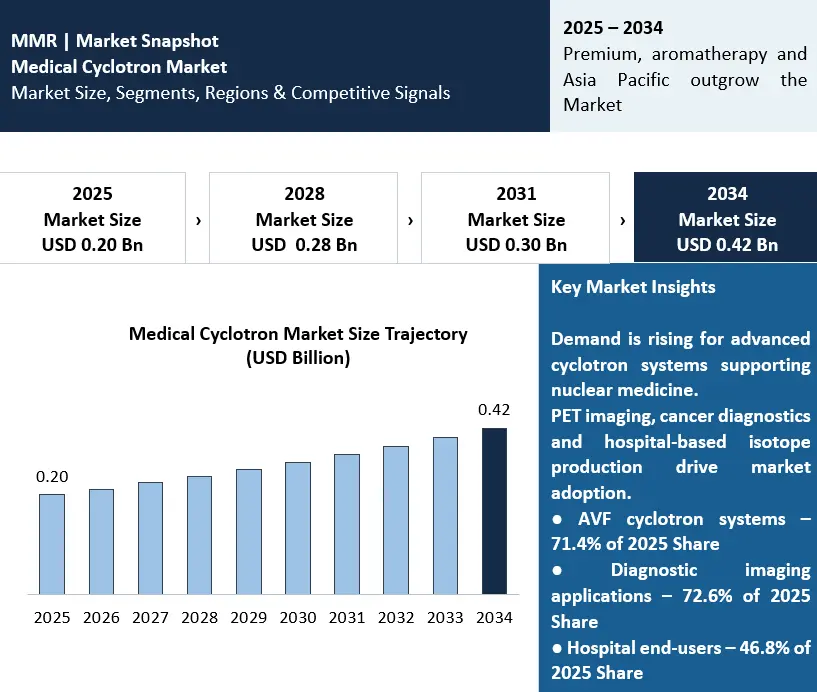
The Global Medical Cyclotron Market was valued at USD 0.20 Billion in 2025 and is projected to reach USD 0.42 billion by 2034, growing at a CAGR of 10.8 % during 2026-2034, according to Maximize Market Research (MMR). A medical cyclotron is a compact particle accelerator that fires protons, and in some designs deuterons or alpha particles, at a target to make short-lived radioisotopes such as fluorine-18, carbon-11, nitrogen-13, gallium-68 and zirconium-89 for PET and SPECT imaging, plus alpha-emitters such as astatine-211 and actinium-225 for targeted cancer therapy. The market covers ring and azimuthally varying field (AVF) cyclotrons, low- to very-high-energy machines, fixed- and variable-energy systems, compact and superconducting designs, and the accelerator sub-systems installed in hospitals, radiopharmacies, research centres and commercial isotope plants.
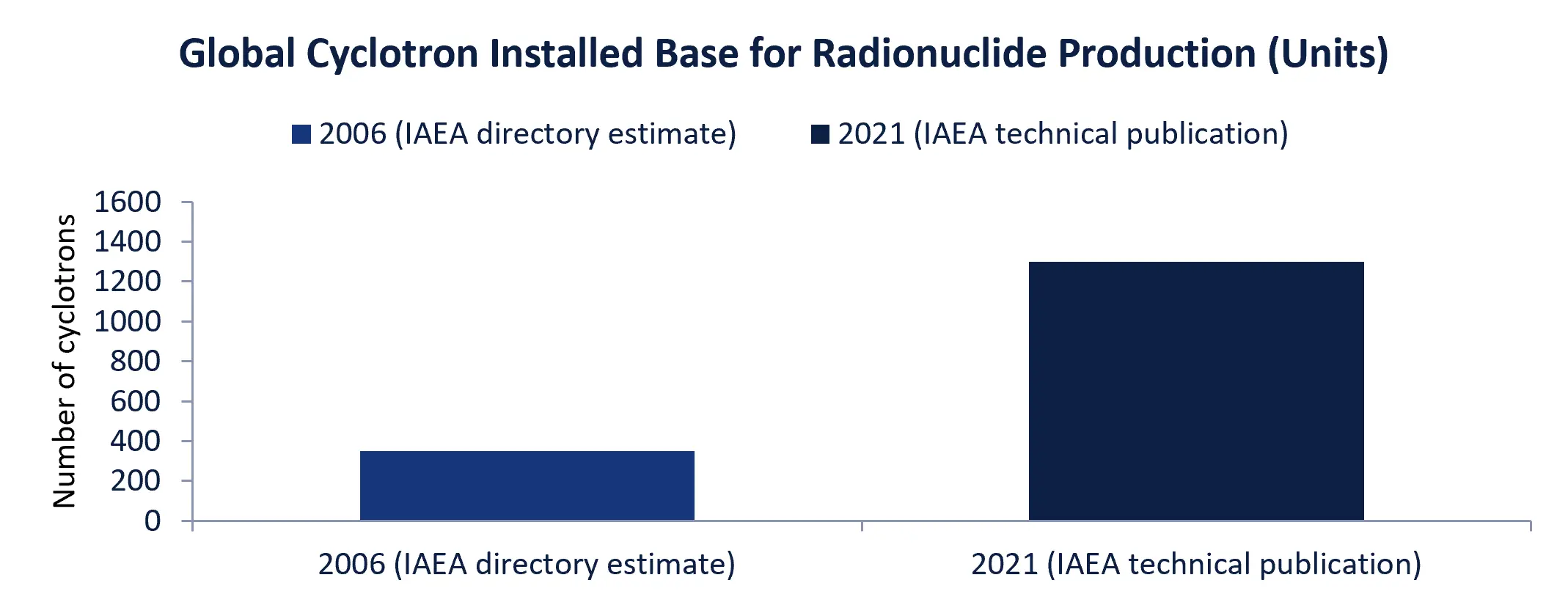
Cyclotrons sit at the front of the PET supply chain. The International Atomic Energy Agency (IAEA) reports that there are now over 1,200 cyclotrons in operation worldwide and that cyclotrons account for 95% of the radiopharmaceuticals used in PET. A later IAEA publication counts more than 1,300 cyclotron facilities, growing every year, with the fastest growth in developing countries. The IAEA’s 2006 directory, by comparison, put the number of cyclotrons involved in radionuclide production at about 350. Demand is therefore a story of installed-base growth, higher output per machine and a push to higher energies for theranostic isotopes.
This report answers both sides of the search: what the medical cyclotron market is worth for manufacturers, radiopharmacies, hospitals and investors, and what buyers ask most, from medical cyclotron cost and PET cyclotron energy requirements to hospital-based versus centralised isotope production, superconducting versus conventional machines, and cyclotron-produced gallium-68 versus generators.
Maximize Market Research provides a segment-level analysis of the global medical cyclotron market size, share, type, energy range, product configuration, installation type, application, component, and end user, together with regional analysis, supply-chain mapping, competitive landscape, and strategic scenarios through 2034.
To Know about the Research Methodology: Request Free Sample Report
Global Medical Cyclotron Market Overview:
MMR measures the market at the manufacturer-selling-price level across medical cyclotron systems, and sub-systems sold worldwide for radioisotope production: ring and AVF cyclotrons, the magnet, RF, beam-transport, target, control and shielding systems that go with them, and installation into hospital, commercial and research facilities. The defining traits are short isotope half-lives that force production close to the patient, a sharp split between compact PET machines and higher-energy multi-particle machines, strict radiation-protection rules, and strong public-sector involvement in isotope supply.
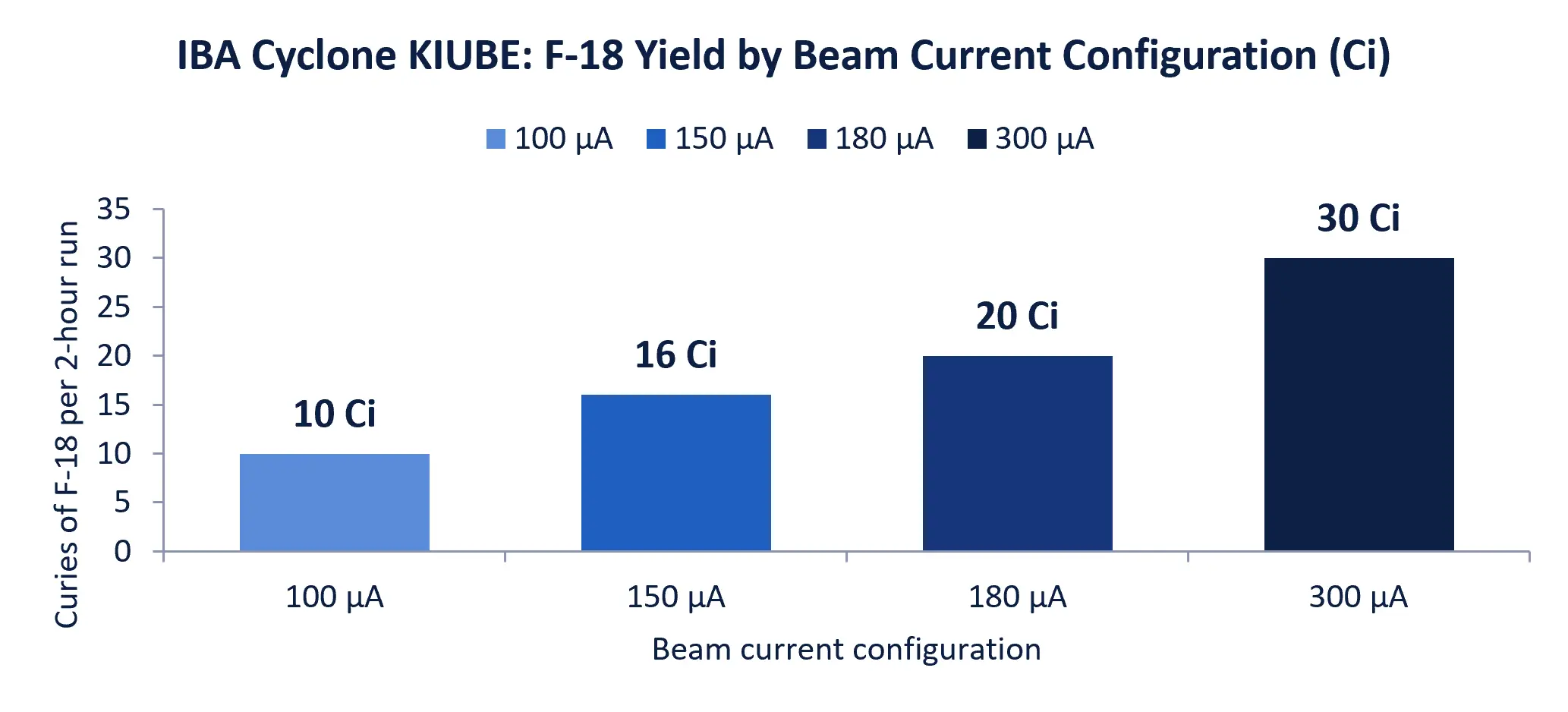
Three shifts shape 2026-2034. First, output per machine is rising: IBA’s Cyclone KIUBE is offered in configurations from 100 µA to 300 µA, producing 10 to 30 curies of F-18 in a two-hour run. Second, energy ranges are widening for theranostics: the IBA Cyclone IKON covers 13 to 30 MeV, and IBA reports three sites set to produce astatine-211 with its Cyclone 30 XP. Third, footprints are shrinking: Ionetix describes its 12.5 MeV ION-12SC superconducting cyclotron as having an installed weight of about 2.3 tons, with more than 21 doses a day and above 99% availability.
Key Findings: Eight Insights Shaping the Global Medical Cyclotron Market
| Sr. No. | Finding | Evidence | So what |
| 1 | Installed base up about 3.7x in 15 years | About 350 (IAEA, 2006) to more than 1,300 (IAEA, 2021) | Upgrades, service, and replacement now matter alongside new sites |
| 2 | PET depends on cyclotrons | 95% of PET radiopharmaceuticals; 10-12% of all radiopharmaceuticals (IAEA) | PET growth converts directly into cyclotron demand |
| 3 | Many machines are under-used | IAEA: most not at full capacity; output often limited to one or two PET tracers | Multi-isotope targets and upgrades are a revenue path |
| 4 | Output per machine is rising | IBA KIUBE: 10 to 30 Ci F-18 per 2-hour run at 100 to 300 µA | Buyers can consolidate several small machines into one |
| 5 | Energy range is widening | IKON 13-30 MeV; Cyclone 30 XP at three At-211 sites; six Cyclone 70 and 35+ 30 MeV units installed (IBA) | High-energy demand is the swing factor for alpha-emitters |
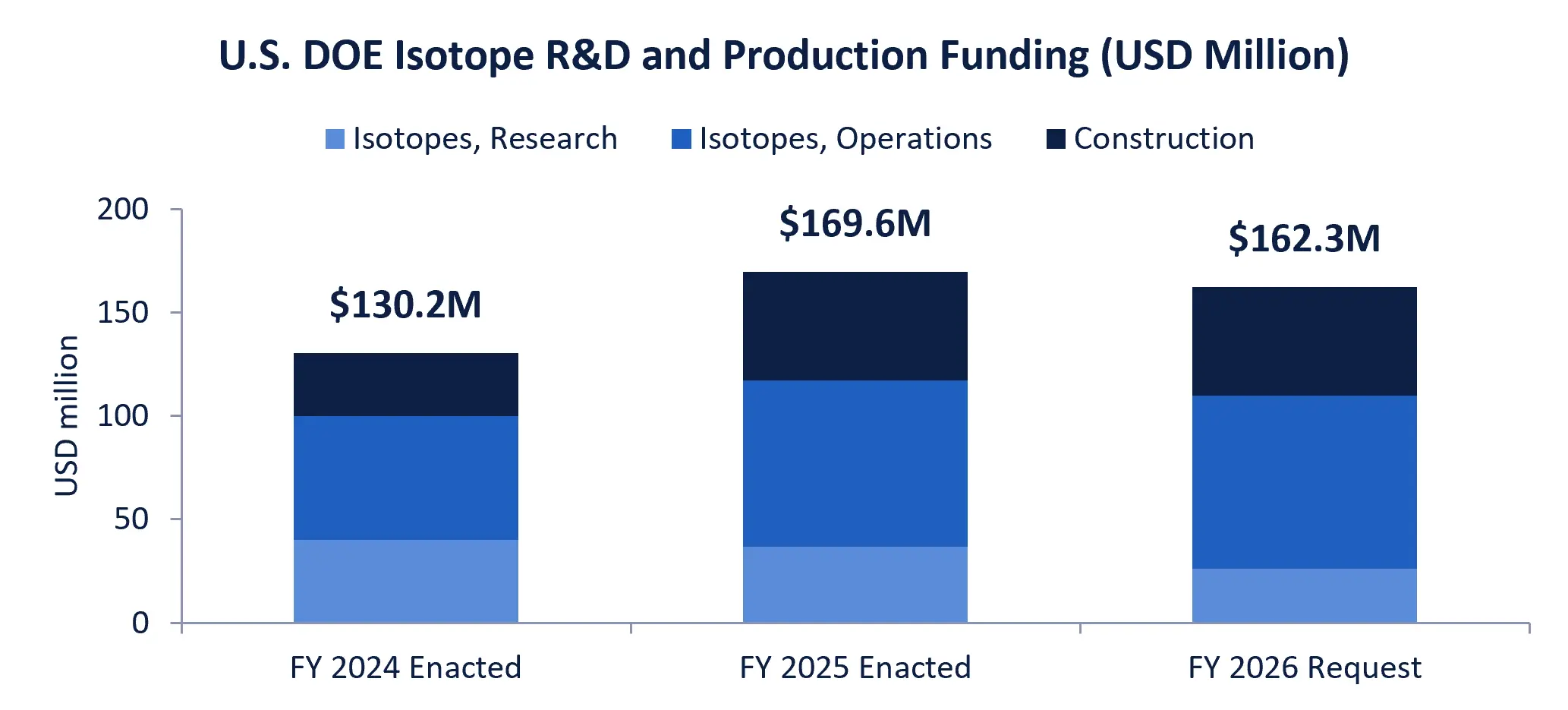
| 6 | Government isotope funding is rising | DOE: USD 130.2 Mn (FY24), USD 169.6 Mn (FY25), USD 162.3 Mn requested (FY26) | Public programmes de-risk Ac-225 and At-211 supply |
| 7 | Superconducting systems shrink the footprint | ION-12SC: 12.5 MeV, about 2.3 tons, 21+ doses a day, 99%+ availability (Ionetix) | Opens hospital-based on-demand dose models |
| 8 | Public-sector build-out in emerging markets | India: 30 MeV facility in Kolkata delivered 371 Ci-equivalent doses (PIB, 2025) | Government-led centres anchor Asia-Pacific demand |
Global Medical Cyclotron Market Dynamics:
Medical Cyclotron Market Growth Drivers: PET Demand, Theranostics and Public Isotope Programmes
PET and theranostic demand. The IAEA notes that demand for cyclotrons is increasing as more of the radionuclides they produce are used in research, diagnosis and treatment, and that cyclotrons make 95% of PET radiopharmaceuticals.
Alpha-emitter supply programmes. The U.S. DOE Isotope Program will supply accelerator-produced actinium-225 to a U.S. company for a clinical trial for the first time. The DOE’s FY 2026 budget document highlights multi-particle cyclotrons at the University of Washington and Texas A&M for astatine-211, and a newly refurbished cyclotron at Brookhaven National Laboratory moving to routine operations.
Higher throughput and new platforms. IBA’s Cyclone KIUBE reaches up to 300 µA proton current; IBA reports the 100th KIUBE sale, and the Cyclone IKON offers 13 to 30 MeV with up to 1,500 µA extracted beam current.
Cyclotron-based gallium-68. The IAEA says cyclotron production can supply Ga-68 for up to around 20 patients a day at lower cost, and that at least 10 centres worldwide use the approach.
Government-led infrastructure. India’s Department of Atomic Energy operates a 30 MeV Medical Cyclotron Facility in Kolkata, and the Government has said it plans to support investors in radioisotope and radiopharmaceutical production.
Medical Cyclotron Market Restraints: Capital Cost, Short Half-Lives, Under-Utilisation and Funding Volatility
Capital and facility cost. India’s Comptroller and Auditor General records the 30 MeV Medical Cyclotron at INR 58.78 crore and its radiopharmaceutical processing facility at INR 19.23 crore, a public benchmark for high-energy installations.
Short half-lives. F-18 lasts only about 1 hour 50 minutes (IAEA), which limits delivery radius and pushes production close to hospitals.
Under-utilisation. The IAEA reports that most cyclotrons are not running at full capacity and often make only one or two PET tracers, which slows replacement cycles.
Radiation-protection regulation. In India, medical cyclotron facilities are regulated by the Atomic Energy Regulatory Board under the Atomic Energy (Radiation Protection) Rules, 2004; licensing, shielding, and staffing add time and cost everywhere.
Public funding volatility. The DOE’s FY 2026 request of USD 162.3 Mn is USD 7.3 Mn (about 4.3%) below the FY 2025 enacted level, and its isotope research line falls by USD 10.5 Mn.
What Are the Biggest Medical Cyclotron Market Opportunities Through 2034?
• Theranostic isotopes: astatine-211 and actinium-225 programmes pull demand for 30 MeV-class and multi-particle machines.
• Upgrades and multi-isotope retrofits: under-used machines can add targets, solid-target stations and software.
• Hospital-based compact and superconducting units: on-site N-13 ammonia and F-18 doses without a regional radiopharmacy.
• Centralised commercial isotope hubs and CDMOs: high-current machines serving several hospitals.
• Emerging markets: the IAEA reports the highest rate of cyclotron growth in developing countries.
Global Medical Cyclotron Market Segmentation:
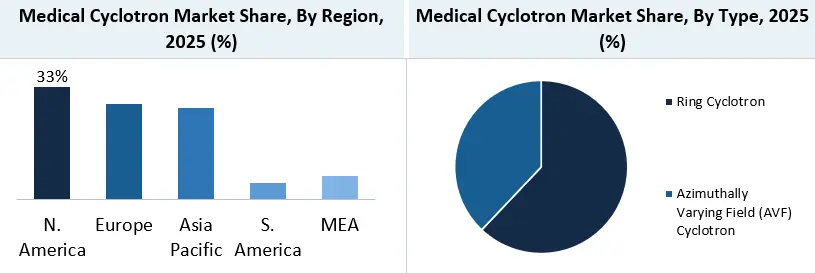
Medical Cyclotron Market by Type: Ring Cyclotron and AVF Cyclotron
Compact medical machines are azimuthally varying field (isochronous) designs; Ionetix, for example, describes its ION-12SC as an isochronous, sector-focused superconducting cyclotron. Ring cyclotrons use separated sectors and serve higher energies, mainly in research institutes and large isotope-production programmes.
| Type | Typical role in medical isotope production |
| Ring Cyclotron | Higher-energy, research-led and large-scale isotope programmes |
| Azimuthally Varying Field (AVF) Cyclotron | Mainstream PET and SPECT isotope production, hospital to commercial |
Medical Cyclotron Market by Energy Range: Low, Medium, High and Very High Energy
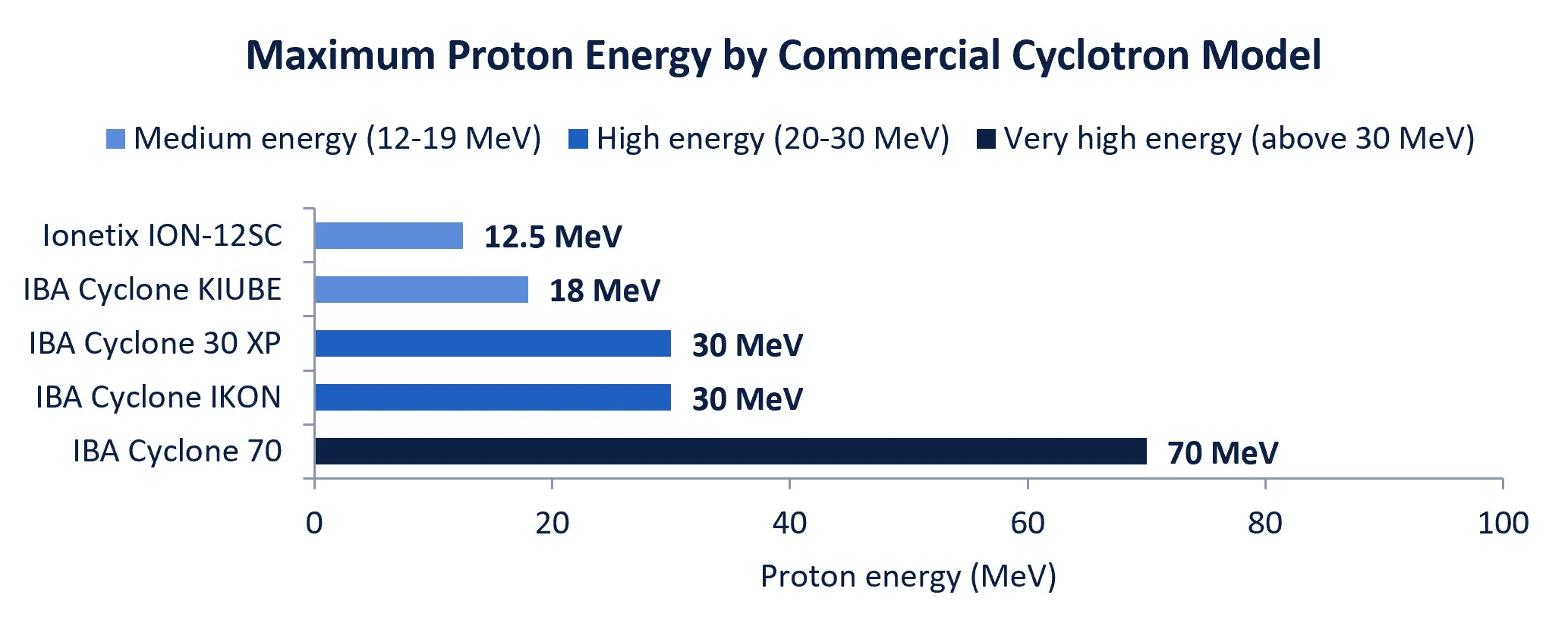
Energy decides which isotopes a machine can make. Compact machines in the 12 to 19 MeV range cover the main PET isotopes; 30 MeV-class machines add SPECT and theranostic isotopes; machines above 30 MeV serve parent isotopes for generators. IBA reports that six Cyclone 70 MeV machines and over 35 cyclotrons of 30 MeV have been installed worldwide, and its Cyclone 70 at iThemba LABS in Cape Town is aimed at strontium-82 and germanium-68. The DOE’s Isotope Production Facility and Brookhaven Linac Isotope Producer also make Sr-82, Ge-68, and Ac-225.
| Energy range | Representative models |
| Low-Energy Cyclotron (Below 12 MeV) | Dedicated PET units |
| Medium-Energy Cyclotron (12-19 MeV) | Ionetix ION-12SC; IBA Cyclone KIUBE |
| High-Energy Cyclotron (20-30 MeV) | IBA Cyclone IKON; Cyclone 30 XP |
| Very High-Energy Cyclotron (Above 30 MeV) | IBA Cyclone 70 |
Medical Cyclotron Market by Product Configuration: Fixed-Energy, Variable-Energy, Compact and Superconducting
Fixed-energy machines such as the Cyclone KIUBE are built for high-volume F-18 production; variable-energy machines such as the Cyclone IKON (13 to 30 MeV) and Cyclone 30 XP (protons 15 to 30 MeV, deuterons 8 to 15 MeV, alpha 30 MeV) serve multi-isotope and theranostic work. Compact designs focus on footprint and shielding: the ION-12SC has a diameter of 884 mm, a height of 1,955 mm, a 4.5-tesla central field, and a cryogen-free superconducting magnet.
| Configuration | What it delivers | Sourced anchor |
| Fixed-Energy Cyclotron | High-volume, single-energy PET production | KIUBE: up to 30 Ci of F-18 in a 2-hour run (IBA) |
| Variable-Energy Cyclotron | Multi-isotope, multi-particle flexibility | IKON 13-30 MeV; 30 XP proton, deuteron and alpha beams (IBA) |
| Compact Cyclotron | Small footprint, on-site doses | ION-12SC about 2.3 tons, 884 mm diameter (Ionetix) |
| Superconducting Cyclotron | High field, small, low power | 4.5 T central field; 21+ doses a day; 99%+ availability (Ionetix) |
Medical Cyclotron Market by Installation Type: Hospital-Based, Centralised, Commercial Radiopharmacy and Research Facilities
Hospital-based units serve one site; centralised and commercial radiopharmacy facilities ship doses to many hospitals; academic facilities double as isotope suppliers. The DOE’s University Isotope Network includes the University of Washington Medical Cyclotron Facility, the University of Alabama at Birmingham (a cyclotron with four beamlines) and Texas A&M. In India, the 30 MeV Medical Cyclotron Facility in Kolkata delivered 371 Ci-equivalent doses to hospitals, and an Ionetix unit at the University of Michigan Medical School treated about 100 patients a month with N-13 ammonia.
| Installation type | Model | Sourced anchor |
| Hospital-Based Cyclotron Facilities | On-site daily doses | ION-12SC at U. Michigan: about 100 patients a month (Ionetix) |
| Centralised Radioisotope Production Facilities | Regional supply to many hospitals | VECC Kolkata: 371 Ci-equivalent doses delivered (PIB, 2025) |
| Commercial Radiopharmacy Facilities | Unit-dose distribution | NA |
| Research and Academic Facilities | R&D plus isotope supply | DOE University Isotope Network: UW, UAB, Texas A&M |
Medical Cyclotron Market by Application: Diagnostic, Therapeutic and Research Isotope Production
Diagnostic production covers PET isotopes (F-18, C-11, N-13, Ga-68, Zr-89) and SPECT isotopes. India’s Department of Atomic Energy notes that Ga-67 and Tl-201 radiopharmaceuticals were hitherto imported and are now being made at the Kolkata facility. Therapeutic production covers beta-emitters, such as Cu-67 at Brookhaven, and alpha-emitters, such as At-211 and Ac-225. The IAEA is also formulating guidelines for Zr-89, whose half-life of 3.3 days is far longer than F-18.
Medical Cyclotron Market by Component: Acceleration, Target, Beam Transport, RF, Magnet, Control and Shielding
The medical cyclotron system comprises several integrated components that support efficient isotope production and safe operation. The particle acceleration system uses an ion source and accelerating dees, with IBA’s IKON featuring an H⁻ source designed for 15 mA at 30 keV. The target and irradiation system converts accelerated beams into radioisotopes, while beam transport directs particles through dedicated beamlines. The RF system accelerates particles, with IKON operating at 75 MHz. Magnet systems guide particle orbits, including superconducting configurations. Control and monitoring systems regulate beam performance and safety, with Ionetix reporting over 99% availability for ION-12SC. Shielding systems minimise radiation exposure.
Medical Cyclotron Market by End User: Hospitals, Imaging Centres, Research, Pharma, CDMOs and Isotope Manufacturers
Hospitals and diagnostic imaging centres buy for on-site or regional PET supply; the IAEA notes that Portugal, a country of about 10 million, performs over 50,000 PET procedures a year. Research institutes and universities buy for development work. Pharmaceutical and biotechnology companies, contract development and manufacturing organisations (CDMOs) and commercial radioisotope manufacturers buy for GMP production; the DOE expects to sell over 135 different radioactive and stable isotopes to customers including major pharmaceutical companies.
Global Medical Cyclotron Market Regional Analysis: North America, Europe, Asia Pacific, Middle East & Africa, South America
North America. The U.S. DOE Isotope Program is the anchor: USD 169.6 Mn enacted in FY 2025, with about USD 68 Mn of isotope-sales collections expected in the same year. The DOE’s IPF and BLIP proton accelerators, university cyclotrons and the refurbished Brookhaven medical cyclotron support Sr-82, Ge-68, Ac-225 and At-211.
Europe. IBA, based in Belgium, has sold KIUBE systems to Herlev Hospital in Denmark and BV Cyclotron VU in Amsterdam, and reports Cyclone 30 XP sites in Poland, Germany and France for At-211.
Asia Pacific. India’s Department of Atomic Energy runs a 30 MeV facility in Kolkata, and the Government reports over 500 nuclear medicine facilities across the public and private sectors. In China, CNRT and IBA signed an agreement to install a Cyclone IKON in Chengdu, expected to be fully operational by 2025. A Cyclone 70 operates in Korea.
Middle East & Africa. iThemba LABS in Cape Town has commissioned an IBA Cyclone 70 for Sr-82 and Ge-68 production.
South America. The IAEA has surveyed cyclotrons and PET radiopharmaceutical production across Latin America and the Caribbean, and reports the highest cyclotron growth rate in developing countries.
Medical Cyclotron Supply Chain: From Components to the Patient Dose
The medical cyclotron market operates through a six-layer value chain, beginning with component supply, including magnets, RF systems, vacuum equipment, and ion sources from specialist manufacturers. Cyclotron manufacturers such as IBA and Ionetix handle system design, assembly, and commissioning. The next layer involves facility construction, including radiation-shielded vaults, hot cells, and radiosynthesis infrastructure. Isotope and tracer production follows, where targets are irradiated to produce medical isotopes for hospitals, radiopharmacies, and research laboratories. Commercial radiopharmacies then distribute prepared radiopharmaceutical doses within their limited radioactive half-life. Finally, hospitals and diagnostic imaging centres use these products for PET and SPECT imaging and targeted radionuclide therapy.
Medical Cyclotron Companies and Competitive Landscape: Who Supplies the Global Market?
The market is led by a small group of cyclotron manufacturers that compete on beam current, energy range, footprint, uptime and service. IBA offers a range from the 18 MeV Cyclone KIUBE to the 70 MeV Cyclone 70 and reports six Cyclone 70 machines and over 35 cyclotrons of 30 MeV installed worldwide. Ionetix focuses on compact superconducting systems for on-demand N-13 ammonia and other PET isotopes, with manufacturing capacity of up to 30 machines a year. Other established suppliers include GE HealthCare, Sumitomo Heavy Industries, Advanced Cyclotron Systems Inc. (ACSI), BEST Cyclotron Systems and Siemens Healthineers (PETNET Solutions). Non-commercial participants shape demand: the U.S. DOE Isotope Program, the IAEA and India’s Department of Atomic Energy.
Competitive Strategies in the Medical Cyclotron Market
• High-current platforms: KIUBE-class systems consolidate F-18 output.
• Energy and particle flexibility: IKON and 30 XP target theranostic isotopes.
• Compact and superconducting designs: on-site doses with smaller vaults.
• Turnkey radiopharmacy offers: cyclotron, synthesis modules, and facility design in one package.
Global Medical Cyclotron Market Recent Developments
| Date | Development | Source |
| Oct 2026 | GE HealthCare’s MINItrace Magni achieved CE Mark, while its PETtrace Solid Target Platform expanded isotope production capabilities to Copper-64 (Cu-64), strengthening PET imaging and theranostics research. | GE HealthCare |
| Oct 2026 | Longevous Beamtech unveiled its LB-30 series 30 MeV medical cyclotron at EANM 2026, expanding its portfolio for radionuclide production and radiopharmaceutical research. | Longevous Beamtech |
| Nov 2026 | University of Wisconsin–Madison broke ground on a USD 62 million radioisotope cyclotron facility featuring two cyclotrons to expand isotope production capacity by 2–8 times, depending on the isotope. | Nuclear News, University of Wisconsin–Madison |
| Sep 2026 | Ionetix began routine commercial shipments of Astatine-211 (At-211) in North America using its 30 MeV cyclotron, supporting preclinical and clinical development of targeted alpha therapies. | Ionetix |
| Jun 2026 | IBA launched Cyclone iKure, a dedicated cyclotron designed for routine, industrial-scale Astatine-211 production, supporting the expanding targeted alpha therapy market. | IBA |
| Jun 2026 | Eckert & Ziegler and DC Pharma officially opened a medical isotope production facility in Jintan, China. A cyclotron was installed in late 2025, with Ge-68 production expected to begin in 2027. | Eckert & Ziegler |
| Mar 2026 | IBA secured an initial order for four Cyclone KIUBE cyclotrons from Telix Pharmaceuticals for installation at RLS Radiopharmacies in the United States, supporting domestic radiopharmaceutical manufacturing expansion. | IBA |
Global Market Scope: Inquire before buying
| Global Medical Cyclotron Market | |||
|---|---|---|---|
| Report Coverage | Details | ||
| Base Year: | 2025 | Forecast Period: | 2026-2034 |
| Historical Data: | 2020 to 2025 | Market Size in 2025: | USD 0.20 Billion |
| Forecast Period 2026 to 2034 CAGR: | 10.8% | Market Size in 2034: | USD 0.42 Billion |
| Medical Cyclotron Market Segments Covered: |
By Type | Ring Cyclotron Azimuthally Varying Field (AVF) Cyclotron |
|
| By Energy Range |
Low-Energy Cyclotron (Below 12 MeV) Medium-Energy Cyclotron (12–19 MeV) High-Energy Cyclotron (20–30 MeV) Very High-Energy Cyclotron (Above 30 MeV) |
||
| By Product Configuration |
Fixed-Energy Cyclotron Variable-Energy Cyclotron Compact Cyclotron Superconducting Cyclotron |
||
| By Installation Type |
Hospital-Based Cyclotron Facilities Centralized Radioisotope Production Facilities Commercial Radiopharmacy Facilities Research and Academic Facilities |
||
| By Application |
Diagnostic Radioisotope Production PET Radioisotope Production SPECT Radioisotope Production Therapeutic Radioisotope Production Beta-Emitting Isotopes Alpha-Emitting Isotopes Research and Development |
||
| By Component |
Particle Acceleration System Target and Irradiation System Beam Transport System Radiofrequency (RF) System Magnet System Control and Monitoring System Shielding System |
||
| By End User |
Hospitals Diagnostic Imaging Centers Research Institutes and Universities Pharmaceutical and Biotechnology Companies Contract Development and Manufacturing Organizations (CDMOs) Commercial Radioisotope Manufacturers |
||
Global Medical Cyclotron Market, By Region:
North America (United States, Canada, Mexico, Rest of North America)
Europe (United Kingdom, Germany, France, Italy, Spain, Rest of Europe)
Asia Pacific (China, Japan, South Korea, India, Australia, Rest of Asia Pacific)
Middle East & Africa (South Africa, Angola, Botswana, Mauritius, Tanzania, Zambia, Zimbabwe, Mozambique)
Central & South America (Brazil, Argentina, Rest of Central & South America)
Global Medical Cyclotron Market, 40+ Key Players:
1. North America
1. GE HealthCare
2. Siemens Healthineers
3. Advanced Cyclotron Systems Inc. (ACSI)
4. Best Cyclotron Systems, Inc. (BCSI)
5. TeamBest Global / Best Medical International
6. IONETIX Corporation
7. Mevion Medical Systems
8. Lantheus Holdings, Inc.
9. Cardinal Health
10. BWXT Technologies
11. TRIUMF
12. Isologic Innovative Radiopharmaceuticals
13. NorthStar Medical Radioisotopes
14. SOFIE
2. Europe
1. Ion Beam Applications SA (IBA)
2. Eckert & Ziegler
3. Curium
4. Novartis (Advanced Accelerator Applications)
5. Bayer AG
6. Bracco Imaging
7. ITM Isotope Technologies Munich SE
8. ABX-CRO CycloTech
9. PanTera
10. NIIEFA / Rosatom
3. Asia-Pacific
1. Sumitomo Heavy Industries, Ltd.
2. Hitachi, Ltd.
3. Japan Steel Works, Ltd. (JSW)
4. Shinva Medical Instrument Co., Ltd.
5. China Isotope & Radiation Corporation (CIRC)
6. Neuboron Medtech
7. Chengdu New Radiomedicine
8. Telix Pharmaceuticals
9. Clarity Pharmaceuticals
10. StarParticle India
11. Board of Radiation and Isotope Technology (BRIT)
12. Bhabha Atomic Research Centre (BARC)
4. Middle East & Africa
1. Alpha Tau Medical
2. King Faisal Specialist Hospital & Research Centre (KFSHRC)
3. South African Nuclear Energy Corporation (Necsa)
4. Turkish Energy, Nuclear and Mineral Research Agency (TENMAK)
5. South America
1. INVAP
2. Comisión Nacional de Energía Atómica (CNEA)
3. Instituto de Pesquisas Energéticas e Nucleares (IPEN / CNEN)
4. Instituto Nacional de Cancerología
5. INGEOMINAS-linked Nuclear Medicine Centers
Medical Cyclotron Market: Frequently Asked Questions
1. What is a medical cyclotron used for?
Ans: A medical cyclotron accelerates charged particles into a target to produce radioisotopes for PET and SPECT imaging and for targeted therapy. The IAEA says cyclotrons account for 95% of the radiopharmaceuticals used in PET.
2. How many medical cyclotrons are there in the world?
Ans: The IAEA reports over 1,200 cyclotrons in operation and, in a 2021 publication, more than 1,300 cyclotron facilities. Its 2006 directory put the figure at about 350.
3. Why is F-18 produced close to hospitals?
Ans: F-18 has a half-life of only about 1 hour 50 minutes (IAEA), so doses must be made and delivered within hours.
4. Can a cyclotron replace a gallium-68 generator?
Ans: The IAEA says cyclotron production can supply Ga-68 for up to around 20 patients a day at lower cost, and at least 10 centres worldwide use this approach.
5. Which cyclotron energy is needed for alpha-emitters?
Ans: IBA lists a 30 MeV alpha beam on its Cyclone 30 XP, now at three At-211 sites. The DOE produces Ac-225 using proton accelerators at Brookhaven and Los Alamos.
6. How much does a medical cyclotron cost?
Ans: Cost depends on energy, beam current, and facility scope. As a public benchmark, India’s Comptroller and Auditor General records a 30 MeV medical cyclotron at INR 58.78 crore and its processing facility at INR 19.23 crore.
7. Why are many cyclotrons under-used?
Ans: The IAEA reports that most are not at full capacity and often make only one or two PET tracers, which creates demand for new targets, upgrades, and training.
8. What is a superconducting medical cyclotron?
Ans: It uses a superconducting magnet to reach a high field in a small machine. Ionetix’s ION-12SC has a 4.5 tesla central field and weighs about 2.3 tons.