
Lung Cancer Surgery Market by Surgical Devices, Surgical Procedure, End User and Region – Global Market Size Estimation, Industry-Wide Analysis, Competitive Landscape Assessment & Long-Term Forecast to 2032
Overview
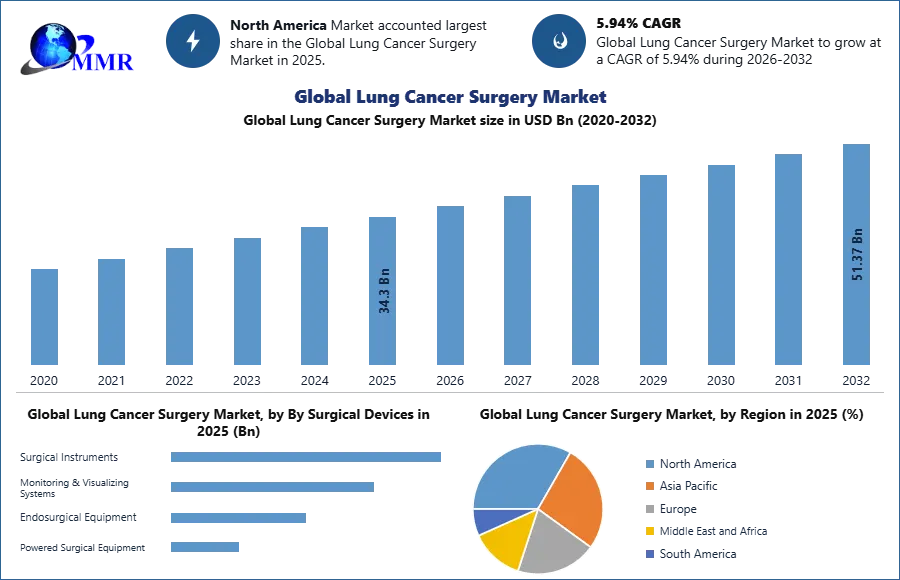
Global Lung Cancer Surgery Market was valued at USD 34.3 Bn in 2025 and is expected to reach USD 51.37 Bn by 2032, growing at a CAGR of 5.94% during the forecast period.
Global Lung Cancer Surgery Market Overview:
Lung Cancer is referred as Lung Carcinoma. It happens due to uncontrollable growth of tissues which are also called tumors on the lung and those are malignant in nature. Lung Cancer Surgery operates to remove those tumors and cures the lung cancer. It happen due to excessive pollution, smoking etc.
 To know about the Research Methodology :- Request Free Sample Report
The report explores the Lung Cancer Surgery Market's segments (on Surgical Devices, Surgical Procedure, End User, Region). Data has been provided by market participants, and regions (North America, Asia Pacific, Europe, Middle East & Africa, and South America). The MMR market report provides a thorough analysis of the rapid advances that are currently taking place across all industry sectors. Facts and figures, illustrations, and presentations are used to provide key data analysis for the historical period from 2020 to 2024. The report investigates the Lung Cancer Surgery Market’s drivers, limitations, prospects, and barriers. This MMR report includes investor recommendations based on a thorough examination of the Lung Cancer Surgery Market's contemporary competitive scenario.
Lung Cancer Surgery Market Dynamics:
Surgery for lung cancer is a treatment used to treat lung cancer, particularly non-small cell lung cancer. A number of variables, including smoking, passive smoking in some cases, exposure to carcinogenic poisons and gases, and others, increase the risk of this disease, which is primarily brought on by the excessive proliferation of aberrant malignant cells in the lung area. Secondary lung cancer begins in other body areas and later spreads to the lungs, whereas primary lung cancer is known as carcinomas that begins in the lungs. Using a biopsy that is carried out under bronchoscopy or CT guidance, lung cancer is found and confirmed. Surgery to treat lung cancer involves removing cancerous tissue from the lung.
The rise in global cancer incidence also points to an upward trend in the prevalence of lung cancer globally. The rising incidence and prevalence of cancer are anticipated to increase the number of patients choosing to have lung cancer surgery in the upcoming years in this situation marked by a favourable financial environment and efficient treatment alternatives. In consequence, it is anticipated that this will fuel market expansion during the ensuing years.
Technology developments in lung cancer therapy, rising lung cancer incidence and prevalence, the rising smoking trend, the ageing population, increased emphasis on early cancer detection and treatment, and reimbursement accessibility are the main factors driving market growth. The market for lung cancer surgery is anticipated to increase even more as a result of the rising prevalence of lung cancer, technical advancements, and the fact that people can now begin treatment at an early stage.
The high prevalence of lung cancer in the growing elderly population, as well as the global burden of trachea and bronchus cancer. The demand for both large and small cell lung cancer surgery will increase during the projected period as a result of the quick advancements in cancer treatment technology and the rise in lung cancer-related deaths. The development of aberrant cells in the lung tissue is referred to as lung cancer. Surgery is used to try to cure the condition by removing the tumor, the lung tissue around it, and any nearby lymph nodes. The best course of action for localized cancer, including carcinoid tumors, is surgery.
The risk of lung cancer in people with chronic obstructive pulmonary disease (COPD) is rising, and the prevalence of COPD will drive up demand for lung cancer surgery. Additional variables that raise the chance of cancer include genetic predisposition, increasing exposure to carcinogens like arsenic, asbestos, and cigarettes, as well as radiation from sources like UV and X-rays. Regarding the consumption of carcinogens, genetic predisposition, and smoking, these factors increase the likelihood of developing lung cancer, which benefits the global market for lung cancer surgery.
The high cost of treating lung malignancies has placed a heavy strain on both cancer sufferers and governments all over the world. Even though there is a big patient pool, only a small percentage of patients choose surgical treatments to address their ailment because of the expensive expenses. This is a significant barrier to market expansion.
There are some other issues that could limit the growth of this market to some extent, including post-surgical side effects including pain and the lack of sufficient market penetration for innovative treatments, which makes them unavailable to many customers.
The market for surgical robots has been grown the opportunity for minimally invasive procedures, growing technologies, highly sophisticated visualization capabilities, and rising investments in modern healthcare infrastructure. Robotic surgery is a form of minimally invasive surgery in which doctors insert a succession of extremely small incisions and tiny surgical equipment into a patient's body. Used for a variety of other treatments as well, such as gallbladder removal and coronary artery bypass surgery. It is also used to remove cancerous tissue from sensitive body areas like blood vessels, nerves, and vital organs.
One surgical option for the treatment of non-small cell lung cancer is segmentectomy (NSCLC). If the patient already has a severely diminished lung reserve, it is typically preferred over lobectomy. Although lung segmentectomy has long been a preferred method for removing benign tumors and supporting lesions, it is typically advised for patients with extremely early-stage lung cancer. This method is becoming more and more popular because it produces better results than conventional surgical approaches and requires less time to recuperate. These benefits are projected to drive the study market's expansion. Segmentectomy method has a strong success rate for eliminating localized tumors and cancers with greater survival rates, with the retention of organ functions to some extent.
Surgery for lung cancer is carried out by qualified specialists. Due to issues including air leaks, tumor movement caused by breathing, and fluid buildup in the chest during the surgery, these surgeries are thought to carry higher risks than conventional surgeries. Lung cancer incidence and prevalence have risen over time and are predicted to continue rising in the years to come. Oncologists have not, however, increased in number since that time; this issue is more severe in developing nations. The ageing and rising number of retirements among the oncology staff are among the causes of the slow/laggard increase in trained personnel.
| Exact Date | Company | Development | Impact |
|---|---|---|---|
| 12 March 2026 | Trinity Biotech plc | The company successfully launched its updated Premier Hb9210™ platform in Brazil following comprehensive regulatory approval for lung-related diagnostic monitoring. | This expansion provides advanced glycemic monitoring essential for diabetic lung cancer patients undergoing complex thoracic surgery to reduce post-operative complications. |
| 10 March 2026 | Johnson & Johnson | Johnson & Johnson filed a FDA de novo submission for OTTAVA, its next-generation robotic surgery system designed for multi-quadrant thoracic procedures. | The system's unified architecture aims to increase operating room flexibility and improve precision in lobectomies compared to traditional multi-port robotic platforms. |
| 15 January 2026 | Intuitive Surgical, Inc. | Intuitive reported a 51% annual increase in Ion endoluminal system procedures for 2025, reaching a global footprint of over 900 installed systems. | Rapid adoption of robotic-assisted bronchoscopy is shifting the market toward earlier surgical interventions by enabling precise biopsy and localization of small peripheral nodules. |
| 24 November 2025 | Ethicon (J&J MedTech) | Ethicon released a milestone report from the Lung Cancer Screening European Expert Summit advocating for standardized early detection protocols to enable life-saving surgery. | This strategic advocacy is expected to drive regional procedural volumes as earlier diagnosis increases the pool of patients eligible for minimally invasive resections. |
| 08 October 2025 | Intuitive Surgical, Inc. | The U.S. FDA cleared new software advancements for the Ion system, integrating AI-powered navigation and tomosynthesis imaging capabilities. | These features address CT-to-body divergence, allowing surgeons to maintain real-time accuracy during lung biopsy and pre-surgical marking in dynamic breathing environments. |
| 20 March 2025 | Johnson & Johnson | The company received regulatory clearance for MONARCH QUEST and the latest AI-powered algorithms for MONARCH Navigation technology. | The integration with GE HealthCare OEC 3D mobile imaging provides intraprocedural 3D visualization, significantly reducing the diagnostic-to-surgical treatment gap. |
Lung Cancer Surgery Market Segment Analysis:
In 2025, the Surgical Procedure segment shows the highest demand for minimally invasive techniques, particularly Video-Assisted Thoracoscopic Surgery (VATS) and robotic-assisted thoracic surgery. These approaches are increasingly preferred for the surgical treatment of Lung Cancer due to their advantages such as smaller incisions, reduced postoperative pain, shorter hospital stays, and faster recovery times. Traditional open procedures like thoracotomy remain essential for complex tumor cases and advanced-stage cancers that require extensive resection. However, the ongoing advancement of robotic platforms and improved surgical visualization technologies continues to accelerate the adoption of minimally invasive procedures across major healthcare facilities worldwide.
Based on Surgical Devices, surgical instruments and endosurgical equipment represent the most demanded segment in 2025. Instruments such as staplers, forceps, and retractors are widely used in lung tumor resections and thoracic procedures, making them essential components in operating rooms. Endosurgical equipment, including advanced energy devices and endoscopic stapling systems, is witnessing rapid adoption due to the growing preference for minimally invasive surgeries. Monitoring and visualizing systems, such as high-definition cameras and imaging systems, also play a crucial role by enabling surgeons to perform precise procedures with enhanced visibility. Overall, technological innovation in surgical tools continues to improve procedural efficiency and patient outcomes.
| Global Lung Cancer Surgery Market | |||
|---|---|---|---|
| Report Coverage | Details | ||
| Base Year: | 2025 | Forecast Period: | 2026-2032 |
| Historical Data: | 2020 to 2025 | Market Size in 2025: | 34.3 USD Bn |
| Forecast Period 2026-2032 CAGR: | 5.94% | Market Size in 2032: | 51.37 USD Bn |
| Segments Covered: | By Surgical Devices | Surgical Instruments Monitoring & Visualizing Systems Endosurgical Equipment Powered Surgical Equipment |
|
| By Surgical Procedure | Thoracotomy Minimally Invasive Surgeries |
||
| By Surgery Type | Open Surgery Minimally Invasive Surgery Robotic-Assisted Surgery |
||
| By Cancer Type | Non-Small Cell Lung Cancer (NSCLC) Small Cell Lung Cancer (SCLC) |
||
| By Tumor Stage | Stage I Stage II Stage III Stage IV |
||
Lung Cancer Surgery Market Regional Insights:
PORTER, PESTEL analysis with the potential impact of micro-economic factors of the market have been presented in the report. External as well as internal factors that are supposed to affect the business positively or negatively have been analyzed, which will give a clear futuristic view of the industry to the decision-makers.
The reports also help in understanding the Lung Cancer Surgery Market dynamic, structure by analyzing the market segments and projecting the Lung Cancer Surgery Market size. Clear representation of competitive analysis of key players by Vehicle Surgical Devices, price, financial position, product portfolio, growth strategies, and regional presence in the Lung Cancer Surgery Market make the report investor’s guide.
Lung Cancer Surgery Market Scope: Inquire before buying
Lung Cancer Surgery Market, by Region
North America (United States, Canada and Mexico)
Europe (UK, France, Germany, Italy, Spain, Sweden, Austria and Rest of Europe)
Asia Pacific (China, South Korea, Japan, India, Australia, Indonesia, Malaysia, Vietnam, Taiwan, Bangladesh, Pakistan and Rest of APAC)
Middle East and Africa (South Africa, GCC, Egypt, Nigeria and Rest of ME&A)
South America (Brazil, Argentina Rest of South America)
Key Players /Competitor Profiles Covered in the Global Lung Cancer Surgery Market Report from a Strategic Perspective
- Medtronic
- Johnson & Johnson
- Intuitive Surgical
- Olympus Corporation
- Siemens Healthineers
- GE Healthcare
- Stryker Corporation
- Zimmer Biomet
- Smith & Nephew
- Boston Scientific Corporation
- B. Braun Melsungen AG
- Teleflex Incorporated
- CONMED Corporation
- Cook Medical
- FUJIFILM Holdings Corporation
- PENTAX Medical
- Ambu A/S
- Richard Wolf GmbH
- Karl Storz SE & Co. KG
- Accuray Incorporated
- AngioDynamics
- Ackermann Instrumente GmbH
- Scanlan International
- TROKAMED GmbH
- Neomend Inc.