Lower Extremity Devices Market Size by Product, Application, Distribution Channel, Region – Revenue Pool Analysis, Margin Structure Assessment, Capital Flow Trends, Competitive Benchmarking & Forecast to 2032

7.5%
CAGR (2026-2032)
1.6 USD Bn.
Market Size
309
Report Pages
152
Market Tables

Overview

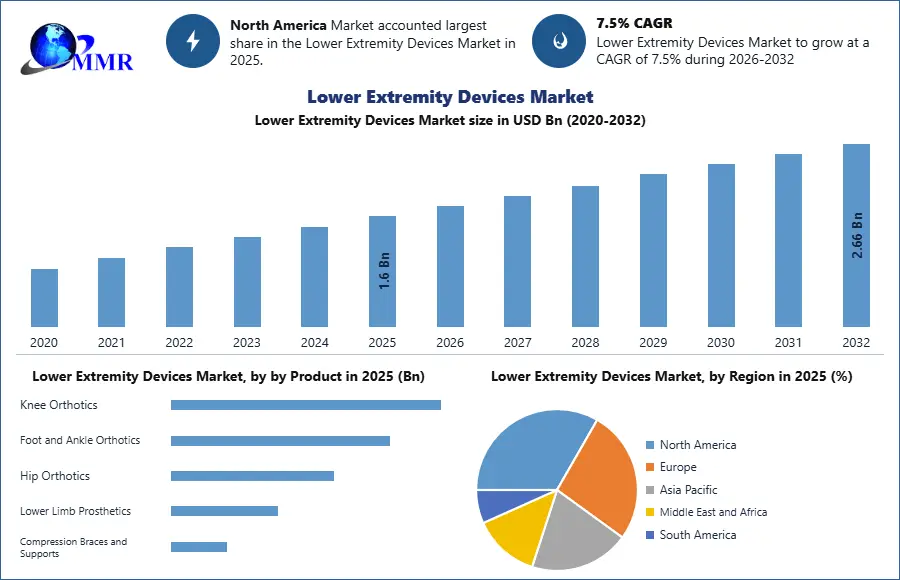
Lower Extremity Devices Market was valued at USD 1.6 Bn in 2025 and is expected to reach USD 2.66 Bn by 2032, growing at a CAGR of 7.5% during the forecast period.

Lower Extremity Devices Market Overview:

Lower extremity devices are external devices attached or applied to a lower limb to improve function by providing support, controlling motion, reducing pain, correcting deformities, and preventing progression. They are used to support a limb, improve alignment and function, control motion, reduce falls, provide pain relief, correct deformities, and slow the progression. These devices can be either cast or non-casted.Casted lower limb orthotics: These are custom-made after an impression of the patient’s feet is taken.

The orthoses will be tailored to the patient’s specific problems and needs. Non-casted lower limb orthotics: these are not tailored to an individual but may be a good way to start wearing orthotics. These devices are made of a variety of materials, including plastic, metal, and carbon fiber. The growing number of sports injuries is driving the lower extremity devices market.

As surgical treatments become more common, there is a greater demand for lower extremity devices. In 2019, 24.3 million surgical procedures were performed worldwide. Lower extremity devices are critical in providing pain relief, improving quality of life, and increasing mobility for patients who have had surgery or have abnormalities. In response to changing customer demands, these lower-extremity devices and methods are constantly evolving. Technological advancements and the incorporation of digital technology are now the primary drivers of revenue growth in the lower extremity devices market.

However, low awareness of the benefits of extremity devices, as well as an unfavorable reimbursement scenario for these products, are expected to hamper the growth of the lower extremity devices market. Conversely, the Asia-Pacific developing economies offer a lucrative lower extremity devices market opportunity.Lower Extremity Devices MarketTo know about the Research Methodology :- Request Free Sample Report
Lower Extremity Devices Market Dynamics:

Lower Extremity Devices Market Drivers

Increased number of accidents to boost the market

Lower extremity devices (or orthoses) is a shoe inserts that a Podiatrist may recommend after a biomechanical assessment/gait analysis. These can be pre-fabricated devices (not tailored to an individual but a less expensive option) or custom-made devices made from a plaster cast of the feet and a bespoke prescription.
1. Increase shock absorption
2. Increase stability (proprioception)
3. Change problematic foot mechanics
4. Moments around joints must be changed (e.g. decrease pronation at the sub-talar joint)
5. Reduce the amount of force within the injured tissue.

The increase in the number of patients with bone degenerative diseases is driving lower extremity devices market growth. Osteoporosis, stress fractures, bone fractures, bone cancer, scoliosis, and osteoarthritis are the most common bone-degrading disorders. One of the primary causes of an increase in bone-related disorders is traffic accidents. Pelvic bone fractures are quite common. Adopting a modern lifestyle also causes illnesses that increase the risk of trauma and fracture, as well as obesity and diabetes, which greatly increases the risk of degenerative joint disease.

The rapid increase in the elderly population is one of the key factors driving the lower extremity devices market. The elderly are more vulnerable to orthopedic disorders. This is due to the fact that arthritis and osteoarthritis are just two of the orthopedic disorders to which older people are predisposed. Broken bones are most commonly seen after car accidents.

Exact Date Company Development Impact
10 March 2026 Stryker Showcased the MAKO Robotic Power System (RPS), a handheld addition to its robotic portfolio for total knee arthroplasty (TKA), at the 2026 AAOS annual meeting. The launch enhances workflow efficiency in ambulatory surgery centers (ASCs) by offering a compact, portable solution for high-volume knee procedures.
02 March 2026 Enovis Announced the 2026 rollout of updated ARVIS (Augmented Reality Visualization and Information System) software specifically for knee arthroplasty. This technological advancement aims to improve surgical precision and patient outcomes through real-time, augmented reality guidance in lower extremity reconstructions.
14 November 2025 Zimmer Biomet Received FDA 510(k) clearance for the ROSA Knee with OptimiZe, an enhanced robotic system featuring personalized surgical planning algorithms. The system is expected to reduce surgical planning time by 46%, driving better implant placement accuracy and clinical reproducibility.
22 May 2025 ConforMIS Launched the iTotal CR-F patient-specific knee implant in Europe, incorporating personalized fit technology and improved surgical instrumentation. The expansion into European markets provides surgeons with customized joint replacement options that optimize bone preservation and patient comfort.
03 March 2026 Smith & Nephew Introduced the TRIGEN MAX Tibia Nailing System expansion, offering side-specific nails for anatomic screw trajectories in trauma cases. This development provides trauma surgeons with optimized fragment fixation and minimizes soft tissue irritation using low-profile, headless screw options.

Growing preference for Foot Orthoses and Therapeutic Footwear

Foot orthoses (FOs) –

1. FOs can be used alone or as a foundation for other lower limb orthoses. FO aligns and supports the foot, as well as prevents, corrects, or accommodates foot deformity and improves overall foot function. FOs are frequently used in conjunction with therapeutic shoes, which should be properly fitted and allow enough room for the foot to grow during weight bearing.

2. Supramalleolar orthoses (SMO) are most commonly used in pediatric patients with hypotonia and flexible foot pronation.

3. Leg length differences of less than 2cm without symptoms are usually not necessary to correct. Never is the total leg length discrepancy corrected; at most, 75% of the discrepancy should be corrected. A shoe can only accommodate a 1cm lift. For shoe lifts greater than 1cm, the patient would need a custom-built shoe with a shoe lift or an external shoe lift.

MMR analyzed that the growing use of foot orthoses (FOs) by overweight or obese people of all ages has increased the lower extremity devices market by 25%.

Therapeutic Footwear

1. Internal and external shoe modifications to the sole or body of the shoe are both possible. Excavation of the heel and internal sole can help relieve pain or ulcers caused by bony prominences. Pad placement supports or relieves pressure on the arch; heel and lateral wedges promote proper foot positioning or alignment. Shoes with bars on the soles can help with weakness, relieve pressure, transfer load, or promote dorsi or plantar flexion.

2. Heel flares broaden the base and provide cushioning, stability, positioning, and arch support with different heel materials.

3. High-top shoes or boots, particularly in young patients, can provide ankle stability in patients with mild ankle instability or mild foot drop.

The growing use of Foot Orthoses and Therapeutic Footwear by accident victims, athletes, and the elderly is driving the lower extremity devices market.
Lower Extremity Devices Market

Lower Extremity Devices Market Restraints

High Cost of lower-extremity devices hampers the market growth

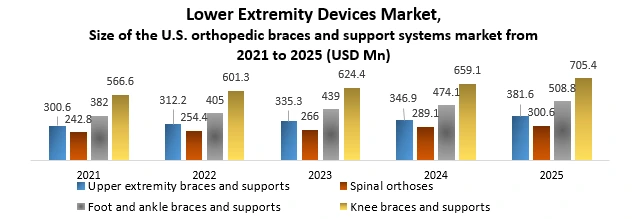
The high cost of lower extremity devices, as well as government restrictions on their use, are impeding the growth of the lower extremity devices market. Restricted healthcare facilities in developing countries, combined with an increase in product recalls, are expected to exert a controlling influence on the lower extremity devices market. The inability of advanced instruments to migrate to a standardized reimbursement landscape hampers their acceptance in the forecast years.

Lower Extremity Devices Market Opportunity

Recent advances boosting the market

As an alternative to traditional orthoses, functional electric stimulation (FES) devices are now used. These devices produce an electrical current that stimulates a muscle, causing it to contract in a predictable movement pattern, resulting in physiological bracing. The FES-AFO, which stimulates the tibialis anterior muscle to produce ankle dorsiflexion and eversion, is the most common FES device for the lower limb. When compared to traditional AFO, these devices have shown moderate gait improvements. A similar concept was used to improve wrist extension in the upper limb.

Recent advancements in traditional lower limb orthoses include stance-control orthotic knee joints that provide stance-phase stability while allowing swing-phase flexion. These should allow for a more normal gait pattern by removing some of the movement restrictions of other orthoses. Material advancements, 3-D printing, and robotic exoskeletons are dramatically altering the durability, fabrication time, overall function, and level of assistance provided by orthotic devices. All these recent advances are boosting the lower extremity devices market and are expected to do the same in the forecast period.

Lower Extremity Devices Market Segment Analysis:

Based on Product, The lower extremity devices market is divided into three categories: knee orthotics, foot and ankle orthotics, and hip orthotics. The knee orthotics segment accounted for 45% of market revenue in 2025 and is expected to grow at the fastest CAGR during the forecast period, owing to numerous benefits provided by these goods, such as medial and lateral support, reduced knee rotation, limited damage during activity, and protection against the possibility of injury following surgery. Knee braces can also relieve pain by relieving pressure on the part of the patient's joint most affected by osteoarthritis. A knee brace can also help patients stand and move around with more confidence if their knee feels like it might buckle when they put weight on it.


Based on the Application, Lower extremity devices are classified as trauma & fracture and others. The trauma and fracture segment is expected to dominate the market in 2025, owing to an increase in road accidents, which leads to more fractures and traumas. The others segment is expected to grow at the fastest CAGR during the forecast period, owing to an increase in osteoporosis cases.


Based on the Distribution Channel, the market is divided into Hospitals and surgical centers, retail pharmacies, and others. Because more patients consult hospitals and surgical centers during trauma and fractures, the hospital & surgical centers segment dominated the lower extremity devices market share in 2025. The other segment is expected to grow at the fastest rate during the forecast period, owing to an increase in the trend of online purchasing due to discounts.

Lower Extremity Devices Market
Report Coverage Details
Base Year: 2025 Forecast Period: 2026-2032
Historical Data: 2020 to 2025 Market Size in 2025: 1.6 USD Bn
Forecast Period 2026-2032 CAGR: 7.5% Market Size in 2032: 2.66 USD Bn
Segments Covered: by Product Knee Orthotics
Foot and Ankle Orthotics
Hip Orthotics
Lower Limb Prosthetics
Compression Braces and Supports
by Application Trauma and Fractures
Orthopedic Disorders
Sports Injuries
Rehabilitation
Others
by Distribution Channel Hospitals and Surgical Centers
Retail Pharmacies
Online Pharmacies
Orthopedic Clinics
Others

Lower Extremity Devices Market Regional Insights:

Based on Region, North America leads the Lower Extremity Devices Market in 2025, supported by advanced healthcare infrastructure, high adoption of orthopedic technologies, and a growing geriatric population. Europe follows closely, driven by increasing awareness and favorable reimbursement policies. Asia Pacific is the fastest-growing region due to rising healthcare investments, expanding patient population, and increasing incidence of orthopedic conditions in countries such as China and India. The Middle East and Africa region shows steady growth due to improving healthcare facilities, while South America demonstrates moderate demand driven by gradual advancements in medical infrastructure.

Lower Extremity Devices Market Scope: Inquiry Before Buying

Lower Extremity Devices Market, by Region

 North America (United States, Canada and Mexico)
 Europe (UK, France, Germany, Italy, Spain, Sweden, Austria and Rest of Europe)
 Asia Pacific (China, South Korea, Japan, India, Australia, Indonesia, Malaysia, Vietnam, Taiwan, Bangladesh, Pakistan and Rest of APAC)
 Middle East and Africa (South Africa, GCC, Egypt, Nigeria and Rest of ME&A)
 South America (Brazil, Argentina Rest of South America)

Lower Extremity Devices Market, Key Players are

1. DePuy Synthes
2. Stryker Corporation
3. Zimmer Biomet
4. DJO Global
5. CONMED
6. Bone Therapeutics
7. Active Implants
8. OsteoMed
9. Medtronic PLC
10. 3M
11. Bauerfeind
12. DeRoyal Industries Inc
13. Colfax Corporation
14. Orthofix
15. Ossue
16. Essity
17. Thuasne Group
18. Ottobock
19. Trulife

Table of Contents

1. Lower Extremity Devices Market Introduction
1.1. Study Assumption and Market Definition
1.2. Scope of the Study
1.3. Executive Summary
2. Global Lower Extremity Devices Market: Competitive Landscape
2.1. MMR Competition Matrix
2.2. Competitive Landscape
2.3. Key Players Benchmarking
2.3.1. Company Name
2.3.2. Business Segment
2.3.3. End-user Segment
2.3.4. Revenue (2025)
2.3.5. Company Locations
2.4. Leading Lower Extremity Devices Market Companies, by market capitalization
2.5. Market Structure
2.5.1. Market Leaders
2.5.2. Market Followers
2.5.3. Emerging Players
2.6. Mergers and Acquisitions Details
3. Lower Extremity Devices Market: Dynamics
3.1. Lower Extremity Devices Market Trends by Region
3.1.1. North America Lower Extremity Devices Market Trends
3.1.2. Europe Lower Extremity Devices Market Trends
3.1.3. Asia Pacific Lower Extremity Devices Market Trends
3.1.4. Middle East and Africa Lower Extremity Devices Market Trends
3.1.5. South America Lower Extremity Devices Market Trends
3.2. Lower Extremity Devices Market Dynamics by Region
3.2.1. North America
3.2.1.1. North America Lower Extremity Devices Market Drivers
3.2.1.2. North America Lower Extremity Devices Market Restraints
3.2.1.3. North America Lower Extremity Devices Market Opportunities
3.2.1.4. North America Lower Extremity Devices Market Challenges
3.2.2. Europe
3.2.2.1. Europe Lower Extremity Devices Market Drivers
3.2.2.2. Europe Lower Extremity Devices Market Restraints
3.2.2.3. Europe Lower Extremity Devices Market Opportunities
3.2.2.4. Europe Lower Extremity Devices Market Challenges
3.2.3. Asia Pacific
3.2.3.1. Asia Pacific Lower Extremity Devices Market Drivers
3.2.3.2. Asia Pacific Lower Extremity Devices Market Restraints
3.2.3.3. Asia Pacific Lower Extremity Devices Market Opportunities
3.2.3.4. Asia Pacific Lower Extremity Devices Market Challenges
3.2.4. Middle East and Africa
3.2.4.1. Middle East and Africa Lower Extremity Devices Market Drivers
3.2.4.2. Middle East and Africa Lower Extremity Devices Market Restraints
3.2.4.3. Middle East and Africa Lower Extremity Devices Market Opportunities
3.2.4.4. Middle East and Africa Lower Extremity Devices Market Challenges
3.2.5. South America
3.2.5.1. South America Lower Extremity Devices Market Drivers
3.2.5.2. South America Lower Extremity Devices Market Restraints
3.2.5.3. South America Lower Extremity Devices Market Opportunities
3.2.5.4. South America Lower Extremity Devices Market Challenges
3.3. PORTER's Five Forces Analysis
3.4. PESTLE Analysis
3.5. Technology Roadmap
3.6. Regulatory Landscape by Region
3.6.1. North America
3.6.2. Europe
3.6.3. Asia Pacific
3.6.4. Middle East and Africa
3.6.5. South America
3.7. Key Opinion Leader Analysis For Lower Extremity Devices Industry
3.8. Analysis of Government Schemes and Initiatives For Lower Extremity Devices Industry
3.9. Lower Extremity Devices Market Trade Analysis
3.10. The Global Pandemic Impact on Lower Extremity Devices Market
4. Lower Extremity Devices Market: Global Market Size and Forecast by Segmentation (in USD Bn) 2025-2032
4.1. Lower Extremity Devices Market Size and Forecast, by by Product (2025-2032)
4.1.1. Knee Orthotics
4.1.2. Foot and Ankle Orthotics
4.1.3. Hip Orthotics
4.1.4. Lower Limb Prosthetics
4.1.5. Compression Braces and Supports
4.2. Lower Extremity Devices Market Size and Forecast, by by Application (2025-2032)
4.2.1. Trauma and Fractures
4.2.2. Orthopedic Disorders
4.2.3. Sports Injuries
4.2.4. Rehabilitation
4.2.5. Others
4.3. Lower Extremity Devices Market Size and Forecast, by by Distribution Channel (2025-2032)
4.3.1. Hospitals and Surgical Centers
4.3.2. Retail Pharmacies
4.3.3. Online Pharmacies
4.3.4. Orthopedic Clinics
4.3.5. Others
4.4. Lower Extremity Devices Market Size and Forecast, by Region (2025-2032)
4.4.1. North America
4.4.2. Europe
4.4.3. Asia Pacific
4.4.4. Middle East and Africa
4.4.5. South America
5. North America Lower Extremity Devices Market Size and Forecast by Segmentation (in USD Bn) 2025-2032
5.1. North America Lower Extremity Devices Market Size and Forecast, by by Product (2025-2032)
5.1.1. Knee Orthotics
5.1.2. Foot and Ankle Orthotics
5.1.3. Hip Orthotics
5.1.4. Lower Limb Prosthetics
5.1.5. Compression Braces and Supports
5.2. North America Lower Extremity Devices Market Size and Forecast, by by Application (2025-2032)
5.2.1. Trauma and Fractures
5.2.2. Orthopedic Disorders
5.2.3. Sports Injuries
5.2.4. Rehabilitation
5.2.5. Others
5.3. North America Lower Extremity Devices Market Size and Forecast, by by Distribution Channel (2025-2032)
5.3.1. Hospitals and Surgical Centers
5.3.2. Retail Pharmacies
5.3.3. Online Pharmacies
5.3.4. Orthopedic Clinics
5.3.5. Others
5.4. North America Lower Extremity Devices Market Size and Forecast, by Country (2025-2032)
5.4.1. United States
5.4.1.1. United States Lower Extremity Devices Market Size and Forecast, by by Product (2025-2032)
5.4.1.1.1. Knee Orthotics
5.4.1.1.2. Foot and Ankle Orthotics
5.4.1.1.3. Hip Orthotics
5.4.1.1.4. Lower Limb Prosthetics
5.4.1.1.5. Compression Braces and Supports
5.4.1.2. United States Lower Extremity Devices Market Size and Forecast, by by Application (2025-2032)
5.4.1.2.1. Trauma and Fractures
5.4.1.2.2. Orthopedic Disorders
5.4.1.2.3. Sports Injuries
5.4.1.2.4. Rehabilitation
5.4.1.2.5. Others
5.4.1.3. United States Lower Extremity Devices Market Size and Forecast, by by Distribution Channel (2025-2032)
5.4.1.3.1. Hospitals and Surgical Centers
5.4.1.3.2. Retail Pharmacies
5.4.1.3.3. Online Pharmacies
5.4.1.3.4. Orthopedic Clinics
5.4.1.3.5. Others
5.4.2. Canada
5.4.2.1. Canada Lower Extremity Devices Market Size and Forecast, by by Product (2025-2032)
5.4.2.1.1. Knee Orthotics
5.4.2.1.2. Foot and Ankle Orthotics
5.4.2.1.3. Hip Orthotics
5.4.2.1.4. Lower Limb Prosthetics
5.4.2.1.5. Compression Braces and Supports
5.4.2.2. Canada Lower Extremity Devices Market Size and Forecast, by by Application (2025-2032)
5.4.2.2.1. Trauma and Fractures
5.4.2.2.2. Orthopedic Disorders
5.4.2.2.3. Sports Injuries
5.4.2.2.4. Rehabilitation
5.4.2.2.5. Others
5.4.2.3. Canada Lower Extremity Devices Market Size and Forecast, by by Distribution Channel (2025-2032)
5.4.2.3.1. Hospitals and Surgical Centers
5.4.2.3.2. Retail Pharmacies
5.4.2.3.3. Online Pharmacies
5.4.2.3.4. Orthopedic Clinics
5.4.2.3.5. Others
5.4.3. Mexico
5.4.3.1. Mexico Lower Extremity Devices Market Size and Forecast, by by Product (2025-2032)
5.4.3.1.1. Knee Orthotics
5.4.3.1.2. Foot and Ankle Orthotics
5.4.3.1.3. Hip Orthotics
5.4.3.1.4. Lower Limb Prosthetics
5.4.3.1.5. Compression Braces and Supports
5.4.3.2. Mexico Lower Extremity Devices Market Size and Forecast, by by Application (2025-2032)
5.4.3.2.1. Trauma and Fractures
5.4.3.2.2. Orthopedic Disorders
5.4.3.2.3. Sports Injuries
5.4.3.2.4. Rehabilitation
5.4.3.2.5. Others
5.4.3.3. Mexico Lower Extremity Devices Market Size and Forecast, by by Distribution Channel (2025-2032)
5.4.3.3.1. Hospitals and Surgical Centers
5.4.3.3.2. Retail Pharmacies
5.4.3.3.3. Online Pharmacies
5.4.3.3.4. Orthopedic Clinics
5.4.3.3.5. Others
6. Europe Lower Extremity Devices Market Size and Forecast by Segmentation (in USD Bn) 2025-2032
6.1. Europe Lower Extremity Devices Market Size and Forecast, by by Product (2025-2032)
6.2. Europe Lower Extremity Devices Market Size and Forecast, by by Application (2025-2032)
6.3. Europe Lower Extremity Devices Market Size and Forecast, by by Distribution Channel (2025-2032)
6.4. Europe Lower Extremity Devices Market Size and Forecast, by Country (2025-2032)
6.4.1. United Kingdom
6.4.1.1. United Kingdom Lower Extremity Devices Market Size and Forecast, by by Product (2025-2032)
6.4.1.2. United Kingdom Lower Extremity Devices Market Size and Forecast, by by Application (2025-2032)
6.4.1.3. United Kingdom Lower Extremity Devices Market Size and Forecast, by by Distribution Channel (2025-2032)
6.4.2. France
6.4.2.1. France Lower Extremity Devices Market Size and Forecast, by by Product (2025-2032)
6.4.2.2. France Lower Extremity Devices Market Size and Forecast, by by Application (2025-2032)
6.4.2.3. France Lower Extremity Devices Market Size and Forecast, by by Distribution Channel (2025-2032)
6.4.3. Germany
6.4.3.1. Germany Lower Extremity Devices Market Size and Forecast, by by Product (2025-2032)
6.4.3.2. Germany Lower Extremity Devices Market Size and Forecast, by by Application (2025-2032)
6.4.3.3. Germany Lower Extremity Devices Market Size and Forecast, by by Distribution Channel (2025-2032)
6.4.4. Italy
6.4.4.1. Italy Lower Extremity Devices Market Size and Forecast, by by Product (2025-2032)
6.4.4.2. Italy Lower Extremity Devices Market Size and Forecast, by by Application (2025-2032)
6.4.4.3. Italy Lower Extremity Devices Market Size and Forecast, by by Distribution Channel (2025-2032)
6.4.5. Spain
6.4.5.1. Spain Lower Extremity Devices Market Size and Forecast, by by Product (2025-2032)
6.4.5.2. Spain Lower Extremity Devices Market Size and Forecast, by by Application (2025-2032)
6.4.5.3. Spain Lower Extremity Devices Market Size and Forecast, by by Distribution Channel (2025-2032)
6.4.6. Sweden
6.4.6.1. Sweden Lower Extremity Devices Market Size and Forecast, by by Product (2025-2032)
6.4.6.2. Sweden Lower Extremity Devices Market Size and Forecast, by by Application (2025-2032)
6.4.6.3. Sweden Lower Extremity Devices Market Size and Forecast, by by Distribution Channel (2025-2032)
6.4.7. Austria
6.4.7.1. Austria Lower Extremity Devices Market Size and Forecast, by by Product (2025-2032)
6.4.7.2. Austria Lower Extremity Devices Market Size and Forecast, by by Application (2025-2032)
6.4.7.3. Austria Lower Extremity Devices Market Size and Forecast, by by Distribution Channel (2025-2032)
6.4.8. Rest of Europe
6.4.8.1. Rest of Europe Lower Extremity Devices Market Size and Forecast, by by Product (2025-2032)
6.4.8.2. Rest of Europe Lower Extremity Devices Market Size and Forecast, by by Application (2025-2032)
6.4.8.3. Rest of Europe Lower Extremity Devices Market Size and Forecast, by by Distribution Channel (2025-2032)
7. Asia Pacific Lower Extremity Devices Market Size and Forecast by Segmentation (in USD Bn) 2025-2032
7.1. Asia Pacific Lower Extremity Devices Market Size and Forecast, by by Product (2025-2032)
7.2. Asia Pacific Lower Extremity Devices Market Size and Forecast, by by Application (2025-2032)
7.3. Asia Pacific Lower Extremity Devices Market Size and Forecast, by by Distribution Channel (2025-2032)
7.4. Asia Pacific Lower Extremity Devices Market Size and Forecast, by Country (2025-2032)
7.4.1. China
7.4.1.1. China Lower Extremity Devices Market Size and Forecast, by by Product (2025-2032)
7.4.1.2. China Lower Extremity Devices Market Size and Forecast, by by Application (2025-2032)
7.4.1.3. China Lower Extremity Devices Market Size and Forecast, by by Distribution Channel (2025-2032)
7.4.2. S Korea
7.4.2.1. S Korea Lower Extremity Devices Market Size and Forecast, by by Product (2025-2032)
7.4.2.2. S Korea Lower Extremity Devices Market Size and Forecast, by by Application (2025-2032)
7.4.2.3. S Korea Lower Extremity Devices Market Size and Forecast, by by Distribution Channel (2025-2032)
7.4.3. Japan
7.4.3.1. Japan Lower Extremity Devices Market Size and Forecast, by by Product (2025-2032)
7.4.3.2. Japan Lower Extremity Devices Market Size and Forecast, by by Application (2025-2032)
7.4.3.3. Japan Lower Extremity Devices Market Size and Forecast, by by Distribution Channel (2025-2032)
7.4.4. India
7.4.4.1. India Lower Extremity Devices Market Size and Forecast, by by Product (2025-2032)
7.4.4.2. India Lower Extremity Devices Market Size and Forecast, by by Application (2025-2032)
7.4.4.3. India Lower Extremity Devices Market Size and Forecast, by by Distribution Channel (2025-2032)
7.4.5. Australia
7.4.5.1. Australia Lower Extremity Devices Market Size and Forecast, by by Product (2025-2032)
7.4.5.2. Australia Lower Extremity Devices Market Size and Forecast, by by Application (2025-2032)
7.4.5.3. Australia Lower Extremity Devices Market Size and Forecast, by by Distribution Channel (2025-2032)
7.4.6. Indonesia
7.4.6.1. Indonesia Lower Extremity Devices Market Size and Forecast, by by Product (2025-2032)
7.4.6.2. Indonesia Lower Extremity Devices Market Size and Forecast, by by Application (2025-2032)
7.4.6.3. Indonesia Lower Extremity Devices Market Size and Forecast, by by Distribution Channel (2025-2032)
7.4.7. Malaysia
7.4.7.1. Malaysia Lower Extremity Devices Market Size and Forecast, by by Product (2025-2032)
7.4.7.2. Malaysia Lower Extremity Devices Market Size and Forecast, by by Application (2025-2032)
7.4.7.3. Malaysia Lower Extremity Devices Market Size and Forecast, by by Distribution Channel (2025-2032)
7.4.8. Vietnam
7.4.8.1. Vietnam Lower Extremity Devices Market Size and Forecast, by by Product (2025-2032)
7.4.8.2. Vietnam Lower Extremity Devices Market Size and Forecast, by by Application (2025-2032)
7.4.8.3. Vietnam Lower Extremity Devices Market Size and Forecast, by by Distribution Channel (2025-2032)
7.4.9. Taiwan
7.4.9.1. Taiwan Lower Extremity Devices Market Size and Forecast, by by Product (2025-2032)
7.4.9.2. Taiwan Lower Extremity Devices Market Size and Forecast, by by Application (2025-2032)
7.4.9.3. Taiwan Lower Extremity Devices Market Size and Forecast, by by Distribution Channel (2025-2032)
7.4.10. Rest of Asia Pacific
7.4.10.1. Rest of Asia Pacific Lower Extremity Devices Market Size and Forecast, by by Product (2025-2032)
7.4.10.2. Rest of Asia Pacific Lower Extremity Devices Market Size and Forecast, by by Application (2025-2032)
7.4.10.3. Rest of Asia Pacific Lower Extremity Devices Market Size and Forecast, by by Distribution Channel (2025-2032)
8. Middle East and Africa Lower Extremity Devices Market Size and Forecast by Segmentation (in USD Bn) 2025-2032
8.1. Middle East and Africa Lower Extremity Devices Market Size and Forecast, by by Product (2025-2032)
8.2. Middle East and Africa Lower Extremity Devices Market Size and Forecast, by by Application (2025-2032)
8.3. Middle East and Africa Lower Extremity Devices Market Size and Forecast, by by Distribution Channel (2025-2032)
8.4. Middle East and Africa Lower Extremity Devices Market Size and Forecast, by Country (2025-2032)
8.4.1. South Africa
8.4.1.1. South Africa Lower Extremity Devices Market Size and Forecast, by by Product (2025-2032)
8.4.1.2. South Africa Lower Extremity Devices Market Size and Forecast, by by Application (2025-2032)
8.4.1.3. South Africa Lower Extremity Devices Market Size and Forecast, by by Distribution Channel (2025-2032)
8.4.2. GCC
8.4.2.1. GCC Lower Extremity Devices Market Size and Forecast, by by Product (2025-2032)
8.4.2.2. GCC Lower Extremity Devices Market Size and Forecast, by by Application (2025-2032)
8.4.2.3. GCC Lower Extremity Devices Market Size and Forecast, by by Distribution Channel (2025-2032)
8.4.3. Nigeria
8.4.3.1. Nigeria Lower Extremity Devices Market Size and Forecast, by by Product (2025-2032)
8.4.3.2. Nigeria Lower Extremity Devices Market Size and Forecast, by by Application (2025-2032)
8.4.3.3. Nigeria Lower Extremity Devices Market Size and Forecast, by by Distribution Channel (2025-2032)
8.4.4. Rest of ME&A
8.4.4.1. Rest of ME&A Lower Extremity Devices Market Size and Forecast, by by Product (2025-2032)
8.4.4.2. Rest of ME&A Lower Extremity Devices Market Size and Forecast, by by Application (2025-2032)
8.4.4.3. Rest of ME&A Lower Extremity Devices Market Size and Forecast, by by Distribution Channel (2025-2032)
9. South America Lower Extremity Devices Market Size and Forecast by Segmentation (in USD Bn) 2025-2032
9.1. South America Lower Extremity Devices Market Size and Forecast, by by Product (2025-2032)
9.2. South America Lower Extremity Devices Market Size and Forecast, by by Application (2025-2032)
9.3. South America Lower Extremity Devices Market Size and Forecast, by by Distribution Channel (2025-2032)
9.4. South America Lower Extremity Devices Market Size and Forecast, by Country (2025-2032)
9.4.1. Brazil
9.4.1.1. Brazil Lower Extremity Devices Market Size and Forecast, by by Product (2025-2032)
9.4.1.2. Brazil Lower Extremity Devices Market Size and Forecast, by by Application (2025-2032)
9.4.1.3. Brazil Lower Extremity Devices Market Size and Forecast, by by Distribution Channel (2025-2032)
9.4.2. Argentina
9.4.2.1. Argentina Lower Extremity Devices Market Size and Forecast, by by Product (2025-2032)
9.4.2.2. Argentina Lower Extremity Devices Market Size and Forecast, by by Application (2025-2032)
9.4.2.3. Argentina Lower Extremity Devices Market Size and Forecast, by by Distribution Channel (2025-2032)
9.4.3. Rest Of South America
9.4.3.1. Rest Of South America Lower Extremity Devices Market Size and Forecast, by by Product (2025-2032)
9.4.3.2. Rest Of South America Lower Extremity Devices Market Size and Forecast, by by Application (2025-2032)
9.4.3.3. Rest Of South America Lower Extremity Devices Market Size and Forecast, by by Distribution Channel (2025-2032)
10. Company Profile: Key Players
10.1. DePuy Synthes
10.1.1. Company Overview
10.1.2. Business Portfolio
10.1.3. Financial Overview
10.1.4. SWOT Analysis
10.1.5. Strategic Analysis
10.1.6. Scale of Operation (small, medium, and large)
10.1.7. Details on Partnership
10.1.8. Regulatory Accreditations and Certifications Received by Them
10.1.9. Awards Received by the Firm
10.1.10. Recent Developments
10.2. Stryker Corporation
10.3. Zimmer Biomet
10.4. DJO Global
10.5. CONMED
10.6. Bone Therapeutics
10.7. Active Implants
10.8. OsteoMed
10.9. Medtronic PLC
10.10. 3M
10.11. Bauerfeind
10.12. DeRoyal Industries Inc
10.13. Colfax Corporation
10.14. Orthofix
10.15. Ossue
10.16. Essity
10.17. Thuasne Group
10.18. Ottobock
10.19. Trulife
11. Key Findings
12. Industry Recommendations
13. Lower Extremity Devices Market: Research Methodology
14. Terms and Glossary

Custom Market Research Services

We Will Customise The Research For You, In Case The Report Listed Above Does Not Meet With Your Requirements