
Lithium-Ion Battery Separator Market - Industry Structure Evaluation, Demand Drivers Analysis, Growth Analysis and Identification, Competitive Positioning Review & Market Size Forecast to 2032
Overview
The Lithium-Ion Battery Separator Market size was valued at USD 9.27 Billion in 2025 and the total Lithium-Ion Battery Separator revenue is expected to grow at a CAGR of 13.5% from 2025 to 2032, reaching nearly USD 22.5 Billion.
A Lithium-Ion Battery Separator is a thin, permeable membrane that acts as a physical barrier between the positive (cathode) and negative (anode) electrodes in a Lithium-Ion Battery. It is a critical component that prevents direct contact between the electrodes, thereby preventing short circuits and improving the safety and performance of the battery. Lithium-Ion Battery Separators are typically made from materials with high porosity, allowing for efficient electrolyte penetration and ion transport. The most commonly used material for separators is a microporous polymer film, typically made from polyethylene or polypropylene. These polymer separators are manufactured through various techniques such as stretching, heat treatment, and surface modifications to optimize their properties.
The Lithium-Ion Battery Separator Market has witnessed significant growth in recent years due to the widespread adoption of Lithium-Ion batteries in various industries, such as automotive, electronics, and energy storage. The market for Lithium-Ion Battery Separators is driven by several factors, including the increasing demand for electric vehicles (EVs) and portable electronic devices, growing renewable energy installations, and the rising need for energy storage solutions. The automotive sector, in particular, has played a major role in the market's expansion, with the global shift towards electric vehicles fuelling the need for separators. Moreover, the rising adoption of renewable energy sources and the demand for energy storage systems have further boosted the market for Lithium-Ion Battery Separators. The market offers various types of separators, including microporous, ceramic-coated, and composite separators, each catering to specific application requirements.
Asia Pacific dominates the market, led by countries like China, Japan, and South Korea, while North America and Europe also hold substantial market shares. Safety remains a key concern in the market, prompting continuous R&D efforts to enhance the safety and thermal stability of separators. The market is highly competitive, with companies investing in innovation and expanding production capacities. With the increasing demand for electric vehicles and energy storage solutions, the Lithium-Ion Battery Separator Market is expected to continue its growth trajectory, contributing to the advancement of clean technologies. However, environmental considerations and proper battery waste management are crucial for ensuring the sustainable use of Lithium-Ion batteries.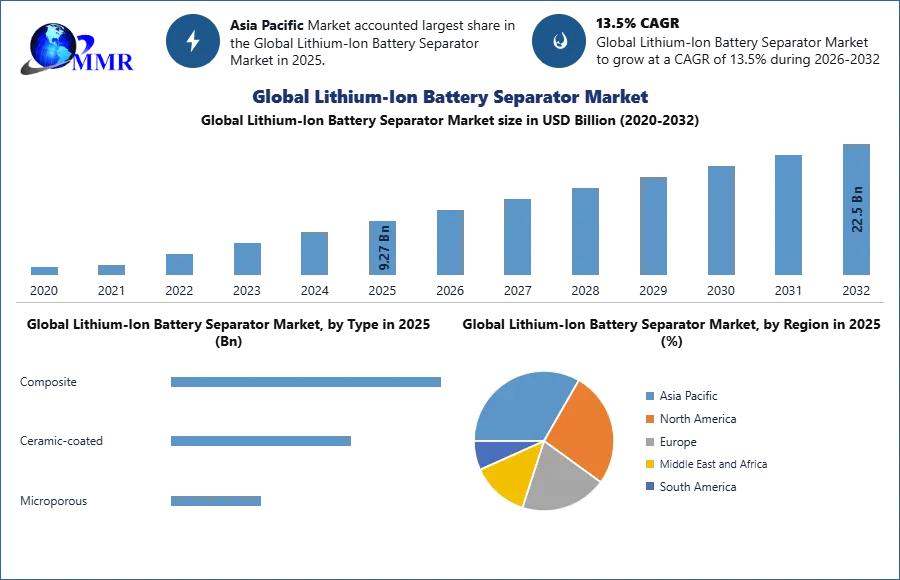 To know about the Research Methodology :- Request Free Sample Report
Lithium-Ion Battery Separator Market Dynamics
Lithium-Ion Battery Separator Market Drivers
The Lithium-Ion Battery Separator industry is driven by several key factors that contribute to its growth and expansion. One of the primary drivers is the increasing demand for electric vehicles (EVs). As governments and consumers prioritize sustainability and seek to reduce carbon emissions, the adoption of electric vehicles is rapidly growing. Another significant driver is the growing demand for portable electronic devices. With advancements in technology and the increasing reliance on smartphones, laptops, tablets, and other portable devices, the demand for efficient and long-lasting batteries has surged. Lithium-Ion Batteries, with their high energy density and longer lifespan, are widely used in these devices.
Consequently, the demand for separators to enhance battery performance and safety has also increased. Also, the integration of renewable energy sources is driving the Lithium-Ion Battery Separator Market. Separators are vital components in these batteries, enabling efficient ion transport and contributing to the overall performance and reliability of energy storage systems.As the deployment of renewable energy installations continues to grow, the demand for Lithium-Ion Battery Separators is expected to rise correspondingly. Government initiatives and policies promoting clean energy and electric mobility are additional market drivers. Many countries have set targets for reducing greenhouse gas emissions and promoting the adoption of electric vehicles. These initiatives often include incentives and subsidies to encourage consumers and businesses to switch to electric vehicles.
Such supportive measures contribute to the increased demand for Lithium-Ion batteries and, consequently, for separators. The continuous focus on improving battery performance and safety is also a significant driver for the market. Manufacturers are investing in research and development to enhance separator materials, design, and manufacturing processes. Advanced separators with improved thermal stability, enhanced safety features, and higher energy efficiency are being developed to meet the evolving demands of various industries. This drive for innovation and technological advancements further stimulates the growth of the Lithium-Ion Battery Separator Market.
Lithium-Ion Battery Separator Market Trends & Opportunities
The Lithium-Ion Battery Separator Market is experiencing notable trends and presenting various opportunities for growth. Safety and thermal stability have become a key focus, leading to research and development investments in enhanced safety features. The development of high-performance separators capable of withstanding higher voltages and supporting rapid charging is another trend. As the demand for renewable energy and energy storage systems increases, there are opportunities for manufacturers to expand production capacities and provide customized separator solutions. Emerging applications such as electric aviation, marine vessels, and stationary storage systems offer growth potential, requiring specialized separators. Partnerships and collaborations within the value chain are essential for integrated and optimized battery systems. These collaborations facilitate technology sharing, mutual growth, and streamlined supply chains, fostering innovation and market expansion.
Lithium-Ion Battery Separator Market Restraints & Challenges
The Lithium-Ion Battery Separator companies faces several restraints and challenges. Volatility in raw material prices impacts manufacturing costs and profit margins. Ensuring safety and thermal stability is a challenge due to the risk of battery failures. Intense competition requires continuous innovation and differentiation. Environmental concerns regarding battery disposal and recycling demand sustainable practices. Manufacturing capacity and supply chain limitations pose operational challenges. Overcoming these obstacles requires strategic partnerships, R&D investment, advanced safety measures, sustainable practices, and efficient supply chain management. Addressing these challenges will contribute to the market's growth and sustainability.
Lithium-Ion Battery Separator Market Segment Analysis
By Type: The Lithium-Ion Battery Separator Market segmentation is done on the basis of types which include, microporous separators, ceramic-coated separators and composite separators. Microporous separators hold the largest market share and are the leading segment. They offer excellent porosity and high permeability, making them suitable for various applications. Ceramic-coated separators, with enhanced thermal stability and safety features, are also gaining traction. Composite separators, combining different materials for improved performance and safety, are a growing segment. While microporous separators lead the market, the demand for ceramic-coated and composite separators is increasing. Manufacturers are focusing on developing advanced coatings and materials to meet industry demands.
By Technology: The Lithium-Ion Battery Separator Market segmentation is done on the basis of technology into dry processing and wet processing. Dry processing holds a significant market share and is the leading segment in the market. This technology involves the use of non-aqueous solvents and thermal processes to create separators with high porosity and uniformity. Dry processing offers advantages such as better dimensional stability, improved mechanical strength, and enhanced thermal stability, making it suitable for a wide range of applications. Wet processing is another segment in the market. This technology involves the use of aqueous solvents and chemical processes to manufacture separators. Wet processing allows for better control over the pore structure and thickness of the separator, resulting in customized properties and performance.
It is commonly used in applications that require specific separator characteristics, such as improved electrolyte wettability or enhanced safety features. While dry processing leads the market, the demand for wet processing is also significant, driven by the need for specialized separator properties. Manufacturers are investing in both technologies to meet the diverse requirements of different industries. As the Lithium-Ion Battery market continues to expand, both segments are expected to maintain their relevance and contribute to the overall growth of the Lithium-Ion Battery Separator Market. By End-User: The Lithium-Ion Battery Separator Market segmentation is done on the basis of end-user, which include, automotive, consumer electronics, energy storage and others. The automotive sector holds the largest market share and is the leading segment in the market. The increasing adoption of electric vehicles (EVs) and hybrid electric vehicles (HEVs) has fueled the demand for Lithium-Ion batteries and separators. Automotive manufacturers are investing in Lithium-Ion Battery technologies to meet stringent emission regulations and offer sustainable transportation solutions.
The consumer electronics sector is another significant segment in the market. The growing demand for smartphones, laptops, tablets, and other portable electronic devices drives the need for Lithium-Ion batteries and separators. Manufacturers are focusing on developing lightweight and high-performance batteries to meet the power requirements of consumer electronics. The energy storage sector is experiencing rapid growth and presents significant opportunities for the Lithium-Ion Battery Separator industry.
With the integration of renewable energy sources and the need for grid stabilization, energy storage systems based on Lithium-Ion batteries are in high demand. The energy storage segment is expected to witness substantial growth, driven by the expansion of renewable energy installations and the implementation of smart grid technologies. Other sectors, such as aerospace, marine, and industrial applications, also contribute to the Lithium-Ion Battery Separator Market. These sectors require specialized separators that can withstand harsh environments and deliver reliable performance.
While the automotive sector leads the market, the growth potential in consumer electronics and energy storage sectors is significant. The increasing demand for electric vehicles and the need for sustainable energy storage solutions will continue to drive the market in the coming years. Manufacturers are focusing on catering to the specific requirements of each end-user segment to capitalize on the market opportunities and maintain their competitive edge.
Lithium-Ion Battery Separator Market: Regional Insights
Asia-Pacific: Asia Pacific Lithium-Ion Battery Separator Market holds the largest share and dominates the global Lithium-Ion Battery Separator Market. The region is a hub for battery manufacturing and has a significant presence of major battery manufacturers and suppliers. Countries like China, Japan, and South Korea are leading contributors to the market growth due to their robust electronics and automotive industries. The rapid adoption of electric vehicles, the presence of prominent consumer electronics manufacturers, and government initiatives to promote clean energy drive the demand for Lithium-Ion batteries and separators in the region.
North America: North American Lithium-Ion Battery Separator Market is another prominent market for Lithium-Ion Battery Separators. The region has a well-established electric vehicle market, with the United States being a major contributor. The growing focus on clean energy, government incentives for electric vehicles, and investments in renewable energy projects drive the demand for Lithium-Ion batteries and separators. The presence of key players in the automotive and energy storage sectors further strengthens the market.
Europe: European Lithium-Ion Battery Separator Market also holds a significant market share. The region is witnessing a surge in the adoption of electric vehicles and renewable energy sources. Countries like Germany, France, and the United Kingdom are leading the transition towards sustainable transportation and energy systems. Government regulations promoting cleaner energy, along with the presence of renowned automotive manufacturers, contribute to the growth of the Lithium-Ion Battery Separator Market in Europe.
South America: The South American Lithium-Ion Battery Separator Market is an emerging market for this region. This region is currently witnessing an increase in the investments in renewable energy projects and the adoption of electric vehicles.
Middle East & Africa: The Middle East & African Lithium-Ion Battery Separator Market is an emerging market for this region. The growing adoption of renewable energy sources and smart cities in these regions is also driving the growth of the Cables and Connector market.
Recent Development: Lithium-Ion Battery Separator Market
| Exact Date | Company | Development | Impact |
|---|---|---|---|
| 09 January 2025 | LG Energy Solution | Officially launched the LG Energy Solution Lithium-ion Battery Separator X2, featuring advanced coating technology. | The product offers a 20% increase in energy density and enhanced durability, addressing the demand for high-performance EV battery components. |
| 14 April 2025 | SK IE Technology (SKIET) | Commenced the supply of uncoated base separator films to LG Energy Solution's production facilities in North America. | The deal, valued at $75.7 million, provides enough material for 300,000 electric vehicles and leverages U.S. tariff advantages over Chinese competitors. |
| 01 September 2025 | Entek / I Squared Capital | Completed a deal where I Squared Capital acquired a majority stake in Entek to accelerate domestic separator production. | This capital infusion supports reshoring critical U.S. battery manufacturing and scales Entek's capacity to meet localized supply chain requirements. |
| 17 December 2025 | Toray Industries / LG Chem | Toray completed the sale of its remaining 30% stake in the Hungarian battery separator joint venture to LG Chem for ¥30 billion. | The transaction allows LG Chem to take full operational control of the European site while Toray focuses on R&D in Japan and South Korea. |
| 22 January 2026 | Celgard (Polypore) | Successfully commissioned the expansion of its Charlotte manufacturing site to begin full-scale operations of domestically sourced separators. | The expansion secures supply chain resilience for the U.S. market by providing a complete portfolio of coated and uncoated dry-process separators. |
| 03 March 2026 | CATL | Began mass production at its Debrecen, Hungary gigafactory, triggering a large-scale pull-through for regional separator suppliers. | This operational start stabilizes the European lithium-ion supply chain and drives demand for high-volume, qualified separator films in the EU. |
Competitive Landscape
The Lithium-Ion Battery Separator Industry is highly competitive, with a mix of established companies, emerging players, and regional manufacturers. Established companies leverage their strong brand reputation, extensive manufacturing capabilities, and customer relationships. They invest in research and development to improve products and maintain a competitive edge. Emerging players focus on innovation and technological advancements to differentiate their offerings.
They specialize in specific types of separators or technologies and target niche markets. Regional Lithium-Ion Battery Separator manufacturers have a deep understanding of local market dynamics and cater to specific needs. Collaboration and partnerships are increasing across the value chain, aiming to develop integrated battery systems and optimize performance. Competition drives companies to invest in R&D, product differentiation, and customer-centric strategies. The industry is dynamic, with evolving trends and opportunities for both established players and new entrants to thrive.
Lithium-Ion Battery Separator Market Scope: Inquire before buying
| Global Lithium-Ion Battery Separator Market | |||
|---|---|---|---|
| Report Coverage | Details | ||
| Base Year: | 2025 | Forecast Period: | 2026-2032 |
| Historical Data: | 2020 to 2025 | Market Size in 2025: | 9.27 USD Billion |
| Forecast Period 2026-2032 CAGR: | 13.5% | Market Size in 2032: | 22.5 USD Billion |
| Segments Covered: | by Type | Composite Ceramic-coated Microporous |
|
| by Technology | Dry Processing Wet Processing |
||
| by End-User | Automotive Consumer Electronics Energy Storage Others |
||
| by Distribution Channel | Offline Online |
||
Lithium-Ion Battery Separator Market by Region:
North America (United States, Canada and Mexico)
Europe (UK, France, Germany, Italy, Spain, Sweden, Austria and Rest of Europe)
Asia Pacific (China, South Korea, Japan, India, Australia, Indonesia, Malaysia, Vietnam, Taiwan, Bangladesh, Pakistan and Rest of APAC)
Middle East and Africa (South Africa, GCC, Egypt, Nigeria and Rest of ME&A)
South America (Brazil, Argentina Rest of South America)
Lithium-Ion Battery Separator Key Players
1.Asahi Kasei Corporation
2.Toray Industries Inc.
3.SK Innovation Co. Ltd.
4.UBE Industries Ltd.
5.Sumitomo Chemical Co. Ltd.
6.W-Scope Corporation
7.Entek International LLC
8.Freudenberg Group
9.Dreamweaver International LLC
10.Cangzhou Mingzhu Plastic Co. Ltd.
11.Mitsubishi Chemical Corporation
12.LG Chem Ltd.
13.Shenzhen Senior Technology Material Co. Ltd.
14.Foshan Jinhui Hi-tech Optoelectronic Material Co. Ltd.
15.Wuxi Qifeng Plastic Co. Ltd.
16.Jinhui Hi-tech New Material Co. Ltd.
17.Tianjin DG Membrane Tech Co. Ltd.
18.Celgard, LLC
19.Beijing Frotec Environmental Co. Ltd.
20.Xingke New Materials Co. Ltd.
21.Tianjin Tianfeng Plastic Machinery Co. Ltd.
22.Sinoma Science & Technology Co. Ltd.
23.Suzhou GreenPower New Energy Materials Co. Ltd.
24.Shenzhen Mingda Technology Co. Ltd.
25.Tianjin Kangde Xin Composite Material Co. Ltd.
FAQs:
1. What are the growth drivers for the Lithium-Ion Battery Separator Market?
Ans. The growth drivers for the Lithium-Ion Battery Separator Market include the increasing adoption of electric vehicles and the rising demand for energy storage systems for renewable energy integration.
2. What is the major restraint for the Lithium-Ion Battery Separator Market growth?
Ans. The major restraint for the Lithium-Ion Battery Separator Market growth is the volatility in the prices of raw materials used in separator manufacturing, such as polyethylene and polypropylene, which can impact the overall production costs and profitability.
3. Which region is expected to lead the global Lithium-Ion Battery Separator Market during the forecast period?
Ans. Asia Pacific is expected to lead the global Lithium-Ion Battery Separator Market during the forecast period.
4. What was the Global Lithium-Ion Battery Separator Market size in 2025?
Ans: The Global Lithium-Ion Battery Separator Market size was USD 9.27 Billion in 2025.
5. What segments are covered in the Lithium-Ion Battery Separator Market report?
Ans. The segments covered in the Lithium-Ion Battery Separator Market report are by Type, Technology, End-User and Region.