
Japan Farm and Agro Equipment Market Size by Equipment Type, Technology, Power Source, Application and End User
Overview
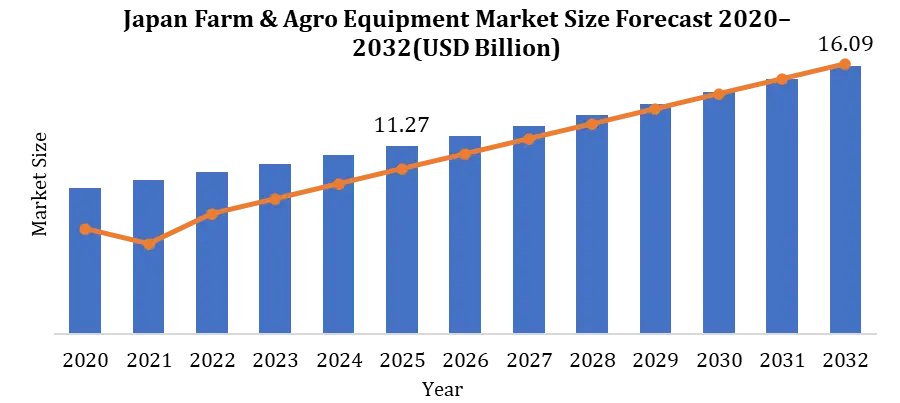
Japan Farm and Agro Equipment Market was valued at USD 11.27 Billion in 2025 and is projected to reach USD 16.09 Billion by 2032, growing at a CAGR of 5.22% during 2026–2032.
Japan Farm and Agro Equipment Market Overview
Japan’s farm and agro equipment market is transitioning from conventional mechanization toward smart, compact, autonomous, and precision-driven agricultural systems. The country’s agriculture sector is shaped by small and fragmented farm holdings, an aging farmer base, declining rural labor availability, and high dependence on rice cultivation, which has increased the need for labor-saving machinery.
To know about the Research Methodology :- Request Free Sample Report
Compact tractors, rice transplanters, harvesters, sprayers, cultivation equipment, and autonomous machines are becoming central to farm productivity. Domestic manufacturers such as Kubota, Yanmar, Iseki, and Mitsubishi Mahindra Agricultural Machinery dominate the competitive landscape due to their strong local distribution, product customization, and technology integration capabilities.
The next phase of growth is expected to come from autonomous tractors, robotic harvesters, AI-enabled crop monitoring, GPS-based field mapping, electric farm machinery, and IoT-enabled precision farming systems. Government support for smart agriculture and digital farm transformation is further strengthening market adoption.
Japan Farm and Agro Equipment Market Key Highlights
| Market Parameter | Value / Insight | Trend |
| Market Size (2025) | USD 11.27 Billion | Mature Market |
| Forecast Size (2032) | USD 16.09 Billion | Steady Growth |
| CAGR (2026–2032) | 5.22% | Moderate Growth |
| Dominant Segment | Compact Tractors | Market Leader |
| Fastest Growing Segment | Smart/Autonomous Equipment | High Growth |
| Leading Application | Rice Cultivation | Core Demand |
| Emerging Trend | Agricultural Robotics | Future Opportunity |
Japan Farm and Agro Equipment Market Dynamics
Driver: Labor Shortage and Aging Farmers Accelerating Automation Demand
Japan’s agriculture sector faces a structural workforce challenge, with a high share of elderly farmers and limited participation from younger workers. This has created strong demand for autonomous tractors, robotic transplanters, automated harvesters, drones, and smart spraying systems. Equipment manufacturers are increasingly positioning automation as a productivity solution rather than a premium feature.
Driver: Compact Mechanization Supporting Small Farm Productivity
Unlike large-scale farming markets, Japan requires compact, high-precision, and multi-functional machinery suitable for small land parcels and rice-based farming systems. Compact tractors and mini harvesters remain critical because they reduce manual workload while improving operational efficiency in fragmented farms.
Restraint: High Equipment Cost and Subsidy Dependence
Advanced machinery such as autonomous tractors, smart harvesters, robotic systems, and precision equipment requires high capital investment. Smaller farms often face budget limitations, making equipment leasing, cooperative ownership, and subsidy-backed procurement important adoption pathways.
Opportunity: Precision Farming and Robotics Creating Premium Growth Pockets
The strongest opportunity lies in AI-powered farm equipment, GPS-guided tractors, robotic harvesting, sensor-based irrigation, automated crop protection, and electric farm equipment. These technologies are likely to attract investment from OEMs, agri-tech companies, cooperatives, and government-backed modernization programs.
Japan Farm and Agro Equipment Market Segment Analysis
Japan Farm and Agro Equipment Market Size By Equipment Type
Tractors dominate the Japan Farm and Agro Equipment Market due to their wide use in land preparation, transport, cultivation, and multi-utility farm operations. Compact tractors are especially important because they match Japan’s small and fragmented farm structure.
Harvesters are the second major revenue contributor, supported by rice, vegetable, and grain harvesting applications. Demand is shifting toward compact and semi-automated harvesters that reduce labor intensity and improve harvesting speed.
Planting & Seeding Equipment is gaining traction due to rising adoption of rice transplanters and precision seed placement systems. Automated transplanters are becoming important in regions facing labor shortages.
Spraying Equipment is expected to grow steadily, supported by drone-based crop protection, precision spraying, and reduced chemical wastage requirements.
Japan Farm and Agro Equipment Market Size By Technology
Semi-automated equipment currently holds a strong position as farmers gradually shift from manual operations to mechanized solutions. However, fully automated and precision farming equipment is expected to record the fastest growth during the forecast period.
The adoption of autonomous tractors, robotic harvesters, GPS-enabled equipment, and IoT-connected farm machinery is increasing as Japan moves toward smart agriculture. OEMs are focusing on operator-assist technologies, remote monitoring, and AI-based farm decision support.
Japan Farm and Agro Equipment Market Size By Application
Land development holds a leading share because tractors, tillers, plowing equipment, and cultivation machinery are essential for regular farm operations. Japan’s rice-based farming structure further supports recurring demand for land preparation equipment.
Harvesting & threshing remains a high-value application area because labor availability during harvest seasons is a major operational challenge. Automated harvesting systems are expected to gain stronger adoption.
Crop protection is emerging as a fast-growing application due to drone spraying, precision chemical application, and integrated pest management practices.

Japan Farm and Agro Equipment Market Competitive Landscape
The Japan Farm and Agro Equipment Market is moderately consolidated, with domestic players holding a strong competitive advantage. Kubota, Yanmar, Iseki, and Mitsubishi Mahindra Agricultural Machinery lead the market through localized product portfolios, strong after-sales networks, and continuous innovation in compact and autonomous machinery.
Global players such as Deere & Company, CNH Industrial, AGCO, CLAAS, Mahindra & Mahindra, Kverneland, and Kuhn Group participate through selected product categories, partnerships, imports, and specialized equipment offerings.
Competition is increasingly shifting from price and machinery durability toward automation capability, fuel efficiency, service network strength, digital integration, equipment financing, and smart farming compatibility
Japan Farm and Agro Equipment Market Recent Developments
• Kubota Corporation (2026): Expanded autonomous rice transplanter solutions to improve planting efficiency and reduce dependence on seasonal labor.
• Yanmar Holdings Co., Ltd. (2026): Strengthened AI-enabled smart tractor capabilities to improve field productivity and support precision farming adoption.
• Iseki & Co., Ltd. (2026): Advanced robotic harvesting equipment development to address labor shortages in high-value crop cultivation.
Japan Farm and Agro Equipment Market Scope: Inquire before buying
| Japan Farm and Agro Equipment Market | |||
|---|---|---|---|
| Report Coverage | Details | ||
| Base Year: | 2025 | Forecast Period: | 2026-2032 |
| Historical Data: | 2020 to 2025 | Market Size in 2025: | USD 11.27 Bn. |
| Forecast Period 2026 to 2032 CAGR: | 5.22% | Market Size in 2032: | USD 16.09 Bn. |
| Segments Covered: | by Equipment Type | Tractors Harvesters Plowing & Cultivation Equipment Planting & Seeding Equipment Irrigation Equipment Spraying Equipment |
|
| by Technology | Manual Equipment Semi-Automated Equipment Fully Automated Equipment Precision Farming Equipment |
||
| by Power Source | Diesel Electric Hybrid |
||
| by Application | Land Development Sowing & Planting Harvesting & Threshing Irrigation Crop Protection |
||
| by End User | Small Farms Medium Farms Large Commercial Farms |
||
Japan Farm and Agro Equipment Market Key Players
Leading Japanese Companies
1. Kubota Corporation
2. Yanmar Holdings Co., Ltd.
3. Iseki & Co., Ltd.
4. Mitsubishi Mahindra Agricultural Machinery Co., Ltd.
5. IHI Shibaura Machinery Corporation
6. IHI Agri-Tech Corporation
7. Yamabiko Corporation
8. Maruyama Mfg. Co., Inc.
9. Kaneko Agricultural Machinery Co., Ltd.
10. Oshima Agricultural Machinery Co., Ltd.
11. Sasaki Corporation
12. Takakita Co., Ltd.
Global Players Operating in Japan
13. Deere & Company
14. CNH Industrial N.V.
15. AGCO Corporation
16. CLAAS KGaA mbH
17. Mahindra & Mahindra Ltd.
18. Same Deutz-Fahr Group
19. Kverneland Group
20. Kuhn Group
Japan Farm and Agro Equipment Market FAQs
1. What is the size of the Japan Farm and Agro Equipment Market?
The Japan Farm and Agro Equipment Market was valued at USD 11.27 Bn in 2025 and is expected to reach USD 16.09 Bn by 2032.
2. What is driving the Japan Farm and Agro Equipment Market?
The market is driven by aging farmers, labor shortages, compact farm requirements, government-backed smart agriculture initiatives, and rising adoption of automation.
3. Which segment dominates the market?
Compact tractors dominate the market due to their suitability for Japan’s small and fragmented agricultural land structure.
4. Which technology is growing fastest?
Fully automated and precision farming equipment is expected to grow fastest, supported by autonomous tractors, robotic harvesters, drones, and IoT-enabled farm management systems.
5. Who are the key players?
Key players include Kubota Corporation, Yanmar Holdings, Iseki & Co., Mitsubishi Mahindra Agricultural Machinery, Deere & Company, CNH Industrial, and AGCO Corporation.