
Global IoT MVNO Market by Service Type (Connectivity Services, Managed Services, Professional Services), by Application 2034
Overview
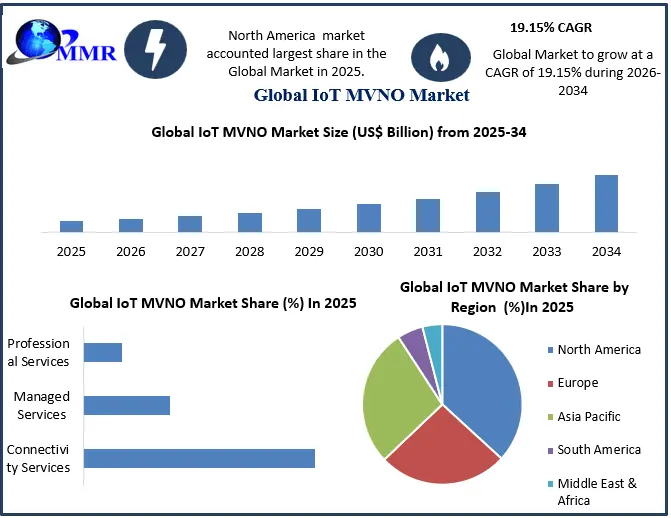
The Global IoT MVNO Market was valued at US$ 9.57 Billion in 2025 and is estimated to reach US$ 11.41 Billion in 2026. The market is expected to grow at a CAGR of 19.15% during the forecast period (2026–2034), reaching US$ 46.34 Billion by 2034.
Key Highlights – Global IoT MVNO Market
• Market Growth: Reaches US$46.34 Bn by 2034, at 19.15% CAGR.
• Dominant Region: North America dominates in 2025.
• Fastest-Growing Region: Asia Pacific grows fastest.
• Dominant Service: Connectivity Services leads with a 64.8% share in 2025.
• Dominant Application: Automotive & Transportation leads with a 28.7% share.
• Key Trend: eSIM orchestration and SGP.32 reshape IoT connectivity. .
Global IoT MVNO Market Overview:
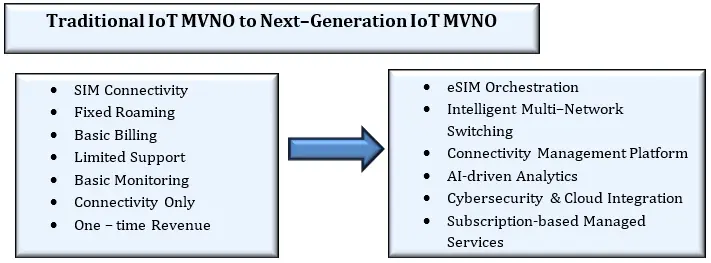
The Global IoT MVNO (Mobile Virtual Network Operator) Market is experiencing rapid transformation as enterprises increasingly demand scalable, secure, and cost-efficient cellular connectivity for connected devices. Modern IoT MVNOs provide comprehensive connectivity solutions such as SIM lifecycle management, connectivity management platforms (CMPs), eSIM orchestration, network security, device management, and analytics. Where traditional MVNOs are only tailored to resell mobile connectivity. The evolved features of modern MVNOs enable seamless deployment and management of millions of IoT devices across multiple countries and mobile networks, making IoT MVNOs essential partners for global IoT deployments.
The rapid expansion of cellular IoT deployments is creating significant growth opportunities for IoT MVNOs. Global cellular IoT connections reached approximately 4.5 billion by the end of 2025 and are projected to approach 7.8 billion by 2031, driven by the widespread adoption of 5G, NB-IoT, LTE-M, and industrial IoT applications. Along with this, NB-IoT and LTE-M connections surpassed 1 billion globally by the end of 2025, highlighting the growing demand for low-power wide-area (LPWA) cellular connectivity across smart utilities, logistics, asset tracking, and smart city deployments.
The proliferation of Industry 4.0, smart manufacturing, connected vehicles, healthcare, logistics, utilities, agriculture, and smart city initiatives is continuously accelerating demand for reliable cellular IoT connectivity. The growing adoption of 5G, NB-IoT, LTE-M, and eSIM technologies, particularly the implementation of the GSMA SGP.32 Remote SIM Provisioning (RSP) standard, is reshaping the market. This enables remote connectivity provisioning, greater network flexibility, and simplified device management. As a result, IoT MVNOs are evolving from connectivity resellers into digital service providers that deliver intelligent connectivity orchestration, cybersecurity, cloud integration, and value-added enterprise solutions.
In the global IoT MVNOs market, North America and Europe remain mature markets due to advanced telecom infrastructure and widespread enterprise IoT adoption; Asia Pacific is emerging as the fastest-growing region, supported by accelerating digital transformation, expanding industrial IoT deployments, and strong investments in next-generation wireless connectivity.
IoT MVNO Market Growth and Share Analysis
To know about the Research Methodology :- Request Free Sample Report
Global IoT MVNO Market Dynamics:
Rising Adoption of Cellular IoT Across Connected Industries Drives Market Growth
The deployment of connected devices across smart manufacturing, logistics, utilities, healthcare, automotive, and smart city applications is increasing significantly, driving the IoT MVNO market at scale. Enterprises increasingly require scalable, secure, and cost-efficient cellular connectivity that can be managed across multiple countries and mobile networks. Cellular low-power wide-area (LPWA) IoT connections surpassed 1 billion globally by the end of 2025, highlighting the accelerating adoption of NB-IoT and LTE-M technologies for large-scale IoT deployments. This growing installed base is creating strong demand for IoT MVNOs that offer multi-network connectivity, centralized device management, and lifecycle services.
Pricing Pressure and Connectivity Commoditization are Limiting Profit Margins continue to restrain the market
Intense competition among IoT connectivity providers and declining data connectivity prices continue to pressure the profitability of IoT MVNOs. Enterprises increasingly expect flexible pricing, global coverage, and value-added services while seeking to reduce connectivity costs, making it difficult for providers that rely solely on SIM resale to differentiate themselves. As a result, many MVNOs are shifting toward platform-based offerings, including connectivity management, security, analytics, and managed IoT services, to maintain sustainable revenue growth.
eSIM Orchestration and GSMA SGP.32 Standard is Creates New Growth Opportunities
The commercialization of the GSMA SGP.32 Remote SIM Provisioning (RSP) standard is transforming the IoT connectivity ecosystem by enabling remote SIM profile management, seamless operator switching, and simplified deployment of large IoT fleets. This evolution allows IoT MVNOs to transition from traditional connectivity providers into eSIM orchestration platforms. This offers intelligent connectivity management, greater network flexibility, and reduced operational costs. The shift is expected to unlock significant opportunities across industrial IoT, connected vehicles, smart utilities, and global asset tracking applications.
Managing Global Regulatory Compliance and Cross-Border Connectivity poses a challenge
The major challenge for IoT MVNOs is ensuring uninterrupted global connectivity while complying with country-specific telecom regulations Many countries impose permanent roaming restrictions, data localization requirements, and telecom licensing obligations, requiring providers to establish partnerships with multiple mobile network operators and maintain compliant connectivity solutions. As IoT deployments become increasingly global, managing network interoperability, security, and regulatory compliance across diverse jurisdictions continues to increase operational complexity for IoT MVNO providers.
Evolution of IoT MVNO Business
Global IoT MVNOs Market Trends:
• Growing Adoption of eSIM Orchestration Platforms is Reshaping the IoT MVNO Ecosystem - The adoption of eSIM technology and the GSMA SGP.32 Remote SIM Provisioning (RSP) standard is transforming the IoT MVNO market. IoT MVNOs are increasingly evolving into eSIM orchestration platform providers, enabling enterprises to remotely provision SIM profiles, switch operators over the air, and centrally manage global IoT deployments, rather than operating solely. This transition reduces operational complexity, enhances network flexibility, and supports seamless cross-border connectivity, making eSIM orchestration a key competitive differentiator for next-generation IoT connectivity providers.
• Shift Toward Value-Added IoT Connectivity Platforms Beyond Traditional SIM Services - IoT MVNOs are going beyond basic cellular connectivity by offering integrated connectivity management platforms (CMPs), device lifecycle management, cybersecurity, analytics, cloud integration, and managed IoT services. Enterprises are seeking end-to-end connectivity solutions rather than standalone SIM connectivity, prompting providers to develop platform-centric business models. This trend is driving strategic partnerships, recurring service revenues, and greater customer retention while enabling IoT MVNOs to differentiate themselves in an increasingly competitive market.
• Emergence of Application-Specific Pricing and Vertical-Focused IoT Solutions - The market is witnessing a gradual shift from traditional per-MB pricing models toward application-specific, usage-based, and subscription-based pricing tailored for industries such as logistics, smart metering, connected healthcare, industrial automation, fleet management, and security. IoT MVNOs are increasingly developing customized connectivity solutions for specific enterprise applications, combining specialized pricing models with value-added services to address unique industry requirements. This evolution is helping providers strengthen customer relationships while supporting the growing adoption of large-scale enterprise IoT deployments.
IoT MVNO Market Segment Analysis:
By Service Type: Connectivity Services Dominate the IoT MVNO Market in 2025
By Service Type segment is divided into Connectivity Services, Managed Services, and Professional Services. Connectivity Services are expected to hold the largest market share, around 64.8% in 2025. This fairly large share owes to the increasing demand for reliable, secure, and cost-effective cellular connectivity across enterprise IoT deployments. IoT MVNOs primarily generate revenue through multi-network SIM connectivity, global roaming, eSIM services, NB-IoT, LTE-M, and 5G connectivity solutions that enable seamless communication for connected devices. The rapid growth of connected vehicles, asset tracking, smart meters, industrial automation, and healthcare monitoring continues to strengthen demand for global connectivity services. Managed Services are expected to witness the fastest growth as enterprises increasingly outsource connectivity management, device lifecycle management, cybersecurity, and analytics to reduce operational complexity. Professional Services maintain steady demand by supporting IoT consulting, deployment, integration, customization, and technical support for enterprise IoT projects.
By Application: Automotive & Transportation Dominates the IoT MVNO Market in 2025
By Application segment is categorized into Automotive & Transportation, Smart Manufacturing & Industrial IoT, Logistics & Supply Chain, Energy & Utilities, Healthcare, Retail, Smart Cities, Agriculture, and Others. Automotive & Transportation accounted for the largest market share of 28.7% in 2025, driven by the growing deployment of connected vehicles, fleet telematics, vehicle tracking, usage-based insurance, V2X communication, and predictive maintenance solutions. Automakers and fleet operators increasingly depend on IoT MVNOs to provide uninterrupted cross-border cellular connectivity, eSIM management, and real-time data transmission across multiple operator networks.

Smart Manufacturing & Industrial IoT is expected to register the fastest growth during the forecast period, supported by accelerating Industry 4.0 adoption, industrial automation, predictive maintenance, and private 5G network deployments. Meanwhile, Logistics & Supply Chain, Energy & Utilities, and Healthcare continue to experience strong demand as organizations expand asset tracking, smart metering, remote patient monitoring, and mission-critical IoT applications requiring secure and scalable cellular connectivity.
Global IoT MVNO Market Regional Analysis:
North America Dominates the Global IoT MVNO Market in 2025
North America accounted for the largest share of the global IoT MVNO market in 2025, supported by its mature telecommunications infrastructure, widespread enterprise IoT adoption, and rapid commercialization of 5G, LTE-M, and NB-IoT technologies. The region benefits from strong digital transformation initiatives across automotive, healthcare, logistics, manufacturing, and smart utility sectors. The United States invested more than US$700 billion in wireless network infrastructure between 1987 and 2024, creating one of the world's most advanced cellular ecosystems for IoT deployment. The presence of leading IoT MVNO providers such as KORE Wireless, Aeris Communications, EMnify (North American operations), and 1NCE also strengthens the regional market. Alongside, investments by major operators including AT&T, Verizon, and T-Mobile in nationwide 5G and IoT connectivity continue to accelerate enterprise IoT adoption across the region.
Europe represents a technologically advanced IoT MVNO market, supported by strong regulatory frameworks, industrial automation, and cross-border connectivity requirements. The European Union Cyber Resilience Act (CRA) and the EU Data Act are encouraging secure IoT deployments while promoting interoperability and data governance across connected devices. The region is witnessing increasing adoption of IoT MVNO services in smart manufacturing, automotive, energy management, and smart city projects. Leading providers including Wireless Logic (UK), 1NCE (Germany), Eseye (UK), and BICS (Belgium) continue to expand their global IoT connectivity platforms through strategic partnerships and eSIM innovations. Europe also benefits from extensive Industry 4.0 initiatives, particularly in Germany, France, and the Nordic countries, where enterprises increasingly require secure multi-network IoT connectivity.
Asia Pacific Registers the Fastest Growth During the Forecast Period
Asia Pacific is projected to witness the highest growth throughout the forecast period as industrialization and 5G infrastructure are increasing at pace. It has the world's largest base of connected IoT devices. Mobile Economy Asia Pacific 2025, 5G is expected to account for nearly half of all mobile connections in the region by 2030. This is creating significant opportunities for IoT MVNOs offering advanced connectivity services. China, Japan, South Korea, and India are investing heavily in smart manufacturing, connected vehicles, digital infrastructure, and industrial IoT under initiatives such as Made in China 2025, Society 5.0 (Japan), and Digital India. Major regional players including Soracom (Japan), NTT Communications, China Mobile IoT, and AIS Business are expanding enterprise IoT connectivity services, while increasing adoption of eSIM and private 5G networks is further accelerating market growth.
South America is emerging as a promising IoT MVNO market, supported by growing investments in digital infrastructure, smart agriculture, mining, logistics, and utility modernization. Countries including Brazil, Chile, and Colombia are witnessing increasing deployment of NB-IoT and LTE-M networks to support asset tracking, precision agriculture, and smart metering applications. According to GSMA, mobile internet adoption across the region continues to rise, creating a favorable environment for enterprise IoT deployments. Regional operators and connectivity providers such as Claro, Telefónica Movistar, and TIM Brasil are expanding IoT connectivity solutions and enterprise services, while governments continue investing in digital transformation programs to improve industrial productivity and public infrastructure.
The Middle East & Africa region is steadily extending its IoT MVNO market through investments in smart cities, digital infrastructure, and industrial diversification. Government-led initiatives such as Saudi Vision 2030, the UAE Smart Cities Programme, and expanding digital economy strategies across Gulf countries are accelerating IoT adoption in utilities, transportation, oil & gas, and public infrastructure. Operators including e& (Etisalat), stc Group, MTN Group, and Vodacom are strengthening enterprise IoT connectivity through NB-IoT, LTE-M, and 5G network expansion. The region is also witnessing growing demand for connected asset monitoring, fleet management, and industrial IoT solutions as governments and enterprises continue investing in digital transformation and critical infrastructure modernization.
Global IoT MVNO Market Recent Developments:
| Date | Recent Development |
| July 2025 | KORE Wireless announced a strategic alliance with TD SYNNEX to expand the global distribution of its IoT connectivity solutions, enabling broader enterprise access to managed IoT connectivity and lifecycle services. |
| April 2025 | Wireless Logic acquired Arqia, one of Brazil's leading IoT connectivity providers, strengthening its presence in South America and expanding its enterprise IoT connectivity portfolio across the region. |
| 2025 | emnify expanded its cloud-native Connectivity Management Platform (CMP) by introducing enhanced AI-driven connectivity management and automation capabilities to simplify global IoT deployments and improve operational efficiency. |
| October 30, 2025 | Transforma Insights released the fifth edition of its Communications Service Provider IoT Peer Benchmarking Report, evaluating leading IoT connectivity providers including 1NCE, KORE, Wireless Logic, Eseye, Soracom, emnify, Vodafone, Verizon, and Deutsche Telekom IoT, highlighting increasing competition in eSIM, CMPs, and managed IoT services. |
| January 2026 | Wireless Logic highlighted SGP.32 eSIM Remote SIM Provisioning, regulatory compliance, and secure global connectivity as the key trends shaping enterprise IoT deployments in 2026, reinforcing the industry's transition toward platform-based IoT connectivity services. |
Global IoT MVNO Market Competitive Landscape:
The global IoT MVNO market revolves around established global connectivity providers, regional MVNOs, telecom operators, and emerging digital connectivity platform providers. They compete through network coverage, eSIM capabilities, connectivity management platforms (CMPs), and value-added IoT services. Competition has shifted beyond traditional SIM connectivity, as leading companies are increasingly offering integrated solutions that include device lifecycle management, cybersecurity, cloud integration, analytics, and IoT application enablement. As enterprises demand seamless cross-border connectivity and centralized management of connected devices, providers are investing in multi-network agreements, platform innovation, and global roaming capabilities to strengthen their competitive positions.
The market is moderately fragmented, with global players such as 1NCE, Wireless Logic, KORE Wireless, Eseye, Soracom, EMnify, Aeris Communications, and BICS competing alongside regional IoT MVNOs and specialized connectivity providers. The global ecosystem comprises 234 dedicated IoT MVNOs, reflecting the increasing number of providers addressing enterprise connectivity requirements. Companies are increasingly differentiating themselves through eSIM orchestration, private 5G connectivity, NB-IoT and LTE-M support. AI-enabled connectivity management platforms rather than competing solely on connectivity pricing. Strategic partnerships with mobile network operators (MNOs), hyperscale cloud providers, and device manufacturers remain central to expanding international coverage and delivering end-to-end IoT connectivity solutions.
Competition is also shifting toward service-based business models as connectivity becomes increasingly commoditized. IoT MVNOs are no longer relying solely on SIM subscriptions; they are generating recurring revenue through managed connectivity services, software platforms, device management, service-level agreements (SLAs), and application-specific connectivity solutions. IoT MVNOs are providing solutions to industries such as automotive, logistics, healthcare, manufacturing, and utilities. Though mergers and acquisitions continue to strengthen market positions, the pace of consolidation has moderated in recent years. Providers are placing greater emphasis on technological differentiation, vertical-specific solutions, and platform innovation. The growing adoption of GSMA's SGP.32 eSIM Remote SIM Provisioning standard is expected to further intensify competition by accelerating the transition from traditional MVNO models toward intelligent global connectivity orchestration platforms.
Global IoT MVNO Market Scope: Inquire before buying
| IoT MVNO Market | |||
|---|---|---|---|
| Report Coverage | Details | ||
| Base Year: | 2025 | Forecast Period: | 2026-2034 |
| Historical Data: | 2020 to 2025 | Market Size in 2025: | 9.57 USD Billion |
| Forecast Period 2026-2034 CAGR: | 19.15% | Market Size in 2034: | 46.34 USD Billion |
| Segments Covered: | by Service Type | Connectivity Services Managed Services Professional Services |
|
| by Subscription Type | Consumer IoT Enterprise IoT |
||
| by Enterprise Size | Large Enterprises Small & Medium-sized Enterprises (SMEs) |
||
| by Application | Automotive & Transportation Smart Manufacturing & Industrial IoT Healthcare Energy & Utilities Retail Smart Cities Agriculture Logistics & Supply Chain Others |
||
IoT MVNO Market, by Region
North America (United States, Canada, and Mexico)
Europe (UK, France, Germany, Italy, Spain, Sweden, Austria, and the Rest of Europe)
Asia Pacific (China, South Korea, Japan, India, Australia, Indonesia, Malaysia, Vietnam, Taiwan, Bangladesh, Pakistan, and the Rest of APAC)
Middle East and Africa (South Africa, GCC, Egypt, Nigeria, and the Rest of ME&A)
South America (Brazil, Argentina Rest of South America)
Global IoT MVNO Market Key Players:
North America
1. KORE Wireless Group, Inc. (U.S.)
2. Aeris Communications, Inc. (U.S.)
3. Hologram, Inc. (U.S.)
4. TEAL Communications, Inc. (U.S.)
5. EMnify GmbH (U.S./Germany)
6. Twilio Inc. (U.S.)
Europe
1. 1NCE GmbH (Germany)
2. Wireless Logic Ltd. (United Kingdom)
3. Eseye Limited (United Kingdom)
4. BICS SA (Belgium)
5. Cubic Telecom Ltd. (Ireland)
6. Onomondo A/S (Denmark)
7. 1oT OÜ (Estonia)
8. Tele2 IoT (Sweden)
9. Transatel S.A.S. (France)
10. Velos IoT Ltd. (United Kingdom)
11. JT Group Limited (Jersey, United Kingdom)
12. BICS Connect Europe (Belgium)
Asia-Pacific
1. Soracom, Inc. (Japan)
2. Tata Communications Ltd. (India)
3. Telit Cinterion (United Kingdom/Global)
4. Ayla Networks (China/U.S.)
5. Bridge Alliance (Singapore)
Middle East & Africa
1. floLIVE Ltd. (Israel)
2. EMnify GmbH (MEA presence)
Frequently Asked Questions:
1. What is driving the growth of the Global IoT MVNO Market?
The market is primarily driven by the rapid adoption of connected IoT devices, increasing demand for secure and scalable cellular connectivity, expansion of 5G, NB-IoT, and LTE-M networks, and growing digital transformation across industries such as automotive, manufacturing, healthcare, logistics, and smart cities.
2. Why are eSIM and GSMA SGP.32 important for the IoT MVNO market?
The GSMA SGP.32 Remote SIM Provisioning (RSP) standard enables remote SIM profile management, seamless operator switching, and simplified deployment of global IoT devices. This allows IoT MVNOs to provide more flexible, scalable, and cost-effective connectivity solutions while reducing operational complexity for enterprises.
3. Which service segment accounted for the largest share of the IoT MVNO Market in 2025?
The Connectivity Services segment accounted for the largest market share in 2025, driven by growing demand for global cellular connectivity, multi-network access, eSIM services, and reliable IoT communication across enterprise applications.
4. Which region dominated the Global IoT MVNO Market in 2025?
North America dominated the market in 2025 due to its advanced telecommunications infrastructure, widespread enterprise IoT adoption, extensive 5G deployment, and the strong presence of leading IoT connectivity providers such as KORE Wireless, Aeris Communications, and major mobile network operators.
5. Who are the leading companies operating in the Global IoT MVNO Market?
Key players in the market include 1NCE GmbH, Wireless Logic Ltd., KORE Wireless Group, Inc., Eseye Limited, EMnify GmbH, Aeris Communications, Inc., Soracom, Inc., BICS SA, Cubic Telecom Ltd., Onomondo A/S, floLIVE Ltd., Hologram, Inc., Tele2 IoT, Transatel S.A.S., and TEAL Communications, Inc. These companies compete through global connectivity coverage, eSIM capabilities, connectivity management platforms, and value-added IoT services.