
Intravenous Iron Drugs Market by Specimen and Application – Global Market Size Estimation, Industry-Wide Analysis, Competitive Landscape Assessment & Long-Term Forecast to 2029
Overview
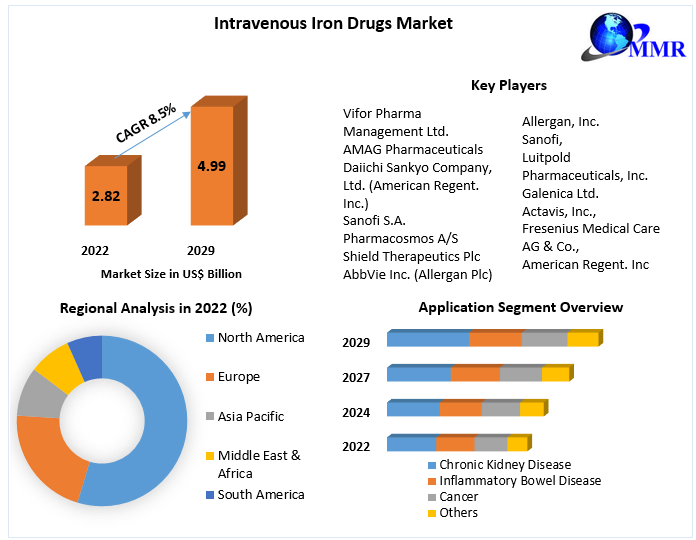
Intravenous Iron Drugs Market size was valued at US$ 2.82 Bn. in 2022 and the total revenue is expected to grow at 8.5% through 2023 to 2029, reaching nearly US$ 4.99 Bn.
Intravenous Iron Drugs Market Overview:
Iron, an essential metal, is involved in a variety of biological activities including heme synthesis, energy metabolism, neurotransmitter generation, myoglobin creation, collagen formation, and immune system activity. Iron deficiency is one of the leading causes of iron deficiency anemia (IDA), which is linked to an increased risk of morbidity and death. According to a 2022 investigation by the Vitamin and Mineral Nutrition Information System, iron deficiency leads to about 30% of anemia in women and children in poor nations. Pierre Blaud developed ferrous sulfate, which became the conventional therapy for IDA in the 19th century.
 To know about the Research Methodology :- Request Free Sample Report
Intravenous Iron Drugs Market Dynamics:
Iron Supplements are available in both the forms intravenous as well as oral form. Oral iron supplements are inferior to intravenous iron preparations, which result in a larger and faster increase in iron and hemoglobin levels. GI side effects, low adherence, poor gastrointestinal absorption, and non-compliance are among the drawbacks of oral supplements.
The growth in the prevalence of iron deficiency, the rise in chronic renal disease patients undergoing dialysis, and the growing diabetes population are all major drivers of the IV iron medicines market. Demand for intravenous iron medicines is driven by an increase in iron deficiency anemia in gynecology, oncology, and gastroenterology, noncompliance with oral treatment, and accurate, quick, and reachable access to IV iron doses.
However, the IV iron medicines market is anticipated to be constrained by a difficult approval procedure, rigorous regulations, medication side effects, nutraceutical options to avoid iron insufficiency, and product pricing.
The COVID-19 Pandemic has hugely affected the manufacturing of pharmaceuticals due to lockdowns and no manpower around the globe. This factor further disrupted the supply chain. However, the market for intravenous iron medicines has grown due to strong attempts by manufacturers and the government to satisfy demand. Furthermore, some studies have linked COVID-19 infection to a higher risk of Acute Kidney Injury (AKI) and Chronic Kidney Disease (CKD), which has driven demand for intravenous iron medications to treat CKD-related anemia. As per the study carried out by National Kidney Foundation, People suffering from COVID-19 are more likely to suffer from Acute Kidney Injuries (AKI) in comparison to non-COVID patients. Further, the health authorities also recommended that COVID-19 patients who have suffered from acute kidney injuries (AKI) must go through regular testing for chronic kidney diseases (CKD). As the risk of chronic kidney disease (CKD) development is higher in COVID-19 patients as compared to others. Hence, these factors are likely to propel the growth of the market.
One of the primary disadvantages of oral iron medications is the possibility of serious side effects. Stomach pains, constipation, lack of appetite, nausea, and vomiting are one of the most common side effects of oral iron treatments. Convulsions, short or fast breathing, lethargy or weakness, fatigue, pale skin, and bluish skin or fingernails all seem to be symptoms of an overdose of oral iron medications. Hence, these factors are estimated to hamper the growth of the market in the forecast period.
Intravenous Iron Drugs Market Segment Analysis:
The Ferric Carboxymaltose (FCM) segment is dominating the Product Type segment of the Intravenous Iron Drugs Market:
In 2022, the Ferric carboxymaltose (FCM) is likely to gain more attractions in the market due to growing applications, higher performance, and lower cost benefits with a revenue share of 46.9%. It's a dextran-free parenteral iron medication designed to replace depleted iron reserves quickly and at large doses. This medication is a stable compound with the advantages of not containing dextran and having a very low immunogenic potential, posing a very minimal risk of anaphylactic responses. Its advantageous features allow for a quick (15-minute) infusion without the need for a test dosage. As a result, the requirement for many tiny dosages and a long infusion duration is reduced. Ferric carboxymaltose (FCM) offers great results in improving the hemoglobin level and further reduces the adverse effects. The FDA clearance of Injectafer in North America, as well as its clearance outside North America under the brand name Ferinject, may be attributed to the substantial increase in the market expansion.
Chronic kidney disease is considered to supplement the growth of the Intravenous Iron Drugs Market.
In 2022, the chronic kidney disease sector led the market for intravenous iron medicines, representing 30.8 % of revenue. The rising frequency of CKD and the high incidence of IDA within CKD patients are responsible for its large market share. In individuals with CKD, IDA is a frequent complication. It is uncommon in the early stages of renal sickness, even though it does occur as the disease progresses and kidney function declines. Anemia is caused by a drop in the number of Red Blood Cells (RBCs) in CKD patients. As the number of people with CKD rises, so does the number of those who have Iron Deficiency Anemia (IDA).
End-stage renal illness and anemia are linked with each other, dialysis patients with kidney failure and kidney transplant recipients both are at high risk for anemia. In comparison to the general population, CKD patients are more likely to develop anemia (15.4 %) (7.6%). Anemia frequency in CKD patients rose from 8.4% to 53.4 % across stages 1 and 5. Hence, chronic kidney disease patients are likely to boost the market expansion in the forecast period.
Regional Insights:
North America is projected to dominate the growth of the market with a market share of 39.9% in 2022. Owing to increased approvals and introductions of new intravenous medicine in the US. The rising frequency of cancer, chronic renal disease, and gastrointestinal problems in the region has also contributed to its dominance. In addition, rising awareness of women's health and the growth in the incidence of celiac disease are two more reasons propelling the market growth. The United States and Canada are among the nations included in the area. In 2021, the United States dominated the intravenous iron medication market in the area
The Asia Pacific is estimated to adhere to market growth in the forecast timeframe. This may be ascribed to significant players' geographic growth in Asia Pacific nations, as well as the development of healthcare infrastructure and government efforts. Furthermore, the increased incidence of IDA in rising economies like China and India has aided industry expansion.
The objective of the report is to present a comprehensive analysis of the Intravenous Iron Drugs Market to the stakeholders in the industry. The past and current status of the industry with the forecasted market size and trends are presented in the report with the analysis of complicated data in simple language. The report covers all the aspects of the industry with a dedicated study of key players that include market leaders, followers, and new entrants.
PORTER, SVOR, PESTEL analysis with the potential impact of micro-economic factors of the market have been presented in the report. External as well as internal factors that are supposed to affect the business positively or negatively have been analyzed, which will give a clear futuristic view of the industry to the decision-makers.
The report also helps in understanding the Intravenous Iron Drugs Market dynamics, structure by analyzing the market segments and project the Intravenous Iron Drugs Market size. Clear representation of competitive analysis of key players by Grade, price, financial position, Grade portfolio, growth strategies, and regional presence in the Intravenous Iron Drugs Market make the report investor’s guide.
Intravenous Iron Drugs Market Scope: Inquire before buying
| Intravenous Iron Drugs Market | |||
|---|---|---|---|
| Report Coverage | Details | ||
| Base Year: | 2022 | Forecast Period: | 2023-2029 |
| Historical Data: | 2018 to 2022 | Market Size in 2022: | US $ 2.82 Bn. |
| Forecast Period 2023 to 2029 CAGR: | 8.5% | Market Size in 2029: | US $ 4.99 Bn. |
| Segments Covered: | by Specimen | Iron Dextran Iron Sucrose Ferric Carboxymaltose Others |
|
| by Applications | Chronic Kidney Disease Inflammatory Bowel Disease Cancer Others |
||
Intravenous Iron Drugs Market, by Region
North America (United States, Canada and Mexico)
Europe (UK, France, Germany, Italy, Spain, Sweden, Austria and Rest of Europe)
Asia Pacific (China, South Korea, Japan, India, Australia, Indonesia, Malaysia, Vietnam, Taiwan, Bangladesh, Pakistan and Rest of APAC)
Middle East and Africa (South Africa, GCC, Egypt, Nigeria and Rest of ME&A)
South America (razil, Argentina Rest of South America)
Key Player:
1. Vifor Pharma Management Ltd.
2. AMAG Pharmaceuticals
3. Daiichi Sankyo Company, Ltd. (American Regent. Inc.)
4. Sanofi S.A.
5. Pharmacosmos A/S
6. Shield Therapeutics Plc
7. AbbVie Inc. (Allergan Plc)
8. Allergan, Inc.
9. Sanofi,
10. Luitpold Pharmaceuticals, Inc.
11. Galenica Ltd.
12. Actavis, Inc.,
13. Fresenius Medical Care AG & Co.,
14. American Regent. Inc
FAQs:
1. What was the market size of Intravenous Iron Drugs Market?
Ans: Intravenous Iron Drugs Market size was valued at 2.82 Billion USD in 2022.
2. Which Product Type segment is expected to dominate the Intravenous Iron Drugs Market during the forecast period?
Ans: The Ferric Carboxymaltose (FCM) segment dominated the market for intravenous iron drugs and held the largest revenue share of 46.9% in 2022 and is predicted to held its dominance during the forecast period due to its increasing application, superior performance, and reduced cost.
3. Which region is expected to dominate the global Intravenous Iron Drugs during the forecast period?
Ans: North America dominated the intravenous iron drugs market with a share of 39.96% in 2022. This is attributable to the increasing application of intravenous iron drugs in cancer research, increasing adoption of low-cost & compact intravenous iron drugs in clinical diagnostics, and infrastructural development of research laboratories.
4. What is the key driving factor for the growth of the Intravenous Iron Drugs Market?
Ans: Key factors that are driving the market growth include the growing prevalence of chronic kidney disease, the increasing number of patients undergoing dialysis, and the rising geriatric population.