
Global Industrial PU Elastomer Market Size by Type, Application, By Processing Technology, Region and Forecast 2034
Overview
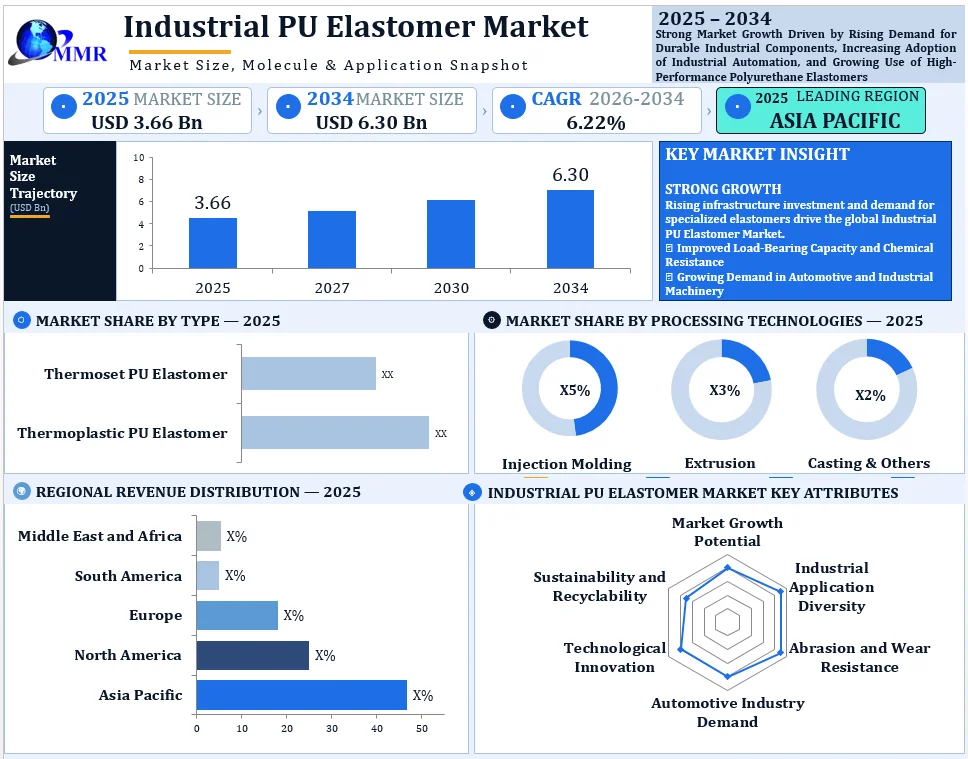
The Global Industrial PU Elastomer Market is valued at USD 3.66 billion in 2025 and is projected to reach USD 6.30 billion by 2034, growing at a CAGR of 6.22% during the forecast period 2026–2034.
Global Industrial PU Elastomer Market Overview:
Polyurethane (PU) elastomers are synthetic polymer materials that combine high elasticity, mechanical strength, and excellent wear resistance. These elastomers are manufactured through reactions between diisocyanates, polyols, and, in some formulations, chain extenders, which determine their physical properties and performance characteristics. Their unique molecular structure consists of hard segments that provide strength and durability and soft segments that offer flexibility and elasticity. Variations in raw materials, chemical formulations, and manufacturing processes enable the production of polyurethane elastomers with specific properties for diverse industrial applications. Industrial PU elastomers offer excellent abrasion resistance, impact resistance, load-bearing capacity, chemical resistance, and flexibility, making them suitable for demanding operating environments. They are widely used in industrial coatings, automotive components, conveyor belts, rollers, wheels, seals, gaskets, mining equipment, material handling systems, and machinery components. Growing demand for durable materials, high-performance industrial components, protective coatings, and wear-resistant solutions supports the expansion of the global industrial PU elastomer market.
Global Industrial PU Elastomer Market Growth and Share Analysis
To know about the Research Methodology :- Request Free Sample Report
Global Industrial PU Elastomer Market: Key Highlights
• Market Growth: The global industrial PU elastomer market reaches USD 3.66 billion in 2025 and is projected to reach USD 6.30 billion by 2034, registering a CAGR of 6.22% during 2026–2034.
• Leading Type Segment: Thermoplastic polyurethane (TPU) elastomers account for 56.67% of the market in 2025, supported by excellent abrasion resistance, flexibility, mechanical strength, and suitability for injection molding and extrusion.
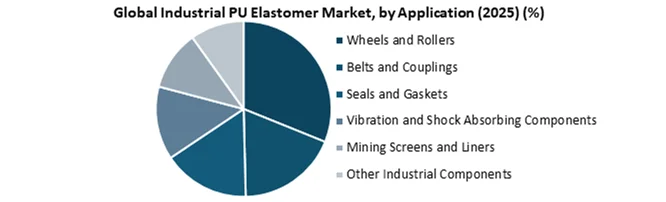
• Dominant Application: Wheels and rollers represent the leading application segment, accounting for 31.11% of application demand in 2025, driven by expanding material handling, warehouse automation, conveyor systems, and industrial equipment applications.
• Leading Regional Market: Asia Pacific dominates the global industrial PU elastomer market, accounting for 46.67% of market share in 2025, supported by industrialization, automotive manufacturing, infrastructure development, and expanding industrial automation.
• Sustainability and Innovation: Manufacturers increasingly focus on recyclable thermoplastic polyurethane, bio-based raw materials, chemical recycling, and improved processing efficiency to enhance environmental performance while maintaining durability and mechanical strength.
Global Industrial PU Elastomer Market Dynamics:
Global Industrial PU Elastomer Market Drivers
The global industrial PU elastomer market experiences strong demand due to the increasing need for durable, abrasion-resistant, and high-performance materials across automotive, mining, construction, material handling, and manufacturing industries. Polyurethane (PU) elastomers offer excellent elasticity, mechanical strength, load-bearing capacity, impact resistance, and resistance to oils and chemicals, making them suitable for industrial wheels, rollers, conveyor belts, seals, gaskets, and machinery components. Their ability to withstand continuous friction, heavy loads, and demanding operating conditions supports their adoption in applications requiring extended service life and reduced maintenance. In 2025, thermoplastic polyurethane (TPU) elastomers account for 56.67% of the industrial polyurethane elastomer market, while wheels and rollers contribute 31.11% of application demand. These applications support market expansion as industries prioritize operational efficiency, equipment reliability, and lower component replacement frequency. Increasing investments in industrial automation, warehouse infrastructure, and advanced manufacturing equipment further strengthen demand for high-performance polyurethane elastomers.
Global Industrial PU Elastomer Market Restraints
The global industrial PU elastomer market faces challenges from fluctuations in raw material prices, particularly for isocyanates, polyols, and other chemical additives used in polyurethane manufacturing. These materials influence production costs, product pricing, and manufacturers' profit margins. Dependence on petrochemical feedstocks exposes producers to changes in crude oil prices, energy costs, transportation expenses, and supply chain disruptions. Additionally, specialized processing equipment, formulation expertise, temperature control, and quality-assurance procedures increase production complexity, particularly for high-performance industrial polyurethane elastomers. Regulatory requirements concerning diisocyanate handling, occupational safety, chemical exposure, and industrial waste management also increase compliance obligations. Small and medium-sized manufacturers face additional pressure from equipment investments and technical requirements, which can limit production expansion and reduce their competitiveness in price-sensitive applications. These factors encourage manufacturers to optimize material consumption, improve production efficiency, and develop cost-effective polyurethane formulations.
Global Industrial PU Elastomer Market Opportunities
The global industrial PU elastomer market presents significant opportunities through expanding industrial automation, increasing electric vehicle production, and rising demand for lightweight, wear-resistant engineering components. Polyurethane elastomers provide a combination of flexibility, durability, abrasion resistance, and mechanical strength that supports their use in automated material handling systems, automotive components, industrial machinery, mining equipment, and protective coatings. Thermoplastic polyurethane elastomers also offer opportunities through injection molding, product customization, and improved material processing, enabling manufacturers to develop components with application-specific properties. In 2025, the Asia-Pacific region accounts for 46.67% of the industrial polyurethane elastomer market, reflecting the importance of its manufacturing industries, automotive production, and industrial infrastructure. Expanding warehouse automation, e-commerce logistics, mining operations, and manufacturing facilities creates additional demand for polyurethane wheels, rollers, conveyor components, vibration-damping products, and industrial seals. Furthermore, research into bio-based polyols, recyclable thermoplastic formulations, and sustainable manufacturing processes creates opportunities to improve environmental performance while maintaining product durability and mechanical efficiency.
Global Industrial PU Elastomer Market Challenges
The global industrial PU elastomer market encounters challenges from competition with conventional rubber, silicone elastomers, thermoplastic materials, and other engineering polymers. Material selection depends on application-specific requirements, including abrasion resistance, temperature stability, chemical compatibility, flexibility, load-bearing capacity, and overall production costs. Although polyurethane elastomers offer several performance advantages, alternative materials remain competitive in applications where lower costs, specialized thermal properties, or established manufacturing processes influence purchasing decisions. Manufacturers must also maintain consistent product quality across different formulations, processing techniques, and operating environments. Precise control over raw material composition, curing conditions, hardness, and manufacturing parameters is essential to achieve the required mechanical properties and product reliability. In addition, increasing environmental expectations create pressure to improve recyclability, reduce manufacturing waste, and explore renewable raw materials. Developing sustainable polyurethane formulations without compromising durability, abrasion resistance, and long-term performance remains an important technical challenge. Addressing these challenges through material innovation, process optimization, and application-specific product development supports long-term competitiveness in the industrial PU elastomer market.
Global Industrial PU Elastomer Market Segment Analysis:
Global Industrial PU Elastomer Market, by Type
The global industrial PU elastomer market is segmented by type into thermoplastic PU elastomers and thermoset PU elastomers.
The thermoset PU elastomer segment maintains a significant market presence due to its cost-effectiveness, high impact strength, excellent resilience, load-bearing capacity, and resistance to oil, grease, and abrasion. These properties support its use in mining equipment, industrial machinery, transportation, material handling, and building and construction. In 2025, demand for durable, wear-resistant, and heavy-duty industrial components supports the adoption of thermoset PU elastomers. The thermoplastic PU elastomer segment benefits from its combination of rubber-like elasticity, flexibility, mechanical strength, and thermoplastic processing advantages. Its excellent abrasion resistance, recyclability, and suitability for injection molding and extrusion support applications in automotive components, industrial rollers, conveyor belts, and cable protection. In 2025, increasing demand for lightweight, durable, and versatile industrial materials strengthens the adoption of thermoplastic PU elastomers.
Global Industrial PU Elastomer Market, by Application
Global Industrial PU Elastomer Market is segmented into Wheels and Rollers, Belts and Couplings, Seals and Gaskets, Vibration and Shock Absorbing Components, Mining Screens and Liners, and Other Industrial Components. Wheels and rollers drive demand through material handling equipment, forklifts, conveyor systems, and warehouse automation, supported by polyurethane's load-bearing capacity and abrasion resistance. Belts and couplings benefit from flexibility, mechanical strength, and reliable power transmission, while seals and gaskets support fluid containment and leakage prevention in hydraulic, pneumatic, and industrial systems. Vibration and shock absorbing components gain traction due to their ability to absorb impact, reduce mechanical vibration, and protect equipment from excessive stress. Mining screens and liners utilize polyurethane's wear resistance and durability in mineral processing, quarrying, and bulk material handling operations. Other industrial components, including wear pads, scraper blades, bushings, and protective bumpers, contribute to market demand through expanding industrial automation, equipment modernization, and the growing need for durable, high-performance components across manufacturing, construction, mining, and material handling industries.
Global Industrial PU Elastomer Market Regional Insights
Asia Pacific leads the global industrial PU elastomer market, accounting for 46.67% of the market share in 2025. The region benefits from rapid industrialization, expanding automotive manufacturing, infrastructure development, and increasing investments in industrial automation. China, India, Japan, and South Korea contribute significantly through automotive production, electronics manufacturing, mining operations, and industrial machinery development. Growing demand for polyurethane rollers, conveyor belts, wheels, seals, gaskets, and abrasion-resistant components supports regional market expansion. The increasing adoption of thermoplastic polyurethane elastomers, coupled with strong manufacturing capabilities and established chemical supply chains, further strengthens Asia Pacific's leading position.
North America maintains a significant position in the global industrial PU elastomer market, supported by advanced manufacturing facilities, automotive production, mining activities, and expanding warehouse automation. The United States and Canada generate demand for high-performance polyurethane elastomers used in industrial rollers, conveyor systems, machinery components, protective coatings, and transportation equipment. Increasing investments in electric vehicle manufacturing, industrial modernization, and material handling infrastructure encourage the adoption of durable, abrasion-resistant, and lightweight elastomer materials. The region also benefits from technological advancements, stringent product quality requirements, and growing demand for specialized polyurethane formulations that improve equipment efficiency and operational reliability.
Europe represents an important regional market for industrial PU elastomers, driven by established automotive manufacturing, advanced industrial engineering, and demand for high-performance materials. Germany, France, Italy, and the United Kingdom support regional consumption through automotive components, industrial machinery, aerospace equipment, and transportation infrastructure. Polyurethane elastomers provide excellent mechanical strength, flexibility, abrasion resistance, and durability, making them suitable for demanding industrial applications. Increasing emphasis on sustainable manufacturing, recyclable thermoplastic materials, resource efficiency, and regulatory compliance encourages manufacturers to develop advanced polyurethane formulations. Growing demand for lightweight components, vibration-damping materials, and wear-resistant industrial products further supports market development across Europe.
South America experiences demand for industrial PU elastomers through expanding mining operations, agricultural machinery, construction activities, and industrial maintenance requirements. Brazil and Argentina contribute to regional demand through manufacturing, transportation, infrastructure development, and agricultural equipment production. Polyurethane elastomers support mining screens, conveyor systems, industrial wheels, rollers, seals, and protective components that require high abrasion resistance and load-bearing capacity. Investments in mineral extraction, industrial equipment modernization, and infrastructure projects create additional opportunities for polyurethane elastomer suppliers. However, fluctuations in raw material prices, economic uncertainty, and dependence on imported specialty chemicals influence purchasing decisions and regional market development.
The Middle East and Africa market benefits from expanding oil and gas operations, mining activities, construction projects, and industrial infrastructure development. Countries such as Saudi Arabia, the United Arab Emirates, and South Africa generate demand for durable polyurethane elastomers in material handling systems, industrial machinery, mining equipment, seals, and protective coatings. Their resistance to abrasion, oils, chemicals, and mechanical stress makes these materials suitable for challenging operating environments. Investments in industrial diversification, logistics infrastructure, mineral processing, and manufacturing facilities create opportunities for market expansion. Increasing demand for reliable equipment components and low-maintenance industrial materials further supports the adoption of industrial PU elastomers across the region.
Global Industrial PU Elastomer Market Competitive Landscape
The global industrial PU elastomer market features a moderately concentrated competitive landscape, with leading chemical manufacturers competing through product innovation, advanced polymer technologies, manufacturing capabilities, and global distribution networks. Key players include BASF SE, Covestro AG, Dow Inc., Huntsman Corporation, LANXESS AG, Lubrizol Corporation, Wanhua Chemical Group, Mitsui Chemicals, Inc., and Tosoh Corporation.
Competition primarily revolves around the development of high-performance thermoplastic and thermoset polyurethane elastomers with enhanced abrasion resistance, mechanical strength, flexibility, chemical resistance, and durability. Established manufacturers leverage integrated raw material supply chains, research and development capabilities, specialized polyurethane formulations, and technical support to meet the requirements of automotive, transportation, mining, construction, and industrial manufacturing applications. Meanwhile, specialized producers such as Era Polymers and Herikon BV differentiate themselves through custom casting, application-specific formulations, and engineered elastomer components.
Product customization, sustainable material development, and regional manufacturing expansion remain important competitive strategies. Manufacturers increasingly focus on recyclable thermoplastic polyurethane, bio-based raw materials, improved processing efficiency, and application-specific elastomer systems. Expanding industrial automation, automotive manufacturing, mining operations, and material handling infrastructure creates opportunities for companies offering durable, wear-resistant, and cost-effective solutions. Competitive success therefore depends on product quality, pricing, supply chain reliability, technological innovation, and the ability to meet evolving industrial performance requirements.
Global Industrial PU Elastomer Market: Recent Developments
| Date | Company | Development | Impact |
|---|---|---|---|
| September 17, 2026 | Covestro | Opens a pilot plant in Leverkusen for the chemical recycling of high-performance Vulkollan polyurethane elastomers. |
Advances circular manufacturing, enables recycling of more than 90% of selected end-of-life material by mass, and supports the development of sustainable industrial elastomers. |
| March 2, 2026 | BASF | Begins commercial production of flame-retardant Elastollan thermoplastic polyurethane grades at its Shanghai facility. |
Strengthens regional TPU supply and supports demand from industrial automation, robotics, electric vehicle charging cables, specialty hoses, and belts. |
| August 4, 2026 | Dow and Adient | Commercially launch SPECFLEX REN polyurethane seating material using ISCC PLUS-certified bio-attributed feedstocks. |
Supports lower-carbon polyurethane production and increases opportunities for renewable feedstock integration in automotive material applications. |
| February 26, 2026 | Rogers Corporation | Launches PORON ReSource30 polyurethane foam containing post-industrial recycled and renewable bio-based content. |
Expands sustainable polyurethane material options and supports manufacturers seeking to reduce reliance on conventional petroleum-based feedstocks. |
| March 10, 2026 | BASF | Introduces commercial production of biomass-balance polyether polyols at its Geismar, Louisiana, facility. |
Expands the availability of polyurethane raw materials with renewable feedstock attribution while maintaining conventional product specifications and processing characteristics. |
Industrial PU Elastomer Market Scope: Inquire before buying
| Industrial PU Elastomer Market | |||
|---|---|---|---|
| Report Coverage | Details | ||
| Base Year: | 2025 | Forecast Period: | 2026-2034 |
| Historical Data: | 2020 to 2025 | Market Size in 2025: | 3.66 USD Billion |
| Forecast Period 2026-2034 CAGR: | 6.22% | Market Size in 2034: | 6.3 USD Billion |
| Segments Covered: | by Type | Thermoplastic PU Elastomer Thermoset PU Elastomer |
|
| by Processing Technology | Injection Molding Extrusion Casting Compression and Other Molding Technologies |
||
| by Application | Wheels and Rollers Belts and Couplings Seals and Gaskets Vibration and Shock Absorbing Components Mining Screens and Liners Other Industrial Components |
||
| by End User-Industry | Automotive and Transportation Oil and Gas Mining and Quarrying Industrial Machinery and Manufacturing Material Handling and Warehousing Construction and Infrastructure Electronics and Electrical Other End-User Industries |
||
Global Industrial PU Elastomer Market by Region
Asia Pacific (China, South Korea, Japan, India, Australia, Indonesia, Malaysia, Vietnam, Taiwan, Bangladesh, Pakistan and Rest of APAC)
Europe (UK, France, Germany, Italy, Spain, Sweden, Austria and Rest of Europe)
North America (United States, Canada and Mexico)
Middle East and Africa (South Africa, GCC, Egypt, Nigeria and Rest of ME&A)
South America (Brazil, Argentina Rest of South America)
Global Industrial PU Elastomer Market Key Players
1. Huntsman Corporation
2. Covestro AG
3. Era Polymers Pty Ltd
4. Mitsui Chemicals, Inc.
5. Notedome Limited
6. LANXESS AG
7. The Lubrizol Corporation
8. Wanhua Chemical Group Co., Ltd.
9. BASF SE
10. INOAC Corporation
11. Headway Group
12. Trelleborg AB
13. Tosoh Corporation
14. Dow Inc.
15. COIM Group
16. Herikon B.V.
17. American Urethane, Inc.
18. Argonics, Inc.
19. Unicast Engineered Urethane Products
20. P+S Polyurethan-Elastomere GmbH & Co. KG
21. Hapco, Inc.
22. TSE Industries, Inc.
23. Polytek Development Corp.
24. Accella Polyurethane Systems
25. Foam Supplies, Inc.
26. Rogers Corporation
27. Saint-Gobain
28. Parker Hannifin Corporation
29. James Walker Group Limited
30. H.B. Fuller Company
31. Asahi Kasei Corporation
32. Arkema S.A.
33. UBE Corporation
34. Recticel NV/SA
35. HEXPOL AB
36. Avient Corporation
37. Dongsung Chemical Co., Ltd.
38. Epaflex Polyurethanes S.p.A.
39. Taiwan PU Corporation
40. Miracll Chemicals Co., Ltd.
41. Kingfa Science & Technology Co., Ltd.
42. Novotex Italiana S.p.A.
43. MCPU Polymer Engineering LLC
44. Reckon Rubber Industries
45. Weaver Industries, Inc.
Frequently Asked Questions:
1. What is the global industrial PU elastomer market size in 2025?
Ans. The global industrial PU elastomer market is valued at USD 3.66 billion in 2025, driven by increasing demand for durable, abrasion-resistant, and high-performance polyurethane elastomers across automotive, mining, construction, manufacturing, and material handling industries.
2. What is the projected market size of industrial PU elastomers by 2034?
Ans. The global industrial PU elastomer market is projected to reach USD 6.30 billion by 2034, supported by industrial automation, expanding manufacturing activities, and increasing demand for wear-resistant industrial components.
3. What is the CAGR of the global industrial PU elastomer market?
Ans. The global industrial PU elastomer market is projected to grow at a CAGR of 6.22% during 2026–2034, driven by demand for high-performance polymer materials, durable machinery components, and advanced polyurethane elastomer solutions.
4. Which type dominates the global industrial PU elastomer market?
Ans. Thermoplastic polyurethane (TPU) elastomers account for 56.67% of the market in 2025. Their flexibility, abrasion resistance, mechanical strength, recyclability, and compatibility with injection molding and extrusion support their adoption across industrial applications.
5. Which application leads the global industrial PU elastomer market?
Ans. Wheels and rollers represent the leading application segment, accounting for 31.11% of application demand in 2025. Their use in forklifts, conveyor systems, warehouse equipment, and automated material handling systems supports segment growth.
6. Which region dominates the global industrial PU elastomer market?
Ans. Asia Pacific leads the global industrial PU elastomer market with a 46.67% market share in 2025. China, India, Japan, and South Korea contribute through automotive manufacturing, industrial machinery production, infrastructure development, and expanding industrial automation.