
Industrial Hearables Market Size: Segmentation by Type, Connectivity Technology, Application, Distribution Chanel, End-User, Region, Industry-Wide Analysis, Competitive Landscape Assessment & Long-Term Forecast to 2032
Overview
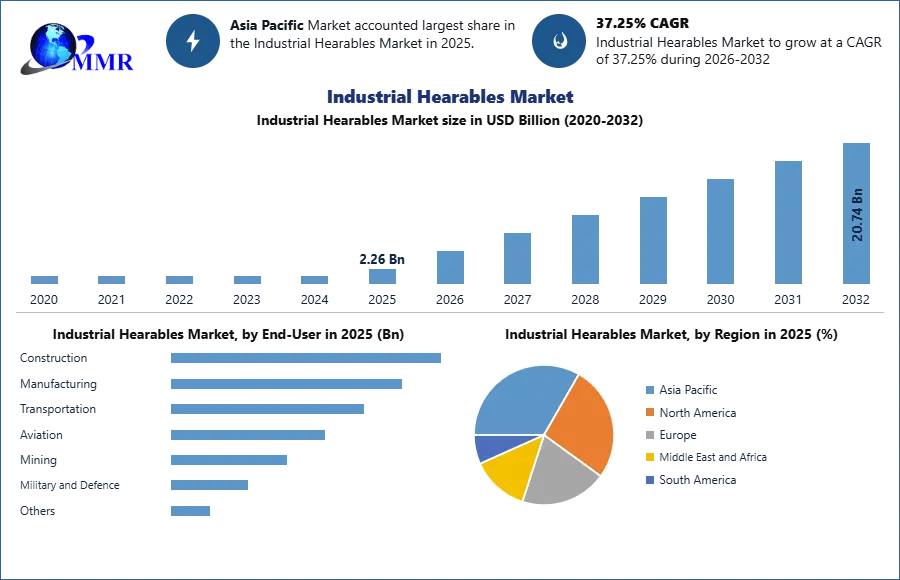
Global Industrial Hearables Market was US$2.26 billion in 2025 and is expected to grow at a CAGR of 37.25% to an estimated revenue of US$ 20.74 Billion by 2032.
Industrial Hearables are a new class of wearable devices that are designed to improve communication and safety in noisy industrial environments. These devices consist of wireless earbuds, earplugs and other types of hearing protection that are equipped with advanced sensors, microphones and software. They can be connected to smartphones, tablets, and other mobile devices, enabling workers to receive real-time information and alerts, communicate with each other, and monitor their health and safety. The global Industrial Hearables Market is expected to grow significantly in the coming years, driven by the increasing adoption of Industry 4.0 technologies, growing safety concerns in industrial workplaces, and the need for improved communication and collaboration among workers. One of the key factors driving the growth of the Industrial Hearables Market is the increasing adoption of wireless technologies and the Internet of Things (IoT) in industrial workplaces.
These technologies enable workers to receive real-time information and alerts on their devices, improving their situational awareness and helping them respond quickly to emergencies. Another factor driving the market growth is the increasing focus on worker safety in industrial workplaces. Industrial Hearables help reduce the risk of hearing loss and other occupational hazards by providing advanced hearing protection and monitoring tools. Also, Industrial Hearables improve communication and collaboration among workers, which can boost productivity and efficiency in industrial workplaces. Workers can use these devices to communicate with each other in noisy environments, share information and instructions, and collaborate on tasks.
To know about the Research Methodology :- Request Free Sample Report
Industrial Hearables Market Dynamics
The Industrial Hearables Market is a dynamic and rapidly growing industry, driven by several key factors. One of the primary drivers of market growth is the increasing demand for advanced hearing protection and monitoring tools in industrial workplaces. With a growing focus on worker safety, there is a rising demand for devices that can help reduce the risk of occupational hazards such as hearing loss. Another significant driver of market growth is the increasing adoption of wireless technologies and the Internet of Things (IoT) in industrial workplaces.
These technologies enable workers to receive real-time information and alerts on their devices, improving their situational awareness and helping them respond quickly to emergencies. Another key driver of the market is the increasing need for real-time communication and collaboration among workers in noisy industrial environments. Industrial Hearables can help overcome the challenges of ambient noise and communication barriers, enabling workers to communicate with each other, share information and instructions, and collaborate on tasks. This can lead to significant productivity gains and operational efficiencies, as well as improved worker safety and job satisfaction.One of the emerging trends in the Industrial Hearables Market is the integration of advanced sensor technologies such as accelerometers, gyroscopes, and biometric sensors.
These sensors can provide valuable data on worker health and safety, enabling employers to identify potential risks and take proactive measures to mitigate them. Studies show that, integrating sensors into hearing protection devices can improve worker safety by detecting potentially hazardous noise levels and providing real-time feedback to workers. Another important trend in the market is the integration of AI and machine learning technologies into Industrial Hearables. These technologies can help optimize device performance, automate data analysis and processing, and provide predictive insights into worker behaviour and safety risks. Research studies found that using AI and sensor technologies in hearing protection devices can reduce the risk of noise-induced hearing loss by up to 30%.
The market also faces several challenges and restraints, such as the high cost of advanced hearable devices, concerns over data privacy and security, limited awareness among industrial workers about the benefits of these devices, the lack of standardization and interoperability among different types of Industrial Hearables, the complexity and cost of integrating these devices into existing infrastructure and workflows and the potential privacy and security risks associated with the collection and processing of sensitive worker data. Additionally, the COVID-19 pandemic has disrupted supply chains and led to a decline in demand for some industrial products, which may impact the growth of the Industrial Hearables Market in the short term.
The market is also threatened by the emergence of new and disruptive technologies, such as augmented reality (AR) and virtual reality (VR) devices that can provide immersive and interactive work environments. While these technologies are still in their early stages of development and adoption, they have the potential to revolutionize the way industrial workers communicate, collaborate, and interact with their environments. The market is also expected to present several opportunities for growth, such as the increasing adoption of Industry 4.0 technologies, the growing trend of remote work and telecommuting, and the rising demand for smart hearing protection devices. As the market continues to evolve and mature, industry players are likely to face intense competition and the threat of new entrants, driving innovation and product differentiation.
Industrial Hearables Market Segment Analysis
By Type: The Industrial Hearables Market is segmented by type into two main categories: earplugs and earmuffs. Earplugs Market are small, discreet devices that are designed to be inserted into the ear canal, providing a tight seal and high level of noise attenuation. They are typically made from soft materials such as foam or silicone and are available in a variety of shapes and sizes to fit different ear sizes and shapes. Earplugs are commonly used in industrial environments where workers are exposed to high levels of noise, such as factories, construction sites, and airports.
Earmuffs, on the other hand, are larger devices that are designed to cover the entire ear, providing a higher level of noise attenuation than earplugs. They consist of two ear cups connected by a headband, which is worn over the head. Earmuffs are typically made from hard materials such as plastic or metal and may also feature additional features such as Bluetooth connectivity or built-in microphones for communication purposes.
Earmuffs are commonly used in industrial environments where workers need a high degree of noise attenuation and protection, such as heavy machinery or construction sites. Other types of Industrial Hearables include electronic earplugs and earbuds, which feature advanced noise cancellation and amplification technologies, as well as communication features such as two-way radios or wireless connectivity. These devices are increasingly popular in industrial settings where workers need to communicate with each other or receive real-time alerts and notifications.
By Technology: The Industrial Hearables Market can also be segmented by technology into three main categories: active noise cancellation, voice recognition, and Bluetooth connectivity. Active noise cancellation technology uses microphones and advanced algorithms to detect and cancel out external noise, providing a more comfortable and effective Hearing Protection Equipment experience for workers in noisy environments. Voice recognition technology uses microphones and software to recognize and interpret spoken commands and other vocal inputs, enabling workers to communicate hands-free and perform tasks more efficiently.
Bluetooth connectivity technology enables wireless communication between Industrial Hearables and other devices, such as smartphones, tablets, and other wearables, enabling workers to access and share information and receive real-time alerts and notifications. Among these, the Bluetooth connectivity segment is expected to hold the highest market share in the coming years. This is due to the increasing popularity and adoption of wireless technologies in industrial environments, as well as the growing demand for seamless and integrated communication and collaboration across different devices and platforms.
By End-User: The Industrial Hearables Market can be segmented by end user into several categories, including construction, manufacturing, transportation, aviation, mining, military, and others. Among these, the manufacturing segment is expected to hold the highest market share in the coming years. This is due to the increasing adoption of smart manufacturing technologies, such as Industry 4.0 and the Internet of Things (IoT), which require workers to be equipped with advanced communication and hearing protection solutions.
Industrial Hearables Market Regional Insights:
Asia-Pacific: The Asia Pacific region is also expected to see significant growth in the Industrial Hearables Market, due to factors such as the increasing adoption of smart manufacturing technologies, rapid industrialization, and growing investments in infrastructure and construction projects. Studies show that the Asia Pacific Industrial Hearables Market is expected to grow at a CAGR of over 14% during the forecast period 2025-2032.
North America: North America is expected to hold the largest market share in the Industrial Hearables Market, due to factors such as the high adoption of advanced technologies in industries such as manufacturing, construction, and transportation, as well as the presence of key market players in the region. According to studies, North America is expected to account for over 40% of the global Industrial Hearables Market in 2032.
Europe: Europe is also a significant market for Industrial Hearables, driven by factors such as the increasing focus on worker safety and health, as well as the growing trend towards automation and digitization in manufacturing and other industries. Reports show that the European Industrial Hearables Market is expected to grow at a CAGR of over 9% during the forecast period 2026-2032.
Recent Developments
January 2024: 3M continued advancing its industrial hearable offerings with updates to the PEL TOR WS Alert XPI line, featuring enhanced Bluetooth communications and environmental sound detection for high‑noise industrial environments. These connected hearing protectors leverage intelligent sound management to help workers focus on speech and alerts while protecting against hazardous noise levels above 110 dB. 3M’s integration of wireless connectivity and smarter noise filtering aligns with broader market growth in industrial hearables that combine safety, situational awareness, and communications. The company also emphasized ergonomic design improvements to boost comfort during extended shifts.
September 2024: Honeywell launched the Howard Leight Sync Series, a new set of industrial hearables with advanced noise‑cancellation and integrated IoT connectivity for real‑time safety monitoring and communication. These solutions are designed for manufacturing and heavy industry, enabling administrators to monitor hearing protection compliance and operational alerts across a factory floor while workers communicate safely in high‑noise environments. Honeywell’s industrial hearable portfolio also expanded to include features like active speech enhancement and cloud connectivity, in line with market trends emphasizing digital and connected safety solutions.
Industrial Hearables Market Scope: Inquire before buying
| Industrial Hearables Market | |||
|---|---|---|---|
| Report Coverage | Details | ||
| Base Year: | 2025 | Forecast Period: | 2026-2032 |
| Historical Data: | 2020 to 2025 | Market Size in 2025: | 2.26 USD Billion |
| Forecast Period 2026-2032 CAGR: | 37.25% | Market Size in 2032: | 20.74 USD Billion |
| Segments Covered: | by Type | Earplugs Earmuffs |
|
| by Connectivity Technology | Bluetooth Wi-Fi DECT Others |
||
| by Application | Industrial Wireless Audio/Voice Application Industrial Noise Cancellation Application |
||
| by Distribution Channel | Supermarkets and Hypermarkets Multi Branded Stores Exclusive Stores Online Stores |
||
| by End-User | Construction Manufacturing Transportation Aviation Mining Military and Defence Others |
||
Industrial Hearables Market, by Region
North America (United States, Canada and Mexico)
Europe (UK, France, Germany, Italy, Spain, Sweden, Austria and Rest of Europe)
Asia Pacific (China, South Korea, Japan, India, Australia, Indonesia, Malaysia, Vietnam, Taiwan, Bangladesh, Pakistan and Rest of APAC)
Middle East and Africa (South Africa, GCC, Egypt, Nigeria and Rest of ME&A)
South America (Brazil, Argentina Rest of South America)
Key players/Competitors profiles covered in the Industrial Hearables Market report in strategic perspective
1. 3M Company
2.Honeywell International Inc.
3.Siemens AG
4.Bose Corporation
5.Eartex Ltd.
6.Sonetics Corporation
7. Sensear Pty Ltd.
8. QuietOn Ltd.
9. NoiseBuster
10.MSA Safety Inc.
11. Phonak AG
12. Motorola Solutions Inc.
13. Walker’s Game Ear Inc.
14.Hultafors Group AB
15.CavCom, Inc.
16.ISOtunes
17. EAR Inc.
18. Firecom
19. DuraForce Inc.
20.Asius Technologies, LLC
21.Earlabs, Inc.
22.Peltor Communications
23.Unitron
24.SHOTHUNT
25.Hearing Components Inc.