India Imitation Jewelry Market Size by Product Type, Jewelry Style, Material, Price Range, Distribution Channel, and Region – Market Share, Industry Trends, Growth Opportunities, Competitive Landscape & Forecast to 2034

8.8%
CAGR (2026-2034)
550 USD Mn.
Forecast Market Size
314
Report Pages
157
Market Tables

Overview

The India Imitation Jewelry Market was valued at USD 550 Million in 2025 and is projected to reach USD 8.8 Million by 2034, growing at a CAGR of 1174.95% during the forecast period 2026–2034.

India Imitation Jewelry Market Definition

The India Imitation Jewelry Market research report assesses the production, distribution channels, retail sales, and online sales of imitation jewelry in India. The driving forces behind this market include a growing consumer preference for affordable jewelry for everyday wear, as well as statements, festivals, weddings, and other occasions, together with changing trends, worth for money, variety, and the increasing influence of social media on consumer behavior, as well as the rising popularity of both traditional and modern jewelry styles.

India Imitation Jewelry Market Overview

The India Imitation Jewelry Market is forecasting to exhibit promising growth in the coming years due to the rising demand for trendy and affordable accessories. These products are also suitable for special events. India Imitation Jewelry Market Report suggests that the demand for jewelry products made from artificial materials is growing due to evolving consumer behavior; availability through organized retailers, fashion counters, and social commerce platforms; and increasing product innovation, social media activity, festive seasons, and wedding seasons. Furthermore, the India Imitation Jewelry Market Trends are influenced by a young consumer base. India Imitation Jewelry Market Outlook is led by earrings due to their high adoption rate and versatility. In addition, the demand for minimalist and modern ethnic jewelry is also gaining traction.

India Imitation Jewelry Market comprises organized players, regional manufacturers, e-commerce platforms, and traditional retailers, leading to a highly competitive environment. India Imitation Jewelry Market Share is significantly contributed to by Voylla, an organized player, helped by its diverse portfolio and wide reach in offline and online counters across the country. India Imitation Jewelry Market analysis mentions that products such as necklaces, earrings, rings, bracelets, bangles, and other accessories appeal to different consumer groups that prioritize ethnicity, luxury, budget, and style. E-commerce platforms, influencer marketing, personalization, value luxury at affordable prices, and design innovation are anticipated to drive India Imitation Jewelry Market Size. Moreover, India Imitation Jewelry Market Growth is supported by the organized retail boom and rising demand for trendy ethnic jewelry.

India Imitation Jewelry Market Size and Share Outlook
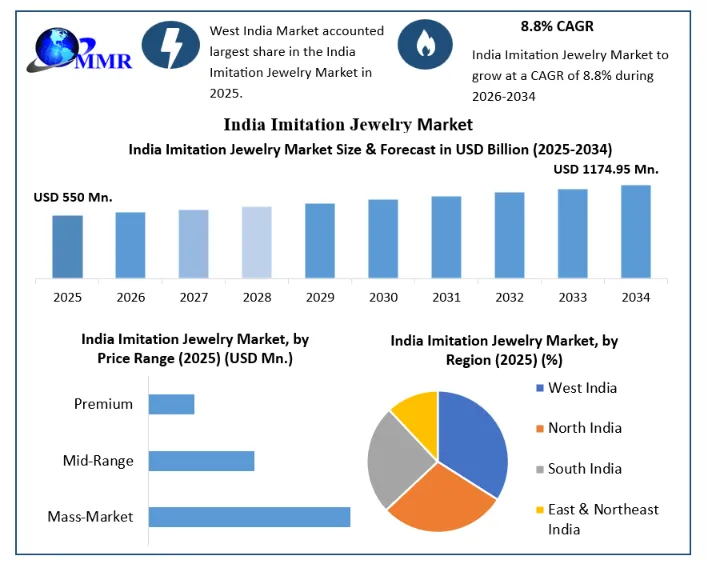
India Imitation Jewelry Market Growth Outlook
To know about the Research Methodology :- Request Free Sample Report

India Imitation Jewelry Market Dynamics

India Imitation Jewelry Market Opportunities

Affordable Fashion and Design Versatility

One of the most attractive aspects of the India Imitation Jewelry Market is that it offers affordability and design versatility. Consumers can buy trendy and beautiful pieces without spending small fortunes on gold, platinum, diamonds, and other precious metals and minerals. They can diversify their jewelry collection and buy different pieces for everyday use, the office, festivals, weddings, parties, and other events. Therefore, there is a need for year-round, seasonal, set jewelry, and other products for occasions. Moreover, there is a demand for affordable luxury collections that promote customer loyalty and recurring sales instead of one-time purchases. Trendy gold-plated jewelry, gold-filled jewelry, American diamonds, beaded jewelry, oxidized jewelry, and other styles are also in demand in the market.

Indian jewelry also has an advantage of offering traditional styles and themes such as kundan jewelry, meenakari jewelry, temple jewelry, and other traditional styles. These motifs could be paired with modern themes and designs to create a unique piece of jewelry that appeals to people’s love for both tradition and innovation.

The Indian Imitation Jewelry Market offers a lucrative opportunity to sell jewelry pieces on social media, influencer marketing channels, and other rapidly evolving verticals. In 2024, it is becoming increasingly common for customers to find pieces on Instagram or other social media platforms, watch short videos about their favorite stars’ jewelry, and purchase them at their favorite online retailers. Therefore, companies that sell jewelry should develop D2C sales opportunities on social media, offer their clients affordable luxury collections, and promote limited-offer, regional-themed jewelry products.

Export Destinations from India

The following Table represents the top 5 major export Designation of Imitation Jewelry from India

Rank County 2021 (in US$ Thousands) 2022 (in US$ Thousands)  2023 (in US$ Thousands)  2024 (in US$ Thousands) 
1 United States 41,654.32 38,376.03 34,420.02 29,912.95
2 United Kingdom 10,866.30 10,986.31 12,535.64 12,023.76
3 France 6,228.49 6,620.40 7,049.75 7,881.41
4 Spain 4,947.58 9,781.48 8,108.76 7,423.12
5 United Arab Emirates 5,924.53 5,502.15 3,959.82 3,232.63

India Imitation Jewelry Market Growth

Young, Fashion Conscious Consumers and Rising Disposable Income

The huge young population of India is one of the significant factors contributing to the growth of the India Imitation Jewelry Market. With the changing attitude toward jewelry as a fashion statement and the evolution of various designs and styles, a young population, that is, below the age of 35, is more influenced by various social factors such as new fashion, changing trends, media personalities, and influencers. This has led to the inclination of the young generation toward experimenting with various designs, colors and materials with imitation jewelry. Moreover, imitation jewelry is more affordable as compared to gold and other precious metal jewelry, enabling consumers to buy multiple pieces within the same budget. In addition, consumers are more willing to upgrade their collection of imitation jewelry due to its lower cost as compared to other jewelry.

Also, an increase in disposable incomes and inclination to spend more on fashion and style of young consumers, along with rising middle-class population will provide a lucrative platform for the growth of the India Imitation Jewelry Market. The growing inclination of the younger generation toward style and fashion has also been enabled with the rising popularity and use of social media platforms such as Instagram, YouTube, Pinterest and others.

These platforms allow young consumers to look for jewelry and related products. This is followed by the ease of availability of products on various digital platforms and social commerce. The short span of fashion trends is also influencing the buying patterns of the young population. Apart from enabling access to a wide range of products, social media is also enabling the popularity of the products through influencers and celebrities. The inclination of the younger generation toward technology and social media is also influencing the demand for fashion jewelry, especially in the lower-tier cities, enabled by rising the rise in e-commerce platforms, offering a wide variety of products.

India Imitation Jewelry Market Trends

Modernization of Traditional Indian Jewelry Designs

The Indian Jewelry Market is witnessing a surge in design creativity and shortened product life cycles as companies adapt to evolving customer preferences and seasonal demands. Moreover, the manufacturers are developing minimalist, light, layered, mixed, and contemporary jewelry to appeal to different demographics, occasions, and fashion statements. This includes utilizing traditional Indian motifs merged with modern patterns to offer diverse design aesthetics and satisfy varied customer needs.

Additionally, technologies are being leveraged for product design and development to meet the changing demands of the Indian Imitation Jewelry Market. For instance, the companies are adopting artificial intelligence, design software, online consultation, and virtual reality to boost their design capabilities and engagement. Similarly, the manufacturers are incorporating circularity, recycled materials, sustainable packaging, coating techniques, and ethical sourcing to align with the rising environmental concerns. Furthermore, the companies are adopting product development strategies involving faster design cycles and diverse design ranges, personalized products, and unique design elements to gain a competitive advantage in the market.

India Imitation Jewelry Market Challenges

Advancing Quality Management and Supply-Chain Resilience

Unlike the main growth drivers and emerging trends, the Indian Jewelry Market is currently confronted with a number of significant challenges that hinder industry progress. One of the main difficulties is aggressive pricing of jewelry from international competitors, primarily China. Reports state that in terms of value, Chinese jewelry accounts for approximately 50% of India’s total imports of imitation jewelry in 2024-25. In addition, some foreign competitors manage to provide their products at significantly lower prices than local suppliers.

Another challenge is the lack of overall organization, which leads to a number of difficulties, including a decrease in the level of differentiation and brand positioning, a lack of economies of scale, and problems with quality control. Finally, a high percentage of companies are concerned about the increasing costs of production resources and operating expenses. According to industry estimates, B2B jewelry prices are projected to rise by 10.2% in 2024. As a result, local manufacturers are faced with the need to balance their prices in order to remain attractive to consumers while maintaining a profit margin. Moreover, the ability to manage import regulations, costs, inventory, and demand is of particular importance to businesses in this industry.

India Imitation Jewelry Market Key Highlights

  • Market size in 2025 – USD 550 Million is indicating strong industry growth
  • Market size in 2034 – USD 1174.95 Million reflecting accelerating market expansion
  • CAGR (2026-2034)– 8.8% Growth during the market period
  • The market is driven by demand for affordable alternatives to precious jewelry.
  • The increasing importance of fashion statements is also contributing to market growth.
  • There are a growing number of trendy and fashionable designs, and more and more people are buying such products.
  • E-commerce platforms facilitate market growth.
  • Demand in the regional market for Tier II and Tier III cities is on the rise.
  • There is a proliferation of ethnic and traditional designs and increased appeal among consumers.
  • Companies are capitalizing on the growth in online sales and are pursuing an omnichannel retail strategy.

India Imitation Jewelry Market Segment Analysis

India Imitation Jewelry Market, by Jewelry Style

The India Imitation Jewelry Market by Jewelry Style is segmented into Traditional & Ethnic Jewelry, Contemporary & Western Fashion Jewelry, Fusion & Indo-Western Jewelry, and Other Jewelry Styles. The Traditional & Ethnic Jewelry segment holds a leading market position, supported by strong demand for Kundan-inspired jewelry, Polki-inspired jewelry, temple jewelry, Meenakari jewelry, and oxidized ethnic jewelry during weddings, festivals, and cultural celebrations. Increasing consumer preference for affordable bridal jewelry, artificial gold jewelry, ethnic necklaces, and designer imitation jewelry sets strengthens segment demand. Contemporary & Western Fashion Jewelry attracts younger consumers through minimalist necklaces, statement earrings, and trendy fashion accessories, while Fusion & Indo-Western Jewelry gains popularity through versatile designs that complement traditional and modern outfits. Growing demand for handcrafted imitation jewelry, lightweight artificial ornaments, and customized fashion jewelry supports India Imitation Jewelry Market growth.
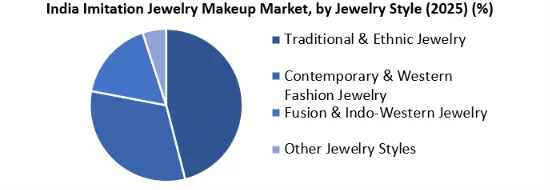
India Imitation Jewelry Market by Jewelry Style

India Imitation Jewelry Market, by Distribution Channel

The India Imitation Jewelry Market by Distribution Channel is segmented into Offline Retail, Online Retail, Non-Store Direct Selling, and Other Distribution Channels. The Offline Retail segment dominates the market, supported by established specialty imitation jewelry stores, general jewelry and fashion accessory stores, apparel and fashion retail chains, department stores, supermarkets, hypermarkets, street markets, bazaars, and independent vendors. Consumers prefer physical stores for product inspection, design comparison, and immediate purchases of bridal imitation jewelry, artificial necklaces, earrings, bangles, and ethnic fashion accessories. Online Retail experiences strong growth through e-commerce marketplaces, brand-owned websites, mobile applications, and social commerce platforms, supported by digital payments, product variety, and competitive pricing. Non-Store Direct Selling supports personalized jewelry sales through independent sellers, exhibitions, and home-based businesses. Increasing adoption of online artificial jewelry shopping, direct-to-consumer jewelry brands, and omnichannel retail strategies creates significant opportunities across the India Fashion Jewelry Market.
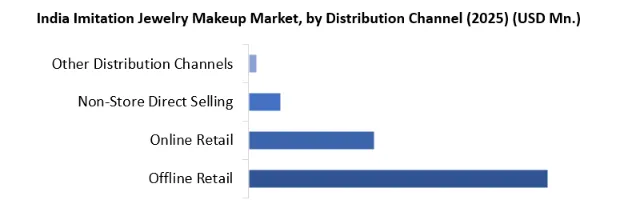
India Imitation Jewelry Market by Distribution Channel

India Imitation Jewelry Market Regional Analysis

West India holds a leading position in the India Imitation Jewelry Market, supported by established artificial jewelry manufacturing hubs, fashion jewelry wholesalers, and organized jewelry distribution networks across Maharashtra and Gujarat. Mumbai serves as a major center for fashion accessories, imitation necklaces, earrings, bracelets, and designer artificial jewelry, while Gujarat supports costume jewelry production, traditional jewelry designs, and wholesale imitation jewelry supply. Strong demand for affordable fashion jewelry, gold-plated imitation jewelry, and bridal jewelry sets strengthens regional market growth. The presence of jewelry manufacturers, local artisans, and expanding online imitation jewelry businesses supports product innovation, domestic sales, and export opportunities.

North India represents a significant market for traditional imitation jewelry, bridal fashion jewelry, ethnic accessories, and artificial gold jewelry, driven by wedding celebrations, festivals, and cultural jewelry preferences. Delhi serves as a major imitation jewelry wholesale and retail hub, while Rajasthan, Uttar Pradesh, and Punjab contribute to demand for Kundan jewelry, Polki-style imitation jewelry, oxidized jewelry, and designer ethnic jewelry sets. Increasing consumer preference for affordable bridal jewelry, statement earrings, artificial necklaces, and customized fashion accessories supports regional market expansion. Growing e-commerce penetration, wedding jewelry collections, and social media-driven fashion trends strengthen the North India imitation jewelry market.

South India experiences steady growth in the India Artificial Jewelry Market, supported by strong cultural demand for temple jewelry, gold-plated imitation ornaments, traditional necklaces, bangles, and ethnic fashion jewelry. Tamil Nadu, Karnataka, Telangana, and Kerala represent important consumer markets, with Chennai, Bengaluru, and Hyderabad supporting organized retail expansion and digital jewelry sales. Increasing demand for one-gram gold jewelry, antique-finish imitation jewelry, bridal jewelry sets, and affordable gold-look accessories strengthens regional consumption. Fashion-conscious consumers and working professionals also support demand for minimalist jewelry, contemporary earrings, lightweight necklaces, and everyday fashion accessories, creating opportunities for regional imitation jewelry manufacturers and retailers.

East and Northeast India offer expanding opportunities in the India Imitation Jewelry Market, supported by rising fashion awareness, increasing disposable income, and growing demand for budget-friendly artificial jewelry and traditional fashion accessories. West Bengal, Odisha, Bihar, Assam, and other northeastern states contribute to regional consumption through festivals, weddings, and changing consumer preferences. Kolkata remains an important center for oxidized silver jewelry, handmade imitation ornaments, traditional earrings, and ethnic jewelry collections. Increasing availability of affordable imitation jewelry, customized fashion accessories, and contemporary jewelry designs through online marketplaces supports market penetration. Growing social commerce adoption and regional jewelry entrepreneurship strengthen the imitation jewelry retail market and create opportunities for small manufacturers, wholesalers, and digital-first jewelry brands.

India Imitation Jewelry Market Competitive Landscape

The Indian Imitation Jewelry Market consists of a large number of players that compete with each other on a variety of factors. The level of competition is high between organized players and unorganized manufacturers and retailers. Some of the major organized brands include Voylla Fashions, Kushal’s Fashion Jewelry, Rubans, Sukkhi, Zaveri Pearls, GIVA, Palmonas, Yellow Chimes, Isharya, and Tribe by Amrapali. Organized players are dominating the market due to a higher focus on branded jewelry collections and wider retail networks. On the other hand, a large number of unorganized regional manufacturers and retailers compete on lower prices and greater design variety.

Fashionable products, bridal and ethnic jewelry collections, lower prices, e-commerce development, social media marketing, faster design development, and product launches define competitive factors for the Indian imitation jewelry market. Many digital-savvy retailers are using innovative marketing strategies and developing e-commerce platforms to promote their jewelry collections and online sale. Moreover, traditional retailers are now focusing on improving brand image, diversifying product collections, targeting young customers, and developing wider retail networks to gain competitive advantage. In general, jewelry price, design variety, brand reputation, social media presence, faster trend adaptation, and omnichannel retail networks determine major competitive factors in India’s imitation jewelry markets.

India Imitation Jewelry Market Scope: Inquire before buying

India Imitation Jewelry Market
Report Coverage Details
Base Year: 2025 Forecast Period: 2026-2034
Historical Data: 2020 to 2025 Market Size in 2025: USD 550 Million
Forecast Period 2026 to 2034 CAGR: 8.8% Market Size in 2034: USD 1174.95 Million
Segments Covered: by Product Type Necklaces & Pendants
Necklaces
Pendants & Chains
Chokers
Others
Earrings
Stud Earrings
Hoop Earrings
Jhumkas & Chandbalis
Drop & Dangle Earrings
Other Earrings
Rings
Bracelets & Bangles
Anklets & Toe Jewelry
Anklets & Payals
Toe Rings
Others
Nose Jewelry
Hair & Head Jewelry
Waist Jewelry
Jewelry Sets
Other Imitation Jewelry
by Jewelry Style Traditional & Ethnic Jewelry
Kundan-Inspired Jewelry
Polki-Inspired Jewelry
Temple Jewelry
Meenakari Jewelry
Oxidized Ethnic Jewelry
Other Traditional Jewelry
Contemporary & Western Fashion Jewelry
Fusion & Indo-Western Jewelry
Other Jewelry Styles
by Material Metal-Based Imitation Jewelry
Brass-Based
Copper-Based
Zinc Alloy-Based
Stainless Steel & Other Base-Metal-Based
Plastic, Acrylic & Resin-Based Jewelry
Glass & Crystal-Based Jewelry
Textile & Thread-Based Jewelry
Other
by Price Range Mass
Mid-Range
Premium
by Distribution Channel Offline Retail
Specialty Imitation Jewelry Stores
General Jewelry & Fashion Accessory Stores
Apparel & Fashion Retail Chains
Department Stores
Supermarkets & Hypermarkets
Street Markets, Bazaars & Independent Vendors
Other Offline Retail
Online Retail
E-Commerce Marketplaces
Brand-Owned Websites & Apps
Social Commerce Platforms
Other Online Retail
Non-Store Direct Selling
Other Distribution Channels

India Imitation Jewelry Market, by Region

West India (Maharashtra, Gujarat, Rajasthan, Goa)

North India (Delhi, Uttar Pradesh, Punjab, Haryana, Uttarakhand, Himachal Pradesh, Jammu & Kashmir)

South India (Tamil Nadu, Karnataka, Kerala, Telangana, Andhra Pradesh)

East & Northeast India (West Bengal, Bihar, Odisha, Jharkhand, Assam, Sikkim, Meghalaya, Manipur, Mizoram, Nagaland, Tripura, Arunachal Pradesh)

India Imitation Jewelry Market Key players

1. Voylla
2. Zaveri Pearls
3. Pipa Bella
4. Sukkhi
5. Tribe by Amrapali
6. Rubans
7. Yellow Chimes
8. Shining Diva
9. Peora
10. YouBella
11. Kushal’s Fashion Jewellery
12. Priyaasi
13. Isharya
14. Joker & Witch
15. Suhani Pittie
16. Zariin Jewelry
17. Rhea
18. Manthan Shop
19. Nakkashi Art
20. Tarinika
21. Satra Fashion Jewellery & Accessories Pvt. Ltd
22. Raj Shringar Jewellery
23. Pyramid & Precious International
24. Shubham Creations
25. Kenway Sartaj Worldwide
26. RGN Export
27. Alex Jewellery Pvt. Ltd
28. Jay Gatral Imitation
29. Tisha Creation
30. Jai Bhavani Imitation Jewellery
31. Indian Imitation Jewellery
32. Archiee Impex
33. V. T. Impex
34. Padmavati Jewellery
35. Trendy Baubles
36. Vardhmaan Jewelers
37. Kanhai Jewels
38. Fashion Galiyara
39. Jewels Galaxy Wholesale
40. R & K Imitation
41. Aatmaj Jewellery
42. Hitaishi-KK Manufacturing Company
43. Arihant Art Jewellery
44. SATRA TRADERS
45. Bombay Fashion Jewellery
46. Sia Impex
47. A. R. Imitation Jewellery
48. Jainam Jewels
49. Bajaj Novelties Pvt. Ltd
50. Vision Crystal
51. Sri Shyam International
52. Lalit Fashions
53. Golden Bangles Stores
54. Salient Art
55. Vipin Jewellers

Frequently Asked Questions

1. What is the India Imitation Jewelry Market size in 2025 and 2034?

The India Imitation Jewelry Market is valued at USD 550 Million in 2025 and is projected to reach USD 1,174.95 Million by 2034, growing at a CAGR of 8.8% during 2026–2034.

2. What are the major growth drivers of the India Imitation Jewelry Market?

Increasing demand for affordable artificial jewelry, fashion accessories, bridal imitation jewelry, traditional ethnic jewelry, and online jewelry shopping drives India Imitation Jewelry Market growth.

3. Which region dominates the India Imitation Jewelry Market?

West India leads the India Imitation Jewelry Market, supported by strong artificial jewelry manufacturing, wholesale jewelry markets, fashion jewelry retail networks, and bridal jewelry demand in Maharashtra and Gujarat.

4. Which segments dominate the India Imitation Jewelry Market?

Traditional & Ethnic Jewelry leads by Jewelry Style, while Offline Retail dominates by Distribution Channel, supported by strong demand for Kundan jewelry, Polki-inspired jewelry, temple jewelry, and affordable fashion accessories.

5. Who are the leading key players in the India Imitation Jewelry Market?

Major India Imitation Jewelry Market key players include Voylla, Zaveri Pearls, Sukkhi, Rubans, Yellow Chimes, Kushal’s Fashion Jewellery, Tribe by Amrapali, Isharya, and Priyaasi, competing through product innovation, affordable jewelry collections, e-commerce expansion, and designer fashion jewelry.

Table of Contents

1. Executive Market Landscape and Industry Overview 1.1 India Imitation Jewelry Market Size (USD Million and Volume in Units), 2025-2034 1.2 Market Definition, Scope, and Key Segmentation Criteria for India 1.3 Overview of India's Imitation Jewelry Industry Structure and Competitive Landscape 1.4 Key Manufacturers, Brands, Wholesalers, Distributors, and Retail Participants in India 1.5 Organized and Unorganized Retail Structures Across India's Imitation Jewelry Market 1.6 Retail Expansion Opportunities Across Emerging Cities and Underserved Consumer Markets 2. India Imitation Jewelry Market Dynamics 2.1 India Imitation Jewelry Market Trends 2.2 India Imitation Jewelry Market DROC Analysis 2.2.1 Drivers 2.2.2 Restraints 2.2.3 Opportunities 2.2.4 Challenges 2.3 PORTER’s Five Forces Analysis 2.3.1 Supplier power 2.3.2 Buyer power 2.3.3 Threat of substitutes 2.3.4 Threat of new entrants 2.3.5 Competitive rivalry 2.4 PESTLE Analysis 3. India Imitation Jewelry Ecosystem and Industry Mapping 3.1 Mapping Raw Material Suppliers, Manufacturers, Wholesalers, Brands, and Retailers 3.2 Roles of Component Suppliers, Jewelry Fabricators, Importers, and Distributors 3.3 Commercial Relationships Between Manufacturers, Retail Chains, Online Platforms, and Dealers 3.4 Participation of Independent Artisans, Small Enterprises, and Organized Jewelry Businesses 3.5 Regional Manufacturing Clusters and Their Connections with Domestic Retail Markets 3.6 Retail Expansion Linkages Across Suppliers, Franchisees, Distributors, and Retail Partners 4. India Imitation Jewelry Value Chain Analysis 4.1 Value Chain Mapping from Raw Material Procurement to Final Retail Sales 4.2 Value Addition Across Jewelry Design, Fabrication, Assembly, Finishing, and Packaging 4.3 Cost and Margin Distribution Across Manufacturers, Wholesalers, Distributors, and Retailers 4.4 Commercial Differences Between Direct Selling and Intermediary-Based Distribution Models 4.5 Opportunities for Supply Chain Integration and Direct-to-Retail Business Relationships 4.6 Value Chain Efficiencies Supporting Profitable Retail Expansion Across Indian Markets 5. India Imitation Jewelry Raw Material and Component Supply Landscape 5.1 Supply Structure for Base Metals, Plastics, Glass, Beads, and Synthetic Stones 5.2 Domestic and Imported Material Sourcing Practices Across Indian Jewelry Manufacturers 5.3 Supplier Availability, Procurement Costs, and Component Quality Across Manufacturing Clusters 5.4 Raw Material Price Fluctuations and Their Impact on Jewelry Production Costs 5.5 Supplier Concentration, Procurement Risks, and Alternative Material Availability in India 5.6 Sourcing Strategies Supporting Retail Expansion and Consistent Product Availability Nationwide 6. India Imitation Jewelry Manufacturing Processes and Technologies 6.1 Manufacturing Process Flow Covering Design, Molding, Assembly, Finishing, and Packaging 6.2 Production Methods Across Metal-Based, Synthetic, Glass, Crystal, and Beaded Jewelry 6.3 Handmade, Semi-Automated, and Automated Manufacturing Practices Across Indian Production Units 6.4 Manufacturing Productivity, Production Lead Times, Quality Control, and Material Utilization 6.5 Adoption of CAD Design, Molding Equipment, Plating, and Precision Finishing Technologies 6.6 Manufacturing Modernization Opportunities Supporting Consistent Quality and Retail Network Expansion 7. India Imitation Jewelry Production Capacity and Utilization 7.1 Installed Manufacturing Capacity Across Major Indian Imitation Jewelry Production Clusters 7.2 Regional Production Output, Capacity Utilization, and Manufacturing Scale Differences Across India 7.3 Production Capacity Distribution Across Product Categories and Material Types 7.4 Manufacturing Infrastructure Requirements Covering Machinery, Labor, Equipment, and Factory Operations 7.5 Planned Capacity Additions and Production Facility Expansion Through 2034 7.6 Manufacturing Capacity Requirements Supporting Organized Retail Growth and Nationwide Distribution 8. India Imitation Jewelry Supply–Demand Balance Analysis 8.1 Domestic Imitation Jewelry Supply and Demand Trends Across Indian Markets 8.2 Regional Production Versus Consumer Demand Across Major Indian Consumption Centers 8.3 Supply–Demand Differences Across Product Types, Materials, and Price Segments 8.4 Import Dependency and Domestic Manufacturing Sufficiency Across Major Product Categories 8.5 Retail Inventory Availability and Supply Gaps Across Urban and Rural Markets 8.6 Projected Supply–Demand Gaps and Production Requirements Supporting Retail Expansion Through 2034 9. India Imitation Jewelry Materials and Product Innovation Landscape 9.1 Adoption of Alternative Materials Across Contemporary Imitation Jewelry Product Categories 9.2 Commercial Opportunities for Lightweight, Durable, and Affordable Jewelry Designs 9.3 Consumer Acceptance of Synthetic Stones, Glass Crystals, Beads, and Mixed Materials 9.4 Product Innovation Trends Across Everyday Wear, Fashion Styling, and Bridal Accessories 9.5 Manufacturing Costs and Availability of Innovative Imitation Jewelry Materials in India 9.6 Product Development Opportunities Supporting Retail Differentiation and Wider Market Penetration 10. India Imitation Jewelry After-Sales and Customer Service Landscape 10.1 After-Sales Services Covering Product Exchanges, Repairs, Cleaning, and Minor Adjustments 10.2 Retailer Policies for Returns, Defective Products, Replacements, and Customer Complaints 10.3 Customer Service Practices Across Organized Stores and Independent Jewelry Retailers 10.4 Warranty Limitations and Product Durability Expectations Across Imitation Jewelry Categories 10.5 Service Quality, Customer Satisfaction, and Repeat Purchase Opportunities Across Retail Formats 10.6 Customer Retention Strategies Supporting Long-Term Retail Expansion Across Indian Markets 11. India Imitation Jewelry Payment and Consumer Financing Landscape 11.1 Consumer Payment Preferences Across Cash, Cards, UPI, and Digital Wallets 11.2 Digital Payment Adoption Across Organized Stores and Independent Jewelry Retailers 11.3 Installment Payment Availability and Financing Practices Across Imitation Jewelry Retail Businesses 11.4 Payment Processing Costs and Transaction Management Requirements Across Retail Channels 11.5 Consumer Spending Patterns Across Mass-Market, Mid-Range, and Premium Jewelry Products 11.6 Payment Infrastructure Development Supporting Retail Expansion Into Emerging Indian Consumer Markets 12. India Imitation Jewelry Returns, Resale, and Secondary Market Landscape 12.1 Product Return Practices Across Online Marketplaces and Physical Jewelry Retail Stores 12.2 Exchange Policies and Replacement Procedures Across Organized Imitation Jewelry Retailers 12.3 Consumer Demand for Pre-Owned and Reusable Imitation Jewelry Products 12.4 Resale Limitations Related to Product Durability, Material Composition, and Brand Recognition 12.5 Reverse Logistics Requirements for Returned Products and Retail Inventory Recovery 12.6 Circular Retail Opportunities Through Reuse, Refurbishment, and Responsible Product Disposal 13. India Imitation Jewelry Pricing and Commercial Benchmarking 13.1 Product-Wise Retail Price Analysis Across Necklaces, Earrings, Rings, and Bracelets 13.2 Price Comparison Across Material Types, Product Complexity, Design, and Craftsmanship 13.3 Retail Pricing Differences Across Mass-Market, Mid-Range, and Premium Product Categories 13.4 Wholesale Pricing, Retail Markups, Distributor Margins, and Promotional Discount Structures 13.5 Regional Average Selling Price Comparison Across Major Indian Jewelry Consumption Markets 13.6 Historical Retail Pricing Trends and Average Selling Price Forecasts Through 2034 14. India Imitation Jewelry Consumption and Domestic Market Demand 14.1 Consumer Demand Patterns Across India's Major Urban, Semi-Urban, and Rural Markets 14.2 Household Spending Patterns Across Income Groups and Consumer Demographic Segments 14.3 Demand for Imitation Jewelry Across Product Types, Materials, and Price Categories 14.4 Consumer Purchasing Activity Across Daily Wear, Weddings, Festivals, and Gifting Occasions 14.5 Regional Consumption Intensity and Per-Capita Spending on Imitation Jewelry Products 14.6 Emerging Consumer Markets Offering Retail Expansion Opportunities Across India 15. India Imitation Jewelry Imports, Exports, and Trade Flows (2020-2025) 15.1 India's Imitation Jewelry Import and Export Value Trends During 2020–2025 15.2 Major Import Sources and Export Destinations for Indian Imitation Jewelry Businesses 15.3 International Trade Flows Across Metal-Based, Synthetic, Glass, and Beaded Jewelry 15.4 Import Dependency, Domestic Production, and Export Competitiveness Across Product Categories 15.5 Trade Corridors Connecting Indian Manufacturers, Importers, Wholesalers, and Retail Buyers 15.6 Cross-Border Sourcing Opportunities Supporting Product Availability and Retail Expansion Across India 16. India Imitation Jewelry Export Competitiveness and Trade Opportunities 16.1 India's Competitive Position Across International Imitation Jewelry Manufacturing and Export Markets 16.2 Export Opportunities Across Fashion Jewelry, Bridal Accessories, and Affordable Statement Jewelry 16.3 Export Competitiveness Based on Manufacturing Costs, Design Capabilities, and Product Quality 16.4 International Market Entry Requirements, Customs Procedures, and Applicable Product Documentation 16.5 Export Distribution Partnerships Connecting Indian Manufacturers with Overseas Retail Buyers 16.6 International Business Opportunities Supporting Production Scale and Retail Brand Development 17. India Imitation Jewelry Distribution Networks and Retail Channels 17.1 Distribution Structure Across Manufacturers, Wholesalers, Distributors, Retailers, and Online Marketplaces 17.2 Retail Channel Coverage Across Jewelry Stores, Fashion Outlets, and Specialty Shops 17.3 Franchise Operations, Authorized Dealers, and Multi-Location Retail Business Models Across India 17.4 Direct-to-Consumer Selling, Omnichannel Retailing, and Marketplace-Based Distribution Strategies 17.5 Channel Economics Covering Retail Margins, Inventory Costs, and Distribution Expenses 17.6 Retail Expansion Strategies Across Tier-One, Tier-Two, Tier-Three Cities, and Rural Markets 18. India Imitation Jewelry Consumer Preferences and Purchasing Behavior 18.1 Consumer Preferences Across Age Groups, Income Levels, Locations, and Lifestyle Segments 18.2 Purchasing Preferences Across Product Types, Materials, Designs, and Price Categories 18.3 Purchase Frequency, Average Transaction Value, and Repeat Buying Behavior Across Consumers 18.4 Consumer Preferences for Physical Stores, E-Commerce Platforms, and Social Commerce 18.5 Influence of Affordability, Design, Durability, and Brand Recognition on Purchase Decisions 18.6 Consumer Insights Supporting Retail Location Selection and Store Expansion Planning 19. India Imitation Jewelry Design Trends and Product Preferences 19.1 Emerging Design Trends Across Traditional, Contemporary, Minimalist, and Statement Jewelry 19.2 Changing Preferences for Lightweight Jewelry, Everyday Accessories, and Occasion-Based Products 19.3 Influence of Social Media, Celebrity Styling, and Regional Fashion Trends 19.4 Growing Demand for Personalized, Customized, and Coordinated Imitation Jewelry Collections 19.5 Regional Design Preferences Across Indian Cultural, Ethnic, and Fashion Markets 19.6 Product Assortment Strategies Supporting Retail Differentiation and Expansion into New Markets 20. India Imitation Jewelry Retail Infrastructure and Store Expansion 20.1 Retail Infrastructure Across Organized Chains, Independent Shops, and Specialty Jewelry Outlets 20.2 Regional Distribution of Retail Stores Across Metropolitan Cities and Emerging Urban Centers 20.3 Store Formats Across High Streets, Shopping Malls, Markets, and Shopping Complexes 20.4 Retail Operating Costs, Sales Productivity, Inventory Turnover, and Revenue Per Store 20.5 Store Network Expansion Across Underserved Cities, Neighborhoods, and Emerging Consumption Centers 20.6 Retail Site Selection, Franchise Development, and Multi-Store Expansion Opportunities Through 2034 21. India Imitation Jewelry Online Retail and Digital Commerce 21.1 Online Retail Structure Across Brand Websites, E-Commerce Marketplaces, and Digital-First Businesses 21.2 Online Sales Trends and Digital Purchasing Preferences Across Indian Consumer Segments 21.3 Adoption of Virtual Try-On, Digital Catalogues, and Personalized Jewelry Shopping Experiences 21.4 Online Order Fulfillment, Returns Management, Packaging, and Customer Service Operations 21.5 Social Commerce Opportunities Across Social Media Platforms and Influencer-Led Selling 21.6 Omnichannel Integration Strategies Supporting Retail Expansion and Wider Customer Reach Across India 22. India Imitation Jewelry Business Models and Commercial Operations 22.1 Comparison of Manufacturing, Wholesale, Franchise, Retail, and Private-Label Business Models 22.2 Commercial Relationships Across Manufacturers, Brand Owners, Distributors, and Retail Operators 22.3 Outsourced Manufacturing Practices and Supplier Partnerships Across Indian Jewelry Businesses 22.4 Capital Requirements, Inventory Ownership, Operating Expenses, and Business Margin Differences 22.5 Advantages of Direct Selling, Franchise Operations, and Brand-Owned Retail Networks 22.6 Scalable Business Models Supporting Profitable Retail Expansion Across Indian Markets 23. India Imitation Jewelry Inventory Management and Working Capital 23.1 Inventory Structure Across Raw Materials, Components, Work-in-Progress, and Finished Products 23.2 Inventory Holding Requirements Across Manufacturers, Wholesalers, Online Sellers, and Retail Stores 23.3 Working Capital Needs Associated with Procurement, Manufacturing, Distribution, and Store Operations 23.4 Inventory Turnover, Replenishment Cycles, Unsold Stock, and Seasonal Demand Management 23.5 Financial Implications of Stockouts, Overstocking, Product Returns, and Discounting Practices 23.6 Inventory Optimization Strategies Supporting New Store Openings and Retail Network Expansion 24. India Imitation Jewelry Manufacturing Technology and Product Innovation 24.1 Adoption of Digital Design, Molding, Plating, Assembly, and Finishing Technologies 24.2 Technology Investments Improving Manufacturing Productivity, Product Consistency, and Operational Efficiency 24.3 Advances in Surface Finishing, Component Assembly, and Automated Quality Inspection Systems 24.4 Digital Production Systems Supporting Customized and Small-Batch Jewelry Manufacturing Requirements 24.5 Technology Partnerships and Modernization Initiatives Across Indian Manufacturing Clusters 24.6 Manufacturing Innovation Supporting Scalable Product Supply and Retail Expansion Plans 25. India Imitation Jewelry Quality Standards and Product Compliance 25.1 Product Quality Requirements Across Metal-Based, Synthetic, Glass, Crystal, and Beaded Jewelry 25.2 Applicable Indian Standards for Product Safety, Material Composition, and Consumer Protection 25.3 Quality Inspection Procedures Covering Coatings, Components, Durability, and Product Defects 25.4 Testing Requirements for Restricted Substances and Potentially Harmful Jewelry Materials 25.5 Product Labeling, Supplier Documentation, and Applicable Retail Compliance Obligations 25.6 Quality Assurance Systems Supporting Customer Trust and Organized Retail Expansion Across India 26. India Imitation Jewelry Sustainability and Responsible Sourcing 26.1 Responsible Procurement Practices Across Metals, Plastics, Glass, Beads, and Synthetic Components 26.2 Opportunities for Recycled Materials and Resource-Efficient Imitation Jewelry Manufacturing 26.3 Environmental Management Practices Covering Plating Chemicals, Manufacturing Waste, and Packaging 26.4 Material Traceability and Supplier Assessment Practices Across Jewelry Supply Chains 26.5 Sustainable Packaging, Waste Reduction, and Responsible Product Disposal Initiatives 26.6 Sustainability Strategies Supporting Brand Differentiation and Long-Term Retail Expansion Across India 27. India Imitation Jewelry Seasonality and Occasion-Based Sales 27.1 Seasonal Sales Patterns Across Indian Weddings, Festivals, Celebrations, and Shopping Events 27.2 Monthly and Quarterly Retail Sales Fluctuations Across Major Indian Consumer Markets 27.3 Revenue Contribution During Wedding Seasons, Festive Periods, and Promotional Campaigns 27.4 Regional Differences in Seasonal Demand Across India's Major Cultural and Consumption Markets 27.5 Seasonal Inventory Planning, Production Scheduling, and Retail Stock Availability Requirements 27.6 Seasonal Store Promotions and Expansion Planning Across High-Demand Indian Retail Locations 28. India Imitation Jewelry Market Risks and Supply Chain Disruptions 28.1 Industry Exposure to Raw Material Price Changes, Currency Fluctuations, and Supply Disruptions 28.2 Supply Risks Associated with Imported Components, Synthetic Stones, Metals, and Packaging Materials 28.3 Impact of Logistics Delays, Supplier Concentration, and Distribution Bottlenecks on Retail Operations 28.4 Financial Risks Related to Inventory Accumulation, Discounting, and Changing Consumer Demand 28.5 Operational Challenges Affecting New Store Openings and Multi-Location Retail Networks 28.6 Risk Mitigation Strategies Covering Supplier Diversification, Inventory Controls, and Distribution Resilience 29. India Imitation Jewelry Regulations and Trade Policies 29.1 Indian Regulatory Requirements Covering Product Safety, Consumer Protection, and Retail Operations 29.2 Applicable Standards for Jewelry Materials, Product Labeling, and Restricted Chemical Substances 29.3 Import Duties, Customs Classification, and Documentation Requirements for Jewelry Components 29.4 Business Registration, Tax Compliance, and Applicable Requirements for Retail Establishments 29.5 E-Commerce Compliance, Consumer Returns, Advertising, and Digital Marketplace Responsibilities 29.6 Regulatory Considerations Affecting Franchise Agreements, Store Openings, and Retail Network Expansion 30. India Imitation Jewelry Investments and Retail Expansion Projects 30.1 Major Investments in Indian Imitation Jewelry Manufacturing, Distribution, and Retail Infrastructure 30.2 Capital Expenditure Trends Across Store Development, Technology, Warehousing, and Production Facilities 30.3 New Store Openings, Franchise Agreements, and Retail Network Expansion Announcements During 2020–2025 30.4 Investment Opportunities Across Emerging Cities, Shopping Centers, and High-Potential Retail Locations 30.5 Planned Retail Expansion, New Distribution Hubs, and Manufacturing Capacity Additions Through 2034 30.6 Investment Priorities Across Store Formats, Digital Commerce, Regional Distribution, and Brand Development 31. India Imitation Jewelry Market: Market Size and Forecast by Segmentation (by Value USD Million and Volume in Units) (2025–2034) 31.1 India Imitation Jewelry Market Size and Forecast, By Product Type 31.1.1 Necklaces & Pendants 31.1.1.1 Necklaces 31.1.1.2 Pendants & Chains 31.1.1.3 Chokers 31.1.2 Earrings 31.1.2.1 Stud Earrings 31.1.2.2 Hoop Earrings 31.1.2.3 Jhumkas & Chandbalis 31.1.2.4 Drop & Dangle Earrings 31.1.3 Rings 31.1.4 Bracelets & Bangles 31.1.5 Anklets & Toe Jewelry 31.1.5.1 Anklets & Payals 31.1.5.2 Toe Rings 31.1.6 Nose Jewelry 31.1.7 Hair & Head Jewelry 31.1.8 Waist Jewelry 31.1.9 Jewelry Sets 31.2 India Imitation Jewelry Market Size and Forecast, By Material 31.2.1 Metal-Based Imitation Jewelry 31.2.1.1 Brass-Based 31.2.1.2 Copper-Based 31.2.1.3 Zinc Alloy-Based 31.2.1.4 Stainless Steel & Other Base-Metal-Based 31.2.2 Plastic, Acrylic & Resin-Based Jewelry 31.2.3 Glass & Crystal-Based Jewelry 31.2.4 Textile & Thread-Based Jewelry 31.3 India Imitation Jewelry Market Size and Forecast, By Price Range 31.3.1 Mass-Market 31.3.2 Mid-Range 31.3.3 Premium 31.4 India Imitation Jewelry Market Size and Forecast, By Jewelry Style (Secondary) 31.4.1 Traditional & Ethnic Jewelry 31.4.1.1 Kundan-Inspired Jewelry 31.4.1.2 Polki-Inspired Jewelry 31.4.1.3 Temple Jewelry 31.4.1.4 Meenakari Jewelry 31.4.1.5 Oxidized Ethnic Jewelry 31.4.2 Contemporary & Western Fashion Jewelry 31.4.3 Fusion & Indo-Western Jewelry 31.5 India Imitation Jewelry Market Size and Forecast, By Distribution Channel 31.5.1 Offline Retail 31.5.1.1 Specialty Imitation Jewelry Stores 31.5.1.2 General Jewelry & Fashion Accessory Stores 31.5.1.3 Apparel & Fashion Retail Chains 31.5.1.4 Department Stores 31.5.1.5 Supermarkets & Hypermarkets 31.5.1.6 Street Markets, Bazaars & Independent Vendors 31.5.2 Online Retail 31.5.2.1 E-Commerce Marketplaces 31.5.2.2 Brand-Owned Websites & Apps 31.5.2.3 Social Commerce Platforms 31.5.3 Non-Store Direct Selling 31.6 India Imitation Jewelry Market Size and Forecast, By Geography 31.6.1 North India 31.6.2 South India 31.6.3 East India 31.6.4 West India 32. Competitive Landscape 32.1 MMR Competition Matrix 32.2 Competitive Positioning of Leading Key Players [Revenue and Market Share(%)] 32.3 Key Players Benchmarking 32.3.1 Company Name 32.3.2 Headquarters 32.3.3 Product Portfolio 32.3.4 Production Capacity (Metric Tons/Year) 32.3.5 Global Distribution Network 32.3.6 Revenue (2025) 32.3.7 Market Share (%) 32.3.8 Price Competitiveness 32.3.9 Profit Margin (%) 32.3.10 Growth Rate (Y-o-Y %) 32.3.11 Employee Strength 32.3.12 Annual Production Volume (Units/Year) 32.3.13 Domestic vs. Export Revenue (%) 32.3.14 Sales Channel Revenue Split (%) 32.3.15 Manufacturing Cost Efficiency (%) 32.3.16 R&D Investment 32.3.17 Patent Portfolio 32.3.18 Certifications & Regulatory Compliance 32.3.19 Geographic Presence 32.4 Market Structure 32.4.1 Market Leaders 32.4.2 Market Followers 32.4.3 Emerging Players 32.5 Mergers and Acquisitions Details 32.6 Recent Key Developments 32.7 Top Company Revenues in 2025 in USD Mn 32.8 Y-o-Y Revenue Growth Rate (%) – 2025 32.9 Company Profit Margin (%) – 2025 33. India Imitation Jewelry Competitive Landscape and Industry Structure 33.1 Competitive Landscape Across Imitation Jewelry Brands, Fashion Jewelry Manufacturers, Costume Jewelry Producers, and Organized Retail Businesses in India 33.2 Competitive Structure Across National Brands, Regional Manufacturers, Independent Artisans, Wholesalers, Importers, and Private-Label Suppliers 33.3 Geographic Distribution of Leading Imitation Jewelry Businesses Across North, South, East, West, and Central India 33.4 Competitive Differences Between Manufacturers, Brand Owners, Wholesale Distributors, Independent Retailers, and Integrated Online Jewelry Businesses 33.5 Industry Structure Across Organized Retail Chains, Independent Jewelry Shops, Traditional Markets, Artisanal Producers, and Social Commerce Sellers 33.6 Retail Expansion Opportunities Across Metropolitan Cities, Tier 1 Cities, Tier 2 Cities, Tier 3 Cities, and Emerging Consumption Markets 34. Leading Imitation Jewelry Companies and Competitive Market Share Positioning 34.1 Market Share Positioning of Leading Indian Imitation Jewelry Brands, Manufacturers, Retailers, and Wholesale Suppliers 34.2 Company-Wise Jewelry Revenue Contribution and Competitive Ranking Across Major Indian Markets, Where Data Is Available 34.3 Competitive Positioning Across Necklaces, Pendants, Earrings, Rings, Bracelets, Bangles, Anklets, and Other Imitation Jewelry Products 34.4 Market Positioning Across Metal-Based, Silver-Based, Synthetic, Glass and Crystal, Textile-Based, and Beaded Jewelry 34.5 Geographic Competitive Positioning Across Major Indian Regions, States, Cities, and Traditional Jewelry Trading Hubs 34.6 Retail Expansion Positioning Based on Store Coverage, Franchise Opportunities, Distribution Partnerships, and Underserved Regional Markets 35. Imitation Jewelry Company Size, Revenue and Financial Performance Benchmarking 35.1 Classification of Leading Imitation Jewelry Businesses Based on Revenue, Employee Strength, Manufacturing Scale, Retail Network, and Business Operations 35.2 Company-Wise Total Revenue, Imitation Jewelry Revenue, Year-on-Year Growth, and Historical Financial Performance During 2020–2025, Where Available 35.3 Revenue Comparison Across Imitation Jewelry Manufacturers, Fashion Jewelry Brands, Wholesale Businesses, Organized Retailers, and Online-First Companies 35.4 Company-Wise Gross Profit, Operating Profit, EBITDA, Net Profit, and Profit Margin Benchmarking, Where Disclosed 35.5 Financial Performance Comparison Based on Raw Material Costs, Manufacturing Expenses, Inventory Management, Retail Operations, and Revenue Generation 36. Imitation Jewelry Manufacturing Footprint, Production Capacity and Facility Mapping 36.1 Company-Wise Manufacturing Facility Locations, Production Hubs, Workshop Infrastructure, and Geographic Manufacturing Presence Across India 36.2 Manufacturing Footprint Across Major Indian Imitation Jewelry Clusters, Wholesale Markets, and Artisan Production Centers 36.3 Company-Wise Installed Manufacturing Capacity, Annual Production Output, and Capacity Utilization, Where Available 36.4 Production Specialization Across Metal-Based, Synthetic, Glass and Crystal, Textile-Based, Beaded, and Mixed-Material Jewelry 36.5 Manufacturing Capabilities Across Handmade, Semi-Automated, Automated, Contract Manufacturing, OEM, ODM, and Private-Label Production 37. Imitation Jewelry Go-to-Market Strategy and Commercial Sales Structure 37.1 Direct-to-Consumer, Wholesale, Distributor-Led, Franchise, Brand-Owned Retail, Marketplace, and Social Commerce Sales Strategies Across Indian Jewelry Businesses 37.2 Company-Wise Domestic Sales Markets, Regional Revenue Distribution, Wholesale Coverage, and Export Presence, Where Disclosed 37.3 Role of Wholesalers, Jewelry Retailers, Specialty Stores, Department Stores, E-Commerce Platforms, and Social Sellers in Commercial Distribution 37.4 Commercial Strategies Followed by Organized Brands, Independent Manufacturers, Artisans, Wholesale Suppliers, and Digital-First Retailers 37.5 Company-Wise Retail Store Networks, Franchise Outlets, Wholesale Partnerships, Online Stores, and Geographic Market Coverage 37.6 Go-to-Market Positioning Based on Pricing, Product Assortment, Sales Channel Mix, Customer Relationships, and Regional Penetration 37.7 Retail Expansion Strategies Covering New Store Openings, Franchise Partnerships, Shop-in-Shop Formats, Local Retail Partnerships, and Omnichannel Development 38. Imitation Jewelry Brand Positioning and Product Portfolio Strategies 38.1 Competitive Brand Positioning Across Mass-Market, Mid-Range, Premium, Occasion-Wear, and Designer Imitation Jewelry Businesses 38.2 Company-Wise Product Portfolio Comparison Across Necklaces, Pendants, Earrings, Rings, Bracelets, Bangles, Anklets, and Other Jewelry Products 38.3 Brand Portfolio Positioning Across Metal-Based, Silver-Based, Synthetic, Glass and Crystal, Textile-Based, and Beaded Materials 38.4 Brand Differentiation Through Design, Craftsmanship, Finish, Lightweight Construction, Affordability, Durability, and Customer Experience 38.5 Private-Label Jewelry Manufacturing Relationships With Indian Retailers, Fashion Brands, Boutique Stores, and E-Commerce Businesses 38.6 Product Portfolio Expansion, Seasonal Collection Launches, Design Innovation, Regional Styling, and Consumer Trend-Based Strategies 38.7 Brand Positioning for Bridal, Festive, Religious, Gifting, Daily-Wear, and Party-Wear Consumer Segments 39. Imitation Jewelry Strategic Alliances and Commercial Partnership Landscape 39.1 Joint Ventures and Strategic Partnerships Between Jewelry Manufacturers, Indian Brands, Retail Chains, Regional Distributors, and Business Groups 39.2 Partnerships Between Raw Material Suppliers, Component Producers, Artisans, Jewelry Manufacturers, Wholesalers, and Retail Distribution Partners 39.3 Strategic Agreements Covering Contract Manufacturing, OEM and ODM Production, Private-Label Supply, and Retail Distribution 39.4 Commercial Partnerships with E-Commerce Marketplaces, Social Commerce Platforms, Fashion Retailers, Logistics Providers, and Digital Payment Businesses 39.5 Technology Partnerships Across CAD-Based Design, 3D Printing, Automated Finishing, Inventory Management, and Digital Retail Systems 39.6 Impact of Strategic Partnerships on Production Capacity, Product Innovation, Distribution Reach, Supply Reliability, and Geographic Expansion 39.7 Franchise, Dealer, and Retail Partnership Models Supporting Expansion Into Tier 2, Tier 3, and Emerging Indian Markets 40. Company Profiles: 55 Key Players 40.1 Profile parameters: Overview; Business Portfolio; Financial Overview; SWOT Analysis; Strategic Analysis; Recent Developments 40.1 Voylla 40.2 Zaveri Pearls 40.3 Pipa Bella 40.4 Sukkhi 40.5 Tribe by Amrapali 40.6 Rubans 40.7 Yellow Chimes 40.8 Shining Diva 40.9 Peora 40.10 YouBella 40.11 Kushal’s Fashion Jewellery 40.12 Priyaasi 40.13 Isharya 40.14 Joker & Witch 40.15 Suhani Pittie 40.16 Zariin Jewelry 40.17 Rhea 40.18 Manthan Shop 40.19 Nakkashi Art 40.20 Tarinika 40.21 Satra Fashion Jewellery & Accessories Pvt. Ltd 40.22 Raj Shringar Jewellery 40.23 Pyramid & Precious International 40.24 Shubham Creations 40.25 Kenway Sartaj Worldwide 40.26 RGN Export 40.27 Alex Jewellery Pvt. Ltd 40.28 Jay Gatral Imitation 40.29 Tisha Creation 40.30 Jai Bhavani Imitation Jewellery 40.31 Indian Imitation Jewellery 40.32 Archiee Impex 40.33 V. T. Impex 40.34 Padmavati Jewellery 40.35 Trendy Baubles 40.36 Vardhmaan Jewelers 40.37 Kanhai Jewels 40.38 Fashion Galiyara 40.39 Jewels Galaxy Wholesale 40.40 R & K Imitation 40.41 Aatmaj Jewellery 40.42 Hitaishi-KK Manufacturing Company 40.43 Arihant Art Jewellery 40.44 SATRA TRADERS 40.45 Bombay Fashion Jewellery 40.46 Sia Impex 40.47 A. R. Imitation Jewellery 40.48 Jainam Jewels 40.49 Bajaj Novelties Pvt. Ltd 40.50 Vision Crystal 40.51 Sri Shyam International 40.52 Lalit Fashions 40.53 Golden Bangles Stores 40.54 Salient Art 40.55 Vipin Jewellers 41. Key Findings 42. Strategic Moves & Industry Outlook 43. Research Methodology

Custom Market Research Services

We Will Customise The Research For You, In Case The Report Listed Above Does Not Meet With Your Requirements