
Hyperloop Market - Industry Structure Evaluation, Demand Drivers Analysis, Regional Growth Analysis and Identification, Competitive Positioning Review & Global Market Size Forecast to 2032
Overview
The Global Hyperloop Market size was valued at USD 7.79 Bn. in 2025 the total market revenue is expected to grow by 8.6% from 2026 to 2032, reaching USD 13.88 Bn by 2032.
Hyperloop Market Overview:
Hyperloop is the third revolution in traveling technologies after road, and air. Hyperloop technology is expected to disrupt traveling technologies and expected to bring the world closer by saving fuel costs, reducing carbon emissions, and mass traveling at near speed of air travel. The Hyperloop market is rapidly evolving, thanks to the potential for high-speed, sustainable transportation significantly drives the Hyperloop Market Growth. With growing investments, technological advancements, and increased public interest, it offers promising opportunities for innovation and market growth. This advanced mode of transportation promises rapid, energy-efficient travel, bolstered. The utilization of renewable energy sources, such as solar and wind power, for propulsion. It helps to a substantial reduction in immediate emissions, signifying a significant leap in the battle against both air pollution and climate change. The Hyperloop market stands as an exciting frontier for sustainable, high-speed transportation innovation and market growth.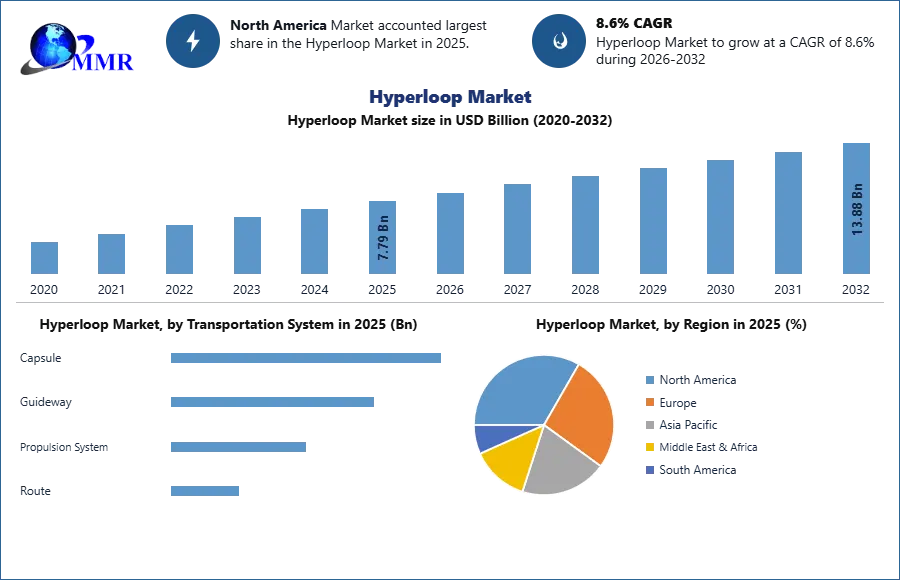 To know about the Research Methodology :- Request Free Sample Report
Competitive Landscape
The Hyperloop Market competitive landscape is characterized by dynamic competition among key players, each vying for market share through product innovation, quality, and customer satisfaction. Hyperloop Market is rapidly growing Hundreds of millions of dollars are being spent on hyperloop technology by companies and countries across the globe. Key objectives of hyperloop companies currently are reducing the cost of technology and making it affordable for mass travel. Though most of the ongoing projects across the globe are for domestic travel, very soon hyperloop is expected to be implemented for international and inter-continent travel. Investment across the globe by governments, companies, and PE firms is making the hyperloop market next-generation travel technology and has been creating opportunities for companies across the globe. The companies focused on continued development despite the initial hype fading, companies are still working on developing Hyperloop technology. For example, TUM Hyperloop, a company affiliated with the Technical University of Munich, is actively building up the technology and expects it to be ready by the end of the decade
Future Scope and Trend of Hyperloop Market:
The future of the Hyperloop market holds significant potential for revolutionizing transportation. In an era characterized by pollution, traffic congestion, and chaotic travel experiences, the Hyperloop emerges as a promising solution to address these challenges. It presents two versions, including Passenger-Only and Passenger-Plus-Vehicle Hyperloop, offering efficient, eco-friendly, and cost-effective mass transit. To unlock its full potential, several avenues for improvement are evident. Firstly, designing stylish, user-friendly stations for seamless passenger boarding and alighting is crucial.
Secondly, enhancing safety features and propulsion systems to accommodate sharp turns and varying altitudes is imperative. The current capsule design, accommodating only 28 passengers, also be optimized for increased capacity. While Hyperloop technology is still in its infancy, its promising triple-crown trajectory suggests room for future advancements. However, realizing this vision necessitates linear routes spanning hundreds of miles and substantial funding, presenting feasibility challenges. Yet, in an industry marked by stagnation, Hyperloop represents a beacon of innovation and a promising step toward modernizing transportation, even if its widespread adoption remains uncertain.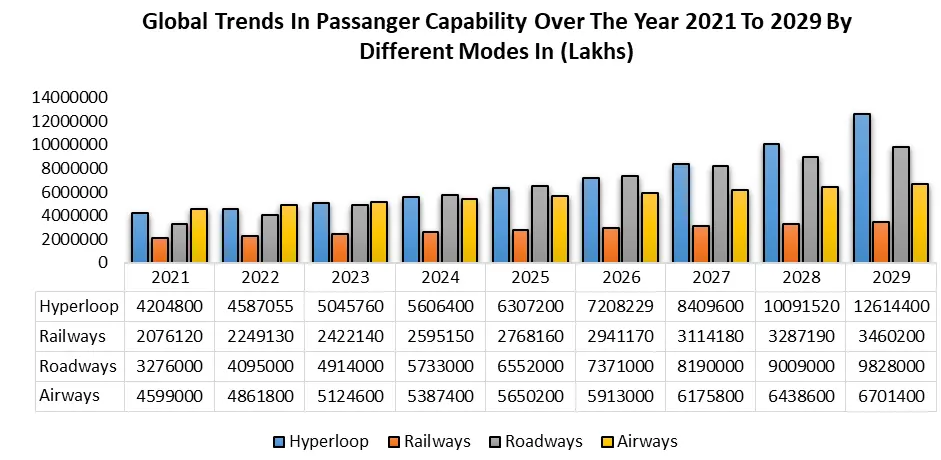
Hyperloop Market Dynamics
Rising Environmental Concerns Drive the Market Growth
Environmental concern is a key driver in the push for the Hyperloop Market. Traditional transportation methods, particularly road and air travel, contribute significantly to carbon emissions and pollution. The sustainability potential of Hyperloop transportation lies in its capacity for energy efficiency and lower emissions per passenger mile. Unlike conventional vehicles relying on fossil fuels, Hyperloop systems harness renewable energy sources like solar and wind power to generate the necessary electricity for propulsion. Eliminating direct emissions from Hyperloop pods, significantly mitigates air pollution, rendering it an appealing choice in the global effort to combat climate change. Reducing the carbon footprint of transportation aligns with global efforts to mitigate environmental impacts. Governments and institutions are placing growing emphasis on sustainable transportation solutions, and the environmentally friendly aspects of Hyperloop are essential in gaining backing and financial support for its advancement. Consequently, Hyperloop technology emerges as a hopeful avenue for tackling environmental issues within the transportation industry.
Reduced Infrastructure Costs Boost the Market Growth
The development of Hyperloop technology is strongly motivated by its potential to drastically lower infrastructure expenses when compared to conventional transportation systems. This promise of significantly reduced infrastructure costs makes Hyperloop technology an immensely attractive prospect. One of its primary cost-saving features is the above-ground nature of the infrastructure. Hyperloop operates on elevated pylons or within low-pressure tubes, eliminating the need for extensive and expensive land acquisition or tunneling, which burdens conventional rail or subway projects.
The modular construction approach used in Hyperloop development simplifies construction processes, lowers labor costs, and minimizes the likelihood of project delays, in stark contrast to the custom-designed, on-site construction common in traditional infrastructure projects. Hyperloop leverages existing transportation corridors, such as highway medians or rail rights-of-way, reducing the necessity for acquiring new land and further curbing expenses. The energy-efficient design of Hyperloop systems decreases operational costs over time and aligns with sustainability goals, making it an economically and environmentally prudent choice. Reduced maintenance needs, thanks to its minimal friction and wear design, translate into long-term cost savings. The involvement of private sector investment in certain Hyperloop projects redistributes financial responsibilities, alleviating the burden on governments and taxpayers. This factor significantly boosts the Hyperloop Market growth.
Regulatory Hurdles Limit the Market Growth
Regulatory hurdles pose a substantial challenge to the successful deployment of Hyperloop technology. These challenges encompass a wide array of complexities, ranging from safety certification to international coordination. First and foremost, ensuring the safety of passengers and cargo within the high-speed, low-pressure environment of Hyperloop systems demands the development of rigorous safety standards and certification processes, a task that lacks established precedents. Additionally, Hyperloop projects often span multiple jurisdictions and countries, requiring the harmonization of regulations on a global scale.
This international dimension adds layers of complexity to the regulatory landscape. Moreover, defining legal liability in the event of accidents or incidents involving Hyperloop systems becomes a delicate issue necessitating careful consideration. The approval processes for Hyperloop infrastructure, involving land use, environmental impact, and property rights, further contribute to regulatory intricacies. To navigate these hurdles successfully, stakeholders must collaborate to develop comprehensive, forward-thinking regulatory frameworks that prioritize safety, environmental sustainability, and public acceptance while accommodating the unique attributes of Hyperloop technology. Such frameworks will be pivotal in ensuring the safe and efficient integration of Hyperloop systems into the global transportation network.
Innovation and technological advancement create lucrative growth opportunities for the Market Growth
Innovation and technological advancement are the lifeblood of the Hyperloop Market, offering a multitude of lucrative growth opportunities Hyperloop technology undergoes ongoing evolution, it unveils ground-breaking achievements in propulsion, materials, safety systems, and energy efficiency. These strides in innovation hold the potential to offer swifter, safer, and more economically efficient transportation solutions, rendering Hyperloop an increasingly appealing choice for governments, investors, and commuters. This continual pursuit of progress fosters fierce competition among companies competing to create superior Hyperloop systems that could transform the transportation landscape.
The economic ramifications of such technological advancements are substantial, as they generate high-tech employment opportunities, stimulate research and development endeavors, and drive investments in related sectors, renewable energy. Safety concerns are addressed through innovation, and public trust in the technology grows, further boosting Market growth. The Hyperloop ecosystem, comprised of start-ups, research institutions, and established players, thrives in this environment, collectively driving the advancement and proliferation of this ground-breaking transportation mode.
Hyperloop Market Challenges: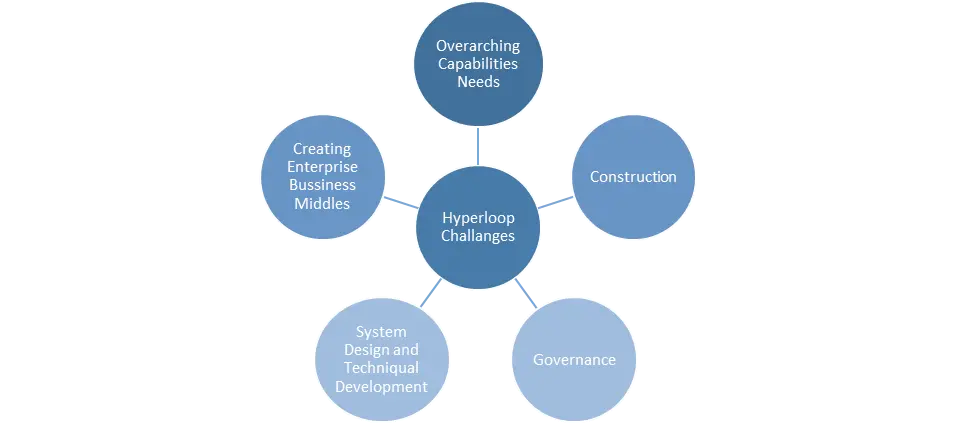
1. Overarching Capability Needs
Overarching capability needs refers to capabilities that are fundamental to delivering most aspects of the hyperloop system. This includes management of risks to project delivery. Risks will not only relate to technology readiness levels but also to manufacturing readiness levels and supply chain readiness levels. During conversations about the project, the team was encouraging the Hyperloop developers to outline what they considered to be the biggest risks to delivery.
2. Creating Enterprising Business Models
This capability area is focused on securing finance, which could come from a variety of private and public sources. Without financing, infrastructure projects simply cannot happen. Related to financing is the building of the business case, which forms the basis of investment.
Hyperloop Market Segment Analysis:
Hyperloop Market Regional Insight
North America dominates the Hyperloop Market due to the presence of key technology developers such as Virgin Hyperloop and HyperloopTT, strong investments in advanced transportation technologies, and early-stage testing projects in the United States. Government support for next-generation transportation infrastructure and research collaborations with universities and technology companies are also contributing to the region’s leadership.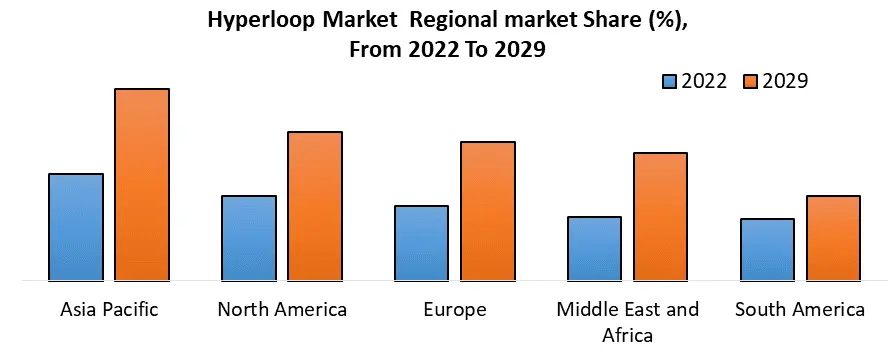
Hyperloop Market Recent Developments (2025-2026):
| Exact Date | Company | Development | Impact |
|---|---|---|---|
| 06 March 2026 | Hardt Hyperloop | The Dutch hyperloop pioneer Hardt B.V. was officially declared bankrupt by a court in the Netherlands following a failure to secure bridge financing. | This represents a significant setback for the European hyperloop ecosystem, potentially stalling projects like the Veendam test facility and Italian cargo corridors. |
| 11 February 2026 | HyperloopTT | The company announced the successful advancement of its full-scale passenger capsule testing within controlled vacuum environments to validate safety protocols. | These tests provide critical empirical data on aerodynamic drag and energy efficiency, moving the technology closer to commercial certification standards. |
| 30 October 2025 | Nevomo / DP World | Nevomo signed a definitive agreement with DP World and Deendayal Port Authority to deploy MagRail technology at a major port in India. | The pilot program aims to revolutionize port logistics by enabling autonomous, magnetic freight movement within existing railway infrastructure. |
| 02 October 2025 | TransPod | TransPod formed a strategic partnership with Algoma Steel and Supreme Steel to manufacture precision guideways for the Edmonton–Calgary TransPod Line. | This collaboration secures 2 million tonnes of Canadian steel and local manufacturing expertise, essential for the construction of the FluxJet ultra-high-speed system. |
Hyperloop Market Scope: Inquiry Before Buying
| Hyperloop Market | |||
|---|---|---|---|
| Report Coverage | Details | ||
| Base Year: | 2025 | Forecast Period: | 2026-2032 |
| Historical Data: | 2020 to 2025 | Market Size in 2025: | 7.79 USD Billion |
| Forecast Period 2026-2032 CAGR: | 8.6% | Market Size in 2032: | 13.88 USD Billion |
| Segments Covered: | by Transportation System | Capsule Guideway Propulsion System Route |
|
| by Carriage Type | Passenger Cargo / Freight |
||
| by Speed | More than 700 km/h Less than 700 km/h |
||
| by Component | Tube / Infrastructure Propulsion System Capsules / Pods Control Systems Communication Systems |
||
| by Application | Passenger Transportation Freight Transportation |
||
| by Technology | Magnetic Levitation (Maglev) Air-based Levitation / Air Bearings |
||
| by End-User | Government Transportation Authorities Logistics & Freight Companies Private Transport Operator |
||
Hyperloop Market by Region
North America (United States, Canada, and Mexico)
Europe (UK, France, Germany, Italy, Spain, Sweden, Austria, and the Rest of Europe)
Asia Pacific (China, South Korea, Japan, India, Australia, Indonesia, Malaysia, Vietnam, Taiwan, Bangladesh, Pakistan, and the Rest of APAC)
Middle East and Africa (South Africa, GCC, Egypt, Nigeria, and the Rest of ME&A)
South America (Brazil, Argentina Rest of South America)
Hyperloop Market Key Players:
- Hyperloop Transportation Technologies (HyperloopTT)
- Virgin Hyperloop (Virgin Red Limited)
- TransPod Inc.
- Hardt B.V. (Hardt Hyperloop)
- Zeleros Global SL
- The Boring Company
- Space Exploration Technologies Corp. (SpaceX)
- Nevomo (formerly Hyper Poland)
- Dinclix GroundWorks
- Swisspod Technologies
- AECOM
- Arrivo Corporation
- TuTr Hyperloop
- TUM Hyperloop
- Swisspod Technologies
- Eurotube
- DGWHyperloop
- Hyperloop Italia
- Hyper Chariot
- Delft Hyperloop
- Swissloop
- Next Prototypes e.V. (NEXT Hyperloop)
- Avishkar Hyperloop
- Quintrans Hyperloop
- Tesla, Inc.