
Hydrogen Fuel Cells Market - Industry Structure Evaluation, Demand Drivers Analysis, Growth Analysis and Identification, Competitive Positioning Review & Market Size Forecast to 2032
Overview
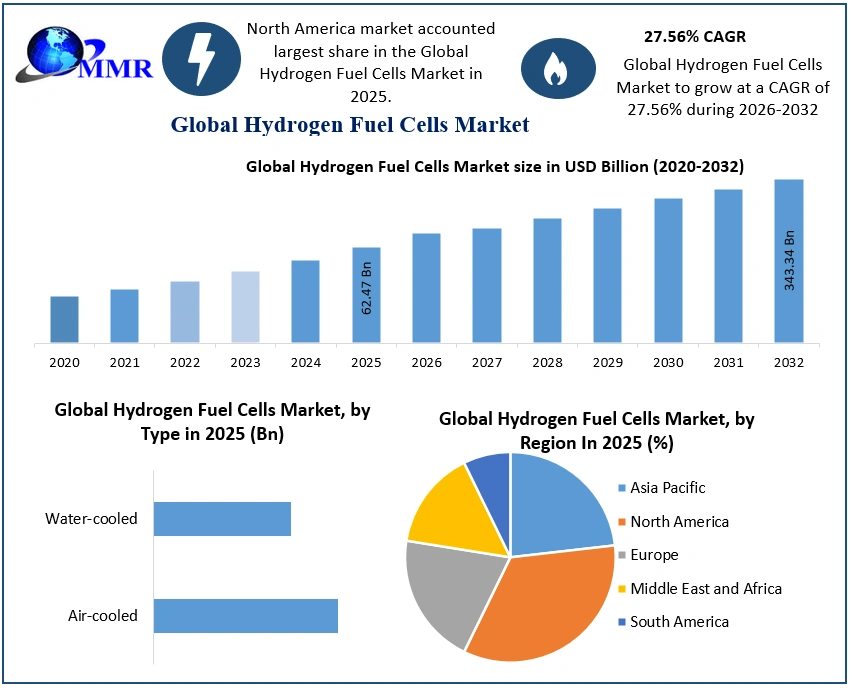
The Hydrogen Fuel Cells Market size was valued at USD 62.47 Billion in 2025 and the total Hydrogen Fuel Cells revenue is expected to grow at a CAGR of 27.56% from 2025 to 2032, reaching nearly USD 343.34 Billion by 2032.
Hydrogen Fuel Cells Market Overview
Hydrogen fuel cells represent cutting-edge technology in the field of clean energy. These cells generate power through a chemical reaction between hydrogen and oxygen. The only byproduct of this reaction is water, making it an environmentally friendly energy source. The core appeal of hydrogen fuel cells lies in their high energy efficiency and low environmental impact. Growing awareness of environmental issues and the need for sustainable energy solutions drive demand for hydrogen fuel cells.
Industries seeking to reduce their carbon footprint, as well as consumers looking for environmentally friendly transportation options, are driving the adoption of fuel cell technology and boost the Hydrogen Fuel Cells Market growth.
To know about the Research Methodology:- Request Free Sample Report
Investments in hydrogen infrastructure, including production, storage, and distribution facilities, play a crucial role in driving market growth. Governments, industry players, and investors are collaborating to build a robust hydrogen ecosystem, enabling widespread adoption of fuel cell technology across various sectors.
Hydrogen Fuel Cells Market Dynamics
Increasing Demand for Clean Energy Solutions:
The hydrogen fuel cells market is being propelled by the global shift towards cleaner and more sustainable energy sources. With mounting concerns over climate change and air pollution, there is a growing emphasis on reducing carbon emissions across various sectors such as transportation, manufacturing, and power generation. Hydrogen fuel cells offer a promising solution as they produce electricity through a chemical reaction between hydrogen and oxygen, emitting only water vapor and heat as byproducts.
As governments worldwide implement stricter regulations and policies to curb emissions, the demand for hydrogen fuel cells is expected to surge. Additionally, the renewable nature of hydrogen production through methods like electrolysis using renewable energy sources further enhances its appeal, driving the growth of the market.
Increasing Demand for Fuel Cell Vehicles: There is high technology investment from many regions in automotive manufacturers for the development of fuel vehicle cells because it is expected higher growth in the Hydrogen Fuel Cells Market in the forecasted year. Many countries are already using hydrogen-fueled vehicles Japan, South Korea, and China are in use of it. Japan has also promoted it into Tokyo Olympics 2021 to run fuel cell cars and buses. Hyundai, Toyota, and Honda are companies that are already working on them. Hydrogen fuel-cell electric vehicles (FCEVs) use both a fuel cell stack and a smaller battery for energy storage. The battery in an FCEV is typically much smaller than a BEV’s. It is used primarily for power buffering during acceleration, other peak power demands, and regenerative braking.
However, both vehicles face challenges related to their energy storage systems. BEVs face challenges related to the battery’s limited range and the time required to recharge it, as well as the cost and weight of the battery. FCEVs face challenges related to the cost and complexity of the fuel cell stack and hydrogen storage and the limited availability of hydrogen refueling infrastructure.
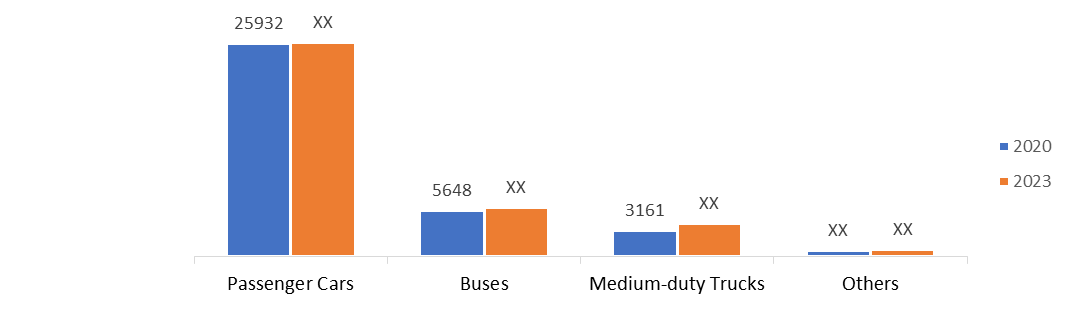
Table: Hydrogen Fuel Cell Vehicles in Action
| Vehicle Type | Description |
| Forklifts | Over 50,000 hydrogen fuel cell electric forklifts are operational nationwide. These forklifts offer quick refueling times and lower maintenance requirements, enhancing warehouse productivity. |
| Public Transit Buses | The Alameda-Contra Costa Transit District (AC Transit) in California operates a fleet of thirty-six (36) 40-foot fuel-cell electric buses alongside battery electric buses, reducing CO2 emissions. |
| Seaport Vehicles and Vessels | Hydrogen fuel cell technologies show promise in seaports, aiming to replace diesel engines in various applications like port drayage trucks, yard tractors, cargo handlers, and marine vessels. |
These real-world examples demonstrate the diverse applications of hydrogen fuel cell technology, ranging from warehouse operations to public transportation and seaport activities.
Technological Advancements and Cost Reduction:
The advancements in hydrogen fuel cell technology, coupled with ongoing research and development efforts, are driving down costs and improving the efficiency of the Hydrogen Fuel cell industry growth. Innovations in catalyst materials, membrane electrode assemblies, and system designs have led to more durable, efficient, and affordable fuel cell systems. These advancements are making hydrogen fuel cells increasingly competitive with traditional energy sources, such as internal combustion engines and batteries.
The U.S. Department of Energy's Hydrogen and Fuel Cell Technologies Office (HFTO) drives research, development, and demonstration efforts to advance hydrogen and fuel cell technologies, fostering innovation and paving the way for a clean, equitable energy future. HFTO's initiatives have led to significant progress, including the development of the U.S. National Clean Hydrogen Strategy and Roadmap, the reduction in heavy-duty transportation fuel cell costs by approximately 10%, and achieving world records in solar-to-hydrogen conversion efficiency.
Additionally, HFTO has played a crucial role in reducing the cost of producing hydrogen from renewables and advancing delivery and storage technologies. These efforts align with the H2Scale initiative, aiming for affordable hydrogen production, storage, distribution, and utilization across various sectors.
The economies of scale, increased production volumes, and streamlined manufacturing processes are further contributing to cost reductions. As the technology continues to mature and production costs decline, hydrogen fuel cells are becoming more accessible to a broader range of applications, including automobiles, buses, trucks, stationary power generation, and even maritime and aerospace industries, fostering robust growth in the Hydrogen Fuel Cells Market.
Advancement in Renewable Energy Integration to Create Lucrative Opportunities for Market Growth
Innovations in natural gas technology are revolutionizing the energy industry, particularly in advancing hydrogen fuel cell technology. By leveraging natural gas, which is abundant and cost-effective, significant advancements have been made in hydrogen production, storage, and distribution. The integration of natural gas in fuel cells enhances efficiency, reduces costs, and improves durability, making fuel cells a more practical and sustainable energy solution. This synergy between natural gas and hydrogen fuel cells offers a pathway to a cleaner and more efficient energy ecosystem, with potential applications in transportation, power generation, and energy storage. Hydrogen Fuel Cells Market, the existing infrastructure for natural gas facilitates the adoption of hydrogen fuel cells, accelerating the transition to a low-carbon future. As the world embraces the shift towards clean energy alternatives, the collaboration between natural gas and hydrogen fuel cell technology presents promising opportunities for addressing environmental challenges and shaping a more sustainable energy landscape.
As nations worldwide strive to reduce carbon emissions and transition towards cleaner energy sources, hydrogen fuel cells offer a promising solution. These cells efficiently store and deliver energy generated from renewable sources like wind and solar power. By leveraging electrolysis, excess renewable energy is converted into hydrogen, which then be stored and utilized in fuel cells to produce electricity when needed. This capability not only enhances the reliability and stability of renewable energy systems but also facilitates the decarbonization of various sectors such as transportation, manufacturing, and heating. As the demand for sustainable energy solutions continues to grow, the integration of hydrogen fuel cells with renewable energy sources presents a compelling opportunity to accelerate the global transition towards a low-carbon future.
Expansion in Transportation Applications to Boost the Market
Another key opportunity in the hydrogen fuel cells market is the expansion of its applications in transportation. With increasing concerns over air pollution and the depletion of fossil fuels, there is a growing demand for alternative propulsion technologies in the automotive sector. Hydrogen fuel cells offer a clean and efficient solution, emitting only water vapor as a byproduct and providing longer driving ranges compared to battery electric vehicles. Hydrogen fuel cell vehicles refueled quickly, addressing range anxiety and infrastructure limitations associated with battery-electric vehicles. Beyond passenger cars, hydrogen fuel cells also hold potential for heavy-duty transportation such as buses, trucks, and trains, offering a scalable solution for decarbonizing the transportation sector. As governments worldwide implement stringent emission regulations and provide incentives for zero-emission vehicles, the expansion of hydrogen fuel cell applications in transportation presents a lucrative opportunity for market growth and innovation.
Hydrogen Fuel Cells Market Restraining Factors
The risk of explosion during pneumatic testing of hydrogen fuel cells stems from hydrogen's flammability and the potential for pressure exceeding design specifications, leading to rupture. This poses hazards such as ballistic fragments, pressure waves, and explosive fires that restrain the Hydrogen Fuel Cells Market. TotalShield provides shield enclosures and rooms to mitigate these risks, tailored to fuel cell size. Proper ventilation is vital to prevent suffocation from hydrogen displacement, with oxygen sensors for early detection. Their products also support emergency procedures, including evacuation plans and fire safety equipment. Flexible framing systems accommodate additional safety features like fire suppression and monitoring, ensuring comprehensive protection during testing and operation.
Despite promising advancements in fuel cell technology, the infrastructure required to support widespread adoption, such as hydrogen refueling stations, distribution networks, and storage facilities, remains underdeveloped. This deficiency poses a considerable barrier to the expansion of hydrogen fuel cell vehicles and other applications. Without a comprehensive infrastructure in place, consumers may hesitate to invest in hydrogen-powered vehicles due to concerns about accessibility and convenience. Additionally, the high costs associated with building such infrastructure further exacerbate the issue, deterring potential investors and hindering market growth.
Hydrogen Fuel Cells Market Segment Analysis:
Based on Type: The Hydrogen Fuel Cells Market is segmented into Air-Cooled and water-cooled Type. The Air-Cooled segment held the largest market share accounting for xx.4% in 2025. Air-Cooled is dominating the market of hydrogen fuel gas because it is very efficient and cost-effective and also promotes hydrogen fuel cell growth. In many parameters, air-cooled is better than water-cooled like high power density, high efficiency, flexibility in packaging, simplicity and low cost, customers and manufacturers are more attracted by air-cooled hydrogen fuel cells and which is leading to market growth.
Based on the Application: The Hydrogen Fuel Cells Market is segmented into Stationary, Transport, and Portable. The transportation sector is dominating the market because the use of hydrogen fuel cells is more prevalent in cars, trucks, buses, etc. Japan, China, and South Korea are the primary users of hydrogen fuel cell vehicle technology, like Toshiba, Toyota is the main leader in fuel cell technology. Government subsidies for fuel-cell electrical vehicles in Asian countries created opportunities for the private sector.

Hydrogen Fuel Cells Market Regional Insight
Regional insights into the hydrogen fuel cells market reveal significant trends across North America, Europe, Asia-Pacific, and the rest of the world. In 2025, the North America market held the largest market share, with anticipated substantial growth driven by robust research and development initiatives and government incentives. The US dominates this market, while Canada shows the fastest growth. Key countries analyzed include the US, Canada, Germany, France, the UK, Italy, Spain, China, Japan, India, Australia, South Korea, and Brazil.
In Asia-Pacific, the Hydrogen Fuel Cells Market holds the second-largest share, buoyed by population growth and rising disposable incomes. The region's pursuit of cleaner energy sources due to environmental concerns positions hydrogen fuel cells as a preferred option, with China leading the market and India exhibiting the highest growth rate. In addition, the growing economies are also known as the world's worst polluters. Hydrogen fuel cells are the best solution for other traditional fossil fuel energy sources for reducing carbon emissions and efficiently meeting energy needs.
Europe anticipates the fastest growth rate through 2032, propelled by expanding user bases and the rapid commercialization of fuel-cell electric vehicles (FCEVs). Continued growth hinges on substantial investments in refueling networks by public and commercial entities. Germany leads this Hydrogen Fuel Cells Market, while the UK demonstrates the fastest growth.
Hydrogen Fuel Cells Market Scope: Inquire before buying
| Global Hydrogen Fuel Cells Market | |||
|---|---|---|---|
| Report Coverage | Details | ||
| Base Year: | 2025 | Forecast Period: | 2026-2032 |
| Historical Data: | 2020 to 2025 | Market Size in 2025: | USD 62.47 Bn. |
| Forecast Period 2026 to 2032 CAGR: | 27.40% | Market Size in 2032: | USD 343.34 Bn. |
| Segments Covered: | by Type | Air-cooled Water-cooled |
|
| by Technology | Proton Exchange Membrane Fuel cells Phosphoric Acid Fuel Cells Solid Oxide Fuel Cells Others |
||
| by Application | Transportation Portable Stationary |
||
Hydrogen Fuel Cells Market, by Region
North America (United States, Canada and Mexico)
Europe (UK, France, Germany, Italy, Spain, Sweden, Austria and Rest of Europe)
Asia Pacific (China, South Korea, Japan, India, Australia, Indonesia, Malaysia, Vietnam, Taiwan, Bangladesh, Pakistan and Rest of APAC)
Middle East and Africa (South Africa, GCC, Egypt, Nigeria and Rest of ME&A)
South America (Brazil, Argentina Rest of South America)
Hydrogen Fuel Cells Key players
1. Audi AG (Ingolstadt, Germany)
2. BMW Group (Munich, Germany)
3. Daimler AG (Stuttgart, Germany)
4. General Motors Company (Detroit, Michigan, USA)
5. Honda Motors Co. Ltd. (Tokyo, Japan)
6. Hyundai Motor Group (Seoul, South Korea)
7. Toyota Motor (Toyota City, Japan)
8. Volvo Group (Gothenburg, Sweden)
9. Ballard Power System Inc. (Burnaby, British Columbia, Canada)
10. Plug Power (Latham, New York, USA)
11. Nikola (Phoenix, Arizona, USA)
12. Hyzon Motors (Rochester, New York, USA)
13. AFC Energy (Cranleigh, Surrey, UK)
14. Advent Technology (Boston, Massachusetts, USA)
15. MAN SE (Munich, Germany)
Frequently Asked Questions:
1] What is the growth rate of the Global Hydrogen Fuel Cells Market?
Ans. The Global Hydrogen Fuel Cells Market is growing at a significant rate of 27.40 % during the forecast period.
2] Which region is expected to dominate the Global Hydrogen Fuel Cells Market?
Ans. North America is expected to dominate the Hydrogen Fuel Cells Market during the forecast period.
3] What is the expected Global Hydrogen Fuel Cells Market size by 2032?
Ans. The Hydrogen Fuel Cells Market size is expected to reach USD 343.34 Bn by 2032.
4] Which are the top players in the Global Hydrogen Fuel Cells Market?
Ans. The major top players in the Global Hydrogen Fuel Cells Market are Audi AG, BMW Group and others.
5] What are the factors driving the Global Hydrogen Fuel Cells Market growth?
Ans. The versatility of hydrogen fuel cells enables their use in a wide range of applications, including transportation, stationary power generation, and portable devices. As technology continues to mature, new and innovative applications for fuel cells are emerging, further driving market growth.
6] Which country held the largest Global Hydrogen Fuel Cells Market share in 2025?
Ans. The United States held the largest Hydrogen Fuel Cells Market share in 2025.