Harvester Heads Market by Type, De-limbing Knives, Feed Seed, Application and Region – Global Market Size Estimation, Industry-Wide Analysis, Competitive Landscape Assessment & Long-Term Forecast to 2032

4.51%
CAGR (2026-2032)
4.94 USD Bn.
Market Size
305
Report Pages
124
Market Tables

Overview

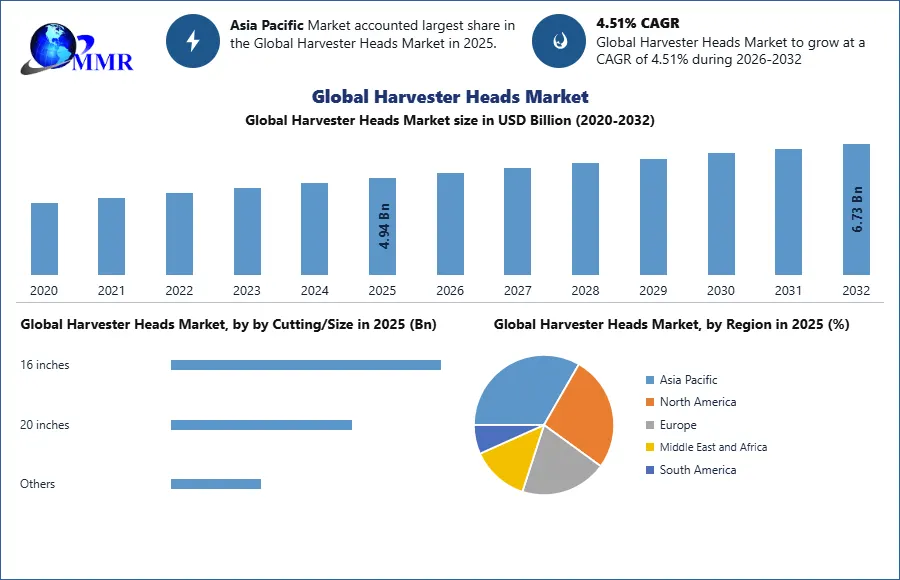
Harvester Heads Market valued at USD 4.94 Bn in 2025, projected to reach USD 6.73 Bn at a CAGR of 4.51%. Innovation surge drives demand for mechanized forestry.

Harvester Heads Market Overview

Harvester heads are specialized forestry attachments used in mechanized logging to fell, delimb, and cut trees into desired lengths, enhancing efficiency in timber harvesting. The global harvester heads market is driven by increasing mechanization in forestry operations and demand for high-speed, precision-based cutting solutions. Key growth factors include the need for operational efficiency and advancements in automated harvesting technologies, though environmental concerns over deforestation pose challenges. Demand is rising from commercial forestry sectors, while supply is bolstered by manufacturers focusing on durable, customizable designs. Regionally, Asia-Pacific leads with a 39% market share, fueled by large-scale forestry activities in China and India, while North America remains strong due to advanced logging practices and heavy-duty equipment adoption. Major players like John Deere (AI-driven precision) and Komatsu Forest (electric/hybrid models) dominate through innovation and sustainability-focused solutions. End-users, including timber companies and government forestry agencies, contribute significantly to demand. Trade policies, such as tariffs on imported forestry machinery, have also influenced regional market dynamics, impacting competitive pricing and localization strategies.

The report covers the Composite Rebar Market dynamics, structure by analyzing the market segments and projecting the Harvester Heads Market size. Clear representation of competitive analysis of key players by type, price, financial position, product portfolio, growth strategies, and regional presence in the Harvester Heads Market.Global Harvester Heads MarketTo know about the Research Methodology :- Request Free Sample Report
Research Methodology: -

This is a comprehensive international report targeted at present and future prospects of the Harvester Heads Market. This report presents a consolidation of primary and secondary analysis that provides market size, share, dynamics and forecast for numerous segments and sub-segments considering the macro and small environment factors. The report also covers an in-depth analysis of COVID 19 pandemic impact on the sales revenue of Harvester Heads Market by year-wise and region and on the key players revenue affected till July 2020 and expected short term and long-term impact on the market.

Global Harvester Heads Market Dynamics

Rising Mechanization in Forestry Operations Accelerates Global Harvester Heads Market Growth

The increasing adoption of advanced forestry machinery is a major driver boosting the growth of the Global Harvester Heads Market. Forestry companies are rapidly shifting toward automated logging equipment to improve harvesting efficiency, reduce labor dependency, and enhance timber processing accuracy. Harvester heads equipped with advanced cutting, delimbing, and measuring technologies enable faster operations while minimizing wood wastage. Growing demand for sustainable forest management practices across countries such as Canada, Sweden, Finland, and the United States is further supporting market expansion. In addition, rising investments in smart forestry equipment integrated with GPS, IoT, and real-time monitoring systems are increasing operational productivity in commercial logging activities. The expansion of the wood processing, pulp & paper, and biomass energy industries is also generating strong demand for high-performance harvester heads. Furthermore, government initiatives promoting mechanized forestry and improved timber yield are encouraging contractors to replace traditional harvesting methods with technologically advanced forestry equipment, thereby driving the Global Harvester Heads Market growth.

High Equipment Cost and Maintenance Challenges Limit Harvester Heads Market Expansion

The high initial investment associated with advanced harvester heads remains a significant restraint for the Global Harvester Heads Market. Modern harvester heads require sophisticated hydraulic systems, automation sensors, and durable cutting components, making them expensive for small and medium-scale forestry contractors. In addition, ongoing maintenance costs, including replacement of saw chains, rollers, hydraulic parts, and electronic control systems, increase the overall operational expenditure. Harvester heads operating in harsh forest environments are exposed to heavy wear and tear, resulting in frequent servicing requirements and downtime risks. Limited availability of skilled operators and technical professionals in developing regions further restricts equipment adoption. Moreover, fluctuating raw material prices and supply chain disruptions affecting steel and hydraulic component manufacturing create pricing uncertainties for forestry machinery manufacturers. These financial and operational barriers may slow the penetration of advanced harvesting technologies, particularly in emerging forestry economies with budget constraints.

Integration of Smart Forestry Technologies Creates New Opportunities in the Global Harvester Heads Market

The growing integration of digital forestry technologies is creating substantial opportunities for the Global Harvester Heads Market. Manufacturers are increasingly developing intelligent harvester heads equipped with automation software, artificial intelligence, telematics, and precision measurement systems to improve logging performance and forest resource management. The rising trend of data-driven forestry operations enables companies to monitor tree species, log dimensions, productivity levels, and machine performance in real time. Increasing demand for eco-friendly and fuel-efficient forestry equipment is also encouraging innovation in lightweight and energy-efficient harvester head designs. Emerging markets in Asia-Pacific and Latin America are witnessing rapid infrastructure development and rising timber consumption, creating strong growth potential for forestry machinery suppliers. Additionally, expanding investments in biomass energy production and sustainable wood harvesting practices are expected to boost demand for technologically advanced harvester heads. Strategic collaborations between forestry equipment manufacturers and software providers are further accelerating innovation and opening new revenue opportunities in the Global Harvester Heads Market.

Global Harvester Heads Market Segment Analysis

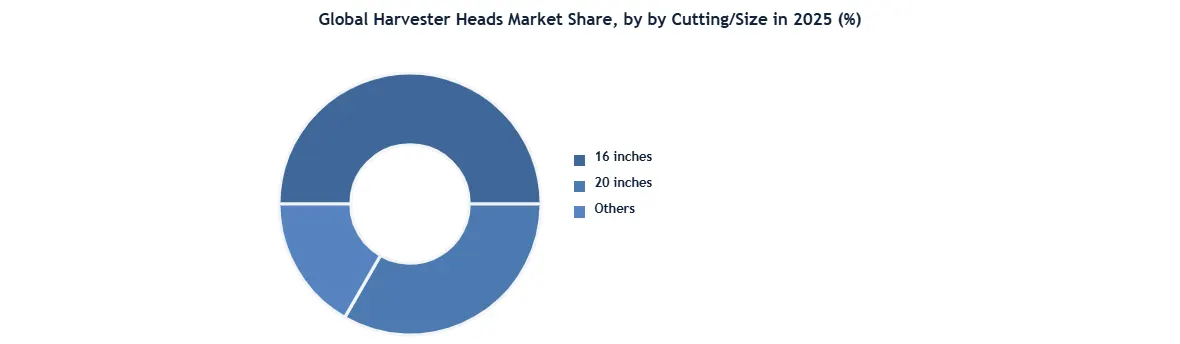
Based on cutting size ,The 16 inches segment dominates the Global Harvester Heads Market owing to its strong demand across small-to-medium scale forestry operations, plantation harvesting, and thinning activities. These harvester heads offer an ideal balance between cutting efficiency, operational flexibility, and cost-effectiveness, making them highly preferred among forestry contractors. Their compact size and lightweight structure enable easy maneuverability in dense forests, uneven terrain, and narrow working environments where larger harvester heads face operational limitations.

In addition, 16-inch harvester heads are widely compatible with compact forestry machinery and excavator-based harvesting systems, increasing their adoption among cost-sensitive operators. The lower fuel consumption, reduced maintenance costs, and easier transportation capabilities further support segment growth. Rising demand for selective logging and sustainable forest management practices is also boosting the utilization of 16-inch cutting systems, as they help minimize environmental impact while improving harvesting precision.

Emerging economies in Asia-Pacific and Latin America are increasingly adopting compact forestry equipment due to expanding commercial forestry activities and infrastructure development. Furthermore, manufacturers are introducing technologically advanced 16-inch harvester heads integrated with automation, hydraulic efficiency systems, and precision measuring technologies, strengthening the segment’s dominance in the Global Harvester Heads Market.
Global Harvester Heads Market Regional Analysis

The Asia-Pacific region dominated the global harvester heads market in 2025, accounting for approximately 39% of the total market share. This dominance is driven by large-scale forestry operations in countries like China and India, along with strong government subsidies promoting mechanization. The region also witnessed a sharp rise in exports, with over 292,000 harvester units shipped, 88% originating from China. Rapid urbanization and growing demand for efficient logging equipment continue to fuel Asia-Pacific’s leadership in this market.

Also, Asia-Pacific benefits from a growing focus on sustainable forestry and modernization of timber harvesting practices. Manufacturers in the region are increasingly adopting advanced technologies to improve productivity in diverse and rugged terrains. Local production capabilities and expanding infrastructure further support market growth, making the region attractive for global investors and equipment suppliers.

Harvester Heads Market Competitive Landscape

The harvester heads market features intense competition among key players like John Deere, Komatsu Forest, Ponsse, Tigercat, and Logset, who dominate through technological leadership and strategic innovation. John Deere leads with its AI-powered Harvest Smart system, optimizing cut precision and fuel efficiency by 15-20%, while its strong dealer network ensures global service support. Komatsu Forest focuses on hybrid and electric harvester heads, aligning with sustainability trends, and integrates IoT for real-time fleet management, reducing downtime by 25%. Ponsse excels in modular, multi-functional designs, allowing quick attachment swaps for varying tree sizes, boosting operational flexibility in Scandinavian markets.
Tigercat prioritizes durability and heavy-duty performance, using reinforced steel components that extend equipment life by 30%, making it preferred for rugged terrains in North America. Logset stands out with remote-controlled automation and lightweight composite materials, improving manoeuvrability in dense forests. These players maintain dominance through R&D investments, strategic OEM partnerships, and adaptability to regional logging demands, ensuring they meet the growing need for efficient, eco-friendly forestry solutions.

Harvester Heads Market Recent Development

• On January 6, 2025, John Deere (USA) announced at CES 2025 the rollout of its second-generation autonomy kit (16-camera, AI + lidar), which can be retrofitted on existing tractors and enables fully autonomous operation for large-scale farming and orchard tractors.
• May 5, 2021, Ponsse Plc (Finland) introduced the PONSSE H7 HD Euca, a heavy-duty harvester head tailored for eucalyptus processing, featuring robust rollers, an automated saw, and a durable structure.
• April 2, 2025, Ponsse Plc (Finland) launched the PONSSE Greasing System, an automatic chainsaw lubrication system integrated with the Opti5G control interface, enhancing maintenance efficiency.
• August 28, 2024, Komatsu Forest AB (Sweden) released the Komatsu C124 MY2025, featuring upgraded hydraulics, software-controlled knife pressure, and an advanced feed system for improved reliability and energy efficiency

Harvester Heads Market Scope: Inquire before buying

Global Harvester Heads Market
Report Coverage Details
Base Year: 2025 Forecast Period: 2026-2032
Historical Data: 2020 to 2025 Market Size in 2025: 4.94 USD Billion
Forecast Period 2026-2032 CAGR: 4.51% Market Size in 2032: 6.73 USD Billion
Segments Covered: by Cutting/Size 16 inches
20 inches
Others
by De-limbing Knives Three or below
Between 3 to 5
More than 5
by Feed Seed Less than 5 m/sec
More than 5 m/sec
by Design Type Fixed Harvester Heads
Multi-Tree Handling Heads
Processing Heads
Others
by Application Forestry
Agriculture
Land Clearing / Infrastructure
Biomass
Others
by Mechanism Hydraulic
Electric
Mechanical
by Sales Channel OEMs
Aftermarket

Harvester Heads Market, by region

North America (United States, Canada and Mexico)
Europe (UK, France, Germany, Italy, Spain, Russia, Rest of Europe)
Asia Pacific (China, South Korea, Japan, India, Australia, Indonesia, Philippines, Malaysia, Vietnam, Thailand, Rest of Asia Pacific)
Middle East and Africa (South Africa, Saudi Arabia, UAE, Rest of the Middle East &Africa)
South America (Brazil, Argentina, Rest of South America)

Harvester Heads Market Key Players

  1. Ponsse Plc.
  2. John Deere
  3. Komatsu Forest
  4. Weiler Forestry
  5. Logset Oy
  6. Moresil
  7. Rottne Industri
  8. Kesla
  9. Waratah
  10. Tigercat Industries Inc
  11. SP Maskiner AB
  12. Nisula Forest
  13. AFM-Forest
  14. Hultdins
  15. Sampo Rosenlew
  16. Eco Log
  17. Biojack
  18. Log Max
  19. Southstar Equipment
  20. Konrad Forsttechnik
  21. Arbro
  22. Malwa Forest AB
  23. Kone-Ketonen Ltd
  24. Mecanil Oy Ab
  25. Menzimuck
  26. Jenz Gmbh
  27. Bell Equipment
  28. AgriExpo
  29. Forest Pioneer
  30. Agroline
    Others

Table of Contents

1. Harvester Heads Market: Executive Summary 1.1. Executive Summary 1.2. Market Size (2025) & Forecast (2026-2032), 1.3. Market Size (Value in USD, Volume in 000'Units) and Market Share (%) – By Segments, Regions, and Country 2. Competitive Landscape 2.1. MMR Competition Matrix 2.2. Competitive Positioning Of Global Key Players 2.3. Key Players Benchmarking 2.3.1 Company Name 2.3.2 Headquarters 2.3.3 Product Portfolio 2.3.4 Hybrid & Electric Powertrain Options 2.3.5 Range of Harvester Head Models 2.3.6 Manufacturing Scale & Capacity 2.3.7 Production Lead Time & Flexibility 2.3.8 Sales Channels 2.3.9 Revenue (USD Million, 2025) 2.3.10 Gross Margin (%) 2.3.11 Year-on-Year Growth (%) 2.3.12 Market Share (%) (2025 2.3.13 Product Performance & Reliability Ratings 2.3.14 Certification & Compliance Strength 2.3.15 R&D & Innovation Capability 2.3.16 Geographical Presence 2.4. Market Structure 2.4.1 Market Leaders 2.4.2 Market Followers 2.4.3 Emerging Players 2.5 list of Customer Base & Major Clients Of Top Key Players 2.6 Company Revenue Share By Region For Harvester Heads (2025) 2.7. Mergers and Acquisitions Details 2.8 Analysis of Market Positioning and Product Differentiation By Key Players 2.8.1 Positioning Strategies by Market Leaders 2.8.2 Product Differentiation Factors 2.8.3 Competitive Advantage in Product Offering 2.9 Global Manufacturing Network 2.9.1 Overview of Major Manufacturing Hubs 2.9.2 Key Manufacturers and Their Facilities 2.9.3 Outsourcing vs. In-house Production In 2025 2.10 Branding and Marketing Strategies By Key Players 2.10.1 Key Marketing Techniques 2.10.2 Overview of Branding by Key Players 2.10.3 Role of Digital Marketing 3. Market Dynamics 3.1. Market Trends 3.2. Harvester Heads Market Dynamics 3.2.1 Drivers 3.2.2 Restraints 3.2.3 Opportunities 3.2.4 Challenges 3.3. PORTER’s Five Forces Analysis 3.4. PESTLE Analysis 3.5. Value Chain Analysis 3.6. Key Opinion Leader Analysis For the Global Harvester Heads Industry 4. Harvester Heads Adoption Statistics (2025) 4.1 Total Installed Base of Harvester Heads By Region in 2025 in 000'Units 4.2 Rate of Harvester Heads Adoption by Region in % in 2025 4.3 Adoption rate in % end user by Industry Segment in 2025 4.4 Harvester Heads Market Adoption Volume and Revenue (2018-2025) 5. Technological Innovations & Advancements 5.1 Evolution of Hydraulic Systems to Intelligent Machine Controls 5.2 Shift from Conventional Hydraulic Systems 5.3 Impact on Fuel Efficiency and Performance: 5.4 Integration of AI, Sensors, and Advanced Telematics Platforms 5.5 Adoption of Electric and Hybrid Powertrains 5.6 Predictive Maintenance and Real-Time Equipment Health Monitoring 5.7 Role of AI and Machine Learning 5.8 Automation Technologies in Harvester Heads Production 5.9 AI for Consumer Insights and Personalization 5.10 Automation in Supply Chain Management 6. Pricing & Revenue Analysis (2025) 6.1 Historical and Current Pricing Trends by Harvester Head Category and Capacity 6.2 Price Trends by Harvester Head Type 6.3 Impact of Capacity on Pricing: 6.4 Regional Price Comparison Across Developed and Developing Markets 6.5 Developed Markets (North America, Europe) 6.6 Developing Markets (Asia-Pacific, Latin America, Africa 6.7 Impact of Raw Material Costs on Equipment Pricing Structures 6.8 OEM Versus Aftermarket Revenue Contribution and Margin Comparison 6.9 OEM Pricing 6.10 Aftermarket Pricing 6.11 Role of Customization and Technology Add-ons in Price Premium Creation 7. Supply Chain Analysis 7.1 Supply Chain Structure for Harvester Heads 7.2 Overview of Supply Chain Components 7.3 Overview of Tier 1 and Tier 2 Suppliers 7.4 Raw Material Sourcing 7.5 Manufacturing Process Overview 7.6 Role of Technology in the Supply Chain 7.7 Supply Chain Cost Optimization 7.8 Analysis of Supply Chain Logistics & Distribution 8.Demand of Harvester Heads in Application Sector Analysis 8.1 Overview of Annual Demand (Units) and Value (Million) by Application in 2025 8.2 Total Global Market Volume By Region in 2025 8.3 Volume data Breakdown by Sector-Specific Demand in 2025 8.4 Value data Breakdown by Region in 2025 8.5 Factors Influencing Regional Demand 9. Trade, Export, and Import Intelligence (2025) 9.1 Global export destinations and cross-border Harvester Heads trade flows 9.2 Export competitiveness of major manufacturing countries 9.3 Trade barriers including tariffs, certifications, and localization mandates 9.4 Domestic versus global OEM competitiveness matrix 9.5 Impact of free trade agreements on Harvester Heads product movement 9.6 Currency volatility and its effect on export pricing strategies 10. Distribution, Dealer, and Retail Channel Analysis 10.1 Overview of Distribution Channels 10.2 Role of Dealers and Distributors 10.3 Channel Distribution and Market Share by Dealers and Distributors, Direct Sales and Online in 2025 10.4 Direct Sales Channels: Insights into direct-to-consumer sales models. 10.5 E-commerce and Online Marketplaces: The growing role of online platforms in the market. 10.6 Third-Party Distributors: Role of third-party distributors and their market share. 10.7 Retail Partnerships: Strategic alliances between manufacturers and retailers. 10.8 Global Distribution Strategies: Distribution strategies for global market penetration 11. Customer Purchase Decision Factors And Brand Selection Criteria 11.1 Awareness and perception of advanced Harvester Heads product technologies 11.2 Regional differences in adoption and replacement behavior 11.3 Influence of rental companies on purchase decisions 11.4 Price sensitivity versus performance and reliability trade-offs 11.5 Financing availability and its impact on buying behavior 12. Sustainability & Environmental Impact Assessment 12.1 Emission reduction potential through electrified Harvester Heads 12.2 Fuel efficiency improvements and lifecycle emission analysis 12.3 Circular economy practices in Harvester Heads manufacturing and refurbishment 12.4 ESG performance benchmarking of leading OEMs 12.5 Sustainable sourcing of raw materials and components 12.6 Role of Harvester Heads in green infrastructure development 13. Lifecycle, Maintenance, Replacement Ratio and Aftermarket Analysis 13.1 Average Harvester Heads lifespan and replacement cycle assessment 13.2 Predictive maintenance adoption and digital service offerings 13.3 Overhaul, refurbishment, and remanufacturing market trends 13.4 Aftermarket revenue contribution by region and Harvester Heads Type 14. OEM Partnerships and Strategic Collaborations 14.1 Collaboration models between OEMs and Forestry contractors 14.2 Program-level deployment in mega Forestry projects 14.3 Partnerships with technology and automation solution providers 14.4 Co-branding and private labeling strategies 14.5 Long-term service and maintenance contract structures 14.6 Strategic alliances for market entry and regional expansion 15. Investment Landscape & Growth Opportunities 15.1 Investment Landscape: Key trends in market investments and funding. 15.2 Venture Capital: Overview of venture capital trends and leading investors. 15.3 Private Equity: Analysis of private equity involvement in market growth. 15.4 Government Grants and Subsidies: Impact of public funding and subsidies on market innovation. 15.5 Investment Risks and Return: Risk analysis and potential return on investment in the market 16. Risk Management and Mitigation Strategies 16.1 Identifying Key Market Risks 16.2 Mitigation Strategies for Market Risks 16.3 Financial and Operational Risk Management 16.4 Business Continuity and Crisis Management 17. Lifecycle, Maintenance, Replacement Ratio and Aftermarket Analysis 17.1 Average Equipment Lifespan and Replacement Cycle 17.2 Maintenance Practices & Predictive Maintenance Adoption 17.3 Overhaul, Refurbishment & Remanufacturing Trends 17.4 Aftermarket Revenue Contribution c 18. Policy, Regulatory, and Compliance Environment 18.1 Overview of Emission and Environmental Standards 18.2 Overview of Safety and Worker Protection Standards 18.3 Analysis of Sustainability and Circular Economy Policies 18.4 Regulatory Compliance for Digital and Autonomous Systems 18.5 Environmental Reporting and Certification 18.6 Carbon Trading and Emissions Reduction Credits 18.7 Overview of Emerging Regulations in Emerging Market 19. Rental, Leasing Harvester Heads Landscape Analysis 19.1 Structural shift from ownership to rental-based Harvester Heads utilization models 19.2 Financial comparison of renting versus owning Harvester Heads 19.3 Rental trends by Harvester Heads category 19.4 Impact of utilization rates on rental company profitability and pricing 19.5 OEM strategies to directly participate in rental and leasing ecosystems 19.6 Influence of short-term project cycles on rental demand volatility 20. Localization, Manufacturing Strategy, and Make-in-Country Initiatives 20.1 Localization requirements influencing OEM manufacturing footprint decisions 20.2 Cost-benefit analysis of local assembly versus full-scale manufacturing plants 20.3 Impact of local content rules on supplier selection and design choices 20.4 Make-in-country policies shaping investment decisions in emerging economies 20.5 Trade-off between scale efficiency and proximity to demand centers 20.6 Technology transfer agreements and local capability development initiatives 20.7 Long-term competitiveness of localized production versus global sourcing 21. Secondary Market, Used Equipment, and Refurbishment Dynamics 21.1 Global used harvester heads market size in 2025 and (2026-2032) 21.2 Price discovery mechanisms and transparency in secondary equipment markets 21.3 OEM-certified used harvester heads and refurbishment standards 21.4 Buyer profiles and demand drivers in used harvester heads purchasing 21.5 Impact of refurbishment on harvester heads lifecycle extension and value retention 21.6 Secondary market influence on new equipment pricing and replacement cycles 22. Branding and Marketing Strategies 22.1 Overview of Branding Fundamentals for Harvester Heads 22.2 Overview of the Harvester Heads Market Branding and Marketing Strategies 22.3 Digital Marketing Strategies 22.4 Analysis of Influencer and Partnership Marketing 22.5 Trade Shows and Industry Events 22.6 Measuring Brand Effectiveness and Marketing ROI 22.7 Future Trends in Branding and Marketing for Harvester Head 23. Harvester Heads Market: Global Market Size and Forecast by Segmentation (by Value in USD Billion & Volume in 000'Units) (2025-2032) 23.1. Global Harvester Heads Market Size and Forecast, by Cutting/Size 16 inches 20 inches 20.1 Others 23.2. Global Harvester Heads Market Size and Forecast, by De-limbing Knives 23.2.1 Three or below 23.2.2 Between 3 to 5 23.2.3 More than 5 23.3. Global Harvester Heads Market Size and Forecast, by Feed Seed 23.3.1 Less than 5 m/sec 23.3.2 More than 5 m/sec 23.4. Global Harvester Heads Market Size and Forecast, by Design Type 23.4.1 Fixed Harvester Heads 23.4.2 Multi-Tree Handling Heads 23.4.3 Processing Heads 23.4.4 Others 23.5. Global Harvester Heads Market Size and Forecast, by Application 23.5.1 Forestry 23.5.2 Agriculture 23.5.3 Land Clearing / Infrastructure 23.5.4 Biomass 23.5.5 Others 23.6. Global Harvester Heads Market Size and Forecast, by Mechanism 23.6.1 Hydraulic 23.6.2 Electric 23.6.3 Mechanical 23.7. Global Harvester Heads Market Size and Forecast, by Sales Channel 23.7.1 OEMs 23.7.2 Aftermarket 23.8. Global Harvester Heads Market Size and Forecast, by Region 23.8.1 North America 23.8.2 Europe 23.8.3 Asia Pacific Middle East and Africa 23.8.4 South America 24. North America Harvester Heads Market Size and Forecast by Segmentation (by Value in USD Billion & Volume in 000'Units) (2025-2032) 24.1. North America Market Size and Forecast, by Cutting/Size 24.2. North America Market Size and Forecast, by De-limbing Knives 24.3. North America Market Size and Forecast, by Feed Seed 24.4. North America Market Size and Forecast, by Design Type 24.5. North America Market Size and Forecast, by Application 24.6. North America Market Size and Forecast, by Mechanism 24.7. North America Market Size and Forecast, by Sales Channel 24.8. North America Market Size and Forecast, by Country 24.8.1 United States 24.8.2 United States Market Size and Forecast, by Cutting/Size 24.8.3 United States Market Size and Forecast, by De-limbing Knives 24.8.4 United States Market Size and Forecast, by Feed Seed 24.8.5 United States Market Size and Forecast, by Design Type 24.8.6 United States Market Size and Forecast, by Application 24.8.7 United States Market Size and Forecast, by Mechanism 24.8.8 United States Market Size and Forecast, by Sales Channel 24.8.9 Canada 24.8.10 Mexico 25. Europe Harvester Heads Market Size and Forecast by Segmentation (by Value in USD Billion & Volume in 000'Units) (2025-2032) 25.1. Europe Market Size and Forecast, by Cutting/Size 25.2. Europe Market Size and Forecast, by De-limbing Knives 25.3. Europe Market Size and Forecast, by Feed Seed 25.4. Europe Market Size and Forecast, by Design Type 25.5. Europe Market Size and Forecast, by Application 25.6. Europe Market Size and Forecast, by Mechanism 25.7. Europe Market Size and Forecast, by Sales Channel 25.8. Europe Market Size and Forecast, by Country 25.8.1 United Kingdom 25.8.2 France 25.8.3 Germany 25.8.4 Italy 25.8.5 Spain 25.8.6 Netherlands 25.8.7 Belgium 25.8.8 Russia 25.8.9 Turkey 25.8.10 Sweden 25.8.11 Poland 25.8.12 Rest of Europe 26. Asia Pacific Harvester Heads Market Size and Forecast by Segmentation (by Value in USD Billion & Volume in 000'Units) (2025-2032) 26.1. Asia Pacific Market Size and Forecast, by Cutting/Size 26.2. Asia Pacific Market Size and Forecast, by De-limbing Knives 26.3. Asia Pacific Market Size and Forecast, by Feed Seed 26.4. Asia Pacific Market Size and Forecast, by Design Type 26.5. Asia Pacific Market Size and Forecast, by Application 26.6. Asia Pacific Market Size and Forecast, by Mechanism 26.7. Asia Pacific Market Size and Forecast, by Sales Channel 26.8. Asia Pacific Market Size and Forecast, by Country 26.8.1 China 26.8.2 South Korea 26.8.3 Japan 26.8.4 India 26.8.5 Taiwan 26.8.6 Australia 26.8.7 Indonesia 26.8.8 Philippines 26.8.9 Malaysia 26.8.10 Vietnam 26.8.11 Thailand 26.8.12 Rest of Asia Pacific 27. Middle East and Africa Harvester Heads Market Size and Forecast by Segmentation (by Value in USD Billion & Volume in 000'Units) (2025-2032) 27.1. Middle East and Africa Market Size and Forecast, by Cutting/Size 27.2. Middle East and Africa Market Size and Forecast, by De-limbing Knives 27.3. Middle East and Africa Market Size and Forecast, by Feed Seed 27.4. Middle East and Africa Market Size and Forecast, by Design Type 27.5. Middle East and Africa Market Size and Forecast, by Application 27.6. Middle East and Africa Market Size and Forecast, by Mechanism 27.7. Middle East and Africa Market Size and Forecast, by Sales Channel 27.8. Middle East and Africa Market Size and Forecast, by Country 27.8.1 South Africa 27.8.2 GCC 27.8.3 Egypt 27.8.4 Nigeria 27.8.5 Rest of ME&A 28. South America Harvester Heads Market Size and Forecast by Segmentation (by Value in USD Billion & Volume in 000'Units) (2025-2032) 28.1. South America Market Size and Forecast, by Cutting/Size 28.2. South America Market Size and Forecast, by De-limbing Knives 28.3. South America Market Size and Forecast, by Feed Seed 28.4. South America Market Size and Forecast, by Design Type 28.5. South America Market Size and Forecast, by Application 28.6. South America Market Size and Forecast, by Mechanism 28.7. South America Market Size and Forecast, by Sales Channel 28.8. South America Market Size and Forecast, by Country 28.8.1 Brazil 28.8.2 Argentina 28.8.3 Colombia 28.8.4 Chile 28.8.5 Rest Of South America 29. Company Profile: Key Players 29.1. Ponsse Plc. 29.1.1 Company Overview 29.1.2 Business Portfolio 29.1.3 Financial Overview 29.1.4 SWOT Analysis 29.1.5 Strategic Analysis 29.1.6 Recent Developments 29.2. John Deere 29.3 Komatsu Forest 29.4 Weiler Forestry 29.5 Logset Oy 29.6 Moresil 29.7 Rottne Industri 29.8 Kesla 29.9 Waratah 29.10 Tigercat Industries Inc 29.11 SP Maskiner AB 29.12 Nisula Forest 29.13 AFM-Forest 29.14 Hultdins 29.15 Sampo Rosenlew 29.16 Eco Log 29.17 Biojack 29.18 Log Max 29.19 Southstar Equipment 29.20 Konrad Forsttechnik 29.21 Arbro 29.22 Malwa Forest AB 29.23 Kone-Ketonen Ltd 29.24 Mecanil Oy Ab 29.25 Menzimuck 29.26 Jenz Gmbh 29.27 Bell Equipment 29.28 AgriExpo 29.29 Forest Pioneer 29.30 Agroline  Others 30. Key Findings 31. Analyst Recommendations 32. Research Methodology

Custom Market Research Services

We Will Customise The Research For You, In Case The Report Listed Above Does Not Meet With Your Requirements