
Green Polyvinyl Chloride Market Size by Type, Application, End Use, Region – Revenue Pool Analysis, Margin Structure Assessment, Capital Flow Trends, Competitive Benchmarking & Forecast to 2032
Overview
The Green Polyvinyl Chloride Market size was valued at USD 6.2 Billion in 2025 and the total green polyvinyl chloride market revenue is expected to grow at a CAGR of 4.9% from 2026 to 2032, reaching nearly USD 8.67 Billion.
Green Polyvinyl Chloride is a high-strength thermoplastic and versatile material with applications ranging from flexible packaging to rigid building products including extruded pipes, medical devices, wires & cables, injection molded electrical/plumbing fittings, and PVC profiles. PVC is also widely used in refurbishment where it often replaces traditional materials such as metals and wood.
The green PVC formulation develop using the waste PVC pipes supplied by the Canadian Starch Company (CASCO) and its Brazilian subsidiary. The basic ingredient used in Green-PVC formulations is blond glycerol. The green Polyvinyl chloride industry aims to improve the recovery and reuse of bioenergy and industrial plastic waste, and at the same time minimize dependence on fossil resources by gradually replacing them with renewable resources. These factors may fuel the demand for the green polyvinyl chloride market in the forecast years.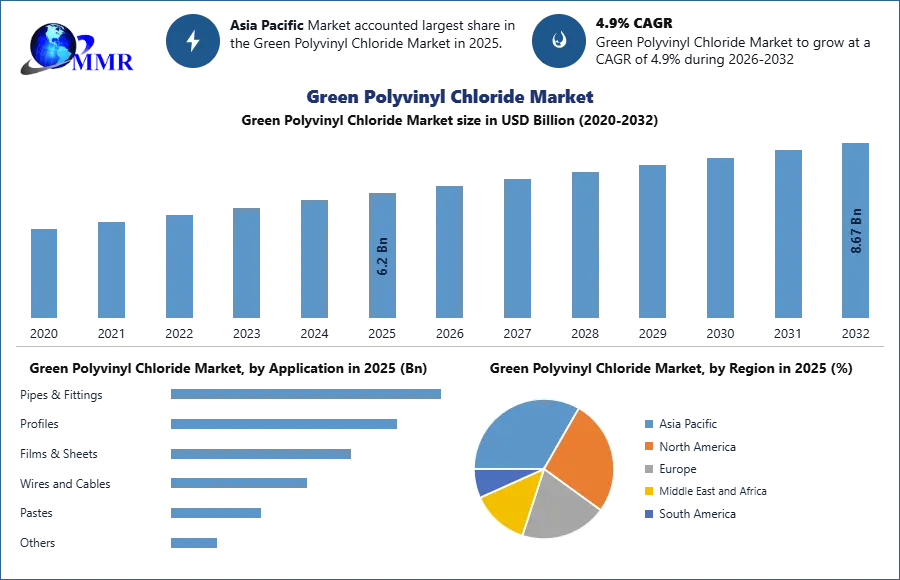 To know about the Research Methodology:- Request Free Sample Report
Increasing demand from the end-use industries:
Polyvinyl chloride (PVC) is widely used in various end-use industries, including construction, automotive, packaging, and others. The construction, automotive, and packaging industries are major consumers of PVC products, due to their superior properties such as durability, flexibility, and resistance to fire and chemicals and this industry is increasingly adopting sustainable practices. PVC is a cost-effective material compared to other materials used in the construction and automotive industry, such as metal or wood.
PVC can be manufactured in different forms, such as rigid and flexible PVC, which makes it versatile for use in a variety of applications. Consumers, End-users, and businesses are becoming aware of the negative impact of traditional Polyvinyl chloride manufacturing on the environment. This has led to increasing demand in the market for green PVC products that are produced using more sustainable and eco-friendly methods. The growing demand from this end-use industry is expected to drive the growth of the green PVC market.
Green PVC with fully recycled industrial waste and renewably sourced content is expected to drive the green polyvinyl chloride market:
There is growing concerned about the environmental impact of plastics, including PVC, and the need to reduce plastic waste and carbon footprint. The use of green PVC made from recycled industrial waste and renewably sourced content addresses these concerns by reducing the amount of waste and emissions associated with traditional PVC. The United Nations Sustainable Development Goals (SDGs) call for the adoption of sustainable practices and the reduction of waste and emissions.
The use of green PVC with recycled industrial waste and renewably sourced content supports these goals by promoting sustainable production and consumption. However, consumers are increasingly concerned about the environmental impact of the products they purchase and are more likely to choose products made from sustainable materials. The use of green PVC with recycled industrial waste and renewably sourced content can help companies meet this demand and differentiate themselves in the market in the forecast period.
High cost involved in the production of green PVC:
Green polyvinyl chloride (PVC) is produced using a more environmentally friendly manufacturing process. The cost involved in the formulation of green PVC can vary depending on various factors, including the specific manufacturing process used, the availability and cost of raw materials, and the scale of production. However, the production of green PVC can be more expensive than traditional PVC production methods, as it requires the use of more expensive raw materials or additional processing steps. This restrains or hampers the market for green polyvinyl chloride. However, the cost of green PVC has been decreasing in recent years due to advancements in manufacturing technology, increased availability of raw materials, and growing demand for sustainable products.
Green Polyvinyl Chloride Market Segment Analysis:
Based on type, the green polyvinyl chloride (PVC) is segmented as flexible and rigid. The rigid segment dominated the green polyvinyl chloride market in 2025 and is expected to continue its dominance during the forecast period. Rigid green PVC does not contain plasticizers and is used in construction activities, piping, roofing sheet materials, and other products. The construction industry is the largest consumer of green PVC, used in windows, doors, and pipes. This drives the demand for rigid green PVC in the future. Whereas flexible PVC is prepared by adding plasticizers to the rigid form. This type of PVC is more flexible and serves as an alternative to rubbers. As a result, polyvinyl chloride manufacturers offer flexible PVC which is widely used in electrical cable insulations, plumbing, flooring, foot wares/ boot grades and manufacturing of the clothing.
Based on application, the Green PVC Market is segmented by Pipes & Fittings, Films & Sheets, Wires & Cables, Pastes, and Others. The pipes & Fitting segment has the largest market share in the green polyvinyl chloride market in 2025 and is expected to boost during the forecast period. As green PVC manufacturers create leak-free pipes that are not prone to corrosion and are resistant to environmental stress, it improves functionality and increases energy efficiency. The wires and cables segment is likely to achieve the fastest CAGR during the forecast period. As this is the most prevalent and trusted material used in electrical wiring and cables.
Based on End-Use, the Green PVC Market is segmented into Building and Construction, Electrical and Electronics, Packaging, Transportation, and Others. The building and construction segment has the largest market share in the green polyvinyl chloride industry in 2025 and is expected to boost during the forecast period. As PVC is the most used plastic material for building & construction products such as cables, plastic pipes, window profiles, flooring, roofing, and plumbing fittings. The Building and Construction segment is expected to boost the green PVC market in the forecast year.
Green Polyvinyl Chloride Market Regional Insights:
Asia Pacific is expected to dominate the global Green Polyvinyl Chloride Market in 2025, and is expected to maintain its dominance during the forecast period. The region's growth is attributed to several sectors, including Building & Construction, Packaging, Electronics, Automotive, and furniture sectors. As polyvinyl chloride is resistant to water, chemical, and oil this makes it a popular material for pipes, tubes, wires, and cables. Asia Pacific and Europe are the leading regions in terms of global green polyvinyl chloride production. China is a prominent country for green PVC producers in East Asia. Countries like USA and China are the leading consumers of green polyvinyl chloride.
As China’s consumer electronics sector is growing rapidly which in turn enhanced the performance of the green polyvinyl chloride market in the region. In addition to consumer electronics, there is also a growing demand for green PVC in the packaging industry. As consumers become more conscious of the environmental impact of packaging materials, there is a growing demand for PVC products that are made from renewable resources or recycled materials. The demand for green PVC in the Asia Pacific region is expected to continue growing in the coming years as environmental concerns and sustainability become important considerations for businesses and consumers
Competitive Landscape
Key Players of the Green Polyvinyl Chloride Market profiled in the report include Axiall Corporation, Formosa Plastics Corporation, GEON, GERMANCARD Technologies GmbH, Goldstab Organics Pvt. Ltd., INEOS Group Ltd, LG Chem Ltd., Mexichem SAB de CV, Occidental Petroleum Corporation, Schilling Ltd., Shin-Etsu Chemical Co, Sylvin Technologies, Inc., V.V. Hitech Innovations India Pvt. Ltd., Vynova Group, Westlake Vinnolit GmbH, Xinjiang Zhongtai Chemical Co. Ltd. These Key manufacturers has a prevalent existence worldwide. This provides huge opportunities to serve many End-uses & customers and expand the green Polyvinyl chloride market.
Recent Developments
On 20 October 2025Westlake VinnolitThe company introduced its GreenVin circular-attributed PVC at the K 2025 trade show, utilizing circular ethylene derived from mixed plastic packaging waste. This launch provides a high-quality virgin-equivalent resin for difficult-to-recycle waste streams, significantly advancing circular economy goals in the European market.
Green Polyvinyl Chloride Market Scope: Inquire before buying
| Green Polyvinyl Chloride Market | |||
|---|---|---|---|
| Report Coverage | Details | ||
| Base Year: | 2025 | Forecast Period: | 2026-2032 |
| Historical Data: | 2020 to 2025 | Market Size in 2025: | 6.2 USD Billion |
| Forecast Period 2026-2032 CAGR: | 4.9% | Market Size in 2032: | 8.67 USD Billion |
| Segments Covered: | by Type | Rigid Flexible Others |
|
| by Application | Pipes & Fittings Profiles Films & Sheets Wires and Cables Pastes Others |
||
| by End Use | Building and Construction Electrical and Electronics Packaging Transportation Others |
||
Green Polyvinyl Chloride Market Regional Insights:
North America (United States, Canada and Mexico)
Europe (UK, France, Germany, Italy, Spain, Sweden, Austria, Turkey, Russia and Rest of Europe)
Asia Pacific (China, India, Japan, South Korea, Australia, ASEAN and Rest of APAC)
Middle East and Africa (South Africa, GCC, Egypt, Nigeria and Rest of ME&A)
South America (Brazil, Argentina, Columbia and Rest of South America)
Green Polyvinyl Chloride Market, Key Players are
1. Axiall Corporation
2. Formosa Plastics Corporation
3. GEON,
4. GERMANCARD Technologies GmbH,
5. Goldstab Organics Pvt. Ltd.
6. INEOS Group Ltd,
7. LG Chem Ltd.
8. Mexichem SAB de CV
9. Occidental Petroleum Corporation,
10. Schilling Ltd.
11. Shin-Etsu Chemical Co,
12. Sylvin Technologies, Inc.,
13. V.V. Hitech Innovations India Pvt. Ltd.
14. Vynova Group,
15. Westlake Vinnolit GmbH,
16. Xinjiang Zhongtai Chemical Co. Ltd.