
Gluten Free Food Market – Global Market Size, Strategic Growth Drivers, Risk Assessment Framework, Regulatory Landscape Review, Competitive Intensity Mapping & Long-Term Industry Outlook to 2034
Overview
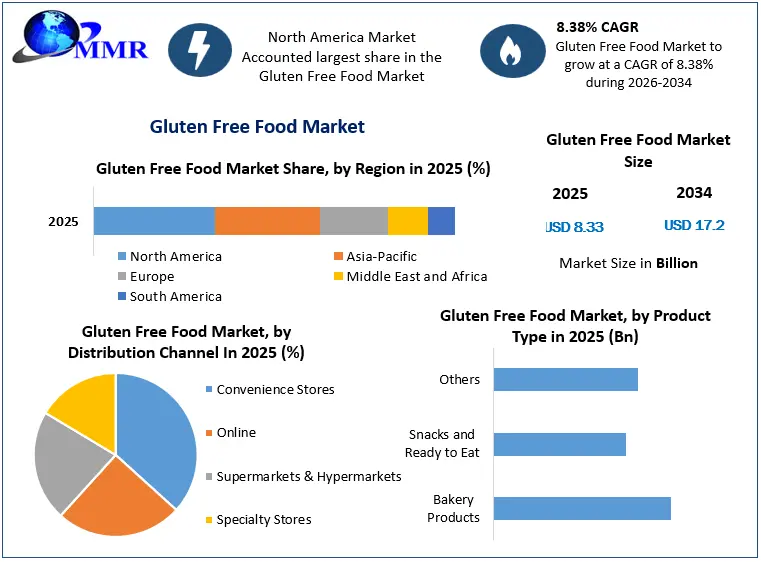
Gluten Free Food Market is projected to grow from USD 8.33 Bn. in 2025, reaching USD 17.2 Bn. in 2034 at a CAGR of 8.38%, driven by clean-label demand.
Gluten Free Food Market Overview
Gluten Free food refers to products that do not contain gluten, a protein found in wheat, barley, and rye. These foods are essential for people with celiac disease or gluten sensitivity, as consuming gluten can cause digestive issues and other health problems. Examples include naturally Gluten Free foods like fruits, vegetables, and rice, as well as specially processed alternatives like Gluten Free bread or pasta.
The Gluten Free food market is expanding rapidly, driven by growing health awareness, increased diagnoses of gluten-related disorders, and a rising preference for clean-label, healthier diets. North America leads the market, accounting for over half of global Gluten Free product launches. Europe follows with about 30%, supported by strict food labelling regulations. Supermarkets have responded to the trend, with 85% of U.S. grocery stores now dedicating shelf space to Gluten Free products. Some major players like General Mills and Kraft Heinz dominate the market through strong distribution networks and continuous product innovation. Emerging opportunities lie in plant-based Gluten Free options and the untapped Asia-Pacific region, where Gluten Free items currently make up less than 5% of packaged foods. The market continues to evolve, with improvements in product quality and increased accessibility for a broader consumer base.
Free Food Market Growth and Share Analysis
To know about the Research Methodology :- Request Free Sample Report
Global Gluten Free Food Market Dynamics
The rising numbers of irritable bowel syndrome (IBS) along with celiac disease are expected to boost the requirement for Gluten Free products across all developed and developing countries. The present occurrence of these diseases in developed countries, from North America and Europe, such as the United States, Canada, Germany, and France, might further market demand. Many consumers are driven by what encourages them to adopt Gluten Free diets for improved health, to adopt Gluten Free foods, which is a compulsory health necessity.
It is also noted that people who are trying new foods such as paleo or keto because of current medical conditions, and those who want to live a Gluten Free lifestyle just because it makes them feel better, are the important drivers of market demand. As the world sees a change in consumers' access to healthy food, consumers now customize their shopping experience with technological advances for their nutritional needs. It has been a long time since consumers made it available to retailers, things as in-store nutritionists and colour-coded shelf tags showing nutritional properties of certain products, such as Healthy Heart or Gluten Free.
However, these efforts rely heavily on sophisticated technology that allows for greater personalisation and customisation of consumer information to meet individual nutritional needs. This has played a major role in promoting Gluten Free products in the consumer diet. Technological trends, including product design, make Gluten Free products more palatable. Additionally, production processes are technologically advanced to reduce prices. New production processes include extrusion and annealing cooking that helps increase product durability and reduce cooking losses. An increase in obesity also drives the increase in demand for Gluten Free products. Therefore, pulses have become an adequate substitute for wheat in Gluten Free products.
Market Growth Opportunities
The Gluten Free food industry provides a good space to make products varied and new. There are chances to create fresh types of Gluten Free traditional food items, like bread, pasta, snacks, and desserts. It is possible to produce ready-to-eat meals along with convenience foods as well as beverages. The taste, texture, and nutritional value of Gluten Free products are being enhanced due to advancements in ingredients and methods used during manufacturing processes. This is making these items more appealing for a wider range of consumers. This holds especially true for areas that have less awareness and availability of products without gluten. There still exist chances to enter fresh markets by means such as efficient distribution channels, alliances with sellers, and marketing campaigns that are focused on teaching people about Gluten Free choices.
Opportunities are found in targeting specific consumer groups within the Gluten Free market for specialised product offerings. Another potential growth area is creating Gluten Free foods that match additional dietary preferences, such as vegan, paleo, or low-carb diets. Targeted solutions for niche segments like children, athletes, and seniors who have gluten sensitivity or celiac disease could also spur growth. Teamwork between food makers, sellers, and health professionals helps to increase the market by making products more accessible to people who want Gluten Free choices while improving knowledge about this diet and its effects on health. Collaboration with food service providers, restaurants, and hospitality industries can broaden the and accessibility of menu items without gluten.
The production of Gluten Free products requires specialized ingredients and processes, resulting in increased manufacturing expenses in comparison to conventional products. Consequently, their retail prices are often elevated, potentially discouraging cost-conscious consumers from regularly purchasing them. This perception of premium items due to the higher costs restricts or limits the widespread use of the product.
Although the Gluten Free Free Food Market has experienced growth, there exists a constrained assortment of products in contrast to prevalent food categories. This restraint induces a more restricted selection for individuals, ultimately impacting the overall appeal and acceptance of the market by consumers. The lack of diversity among Gluten Free options potentially causes consumer tiredness or apathy over an extended period. Even with a growing recognition of gluten-related medical issues, such as celiac disease and gluten sensitivity, there persists an ongoing necessity for educating consumers about Gluten Free diets and the products that are accessible. False information or ambiguity surrounding Gluten Free labelling and ingredients can generate impediments to adopting these diets and hinder the Gluten Free Free Food Market growth.
Gluten Free Food Market Segment Analysis
Based on the Products, the Bakery Products Segment held the largest market share of 29.3% in 2025 and is expected to maintain its dominance over the forecast period. The awareness about healthy eating is increasing that including natural, organic, and Gluten Free food is expected to drive partial growth. Features such as a portfolio of various products with innovative developments are expected to impact growth in the coming years. The growing demand for Gluten Free bread is the primary driver leading a portion of bakery production. To meet this growing demand, packaged bread producers, preeminent UK players, Warburtons, are developing brands that do not have their high-end brands, which are starting to appeal to consumers from all economic sectors.
Several new bakery start-ups introduced Gluten Free bread, similar to Coconut Wraps by NUCO in the US, which is Gluten Free and explores all other health standards such as organic, raw, vegan, and paleo. These days, the growing awareness about the health benefits of baked goods and the city's rapid growth could continue to grow.
Growing consumer awareness about health and natural health products contributes to developing new products in the sector. Growth in the development of marketing activities and improved distribution channels drive market growth. Bakers see this practice surpassing bread in products such as cakes, biscuits, cakes, pasta, and breakfast cereals. Gluten Free breakfast cereals are very popular, and General Mills Inc. makes up about 90% of all Cheerios' Gluten Free breakfast cereals. The trend of migration of Gluten Free foods from West to East has also led to a sharp increase in demand for baked goods in recent years.
Based on the Distribution Channel, in the year 2025, the Supermarkets and Hypermarkets portion had the most significant part in revenue with 28.2%. The demand for supermarkets & hypermarkets is due to the availability of various items in one place, which is easily accessible for consumers to select products with several options. A growing number of seasonal displays, including Gluten Free products, led to the development of new products, thus increasing the segment. Supermarkets have the benefit of serving one big consumer base, making operations simpler in contrast to dealing with many smaller independent customers. Supermarkets & hypermarkets that can be accessed by a large number of consumers possess considerable sales volumes.
The advantages provided by an online channel, such as purchasing from home, door delivery, free shipping, and discounts, are highly attractive to thousands of years and younger generations who select this segment. Furthermore, earlier retail costs were declining but still proving crucial for retailers' survival, making it clear that having a presence in internet retailing can be beneficial even when other channels show less profit.
Gluten Free Food Market Regional Analysis
North America dominated the Gluten Food Market by holding a significant revenue share of 38% in the year 2025. Gluten Free foods are expected to experience a surge in demand, particularly in the United States, due to their ability to mitigate digestive ailments, lower cholesterol levels, and combat obesity. The accessibility of these foods in grocery outlets is expected to further boost consumption rates. This growth is driven by increased public consciousness surrounding celiac disease, with individuals diagnosed with the illness adhering to a Gluten Free diet to avoid symptoms. Some individuals without a diagnosis also adopt a Gluten Free regimen for potential cardiovascular benefits.
Asia Pacific growth is attributed to factors such as increased internet usage, a thriving e-commerce sector, and favorable census figures. Consumers in the region include those with celiac disease or gluten sensitivity, as well as health-conscious individuals seeking weight management through Gluten Free options. The implementation of innovative marketing tactics by leading manufacturers and increased consumption of nutritious food contribute to the potential for the growth of the Gluten Free food industry in this region.
The Asia Pacific region is witnessing a surge in health and wellness. The market for health tourism in the region is growing, with an increase in expenses for health-related travel and the emergence of resorts catering to wellness-focused clientele. Bali and Vietnam are highlighted as notable locations within the region, with Bali offering a renowned local gastronomy that caters to Gluten Free preferences and Vietnam being a sought-after destination.
Gluten Free Food Market Recent Development
| Date | Company | Development | Impact |
|---|---|---|---|
| 17 March 2026 | Eshbal Functional Food Inc. | Eshbal launched local production of its flagship gluten-free pita bread in North America through a strategic partnership with Queen Street Bakery. | This operational milestone significantly strengthens the company's supply chain resilience and accelerates its commercial expansion across regional markets. |
| 4 May 2026 | Campbell Soup Company | Campbell's partnered with Banza to introduce its first-ever gluten-free condensed chicken noodle soup. | The collaboration broadens mainstream accessibility and captures rising consumer demand for alternative grain dietary options in convenient formats. |
| 4 April 2025 | NIMA Partners | NIMA Partners officially relaunched its portable gluten sensor technology backed by fresh funding from RA Capital Management. | The financing accelerated the return of certified gluten-testing capsules to the market, boosting safety confidence for celiac consumers. |
| 18 December 2025 | Eshbal Functional Food Inc. | Eshbal expanded its better-for-you portfolio by launching innovative gluten-free everyday products under its Caragil and BARILI brands. | The rollout caters to growing health-conscious preferences and increases retail penetration in target domestic sectors. |
Gluten Free Food Market Competitive Landscape
The Gluten Free food market in 2025 is highly dynamic due to rising health awareness and increasing diagnoses of celiac disease and gluten sensitivity. Key players such as General Mills, Dr. Schär, and Hain Celestial Group are leading the market through product innovation, expanded Gluten Free lines, and strategic acquisitions. Companies like CJ CheilJedang and Freedom Foods are also enhancing their portfolios to cater to Asia-Pacific’s growing demand. Gluten Free food market competition is marked by a focus on clean labelling, taste improvement, and expanding retail and e-commerce channels globally.
Companies are investing in R&D to improve taste and texture while maintaining nutritional value. Regional players are emerging, particularly in Europe and Asia-Pacific, further intensifying competition. Marketing strategies emphasize clean labelling, sustainability, and celebrity endorsements to attract health-conscious consumers. Private-label brands are also gaining traction, offering affordable alternatives. Overall, the Gluten Free food market remains dynamic, with innovation and consumer preferences shaping the competitive landscape.
Gluten Free Food Market Key Trends
1. Mainstream Consumer Adoption
Gluten Free food is no longer just for those with celiac disease. Health-conscious consumers are adopting it as part of a clean-eating lifestyle. This shift is expanding the market's customer base significantly. As a result, demand for Gluten Free alternatives in snacks, bakery, and ready meals has surged.
2. Sustainable Packaging and Smart Manufacturing
Companies are integrating smart tech and eco-friendly packaging to stand out. Use of AI in supply chains helps manage allergens and improve traceability. Biodegradable and recyclable materials are being adopted for packaging. These practices align with consumer demand for sustainability.
3. Growth of Ready-to-Eat and Frozen Foods
Busy lifestyles are fueling demand for convenient Gluten Free options. Ready-to-eat and frozen meals now form a large share of the Gluten Free segment. These products offer both time savings and dietary compliance. Popular examples include frozen pizzas, pre-cooked pasta, and microwaveable meals.
Gluten Free Food Market Scope: Inquiry Before Buying
| Gluten Free Food Market | |||
|---|---|---|---|
| Report Coverage | Details | ||
| Base Year: | 2025 | Forecast Period: | 2026-2034 |
| Historical Data: | 2020 to 2025 | Market Size in 2025: | USD 8.33 Bn. |
| Forecast Period 2026 to 2034 CAGR: | 8.38% | Market Size in 2034: | USD 17.2 Bn. |
| Segments Covered: | by Product Type | Bakery Products Snacks and Ready to Eat Others |
|
| by Distribution Channel | Convenience Stores Online Supermarkets & Hypermarkets Specialty Stores |
||
Gluten Free Food Market, by region
North America (United States, Canada, and Mexico)
Europe (UK, France, Germany, Italy, Spain, Russia, Rest of Europe)
Asia Pacific (China, South Korea, Japan, India, Australia, Indonesia, Philippines, Malaysia, Vietnam, Thailand, Rest of Asia Pacific)
Middle East and Africa (South Africa, Saudi Arabia, UAE, Rest of the Middle East &Africa)
South America (Brazil, Argentina, Rest of South America)
Gluten Free Food Market Key Players
North America
1. General Mills (USA)
2. Hain Celestial Group (USA)
3. The Kraft Heinz Company (USA)
4. Conagra Brands (USA)
5. Kellogg Company (USA)
6. Glutenull Bakery (Canada)
Europe
7. Dr. Schär (Italy)
8. Warburtons (UK)
9. Bahlsen (Germany)
10. Groupe Léa Nature (France)
11. Genius Foods (UK)
12. BFree Foods (Ireland)
Asia Pacific
13. Freedom Foods Group (Australia)
14. Bikano – Bikanervala Foods (India)
15. Kikkoman Corporation (Japan)
16. Wahaha Group (China)
17. CJ CheilJedang (South Korea)
18. Thai Union Group (Thailand)
Middle East & Africa
19. Hunter Foods (UAE)
20. Nature’s Choice (South Africa)
21. Sugat Ltd. (Israel)
22. Halwani Bros. (Saudi Arabia)
23. Edita Food Industries (Egypt)
South America
24. BRF S.A. (Brazil)
25. Molinos Río de la Plata (Argentina)
26. Carozzi S.A. (Chile)
27. Grupo Nutresa (Colombia)
Frequently Asked Questions:
1] What segments are covered in the Global Gluten Free Food Market report?
Ans. The segments covered in the Gluten Free Food Market report are based on Product Type, Distribution Channel, and Region.
2] Which region is expected to hold the highest share in the Global Gluten Free Food Market?
Ans. The North American region is expected to hold the highest share of the Gluten Free Food Market.
3] What is the market size of the Global Gluten Free Food Market by 2034?
Ans. The market size of the Gluten Free Food Market by 2034 is expected to reach USD 17.2 Bn.
4] What is the forecast period for the Global Gluten Free Food Market?
Ans. The forecast period for the Gluten Free Food Market is 2026-2034.
5] What was the market size of the Global Gluten Free Food Market in 2025?
Ans. The market size of the Gluten Free Food Market in 2025 was valued at USD 8.33 Bn.