
Wood Vinegar Market Size by Method, Application, Region, Industry-Wide Analysis, Competitive Landscape Assessment & Long-Term Forecast to 2032
Overview
The Wood Vinegar Market size was valued at US$ 7.62 Mn in 2024, and the total revenue of the Global Wood Vinegar Market is expected to grow at a CAGR of 7.02% through 2025 to 2032, reaching nearly US$ 13.11 Mn.
Wood Vinegar Market Overview:
Wood vinegar or pyroligneous acid, is a brown liquid made by condensing the smoke that is generated during the charcoal production process. It is a mixture of organic compounds such as acetic acid, methanol, and phenols, which are the sources of energy for their respective uses in agriculture, pest control, and organic farming. Its use has become more widespread due to the increasing restrictions on chemical pesticides and fertilizers set by the government, which is good news for organic alternatives such as wood vinegar, as well as for the markets that are already developing for the latter. In addition, the variations in wood vinegar, such as different feedstock sources, pyrolysis temperatures, and purification levels, allow customized solutions for agriculture, animal feed, and healthcare. These new applications serve as new sources of customer attraction and expand existing market opportunities. The Asia Pacific region led the wood vinegar market in 2024 with the major factors being the rapidly unrolling population, the strong rise of organic farm operations, and the catch on of Western-style agricultural practices. The main market players such as ACE Pte Ltd and B&G Foods were the sources of market strengthening through both their advanced production techniques and their distribution networks that were strong. Their new ventures in bio-based agrochemicals and organic fertilisers have not only reinforced the region's position but also extended its influence further.
This market report provides a thorough analysis of the rapid advances that are currently taking place across all industry sectors. Facts and figures, illustrations, and presentations are used to provide key data analysis. The report investigates the Wood Vinegar market's drivers, limitations, prospects, and barriers. This MMR report includes investor recommendations based on a thorough examination of the Wood Vinegar market's contemporary competitive scenario.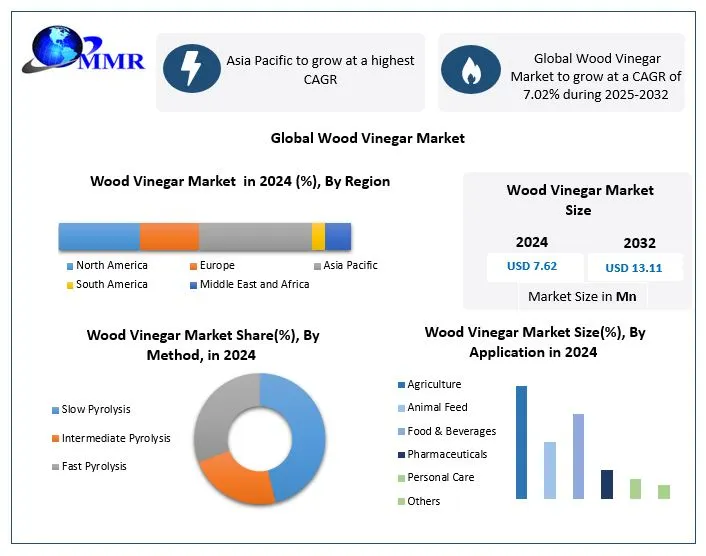 To know about the Research Methodology :- Request Free Sample Report
Wood Vinegar Market Dynamics:
Increased government regulations to Drive the Wood Vinegar Market
Increased government regulations regulating the use of crop protection chemicals, improved crop production, and rising consumer adoption of organic food products are likely to drive the growth of the global market forward throughout the forecast period. Also, the rising demand for wood vinegar in the pharmaceutical and cosmetic industries is a key factor driving the target market forward. Similarly, increasing use of wood vinegar in various sectors, cost-effective manufacturing, and increasing use of wood vinegar in the food industry to improve the flavour, color, and firmness of food products are all projected to drive market expansion in the near future.
Variations in Vinegar to Create Opportunities in the Wood Vinegar Market
The widespread use of wood vinegar in a variety of applications may present attractive prospects for firms in the target market all over the world. The increased demand for organic food, bio-based agricultural inputs, and the product's widespread use in animal feed and medicine. Wood vinegar is in high demand because it aids plant growth. Maintains soil fertility, improves seed development, lowers odour, and prevents pests, rotting, and weed growth. Because wood vinegar can be made on a small or large scale in villages utilising local feedstock, poverty alleviation is a major driver of the industry.
Obstacles in manufacturing to Create Challenges in the Wood Vinegar Market
One of the possible restrictions on the expansion of the wood vinegar industry is that wood vinegar is made from a variety of organic sources. However, there are a number of obstacles associated with obtaining and making wood vinegar from these similar natural sources, which could result in inconsistent/unreliable outcomes, restricting its usage in a variety of industries. Furthermore, because so much of the wood required for charcoal manufacture comes from natural forests, forest exploitation is inevitable. Charcoal manufacturing is a major cause of deforestation around the world. The demand for charcoal and its by-products, such as wood vinegar for energy production, grows as the standard of living in developed and developing countries rises. As a result, governments have been required to issue rules governing the manufacture and sale of charcoal and its derivatives, so reducing overall charcoal output and, as a result, wood vinegar production.
Wood Vinegar Market Segment Analysis:
Based on Method, the Wood Vinegar Market is segmented into Slow Pyrolysis, Intermediate Pyrolysis and Fast Pyrolysis. In this, slow pyrolysis dominated the market in 2024 and is expected to dominate the market in the forecast period. Slow pyrolysis yields a critical amount of wood vinegar, a liquid component containing organic acids. Also, this approach has several advantages over other methods, including a better yield, lower temperature requirements, and the capacity to handle low quality and inhomogeneous feedstock, among others. Moreover, during the forecast period, the slow pyrolysis method is expected to expand at the fastest rate of in the wood vinegar market, the fast pyrolysis category had the second-largest share. This is due to its advantages, such as a shorter vapour residence period. The disadvantage of this method is that it requires a high temperature.
Based on Application, the Wood Vinegar Market is segmented into Agriculture, Animal Feed, Food & Beverages, Pharmaceuticals, Personal Care & Cosmetics, and Others. Agriculture dominated the market in 2024 and is expected to dominate the market in the forecast period also It's because wood vinegar is widely used in herbicides and fertilisers to reduce insect assault on crops. It decreases odour and aids in productive composting procedures when mixed with manure. It also acts as a stimulant for the creation of a wide range of enzymes and microorganisms, allowing for efficient nutrient absorption and cell growth in crops. It removes numerous germs that cause gastrointestinal sickness in poultry animals when used as a feed supplement with charcoal in chicken. It also helps in egg-laying.
Wood Vinegar Market Regional Insights:
Asia Pacific dominated the market in 2024 due to rapidly growing population and rampant Westernisation
The Asia Pacific region has dominated the market share, accounting for xx% in 2024. The rising meat consumption is being driven by a rapidly growing population and rampant Westernisation across the Asia Pacific. As a result, consumption of processed meat products is expected to rise, raising the demand for liquid smoke/wood vinegar for flavouring and preservation. Wood vinegar has cleared the way for Asian countries like India, where the agriculture industry accounts for a large portion of the country's GDP, to increase crop yielding capacity while retaining quality.
In addition, as customers' preferences for organic food products rise across the area, a greater number of farmers are adopting organic agricultural techniques, which is driving the market for bio pesticides and bio-based fertilisers like wood vinegar in the agricultural sector. As a result of these circumstances, the number of wood vinegar makers in the region is increasing in order to fulfil the growing demand for various industries, including food and beverage, agricultural, feed additives, food products, cosmetics, and others.
Wood Vinegar Market Competitive Landscape
Top players inWood Vinegar Market are B&G Foods, Inc., Verdi Life, ACE Pte Ltd., Green Life Company, and Biochar do Brasil. Among these, the ACE Pte Ltd and the B&G Foods company hold the largest share in the whole market. The ACE Pte Ltd is known for high-quality wood vinegar from sustainable pyrolysis activities, with 70% focus on agricultural and industrial markets in organic farming and soil conditioning. This is in contrast to B&G Foods, which utilizes food and agricultural product expertise to promote wood vinegar as a natural preservative and soil conditioner due to the need for green solutions. Both companies are positioned on innovation and sustainability, with ACE Pte Ltd positioned well in niche agri-markets and B&G Foods expanding wood vinegar to wider food and agri-product offerings, overall driving market growth and environmental impact through their multi-faceted.
The objective of the report is to present a comprehensive analysis of the Wood Vinegar Market to the stakeholders in the industry. The past and current status of the industry with the forecasted market size and trends are presented in the report with the analysis of complicated data in simple language. The report covers all the aspects of the industry with a dedicated study of key players that include market leaders, followers, and new entrants.
PORTER, PESTEL analysis with the potential impact of micro-economic factors of the market have been presented in the report. External as well as internal factors that are supposed to affect the business positively or negatively have been analyzed, which will give a clear futuristic view of the industry to the decision-makers.
The reports also help in understanding the Wood Vinegar Market dynamic, and structure by analyzing the market segments and projecting the Wood Vinegar Market size. Clear representation of competitive analysis of key players by Design, price, financial position, product portfolio, growth strategies, and regional presence in the Wood Vinegar Market make the report investor’s guide.
Wood Vinegar Industry Ecosystem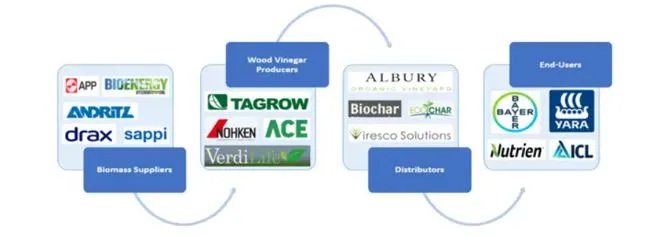
Wood Vinegar Market Key Trends
• Rising Demand in Organic & Sustainable Agriculture- Organic farming regulations (EU, USDA, India’s NPOP) are driving adoption of wood vinegar as a natural alternative to chemical pesticides & fertilizers.
• Technological & Product Innovations- Precision Agriculture (2024-2025): Startups are blending wood vinegar with IoT-based spraying systems for optimized crop treatment.
• Shift Towards Circular Economy & Waste Valorization- Companies like B&G Foods (USA) and Biochar do Brasil use forestry/agricultural waste to produce wood vinegar, reducing carbon footprint.
Wood Vinegar Market Key Developments
| Year | Company Name | Recent Development |
| January 15, 2025 | B&G Foods, Inc. (United States) | Acquired a small-scale wood vinegar producer in Oregon to strengthen its supply chain for organic inputs. |
| October 23, 2024 | Verdi Life – Netherlands (Europe) | Developed a wood vinegar-based animal feed additive to improve livestock digestion, tested in Dutch dairy farms. |
| March 12, 2025 | ACE Pte Ltd (Singapore) | Partnered with Singapore’s vertical farming startups to test wood vinegar in hydroponic systems. |
| November 5, 2024 | Green Life Company (UAE/Saudi Arabia) | Expanded exports to North Africa (Egypt & Morocco) for use in olive and citrus farming. |
| February 14, 2025 | Biochar do Brasil (Brazil) | Received organic certification from the Brazilian Ministry of Agriculture, boosting exports to Europe. |
Wood Vinegar Market Scope: Inquiry Before Buying
| Wood Vinegar Market | |||
|---|---|---|---|
| Report Coverage | Details | ||
| Base Year: | 2024 | Forecast Period: | 2025-2032 |
| Historical Data: | 2019 to 2024 | Market Size in 2024: | USD 7.62 Mn. |
| Forecast Period 2025 to 2032 CAGR: | 7.02% | Market Size in 2032: | USD 13.11 Mn. |
| Segments Covered: | by Method | Slow Pyrolysis Intermediate Pyrolysis Fast Pyrolysis |
|
| by Application | Agriculture Animal Feed Food & Beverages Pharmaceuticals Personal Care & Cosmetics Others |
||
Wood Vinegar Market by Region
North America (United States, Canada, and Mexico)
Europe (UK, France, Germany, Italy, Spain, Sweden, Austria, and the Rest of Europe)
Asia Pacific (China, South Korea, Japan, India, Australia, Taiwan, Indonesia, Philippines, Malaysia, Vietnam, Thailand, Rest of Asia Pacific region)
Middle East & Africa (South Africa, GCC, Nigeria, Rest of ME&A)
South America (Brazil, Argentina Rest of South America)
Wood Vinegar Market, Key Players are:
North America
1. B&G Foods, Inc. (United States)
2. Red Arrow International LLC (United States)
3. Baumer Foods, Inc. (United States)
4. Canada Renewable Bioenergy Corp (Canada)
5. New Life Wood Vinegar (USA)
Europe
1. Verdi Life – Netherlands (Europe)
2. Nettenergy – Netherlands (Europe)
3. Kerry Group PLC – Ireland (Europe)
4. ETIA S.A.S. (France)
5. Fasera (France)
Asia Pacific
1. ACE Pte Ltd (Singapore)
2. New Life Agro (India)
3. Doi & Co. Ltd (Japan)
4. Tagrow Co., Ltd. (South Korea)
5. Sane Shell Carbon (India)
6. Thai Wood Vinegar (Thailand)
7. Penta Manufacturer (Thailand)
8. Nakashima Trading Co. Ltd. (Japan)
9. Taiko Pharmaceutical Co., Ltd. (Japan)
10. Applied Gaia Corporation (Japan)
Middle East & Africa
1. Green Life Company (UAE/Saudi Arabia)
2. BioArabia (Saudi Arabia)
3. AfriPyro (Pty) Ltd (South Africa)
4. EcoGen Africa (Kenya)
5. AgriBio Solutions (Nigeria)
South America
1. Biochar do Brasil (Brazil)
2. Pirólise Brasil (Brazil)
3. Ecofogão (Brazil)
4. Carbono Sur (Argentina)
5. AgroPyro (Colombia)
Frequently Asked Questions:
1) Which industry is expected to increase the demand for the Wood Vinegar Market?
Ans. Agriculture industry is expected to increase the demand for Wood Vinegar.
2) Which region has the largest share in the Global Wood Vinegar Market?
Ans. The Asia Pacific region holds the highest share in 2024.
3) What was the Global Wood Vinegar Market size in 2024?
Ans. The Global Wood Vinegar Market size was USD 7.62 Mn in 2024.
4) What is the growth rate of the Wood Vinegar Market?
Ans. The Global Wood Vinegar Market is growing at a CAGR of 7.02% during the forecasting period 2025-2032.
5) Which are the top Companies in the wood vinegar industry?
Ans. Tagrow co. Ltd, Shandong Toroyal Group, New Life Agro, Verdi Life are some of the top companies in the wood vinegar industry.