
Wire Bonder Equipment Market – Industry Structure Evaluation, Demand Drivers Analysis, Regional Growth Analysis and Identification, Competitive Positioning / Landscape Review & Global Market Size Forecast to 2032
Overview
Global Wire Bonder Equipment Market size was valued at USD 902.5 Million. in 2024, and is expected to grow by 9.8 % from 2025 to 2032, reaching nearly USD 1906.63 Million.
Wire Bonder Equipment Market Overview:
Wire bonding is the technique of establishing electrical connections between semiconductors and silicon chips using extremely fine bonding wires, typically made from materials such as gold or aluminum. Among the most widely used methods are gold ball bonding and aluminum wedge bonding. Gold wire bonding is carried out through the thermosonic bonding process.
The Wire Bonder Equipment Market is experiencing steady growth, driven by the rising demand for advanced semiconductor packaging solutions across industries such as consumer electronics, automotive, and telecommunications. Wire bonding is one of the most widely used interconnection technologies in semiconductor assembly, valued for its cost-effectiveness, reliability, and flexibility in connecting integrated circuits to substrates. With the rapid proliferation of smartphones, IoT devices, and automotive electronics, the need for efficient bonding equipment has expanded significantly, pushing manufacturers to adopt high-precision and high-speed wire bonders.
Technological advancements with innovations in bonding techniques, automation, and process optimization. Manufacturers are focusing on equipment capable of handling complex chip architectures and smaller geometries, as the trend toward miniaturization continues. The shift to advanced packaging methods, such as system-in-package (SiP) and 3D packaging, is also creating new opportunities for wire bonder equipment suppliers. Additionally, the growing integration of electronics in electric vehicles and renewable energy systems supports Wire Bonder Equipment market growth.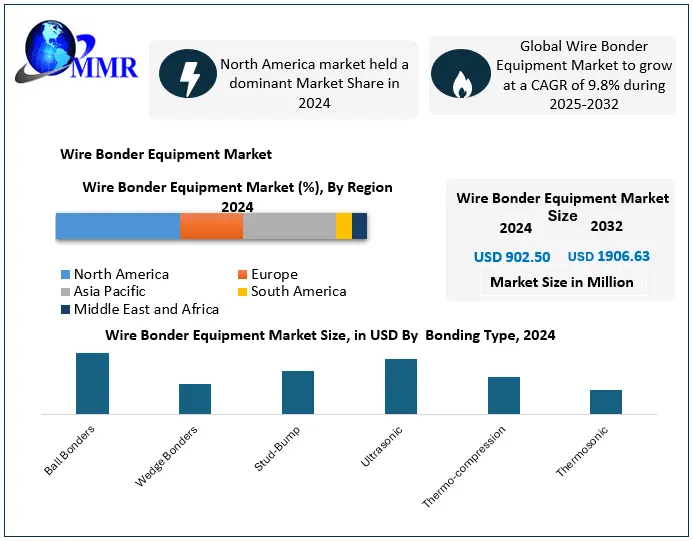 To know about the Research Methodology :- Request Free Sample Report
Wire Bonder Equipment Market Dynamics:
Automation, Miniaturization, and Semiconductor Demand to Drive Wire Bonder Equipment Market Growth
The proliferation of smartphones, wearables, and IoT devices has intensified the need for advanced semiconductor packaging solutions, thereby boosting the adoption of wire bonding technologies. For instance, semiconductor giants in Asia-Pacific, such as TSMC and ASE Group, are increasingly deploying advanced wire bonders to meet the demand for miniaturized and high-density chip packaging. The rising demand for compact and high-performance electronic devices is a major catalyst for the Wire Bonder Equipment Market.
The automotive sector is robust sector, with the growing integration of electronics in electric vehicles (EVs), ADAS, and infotainment systems fueling the need for reliable interconnection technologies. Governments promoting EV adoption through subsidies in regions like China and Europe are indirectly stimulating demand for semiconductor packaging equipment, including wire bonders. The technological advancements in automation, AI-based inspection, and high-precision bonding tools are improving speed, yield, and process accuracy. Equipment providers such as ASMPT and Kulicke & Soffa are investing heavily in R&D to support advanced packaging trends like 3D integration and system-in-package (SiP), further propelling Wire Bonder Equipment Market growth.
High Costs and Competition from Alternative Technologies Restrain Wire Bonder Equipment Market Growth
Despite promising opportunities, high capital costs associated with advanced wire bonder equipment hinder adoption, especially among small and mid-sized semiconductor manufacturers. For example, deploying fully automated, high-speed bonders requires substantial investment, limiting their accessibility in developing economies. This cost barrier slows down widespread adoption, restricting the pace of Wire Bonder Equipment Market growth.
The challenge lies in the competition from alternative interconnection technologies such as flip-chip and wafer-level packaging, which offer enhanced performance for certain high-end applications. As industries like 5G and AI increasingly demand higher-speed and lower-latency devices, reliance on these alternatives reduce the growth potential of traditional wire bonding. Additionally, the complexity of bonding fine-pitch and ultra-thin wires requires highly skilled labor and precise equipment calibration, creating operational challenges.
Infrastructure disparities act as a restraint, with some semiconductor clusters in emerging Wire Bonder Equipment Market lacking access to advanced packaging ecosystems. This gap hinders the adoption of wire bonders in regions with rising electronics demand but limited technological capability. Data security and IP protection within automated bonding systems further add to the concerns of manufacturers, slowing decision-making for large-scale adoption.
Scenarios from Advanced Packaging, Regional Expansion, and Sustainability Trends
The shift toward heterogeneous integration, system-in-package (SiP), and 3D packaging is opening new avenues for wire bonders capable of handling complex chip architectures. Vendors investing in hybrid bonding solutions that combine wire bonding with flip-chip technologies can tap into next-generation semiconductor demand.
Emerging markets in Southeast Asia, India, and South America untapped potential, as governments are investing in semiconductor manufacturing under initiatives such as “Make in India” and “Chip 4 Alliance.” Establishing localized assembly and test facilities in these regions creates strong demand for cost-effective wire bonding equipment.
Sustainability trends provide growth opportunities, as manufacturers increasingly demand energy-efficient equipment that reduces material waste and supports green semiconductor manufacturing. Companies offering eco-friendly and AI-integrated wire bonding solutions gain a competitive edge in winning contracts from environmentally conscious semiconductor producers. The partnerships with the automotive and renewable energy sectors can unlock additional revenue streams as the adoption of EVs, solar, and wind technologies accelerates globally. These are the factors that are expected to drive the growth of the global wire bonder equipment market during the forecast period.
Wire Bonder Equipment Market Segment Analysis:
Based on the Product, the Wire Bonder Equipment Market is segmented into Manual, Semi-Automatic, and Fully Automatic equipment. Among these, Fully Automatic wire bonders dominate the market due to their ability to deliver the high throughput, precision, and efficiency required in mass semiconductor production. These machines are designed for mass production, offering high-speed bonding, reduced cycle time, and improved yield, which are critical as consumer electronics, automotive, and IoT applications demand increasingly complex and miniaturized chips. Companies like ASMPT, Kulicke & Soffa, and Hesse GmbH lead innovation in fully automated systems, integrating AI-based inspection, advanced machine vision, and robotic handling to achieve superior accuracy and reliability.
The dominance of Fully Automatic bonders is strengthened by the global shift toward Industry 4.0 and smart manufacturing, where automation reduces labor costs, enhances consistency, and improves process control. In contrast, manual and semi-automatic bonders cater mainly to niche research, prototyping, or low-volume applications. With semiconductor fabs expanding worldwide and governments investing in chip production (e.g., the U.S. CHIPS Act, Europe’s Chips Initiative), demand for automated solutions surge. Consequently, Fully Automatic wire bonders continue to dominate the Wire Bonder Equipment Market, offering unmatched scalability and efficiency for high-volume production environments.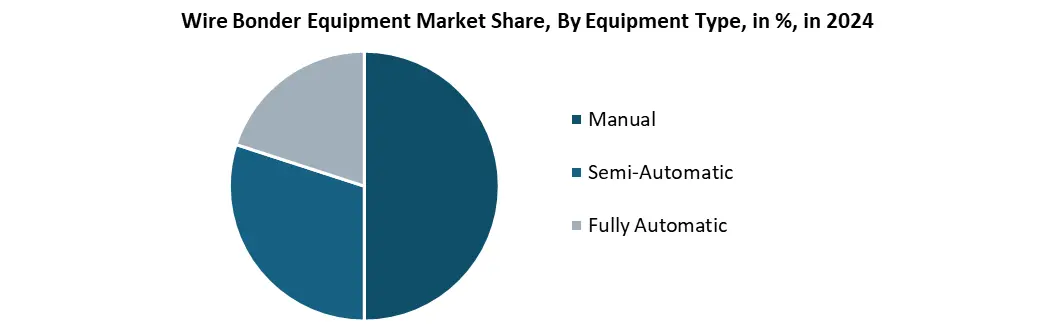
Based on the Bonding Type, the Wire Bonder Equipment Market is categorized into Ball Bonders, Wedge Bonders, Stud-Bump, Ultrasonic, Thermo-compression, and Thermosonic bonding technologies. Among these, Ball Bonders dominated the market in 2024, accounting for the largest revenue share and continued its dominance during the forecast period. This technology is widely used across consumer electronics, automotive, telecommunications, and industrial electronics, making it the most established and scalable bonding solution in semiconductor packaging. Ball bonding enables fine-pitch interconnections using gold, copper, or silver wires, supporting the miniaturization trend in smartphones, wearables, and IoT devices. Its ability to handle high I/O density packages while maintaining low production costs ensures its leadership over other bonding techniques.
Manufacturers like ASMPT and Kulicke & Soffa continue to innovate in ball bonding by introducing high-speed, automated bonders capable of handling ultra-thin wires and small geometries, meeting the requirements of advanced packaging technologies such as system-in-package (SiP) and 3D ICs. While wedge bonding and advanced methods like thermo-compression or ultrasonic bonding are essential for niche, high-reliability applications (aerospace, MEMS, optoelectronics), ball bonders remain the industry’s backbone due to their efficiency in high-volume production.
Wire Bonder Equipment Market Regional Insights:
The North American region is expected to dominate the Wire Bonder Equipment Market during the forecast period 2025-2032. This is due to the presence of established and cutting-edge manufacturers in the region. In North America, the U.S. is a significant market because the region is producing more electronics.
The objective of the report is to present a comprehensive analysis of the Global Wire Bonder Equipment Market to the stakeholders in the industry. The past and status of the industry with the forecasted market size and trends are presented in the report with the analysis of complicated data in simple language. The report covers all the aspects of the industry with a dedicated study of key players that include market leaders, followers, and new entrants.
PORTER, PESTEL analysis with the potential impact of micro-economic factors of the market has been presented in the report. External as well as internal factors that are supposed to affect the business positively or negatively have been analyzed, which will give a clear futuristic view of the industry to the decision-makers.
The reports help in understanding the Global Wire Bonder Equipment Market dynamic and structure by analyzing the market segments and projecting the Global market size. Clear representation of competitive analysis of key players by Distribution Channel, price, financial position, product portfolio, growth strategies, and regional presence in the Wire Bonder Equipment Market report investor’s guide.
Competitive Landscape of Wire Bonder Equipment Market
The Wire Bonder Equipment Market has a moderately consolidated competitive environment, driven by a few significant global players (Kulicke & Soffa, BE Semiconductor Industries, ASM Pacific Technology, Hesse Mechatronics and Shinkawa Ltd). These global players dominate through differentiated wire bonding technologies comprising ball bonders, wedge bonders and multi-chip flip-chip bonders. Product innovation is an important related strategy, where players such as Kulicke & Soffa introduce highly automated and high-speed systems that enhance precision and throughput in high-performance semiconductor packaging. Besi is also a player that stresses multi-functional systems such as "Datacon 2200 evo plus" which underscores the industry's embrace of advanced packaging and hybrid integration.
In terms of geographical market dynamics, the Asia Pacific region is the leading segment of the wire bonder equipment market, mainly attributed to the massive semiconductor manufacturing base in this area. North America, while seeing declining manufacturing activity, is similarly bolstered by rapidly growing research and development and localized production. ASMPT's expansion of operations in China boasts of new materials plants that are representative of a locally concentrated growth strategy. The wire bonder business trend is also reflecting a noteworthy collaboration between wire bond equipment vendors, IDMs and "OSAT" companies that develop application-specific, bonding solutions. New emerging players such as TPT Wire Bonder and F&S Bondtec are also developing a market presence in research laboratories and low-volume production equipped with reasonably priced and compact equipment. Competition hinges upon equipped technical advancement, automation, regional expansion, and continued.
Recent key developments in the Wire Bonder Equipment market
1. 2022– North America (U.S.) – Promex Industries / Besi
Installed several “2200 evo plus” die bonders used for flip-chip, die-attach and multi-chip applications as fourth-generation technology to grow capacity in the market segment for semiconductor packaging in North America.
key trends in the Wire Bonder Equipment Market
1. Shift Towards Advanced Packaging and Multi-Chip Integration
• Trend: The market is seeing a distinct shift towards advanced semiconductor packaging, with wire bonders now doing more multi-chip, flip-chip, and hybrid integration to support compact and high-performance electronic devices.
• Examples: Besi (Netherlands, 2022) introduced the “Datacon 2200 evo plus” automatic wire wedge bonder, capable of high-speed and multi-wire bonding applications.
2. Increased Automation for High-Throughput, High-Precision
• Trend: Manufacturers are increasingly concentrating on automation and process improvements with wire bonding systems to achieve increased accuracy, higher throughput, and cost-effectiveness in semiconductor assembly.
• Examples: Kulicke & Soffa (USA, March 2024) launched an automated wire bonder designed to improve throughput and bonding precision for they key high-performance semiconductor packaging applications.
3. Regional Expansion & Localization of Manufacturing
• Trend: Companies are expanding or localizing their production plants in Asia Pacific and other regions to strengthen their supply chains and support demand for wire bonder materials and equipment.
• Examples: ASM Pacific Technology (China, 2023) signed an agreement with the Jiangxi Government to establish a semiconductor materials manufacturing plant.
Wire Bonder Equipment Market Scope: Inquire before buying
| Wire Bonder Equipment Market | |||
|---|---|---|---|
| Report Coverage | Details | ||
| Base Year: | 2024 | Forecast Period: | 2025-2032 |
| Historical Data: | 2019 to 2024 | Market Size in 2024: | USD 902.50 Mn. |
| Forecast Period 2025 to 2032 CAGR: | 9.8% | Market Size in 2032: | USD 1906.63 Mn. |
| Segments Covered: | by Equipment Type | Manual Semi Automatic Fully Automatic |
|
| by Bonding Type | Ball Bonders Wedge Bonders Stud Bump Ultrasonic Thermo compression Thermosonic |
||
| by Wire Material | Gold Copper Aluminum Others |
||
| by End-Use Industry | Consumer Electronics Automotive Healthcare Aerospace & Defense Industrial Sensors Telecomm |
||
Wire Bonder Equipment Market, by Region
North America (United States, Canada, Mexico)
Europe (United Kingdom, France, Germany, Italy, Spain, Sweden, Russia, Rest of Europe)
Asia Pacific (China, South Korea, Japan, India, Australia, Indonesia, Malaysia, Philippines, Thailand, Vietnam, Rest of Asia Pacific)
Middle East and Africa (MEA) (South Africa, GCC, Nigeria, Rest of MEA)
South America (Brazil, Argentina, Colombia, Chile, Rest of South America)
Wire Bonder Equipment Market, Key Players
North America
1. Kulicke & Soffa Industries, Inc. (USA)
2. Promex Industries Inc. (USA)
3. West·Bond, Inc. (USA)
4. Hybond Inc. (USA)
5. Palomar Technologies (USA)
6. MRSI Systems (USA)
Europe
7. BE Semiconductor Industries N.V. (Besi) (Netherlands)
8. Hesse Mechatronics GmbH (Germany)
9. F&S Bondtec Semiconductor GmbH (Austria)
10. TPT Wire Bonder GmbH (Germany)
11. Kulicke & Soffa Europe B.V. (Netherlands – Regional Office)
12. Amada Miyachi Europe (Germany/UK)
Asia-Pacific
13. ASM Pacific Technology Ltd. (ASMPT) (Hong Kong / China)
14. Shinkawa Ltd. (Japan)
15. Panasonic Smart Factory Solutions Co., Ltd. (Japan)
16. Kaijo Corporation (Japan)
17. KAIJO SHIBUYA Corporation (Japan)
18. Toray Engineering (Japan)
19. K&S China Operations (Shanghai)
Middle East & Africa
20. Kulicke & Soffa – Middle East
21. Hesse Mechatronics
22. Microtronix Manufacturing (South Africa)
23. Technion-Israel Institute of Technology (Israel)
South America
24. ASM Pacific Technology – Brazil Division
25. Kulicke & Soffa – South America
26. West·Bond – South America
27. Palomar Technologies – Mexico & Brazil
28. Microcontrol Automação (Brazil)
29. Semicondutores do Brasil (Brazil, South America)
Frequently Asked Questions:
1] Which region is expected to hold the highest share in the Wire Bonder Equipment Market?
Ans. The North American region is expected to hold the highest share in the market.
2] Who are the top key players in the Wire Bonder Equipment Market?
Ans. ASM Pacific Technology, Kulicke & Sofa Industries Inc., Palomar Technologies, F&K Delvotec Bondetechnik, DIAS Automation (HK) Ltd., F & S BONDTEC Semiconductor GmbH, SHINKAWA Ltd., TPT Wirebonder GmbH & Co., and West Bond Inc. are the top key players in the Wire Bonder Equipment Market.
3] Which segment is expected to hold the largest market share in the Wire Bonder Equipment Market by 2032?
Ans. Ball bonders segment is expected to hold the largest market share in the market by 2032.
4] What is the market size of the Wire Bonder Equipment Market by 2032?
Ans. The market size of the Wire Bonder Equipment Market is expected to reach USD 1906.63 Mn. by 2032
5] What was the market size of the Wire Bonder Equipment Market in 2024?
Ans. The market size of the market was worth USD 902.50 Mn. in 2024.