
Wi-Fi Analytics Market Size – Industry Structure Evaluation, Demand Drivers Analysis, Regional Growth Analysis and Identification, Competitive Positioning Review & Global Market Size Forecast to 2032
Overview
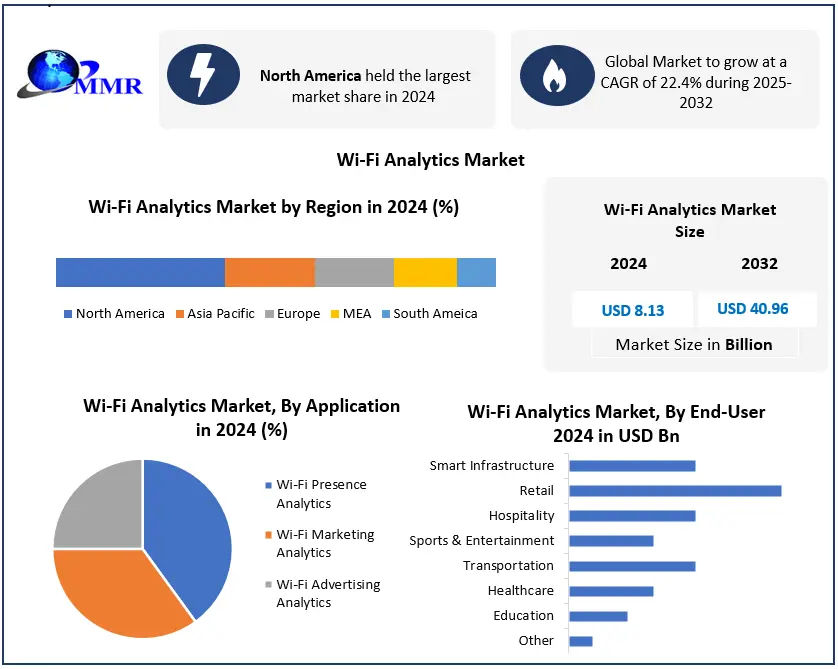
The Wi-Fi Analytics Market was valued at USD 8.13 Bn in 2024, and total global Wi-Fi Analytics Market revenue is expected to grow at a CAGR of 22.4% and reach nearly USD 40.96 Bn from 2025-2032, driven by customer analytics, targeted marketing, footfall tracking.
Wi-Fi analytics is gathering and scrutinizing customer data from Wi-Fi devices via access points. It supports in enhancing business operations, layouts, and marketing strategies. The Wi-Fi analytics market is experiencing rapid growth and evolution, driven by the increasing reliance on Wi-Fi connectivity across various industries. As of the current scenario, businesses are leveraging Wi-Fi analytics to gain insights into customer behavior, preferences, and demographics by collecting data from Wi-Fi-enabled devices through access points. This data is then analyzed to optimize business operations, enhance physical layouts, and tailor marketing initiatives for targeted audiences. Key growth factors boosting the market include the rising number of smart devices, increased demand for location-based services, and the need for personalized customer experiences.
The emergence of advanced analytics tools and artificial intelligence technologies further boosts market growth by enabling deeper analysis and predictive capabilities. Recent developments by market key players reflect the continuous innovation within the Wi-Fi analytics landscape. Major players such as Cisco Systems, Inc., Huawei Technologies Co., Ltd., Aruba Networks (HPE), Purple WiFi, Cloud4Wi, and Euclid Analytics have been actively enhancing their Wi-Fi analytics solutions to offer more comprehensive features, including real-time analytics, predictive modeling, and integration with IoT devices.
Additionally, strategic partnerships, acquisitions, and product launches are shaping the competitive landscape, fostering greater market competitiveness and driving innovation. For instance, recent initiatives include Cisco's acquisition of July Systems to bolster its location-based services portfolio, Huawei's collaboration with Telefonica to deploy Wi-Fi analytics solutions for smart retail, and Purple WiFi's integration with third-party platforms to provide seamless data insights across various business verticals. Overall, the Wi-Fi analytics market is poised for significant growth, propelled by technological advancements, evolving consumer preferences, and the increasing need for data-driven decision-making in business operations.
 To know about the Research Methodology :- Request Free Sample Report
Wi-Fi Analytics Market Dynamics:
Rise in Smart Device Adoption with Emergence of Cloud-Based Solutions Driving Wi-Fi Analytics Market Growth
The increasing adoption of smartphones, tablets, and IoT devices driving the growth of Wi-Fi Analytics Market as widespread adoption of connected devices boosts the demand for insightful data analytics derived from Wi-Fi networks. For instance, in the retail sector, giants such as Starbucks utilize Wi-Fi analytics to gain deeper insights into customer behaviour and preferences. By analysing the devices customers use to connect to Wi-Fi, businesses can tailor targeted marketing campaigns and enhance customer experiences, ultimately driving foot traffic and increasing sales.
Number of Internet of Things (IoT) connected devices worldwide forecasts from 2023 to 2030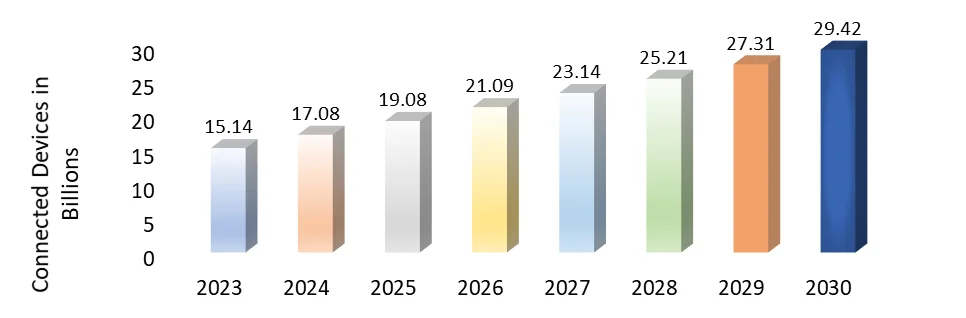 Wi-Fi analytics plays a major role in various industries beyond retail. For example, in the hospitality sector, hotels leverage Wi-Fi analytics to gather valuable data on guest demographics and preferences, enabling them to personalize services and amenities. Similarly, airports utilize Wi-Fi analytics to optimize terminal layouts, track passenger movements, and provide real-time updates on flight statuses, enhancing both operational efficiency and passenger satisfaction. Continuous advancements in analytics technologies, such as machine learning algorithms, further enhance the capabilities of Wi-Fi analytics solutions. This integration of cutting-edge technologies allows businesses to predict customer behaviors and tailor services accordingly, leading to improved customer satisfaction and loyalty. The adoption of cloud-based Wi-Fi analytics platforms offers scalability, flexibility, and cost-effectiveness, driving their adoption across various sectors, including healthcare, restaurants, and theme parks.
High initial investment Hinders the Wi-Fi Analytics Market Growth
The growing worry over data privacy hindering the growth of Wi-Fi Analytics Market as many of the businesses gathering and studying large volumes of customer data, it's important to follow rules such as GDPR and CCPA. For example, in 2018, Google was criticized for tracking where users went, even if they'd turned off location history. This emphasizes how vital it is for Wi-Fi analytics to be upfront and clear about how they handle people's data. Security risks further exacerbate these concerns, exemplified by the massive Equifax data breach in 2017, which compromised sensitive data of millions, underscoring the vulnerability of large-scale databases and emphasizing the imperative for robust security measures in Wi-Fi analytics platforms.
Key Guidelines for Wi-Fi Analytics Implementation
| Rule | Description |
| Trust over transactions | This rule emphasizes the importance of obtaining meaningful consent from individuals before collecting and using their personal data. Companies should prioritize building trust with customers by clearly explaining how their data will be used and obtaining consent in a transparent manner. |
| Insight over identity | Companies should focus on extracting insights from data without compromising individual privacy or security. Rather than transferring large amounts of personal identifiable information (PII), technologies like federated learning and trust networks allow for the extraction of insights while keeping data anonymous and secure. |
| Flows over silos | Collaboration between CIOs (Chief Information Officers) and CDOs (Chief Data Officers) is essential to facilitate the flow of insights within organizations. By breaking down data silos and working together, organizations can maximize the value of consented data for the benefit of customers. |
Limited Wi-Fi coverage in certain areas, such as remote rural regions or underground transportation systems, presents a formidable obstacle to accurate data collection and analysis also hampers the growth of Wi-Fi Analytics Market. Integration complexity adds another layer of challenge, as businesses struggle to seamlessly integrate Wi-Fi analytics solutions with existing IT infrastructure, hindering efficient data utilization and analysis. The high cost of implementation prevents smaller businesses from investing in sophisticated Wi-Fi analytics platforms, further widening the accessibility gap affecting the growth of Wi-Fi Analytics Market.
The Wi-Fi Analytics Market also grapples with a shortage of skilled professionals proficient in data science and analytics, hindering effective implementation and management of Wi-Fi analytics initiatives. Ensuring the accuracy of data analysis amidst signal interference and environmental factors poses a significant challenge, impacting the reliability of insights generated. User opt-out preferences, driven by growing awareness of data privacy, and regulatory compliance burdens, such as HIPAA regulations in healthcare, compound the challenges facing the Wi-Fi analytics market. Ethical considerations surrounding surveillance, consent, and data ownership are some major challenges, necessitating clear policies and guidelines to navigate responsibly.
Number of internet connections in rural and urban areas of India from financial year 2018 to 2023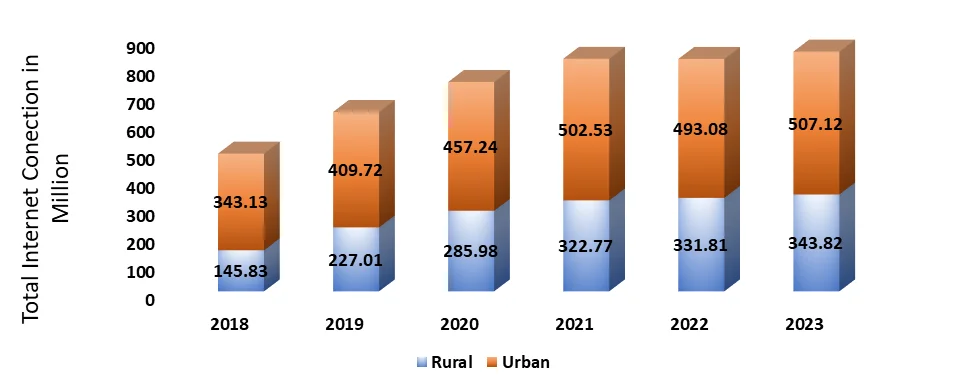
Wi-Fi Analytics Market Segment Analysis:
Based on Component, Solutions segment dominated the Wi-Fi Analytics Market in 2024 it includes software platforms and hardware devices tailored for Wi-Fi data analysis, finding application across various industries such as retail, hospitality, transportation, and smart cities. These solutions enable businesses to gather valuable insights into customer behaviour, optimize operations, and enhance user experiences. While services in Wi-Fi analytics include managed services and professional services, offering support, consulting, customization, and integration.
Managed services are increasingly adopted by enterprises seeking outsourced network management tasks, ensuring continuous functionality and optimization of Wi-Fi networks. Professional services cater to specific business needs, driving adoption among industries with complex data requirements such as healthcare and manufacturing. While solutions provide the technological backbone for Wi-Fi analytics, services complement them by offering support and customization, thereby contributing to the Wi-Fi Analytics market growth.
Based on Application, the Wi-Fi analytics market is segmented into Wi-Fi presence analytics, Wi-Fi marketing analytics, and Wi-Fi advertising analytics. Wi-Fi presence analytics dominated as it helps businesses track customer movement, dwell time, and footfall to enhance operational efficiency and customer experiences. Wi-Fi marketing analytics is gaining traction due to its ability to collect customer data and preferences, enabling personalized campaigns and targeted promotions. Wi-Fi advertising analytics focuses on evaluating the performance of ads delivered over Wi-Fi networks, optimizing content and placement for better engagement. Together, these applications drive data-driven strategies in retail, hospitality, and smart venues.
Wi-Fi Analytics Market Regional Insights:
North America Dominance in the Wi-Fi Analytics Market
North America dominated the Wi-Fi Analytics Market in 2023, with a growth rate of 8.5%. This growth is driven by the high adoption of IoT devices, particularly in retail, where businesses leverage Wi-Fi analytics to enhance customer experiences through location-based services and targeted marketing campaigns. The emphasis on customer-centric approaches in retail further boosts the demand for Wi-Fi analytics solutions to gain valuable insights into consumer behavior and preferences.
In Europe, the Wi-Fi analytics market is rapidly growing as Stringent data privacy regulations such as GDPR (General Data Protection Regulation) drive the adoption of Wi-Fi analytics solutions that prioritize user consent and data protection. The increasing focus on smart city initiatives across European countries fosters the adoption of Wi-Fi analytics for urban planning, transportation optimization, and public services improvement. Cloud-based solutions are gaining traction in Europe, enabling businesses to leverage advanced analytics capabilities while ensuring compliance with data privacy regulations.
Across the Asia Pacific region, the Wi-Fi analytics market is growing with a growth rate of 10.1%. Rapid urbanization and the expansion of retail and hospitality sectors drive the adoption of Wi-Fi analytics solutions to meet the growing demand for personalized services and enhanced customer experiences. Government investments in smart infrastructure projects further drive the Wi-Fi Analytics Market growth, particularly in countries such as China and India. The Asia Pacific region presents significant opportunities for Wi-Fi analytics vendors to tap into the burgeoning market and address the evolving needs of businesses and governments in the region.
Global Wi-Fi Analytics Market Scope: Inquire before buying
| Wi-Fi Analytics Market | |||
|---|---|---|---|
| Report Coverage | Details | ||
| Base Year: | 2024 | Forecast Period: | 2025-2032 |
| Historical Data: | 2019 to 2024 | Market Size in 2024: | USD 8.13 Bn. |
| Forecast Period 2025 to 2032 CAGR: | 22.4% | Market Size in 2032: | USD 40.96 Bn. |
| Segments Covered: | by Component | Solutions Services |
|
| by Deployment Mode | Cloud On-Premises |
||
| by Application | Wi‑Fi Presence Analytics Wi‑Fi Marketing Analytics Wi‑Fi Advertising Analytics |
||
| by End-User | Smart Infrastructure Retail Hospitality Sports & Entertainment Transportation (Airports, Transit) Healthcare Education Other |
||
Global Wi-Fi Analytics Market, by Region
North America (United States, Canada, and Mexico)
Europe (UK, France, Germany, Italy, Spain, Sweden, Austria, and the Rest of Europe)
Asia Pacific (China, South Korea, Japan, India, Australia, ASEAN, Indonesia, Philippines, Malaysia, Vietnam, Thailand, ASEAN, Rest of Asia Pacific)
Middle East & Africa (South Africa, GCC, Nigeria, Rest of ME&A)
South America (Brazil, Argentina, Rest of South America)
Global Wi-Fi Analytics Market Key Players
Major Contributors in the Wi-Fi Analytics Industry in North America:
1. Adentro, USA
2. Zimperium, USA
3. People Power, USA
4. Kraken Sense, Canada
5. Cloud4Wi, USA
6. Theatro, USA
7. Bloom Intelligence, USA
Leading Figures in the European Wi-Fi Analytics Sector:
1. Navenio, United Kingdom
2. Huq Industries Limited, United Kingdom
3. Cambium Networks Ltd, United Kingdom
4. Purple, United Kingdom
5. OpenSignal, United Kingdom
6. Relayr, Germany
7. Briteyellow, United Kingdom
8. WiCastr, United Kingdom
9. Social WiFi, Poland
10. Infsoft, Germany
Key players driving the Asia-Pacific Wi-Fi Analytics Market:
1. Localz, Australia
2. Locarise, Japan
3. Zenatix, India
FAQs:
1] What Major Key players in the Global Market report?
Ans. The Major Key players covered in the Market report are Navenio,Huq Industries Limited,Cambium Networks Ltd,Purple, OpenSignal, Relayr, Briteyellow, WiCastr
2] Which region is expected to hold the highest share in the Global Market?
Ans. Asia Pacific region is expected to hold the highest share in the Market.
3] What is the market size of the Global Market by 2032?
Ans. The market size of the Wi-Fi Analytics Market by 2032 is expected to reach USD 40.96 Billion.
4] What is the forecast period for the Global Market?
Ans. The forecast period for the Market is 2025-2032.
5] What was the market size of the Global Market in 2024?
Ans. The market size of the Market in 2024 was valued at USD 8.13 Billion.