
Welding Consumables Market by Product Type, Welding Technique, End-use Industry and Region – Global Market Size Estimation, Industry-Wide Analysis, Competitive Landscape Assessment & Long-Term Forecast to 2034
Overview
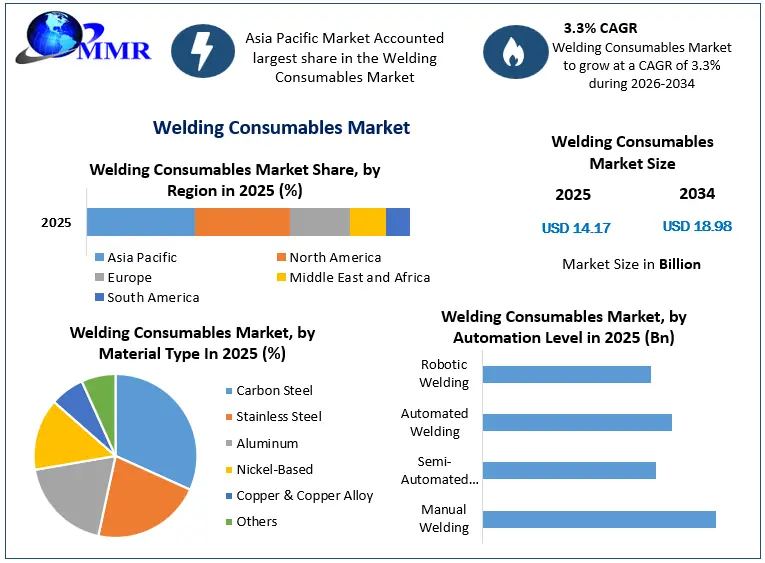
The Welding Consumables Market size was valued at USD 14.17 Billion in 2025 and the total Welding Consumables revenue is expected to grow at a CAGR of 3.3% from 2026 to 2034, reaching nearly USD 18.98 Billion.
Welding Consumables Market Dynamics:
Increasing demand for automated welding solution from end-use industries such as automotive, aerospace, construction, engineering and others are driving the market growth. On account of the ability to achieve short cycle time, decrease post weld work and minimize downtime & reject rates are traits penetrating its demand in end-use industries. Thriving construction and automotive sector in emerging economies expected to propel the market growth in the forecast period.
Increased application of welding consumables for repairing and maintenance is another factor boosting the market growth. Reintegration of old oil refineries coupled with the construction of new gas manufacturing facilities to fulfill global demand is contributing significantly in the market growth.
According to product type, the global welding consumables market can be segmented into stick electrodes, solid wires, flux cored wires, SAW wires & fluxes and others. The stick electrodes segment accounted for a xx% value share in 2025, and is anticipated to expand at a significant CAGR over the forecast period.
Welding Consumables Market Growth and Share Analysis
To know about the Research Methodology:-Request Free Sample Report
Welding Consumables Market Regional Insights:
Geographically, Asia Pacific excluding Japan accounts for the biggest market share of welding consumables market in terms of value in 2025 due to its large population and its rising demand for the construction, automobile, steel, and marine (oil and gas) industry. The market is probable to be dominant during the forecast period by 2034.
Europe and North America are completely developed markets for welding consumables providers and are anticipated to show consistent market growth over the forecast period. While the region of Middle East & Africa is projected to experience a considerable growth because of increasing demand for the automobile industry and accessibility of raw materials in automobile & transportation sector in this region.
Global welding consumables market report evaluates several vital segments to estimate the current size of welding consumables industry. The report covers significant details that derived from wide analysis of welding consumables market and its parent and peer markets. Before moving further, it has validated all of the findings, values, information by industry experts to offer a reliable analysis of the welding consumables industry. The report also comprises specific market breakdown was performed to analyze precise market of segments such as types, applications, leading manufacturers, regions, and technology.
The objective of the report is to present a comprehensive assessment of the market and contains thoughtful insights, facts, historical data, industry-validated market data and projections with a suitable set of assumptions and methodology. The report also helps in understanding global welding consumables market dynamics, structure by identifying and analyzing the market segments and project the global market size.
Further, the report also focuses on the competitive analysis of key players by product, price, financial position, product portfolio, growth strategies, and regional presence. The report also provides PEST analysis, PORTER’s analysis, SWOT analysis to address the question of shareholders to prioritizing the efforts and investment in the near future to the emerging segment in global welding consumables market.
Welding Consumables Market, Key Highlights:
1. Global Welding Consumables Market analysis and forecast, in terms of value.
2. Comprehensive study and analysis of market drivers, restraints and opportunities influencing the growth of the Global Welding Consumables Market
3. Global Welding Consumables Market segmentation on the basis of type, source, end-user, and region (country-wise) has been provided.
4. Global Welding Consumables Market strategic analysis with respect to individual growth trends, future prospects along with the contribution of various sub-market stakeholders have been considered under the scope of study.
5. Global Welding Consumables Market analysis and forecast for five major regions namely North America, Europe, Asia Pacific, the Middle East & Africa (MEA) and Latin America along with country-wise segmentation.
6. Profiles of key industry players, their strategic perspective, market positioning and analysis of core competencies are further profiled.
7. Competitive developments, investments, strategic expansion and competitive landscape of the key players operating in the Global Welding Consumables Market are also profiled.
Welding Consumables Market Recent Industry Developments:
| Date | Company | Development | Impact |
|---|---|---|---|
| 21 May 2026 | ESAB | Launched the Sentinel A70 PRO premium flip-up automatic welding helmet for heavy industrial use. | Enhances welder protection and productivity in demanding industrial environments. |
| 05 May 2026 | Ador Welding | Introduced the XLogic Welding Cobot at E Manufacturing EXPO 2026 to facilitate automated welding. | Simplifies automation adoption for carbon and stainless steel tasks, reducing setup time. |
| 25 February 2026 | ESAB | Collaborated with Linde to distribute EWM advanced welding technology in North America. | Provides U.S. fabricators access to advanced processes that boost performance and profitability. |
| 03 June 2025 | Lincoln Electric | Expanded retail distribution by adding its trusted welding solutions lineup to Tractor Supply stores. | Increases market accessibility for hobbyists and DIY users to professional-grade welding equipment. |
| 19 May 2025 | Lincoln Electric | Introduced the PRISM Robotic Line Hood specifically for large-scale automated production lines. | Improves safety and efficiency in large-scale robotic welding operations. |
Welding Consumables Market Scope: Inquire before buying
| Welding Consumables Market | |||
|---|---|---|---|
| Report Coverage | Details | ||
| Base Year: | 2025 | Forecast Period: | 2026-2034 |
| Historical Data: | 2020 to 2025 | Market Size in 2025: | 14.17 USD Billion |
| Forecast Period 2026-2034 CAGR: | 3.3% | Market Size in 2034: | 18.98 USD Billion |
| Segments Covered: | by Type | Stick Electrodes (SMAW) Solid Wires (MIG/MAG) Flux-cored Wires SAW Wires & Fluxes TIG Rods & Filler Metals Others |
|
| by Material Type | Carbon Steel Stainless Steel Aluminum Nickel-Based Copper & Copper Alloy Others |
||
| by Automation Level | Manual Welding Semi-Automated Welding Automated Welding Robotic Welding |
||
| by End-Use Industry | Building & Construction Automotive & Transportation Shipbuilding & Offshore Oil & Gas, Energy Infrastructure Power Generation & Energy Infrastructure Heavy Machinery & Industrial Equipment Aerospace & Defense Others |
||
Welding Consumables Market, by Region
North America (United States, Canada and Mexico)
Europe (UK, France, Germany, Italy, Spain, Sweden, Austria and Rest of Europe)
Asia Pacific (China, South Korea, Japan, India, Australia, Indonesia, Malaysia, Vietnam, Taiwan, Bangladesh, Pakistan and Rest of APAC)
Middle East and Africa (South Africa, GCC, Egypt, Nigeria and Rest of ME&A)
South America (Brazil, Argentina Rest of South America)
Welding Consumables Market Key Player
Welding Consumables Market
1. Stick Electrodes (Shielded Metal Arc Welding – SMAW Consumables)
Stick electrodes are coated metal rods used in manual arc welding processes. They provide filler metal and create a protective gas shield and slag layer during welding. They are widely used in construction, maintenance, pipeline welding, and heavy fabrication.
Key Players:
1. Lincoln Electric (United States)
2. ESAB Corporation (United States)
3. voestalpine Böhler Welding (Austria)
4. Kobe Steel – Kobelco Welding (Japan)
5. Ador Welding Limited (India)
6. KISWEL Co., Ltd. (South Korea)
7. Golden Bridge Welding Materials Group (China)
8. Tianjin Bridge Welding Materials Group (China)
2. Solid Wires & Flux-Cored Wires (MIG/MAG & FCAW Consumables)
Solid wires and flux-cored wires are extensively used in automated and semi-automated welding systems for high productivity, improved weld quality, and consistent performance. These consumables are highly adopted in automotive, shipbuilding, and industrial manufacturing.
Key Players:
1. Lincoln Electric (United States)
2. ESAB Corporation (United States)
3. Hyundai Welding Co., Ltd. (South Korea)
4. Kobe Steel – Kobelco Welding (Japan)
5. Nippon Steel Welding & Engineering (Japan)
6. KISWEL Co., Ltd. (South Korea)
7. Atlantic China Welding Consumables (China)
8. CS Holdings Co., Ltd. (South Korea)
3. Submerged Arc Welding (SAW) Wires & Fluxes
SAW consumables include specialized wires and granular flux materials used in high-deposition, automated welding processes for heavy-duty applications such as pressure vessels, pipelines, offshore structures, and large steel fabrication.
Key Players:
1. voestalpine Böhler Welding (Austria)
2. ESAB Corporation (United States)
3. Lincoln Electric (United States)
4. Kobe Steel – Kobelco Welding (Japan)
5. Tianjin Bridge Welding Materials Group (China)
6. Golden Bridge Welding Materials Group (China)
7. Ador Welding Limited (India)
4. Brazing & Soldering Consumables
Brazing and soldering consumables use filler metals with lower melting temperatures to join metals without melting the base materials. These products are commonly used in HVAC systems, electronics, automotive components, and precision manufacturing.
Key Players:
1. Harris Products Group (United States)
2. Lucas-Milhaupt (United States)
3. ESAB Corporation (United States)
4. Lincoln Electric (United States)
5. Fronius International GmbH (Austria)
5. Specialty & Hardfacing Welding Consumables
Specialty welding consumables include wear-resistant, corrosion-resistant, and high-performance alloy materials designed for repairing and protecting equipment operating under extreme conditions such as mining, cement, power generation, and oil & gas industries.
Key Players:
1. Welding Alloys Group (United Kingdom)
2. Capilla GmbH (Germany)
3. voestalpine Böhler Welding (Austria)
4. TASETO Co., Ltd. (Japan)
5. Gedik Welding Inc. (Turkey)
6. Hilarius Haarlem Holland B.V. (Netherlands)
6. Automated & Robotic Welding Consumables
These consumables are designed for robotic and automated welding systems, offering superior consistency, high deposition rates, and improved productivity for mass manufacturing applications.
Key Players:
1. Lincoln Electric (United States)
2. ESAB Corporation (United States)
3. Hyundai Welding Co., Ltd. (South Korea)
4. Fronius International GmbH (Austria)
5. Kobe Steel – Kobelco Welding (Japan)
6. KISWEL Co., Ltd. (South Korea)
Frequently Asked Questions:
1. Which region has the largest share in Global Welding Consumables Market?
Ans: North America region held the highest share in 2025.
2. What is the growth rate of Global Welding Consumables Market?
Ans: The Global Market is growing at a CAGR of 3.3% during forecasting period 2026-2034.
3. What is scope of the Global Market report?
Ans: Global Market report helps with the PESTEL, PORTER, COVID-19 Impact analysis, Recommendations for Investors & Leaders, and market estimation of the forecast period.
4. Who are the key players in Global Market?
Ans: The important key players in the Global Market are – voestalpine Bohler Welding GmbH, Hyundai Welding Co., Ltd., Illinois Tool Works Inc., The Lincoln Electric Company, Colfax Corporation, Hilarius Haarlem Holland B.V., Sandvik Materials Technology, EWM AG, Kobe Steel Ltd., Tianjin Bridge Welding Materials Group Co., Ltd., ESAB, ZULFI, KISWEL CO. LTD., CS HOLDINGS CO., LTD., RME MIDDLE EAST, Capilla, Miller Electric Mfg. LLC, and Taiyo Nippon Sanso Corporation.
5. What was the Global Welding Consumables Market size in 2025?
Ans: The Global Welding Consumables Market size was USD 14.17 Billion in 2025.