
Wastewater Diffused Aerator Market - Industry Structure Evaluation, Demand Drivers Analysis, Regional Growth Analysis and Identification, Competitive Positioning Review & Global Market Size Forecast to 2032
Overview
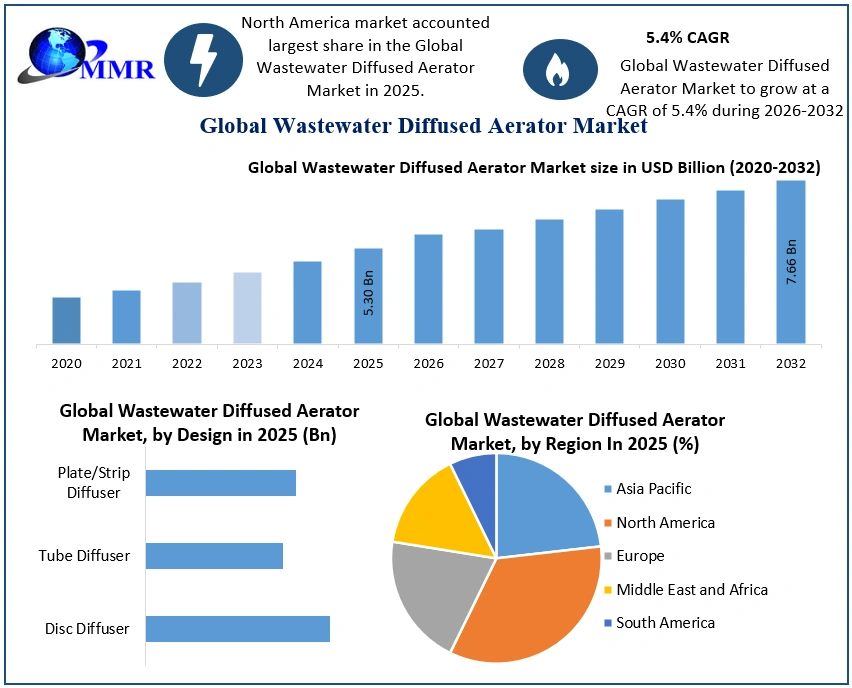
The Wastewater Diffused Aerator Market size was valued at USD 5.30 Billion in 2025 and the total Wastewater Diffused Aerator revenue is expected to grow at a CAGR of 5.4% from 2025 to 2032, reaching nearly USD 7.66 Billion by 2032.
Wastewater Diffused Aerator Market Overview
Wastewater diffused aerator is an essential component in modern wastewater treatment systems, designed to deliver fine bubbles into water to enhance oxygen transfer efficiency and support biological treatment processes.
Market growth is driven by rising urbanization, industrialization, and the growing need for effective municipal and industrial wastewater treatment solutions. Increasing adoption of advanced diffused aeration systems is fueled by regulatory pressures, sustainability goals, and the demand for energy-efficient technologies that lower operational costs and carbon footprints. North America leads the market due to robust environmental regulations and modernization of aging infrastructure. Europe is a mature market, supported by strict EU wastewater directives, widespread adoption of advanced treatment technologies, and increasing investments in upgrading and expanding wastewater infrastructure across countries like Germany, the UK, and France. Key players including Xylem Inc., EDI, Evoqua Water Technologies, and Fluence Corporation compete on technology innovation, system efficiency, cost-effectiveness, after-sales service, and global project expertise.
Report provides detailed insights into market dynamics, segment performance, and the competitive landscape, evaluating companies By Product, price positioning, technological strength, project portfolio, and strategic initiatives to forecast Wastewater Diffused Aerator Market size over the coming years.
 To know about the Research Methodology :- Request Free Sample Report
Wastewater Diffused Aerator Market Research Methodology:
Wastewater Diffused Aerator Market study involved both primary and secondary data sources. The research process involved the study of many factors affecting the industry, including the market environment, competitive landscape, historical data, present trends in the market, technological development, market risks, opportunities, market barriers and challenges. Global Market Size (Value) past status and outlook, market share, growth rate, and market segment. We have analyzed existing market stats. Also, we checked the consistency of definitions among different data validation and data sources like Ministries of Environment and Water Resources, EPA, EEA and others.
We have analysed the wastewater treatment scenario for each country for cross-checking the data. We also analysed competitive analysis data of companies, blogs, articles, news etc. While considering YoY we focus on the growth factors such as stringent environmental regulations, population and urbanization Technological advances and others.
Wastewater Diffused Aerator Market Dynamics:
Growing focus on eco-friendly water treatment technologies driving demand for wastewater diffused aerators. As per the statistics from the UN Water report, only 0.5% of the Earth's surface water is fresh and functioning for consumption. The variable ability of municipal utilities to supply sufficient volumes of usable water has led to an increased need for wastewater treatment plants, subsequently driving the demand for wastewater diffused aerators. Expanding industrialization has significantly increased the volumes of wastewater generated, mainly from energy and power generation, municipal water, and effluent treatment plants. This has spurred the installation of industrial wastewater plants, further driving the wastewater diffused aerators market. A study by MMR indicates that key players in the wastewater diffused aerators market are offering a variety of advanced products, like ceramic plate diffusers and membrane diffusers. Membranes can eliminate the cost of tertiary treatment systems while being durable, lightweight, and cost-effective. Furthermore, many manufacturers are heavily investing in research and development to enhance the lifespan of aerators, which boosts the wastewater diffused aerator market. Major players in the wastewater diffused aerators market offer a many of products with advanced characteristics, like ceramic plate diffusers and Membrane diffusers. Membranes will cut the cost of tertiary treatment systems in half. They also have the benefits of being long-lasting, lightweight, and cost-effective. The current trend of granting private companies water ownership rights is based on their quality. The aim of private ownership and privatization is to achieve economies of scale and higher profit margins. Private business that manages several facilities can be able to reap additional benefits. Manufacturers of wastewater diffused aerators are focusing on research and development and new product releases to keep up with the growing demand for energy-efficient products. Manufacturers of wastewater diffused aerators have described portfolio extension as one of their primary growth strategies.
Opportunities for Wastewater Diffused Aerator Manufacturers
The wastewater diffused aerator market is witnessing steady growth thanks to the increasing demand for effective wastewater treatment and management solutions. Diffused aerators are broadly used in wastewater treatment plants to improve oxygen levels and facilitate the growth of favourable bacteria that aid in breaking down organic matter. Key drivers of wastewater diffused aerator market include a growing population, urbanization, and stringent environmental regulations. The outlook for the market is promising, with the adoption of advanced technologies and the introduction of energy-efficient diffused aerators. Furthermore, the wastewater diffused aerator market is expected to see significant growth in developing economies with ongoing infrastructure development projects.
Wastewater Diffused Aerator Market Segment Analysis:
By Product, the Fine Bubble segment held the highest market share of about 63% in 2025 and is expected to dominate the market at the end of the forecast period. A greater emphasis on the use of aerators with polymer membranes will help to reduce the cost of tertiary treatment systems. Furthermore, they are robust, light in weight, and cost-efficient, all of which are expected to propel the wastewater diffused aerators market over the forecast period.

Fine bubble diffusers with EPDM or PTFE membranes have the highest efficiency for aeration with the shortest retention time, thanks to technical advances. Fine bubble technology is a form of subsurface aeration that uses very small (or fine) bubbles to inject air into water. Because of these features, fine bubble diffusers are being implemented in new installations as well as replacements in existing plants.
Wastewater Diffused Aerator Market Regional Analysis:
In 2025, North America region held 34% share in the wastewater diffused aerators market and is projected to be continue its dominance position during the forecast period. North America boasts a strong culture of innovation and research, continuously delivering advanced technologies and materials for producing ideal bubble diffusers. Industries in the region are heavily investing in research and development to enhance the performance, durability, and efficiency of diffuser products, aiming to meet the growing needs of wastewater treatment plants, aquaculture, and industrial applications. North America's stringent environmental regulations ensure proper wastewater treatment in the municipal and industrial sectors, further protecting aquatic ecosystems. These norms are driving the adoption of high-quality aerators, such as microbubble diffusers, thereby bolstering the Market.
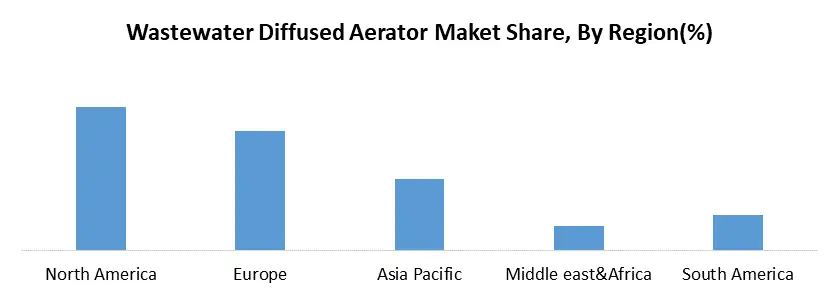
In Europe, countries like the U.K., Italy, Germany, France, and Russia are significant market. The increasing focus on sustainable wastewater treatment solutions and the presence of large industrial sectors drives the market growth in these countries. In the Asia-Pacific region, including countries like China, India, Japan, South Korea, and Australia, there is a increasing demand for wastewater treatment solutions because of rapid urbanization and industrialization. China is a major wastewater diffused aerator market due to its large population and increasing environmental concerns.
Competitive Landscape
Top key players in the Wastewater Diffused Aerator Market including Xylem Inc., Environmental Dynamics International, Evoqua Water Technologies, Fluence Corporation, and Sulzer Ltd., are leading the market through advanced engineering expertise, robust project portfolios, and strong global service networks. These companies are key global participants actively investing in energy-efficient designs, durable materials, and smart monitoring technologies that enhance operational performance while meeting strict environmental standards. Xylem Inc. is renowned for its leadership in sustainable water technologies, leveraging a broad range of diffused aeration solutions, integrated smart systems, and global project experience to maintain its position in the market. Environmental Dynamics International (EDI) focuses on high-efficiency fine and coarse bubble aerators, offering customized aeration systems that help municipalities and industries optimize oxygen transfer rates while reducing energy consumption. With increasing demand for sustainable, low-energy, and intelligent aeration solutions, these players are reshaping the competitive landscape through strategic collaborations, regional manufacturing hubs, and focused R&D investments in next-generation aeration technologies. They continue to strengthen their global footprint through partnerships with engineering firms, acquisitions, and participation in major infrastructure projects across developed and emerging regions.
Wastewater Diffused Aerator Market Trends
• Focus on Energy Efficiency and Carbon Reduction
o Major players like Xylem Inc. and Sulzer Ltd. are investing in aeration systems that significantly lower power consumption, as aeration accounts for 50–60% of energy use in wastewater treatment plants.
• Adoption of Smart and IoT-Enabled Systems
o There is increasing integration of digital monitoring, real-time data analytics, and automation in aeration systems. These smart solutions enable predictive maintenance, optimize oxygen delivery, and help operators reduce operational costs and downtime.
• Growth of Decentralized and Modular Wastewater Solutions
o Decentralized treatment units with integrated diffused aerators are gaining popularity, particularly in regions with rapid urbanization, remote industrial sites, and areas lacking centralized infrastructure. These systems offer scalability and faster deployment.
Recent Developments
|
Date |
Company | Development |
| (Quarter-1) 2025 | Fluence Corporation | Secured multiple municipal and industrial contracts in North America for its pre‑engineered wastewater solutions, including diffused aeration systems. |
| May 2024 | Xylem Inc. | Partnered with the German city of Weissenburg and Technical University of Munich to launch Reuse Brew, producing beer from recycled wastewater using advanced treatment tech |
| Dec 3, 2024 | Fluence Corporation | Received notice to proceed on a Euro 48.4 million addendum for the Lagune D’Aghien water treatment plant in Ivory Coast, supporting modular diffused aeration/treatment delivery in West Africa. |
Wastewater Diffused Aerator Market Scope: Inquire before buying
| Wastewater Diffused Aerator Market | |||
|---|---|---|---|
| Report Coverage | Details | ||
| Base Year: | 2025 | Forecast Period: | 2026-2032 |
| Historical Data: | 2020 to 2025 | Market Size in 2025: | 5.3 USD Bn |
| Forecast Period 2026-2032 CAGR: | 5.4% | Market Size in 2032: | 7.66 USD Bn |
| Segments Covered: | By Type | Fine Bubble Coarse Bubble |
|
| By System | Fixed Grid Retrievable Grid |
||
| By Design | Disc Diffuser Tube Diffuser Plate/Strip Diffuser |
||
| By Installation Type | New Installations Retrofit Installations |
||
| By End-User | Municipal Industrial Pulp & paper Petrochemical Textile Pharmaceutical Food & Beverages Oil & Gas Mining Power Others |
||
Wastewater Diffused Aerator Market, by Region
North America (United States, Canada and Mexico)
Europe (UK, France, Germany, Italy, Spain, Sweden, Austria and Rest of Europe)
Asia Pacific (China, South Korea, Japan, India, Australia, Indonesia, Malaysia, Vietnam, Taiwan, Bangladesh, Pakistan and Rest of APAC)
Middle East and Africa (South Africa, GCC, Egypt, Nigeria and Rest of ME&A)
South America (Brazil, Argentina Rest of South America)
Wastewater Diffused Aerator Market, Key Players
- Xylem Inc.
- Evoqua Water Technologies
- Fluence Corporation
- Sulzer Ltd.
- Aqua-Aerobic Systems, Inc.
- Environmental Dynamics International (EDI)
- Parkson Corporation
- Aquarius Technologies, LLC
- Mazzei Injector Company
- AERZEN Maschinenfabrik GmbH
- WILO SE
- INVENT Umwelt- und Verfahrenstechnik
- METAWATER
- Jacopa Ltd
- Paras Hydrotech Private Limited
- SSI Aeration, Inc.
- Ovivo Inc.
- WTE Italy
- Esmil Group
- EKOTON Industrial Group
- Hangzhou Juntai Plastic Products Co., Ltd
- KHN Water Treatment Equipments Co., Ltd
- Holly Environmental Protection
- Century Yamakyu Corporation
- Vasu Pharmatech
- Matala Water Technology Co., Ltd.
- Air Diffusion Systems (ADS)
- Ennovo Services
- WOG Technologies Limited
- New Waste Concepts, Inc. (NWCI)