
Waste Oil Market - Industry Structure Evaluation, Demand Drivers Analysis, Regional Growth Analysis and Identification, Competitive Positioning / Landscape Review & Global Market Size Forecast to 2032
Overview
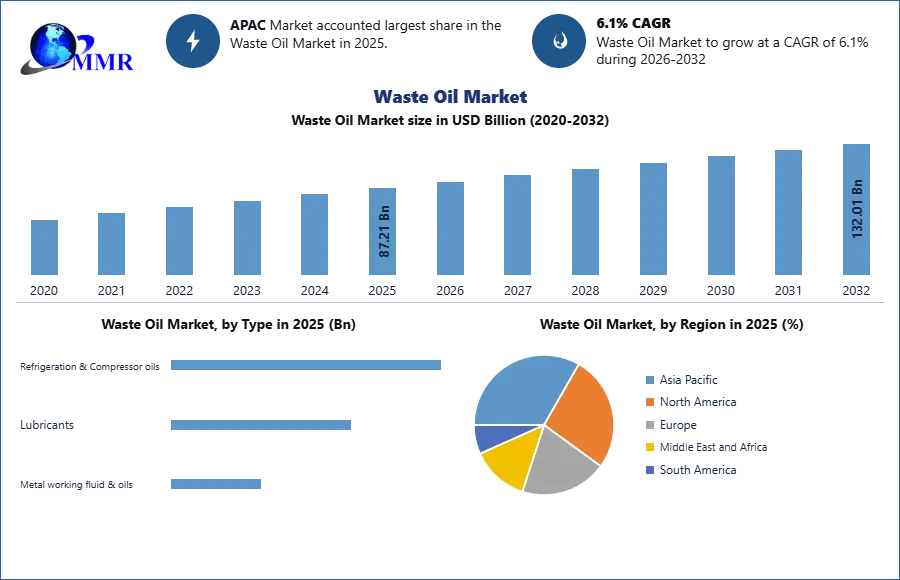
The Waste Oil Market size was valued at USD 87.21 Billion in 2025 and the total Waste Oil revenue is expected to grow at a CAGR of 6.1% from 2026 to 2032, reaching nearly USD 132.01 Billion.
Waste Oil Market Overview:
Re-refining waste oil calls for appropriate recycling and disposal methods, which are developed by governmental organisations. This helps protect the environment by preventing the illegal dumping of waste oil. Modern waste oil treatment and disposal techniques allow for effective maintenance and aid in reducing the risk of pollution. The demand for waste oil is driven by an increasing investments in automotive operations as a result of rising industrialization and urbanisation.
To know about the Research Methodology :- Request Free Sample Report
In addition, the report explores the Global Market's segments (Type, Technology, Application and Region). Data has been provided by market participants, and regions (North America, Asia Pacific, Europe, Middle East & Africa, and South America). The report also investigates the Global Market's drivers, limitations, prospects, and barriers. This MMR report includes investor recommendations based on a thorough examination of the Global Market's contemporary competitive scenario.
This report evaluates the Waste Oil Market’s pivot as Middle East instability drives crude toward $120/bbl. With traditional supply chains fractured, waste oil has transformed from a byproduct into a vital strategic hedge. We analyze the surge in advanced re-refining technologies and circular recovery frameworks, providing stakeholders with localized strategies to achieve resource autonomy and bypass geopolitical price shocks in an increasingly volatile global energy landscape.
Waste Oil Market Dynamics:
According to the EPA (Environmental Protection Agency), two hundred million gallons of waste oil are improperly disposed in the United States, additional method of recycling waste oil, are being innovated in order to propel the market of waste oil. Innovations of the commonest things has built up masterminds deserving acknowledgment for the incredible solution to utilize the waste oil. The rise of the market is anticipated to boost in the future years due to increase in the usage of waste oil in the automotive and industrial sectors. Oil waste can be recycled or utilized again. In the near future, it is projected that factors like increased industrialization, urbanization, and rising energy consumption would propel the expansion of the worldwide market. The advancement of waste oil technology and ongoing government backing also contribute to the market's expansion. Government agencies impose penalties and pursue strict action against businesses that violate the Clean Environment Act. For instance, the Repurpose Used Cooking Oil (RUCO) programme, launched by the Food Safety and Standards Authority of India (FSSAI), gathers and transforms used cooking oil.
In addition, during periods of high crude oil prices around the world, the need to produce waste oil is spurred by its sustainable usage and recycling. The high installation costs of Waste Oil plants are likely to prevent small enterprises with limited capital investments from adopting Waste Oil because re-refining Waste Oil often necessitates adequate recycling and disposal processes.
The startup autonomous has innovated robot moves along the pipes in industrial plants top detect and localize the gas and oil leakage. This effect allows the plant operators in identifying wastage promptly. These robot also collects pipeline data that enables preventive mainatinace. These continuously monitoring the pipelines for leaks allows operators in ensuring productivity ,preventing toxic emission, preserving infrastructure health and saving cost. The above aforementioned robots leak detection system serves the nuclear, pharmaceutical and chemical industries, thus creating growth opportunity in market.
Waste Oil Market Segment Analysis:
Based on type, the Global Market is segmented into Refrigeration & Compressor oils, Lubricants, Metal working fluid & oils, Transmission oils and others. Lubricant Waste oil accounted for the largest share in the market and is dominating the global waste oil market. This industry has increasingly became more environmentally concise as great strides have been made in the area of lubricant management and disposal. The automotive, industrial, aviation, and marine industries are few of the sectors that are helping to make up the market share for this highly sought-after market segment.
Based on Technology, the Global Market is segmented into Distillation Hydrogen Treatment, Vacuum Distillation Process, Thin Film Evaporation, Others. The Vacuum distillation is an effective method and is dominating the market as this distillation process is an effective method, the treated waste lubricating oil would be used as fuel alone or blending with another fuel, thus this technology is widely used in the market for processing the waste oil.
Based on Application, the Global market is segmented into Special Space Heaters, Waste Oil Boilers, Asphatt Plants, Steel Mills,Re-refiners, Biodisel,Others. The innovative technology and processes used in the modern re-refinery are far more environmental friendly and are efficient than conventional processes, contributing strongly to sustainability and conservation of market, moreover the well –equipped laboratory and R&D work has made the re-refinery a dominating segment in the market. Additionally this segment has advanced technology and safety measures that are operated in yearly capacity of 1, 00,000 tons of used lubricant oils.
Waste Oil Market Regional Insights:
The region that dominated the worldwide waste oil market in 2025 is anticipated to continue growing at the quickest rate during the forecast period. Due to the expansion of the automotive and industrial sectors in the Asia-Pacific region, particularly in China, Japan, and India, as a result of an increase in automobiles due to population growth. Therefore, this is anticipated to fuel the waste oil market's rise in the ensuing years. North America leads the market, leveraging a nationwide footprint of treatment facilities and service centers. Favorable circumstances were produced as a result of market expansion and a rise in re-refining demand.
Recent Industry Developments (2025–2026)
| Exact Date | Company | Development | Impact |
|---|---|---|---|
| 16 March 2026 | Neste Oyj | The company implemented new analytical standards and verification protocols to mitigate fraud risks in the Used Cooking Oil (UCO) supply chain. | This move strengthens traceability and market integrity for renewable feedstock used in sustainable aviation fuel (SAF). |
| 10 December 2025 | Slicker Recycling | Announced a major equity investment and the appointment of Dr. Andreas Weinberger to the board to drive European re-refining expansion. | The injection of new capital will accelerate cross-border waste oil collections and infrastructure development in the UK and Denmark. |
| 16 September 2025 | Clean Harbors, Inc. | Released its 2025 Sustainability Supplement, reporting the management of nearly 400 million combined gallons of used oil and solvents in 2024. | The company achieved its 2030 recycling goal five years early, solidifying its position as the North American leader in hazardous waste recovery. |
| 03 February 2025 | Lootah Biofuels | Launched a dedicated smart app for iOS and Android to digitize and expand its Used Cooking Oil (UCO) collection network in the UAE. | This technological integration optimizes logistics and increases the recovery rate of waste oils from commercial and residential sources. |
The objective of the report is to present a comprehensive analysis of the global Market to the stakeholders in the industry. The past and current status of the industry with the forecasted market size and trends are presented in the report with the analysis of complicated data in simple language. The report covers all the aspects of the industry with a dedicated study of key players that include market leaders, followers, and new entrants.
PORTER, PESTEL analysis with the potential impact of micro-economic factors of the market have been presented in the report. External as well as internal factors that are supposed to affect the business positively or negatively have been analyzed, which will give a clear futuristic view of the industry to the decision-makers.
The reports also help in understanding the Global Waste Oil Market dynamic, and structure by analyzing the market segments and projecting the Global Waste Oil Market size. Clear representation of competitive analysis of key players by Design, price, financial position, Instrumentation Technology portfolio, growth strategies, and regional presence in the Global Market make the report investor’s guide.
Waste Oil Market Scope: Inquiry Before Buying
| Waste Oil Market | |||
|---|---|---|---|
| Report Coverage | Details | ||
| Base Year: | 2025 | Forecast Period: | 2026-2032 |
| Historical Data: | 2020 to 2025 | Market Size in 2025: | 87.21 USD Billion |
| Forecast Period 2026-2032 CAGR: | 6.1% | Market Size in 2032: | 132.01 USD Billion |
| Segments Covered: | by Type | Refrigeration & Compressor oils, Lubricants, Metal working fluid & oils |
|
| by Technology | Distillation Hydrogen Treatment Vacuum Distillation Process Thin Film Evaporation Others |
||
| by Application | Special Space Heaters, Waste Oil Boilers Asphatt Plants Steel Mills Re-refiners Biodiesel Others |
||
Waste Oil Market, by Region
North America (United States, Canada and Mexico)
Europe (UK, France, Germany, Italy, Spain, Sweden, Austria and Rest of Europe)
Asia Pacific (China, South Korea, Japan, India, Australia, Indonesia, Malaysia, Vietnam, Taiwan, Bangladesh, Pakistan and Rest of APAC)
Middle East and Africa (South Africa, GCC, Egypt, Nigeria and Rest of ME&A)
South America (razil, Argentina Rest of South America)
Key Players / Competitors Profiles Covered in Brief in Global Waste Oil Market Report in Strategic Perspective:
- J.J. Richards and Sons Pty Ltd
- Goins Waste Oil Company Inc.
- Enva (Rilta Environmental Ltd)
- All Waste Matters Ltd
- Alexandria Petroleum Company
- Enfields Chemicals CC
- Solway Recycling Ltd
- Business Waste
- Oil Salvage Ltd
- Slicker Recycling
- Safety-Kleen Systems, Inc.
- Oil Monster
- MIB Waste Services
- Falzon Group
- Gecco Fuels
- Shell plc
- Neste Oyj
- TotalEnergies SE
- Clean Harbors, Inc.
- Exxon Mobil Corporation
- BP plc
- Valero Energy Corporation
- Chevron Corporation
- PetroChina Company Limited
- Sinopec Group
Frequently Asked Questions
1.What is the projected Waste Oil Market Size & Forecast through 2032?
Ans. The market reached USD 87.21 billion in 2025. With a 6.1% CAGR, the Waste Oil Market Trends 2026 suggest a valuation of USD 132.01 billion.
2. Which region leads the Waste Oil Market Share Analysis and why?
Ans. North America dominates production with vast treatment networks, while Asia-Pacific shows rapid Industry Growth Drivers due to surging automotive demand and urbanization in China and India.
3. How is the impact of AI/Technology transforming waste oil collection efficiency?
Ans. Innovative Waste Oil Market Trends 2026 include smart apps and autonomous robots for leak detection, optimizing logistics and enhancing recovery rates for industrial and commercial sources.
4. What are the primary Industry Growth Drivers for the re-refining segment?
Ans. Sustainability mandates and high crude prices drive the Waste Oil Share Analysis, favoring advanced re-refining technologies over traditional disposal to produce eco-friendly lubricants and fuel.
5. How do sustainability trends and RUCO programs influence market expansion?
Ans. Government initiatives like FSSAI’s RUCO program promote Waste Oil Market Trends 2026 by converting used cooking oil into biodiesel, reducing environmental pollution and illegal dumping.
6. What are the main supply chain challenges for Waste Oil Market participants?
Ans. High installation costs and fraud risks in feedstock supply chains hinder Industry Growth Drivers, necessitating strict analytical standards and significant capital for modern re-refining infrastructure.
7. Which technology is most effective for Waste Oil Market processing today?
Ans. Vacuum distillation leads the Waste Oil Share Analysis as a highly efficient method for treating lubricants, enabling the sustainable reuse of oil as high-quality fuel.