
Digital Textile Printing Market in - Industry Structure Evaluation, Demand Drivers Analysis, Regional Growth Analysis and Identification, Competitive Positioning Review & Global Market Size Forecast to 2034
Overview
Digital Textile Printing Market size was valued at US$ 3.99 Bn. in 2025 and the total revenue is expected to grow at a CAGR of 14.8% from 2026 to 2034, reaching nearly US$ 13.83 Bn.
Digital Textile Printing Market Overview:
Market is expected to reach US$ 13.83 Bn. by 2034. Digital textile printing is a method of printing colourants onto fabric using inkjet technology on textiles and apparel. This report focuses on the different segments of the market (Printing Process, Substrate Type, Ink Type, Application, and Region). This report examines the major market players and regions in depth (North America, Asia Pacific, Europe, Middle East & Africa, and South America). It's a thorough examination of today's quick advances in a variety of sectors. Facts and figures, visualisations, and presentations are utilised to demonstrate the core data analysis from 2017 through 2020. The market drivers, restraints, opportunities, and challenges for Digital Textile Printing are examined in this report. The MMR report's investment suggestions are based on a thorough examination of the current competitive environment in the market.
Digital Textile Printing Market Size ,Share and Growth Analysis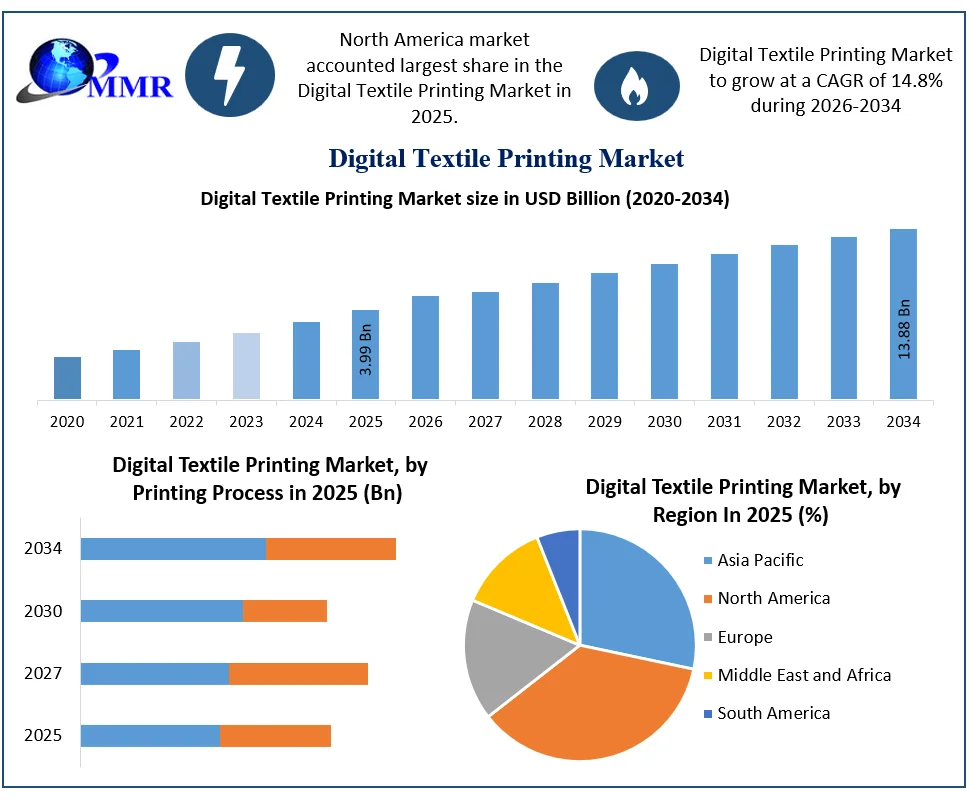
To know about the Research Methodology:-Request Free Sample Report
Digital Textile Printing Market Dynamics:
Fine patterns, high resolution, and flexibility
Digital textile printing takes less space than traditional rotary screen printing since it can use an endless number of colour combinations. It also consumes less energy and ink. Sublimation digital textile printing does not require water. All of these factors contribute to cheap costs. As a result, digital textile printing can be done without spending a lot of money. Furthermore, colour and print accuracy are both clean and neat with digital textile printing. When compared to the other types of chemical waste generated by screen printing, digital textile printing is a far more environmentally friendly option.
Increased investment costs
Traditional printing machines are more expensive than digital textile printing machines. When comparing the total cost of ownership (water, energy, operators, service expenses, ink, fabric post-treatment, and so on) of conventional and digital textile printing, digital textile printing costs around 1.5 times as much as conventional printing. Single-pass printing is a new printing technique that produces higher-quality prints in less time. It is more expensive than multi-pass printing since more print heads are required to cover the entire width of the printer.
Rising demand in Asia Pacific
Due to the region's financial stability and government assistance, the market in Asia Pacific is expected to grow significantly during the forecast period. During the forecast period, emerging countries such as India and China are expected to see significant growth in the market. The market is expected to be driven by increased domestic demand for textile printing in both countries. According to the Indian Brand Equity Foundation (IBEF), fibre output in India reached 1.44 million tonnes (MT) in FY19 and 1.60 MT in FY20 (till January 2020). This demonstrates the region's increasing textile industry need.
Digital Textile Printing Market Segment Analysis:
The Market is segmented by Printing Process, Substrate Type, Ink Type, and Application.
Based on the Printing Process, the market is segmented into Roll to Roll, and DTG. DTG Printing Process segment is expected to hold the largest market share of xx% by 2034. Direct to garment printing is an obvious option for digital fabric printing service providers since demand is high due to emerging fashion trends, and margins are high in areas like garment decorating and customisation, which is expected to boost demand.
Roll to Roll Printing Process segment is expected to grow rapidly at a CAGR of xx% during the forecast period 2026-20234. Textile and decor, soft signage, and industrial applications all use this method. Home textiles, upholstery, linens, curtains, scarves, ties, bags, sportswear, footwear, garments, interior décor, and other textile and decor applications are common. Carpets, posters, banners, flags, vehicle wrapping, wallpaper, building material, POS display, and other soft signage and industrial applications include.
Based on the Substrate Type, the market is segmented into Cotton, Silk, Polyester, and Others. Polyester segment is expected to grow rapidly at a CAGR of xx% during the forecast period 2026-2034. Polyester is a sanitary material because it absorbs less moisture than other textiles. When anything is printed on polyester, the quality of the cloth stays the same. To put it another way, it neither improves nor degrades the quality. Polyester products, unlike most natural textiles, are also recyclable. It's a tough material that can withstand the sun and is less sensitive to high temperatures than many other synthetic fibres. Polyester materials fade slowly yet are simple to care for. As a result, polyester is frequently the fabric of choice in public settings where wear and tear are inescapable.
Digital Textile Printing Market Recent Development
| Date | Company | Development | Impact |
|---|---|---|---|
| 15 January 2025 | Seiko Epson Corporation | Epson launched its next-generation Monna Lisa ML-32000 direct-to-fabric digital textile printer equipped with high-density PrecisionCore printheads. | The system significantly increases production throughput by 25% while reducing energy and water consumption in commercial textile printing operations. |
| 22 May 2025 | Mimaki Engineering Co., Ltd. | Mimaki unveiled the TRAPIS digital transfer pigment printing system, delivering eco-friendly, waterless textile printing capabilities. | This development eliminates wastewater generation and enables seamless operation across diverse fabric types without specialized pretreatments. |
| 18 September 2025 | Kornit Digital Ltd. | Kornit Digital partnered with leading apparel manufacturers to expand commercial adoption of its MAX technology and Apollo direct-to-garment platform. | The collaboration accelerates on-demand digital textile production, driving nearshore supply chain agility and reducing unsold inventory waste. |
| 10 November 2025 | EFI Reggiani | EFI Reggiani introduced the ecoTERRA waterless digital printer line utilizing advanced pigment ink technology with integrated pretreatment. | The machine streamlines the manufacturing workflow by cutting water usage by 95% and significantly lowering thermal energy requirements. |
| 12 February 2026 | Kyocera Corporation | Kyocera commercialized its latest high-speed KJ4B-EX series inkjet printheads optimized for water-based digital textile inks. | The innovation provides higher jetting stability and resolution, driving scalable industrial capacity for high-volume textile converters. |
Digital Textile Printing Market Regional Insights:
The Asia Pacific region is expected to dominate the Market during the forecast period 2026-2034. The Asia Pacific region is expected to hold the largest market share of xx% by 2034. The rise and development of the textile market in countries like China and India has spurred the growth of the market in the region due to low labour costs. China has been one of the main producers and exporters of textiles for several decades. Investments in inventories, such as shuttle-less looms and capacity expansions to produce high-quality textiles, are also expected to improve the textile and garment sector.
China accounted for 43.5 percent of global textile export value in 2020, according to the World Trade Organization. With an export value of roughly USD 154 billion in 2020, China was also one of the world's major textile exporters. In 2020, India's export value was reached to USD 15 billion. In October 2021, China manufactured around 3.41 billion metres of clothing fabric, according to the National Bureau of Statistics.
Furthermore, the dramatic upheaval of the textile manufacturing industry as a result of the rise of digital textile printing and advancements in dye-sublimation technology has created new, profitable market segments and application prospects in the region. Soft signage for buildings and store window displays, retail locations, and other points of sale has offered a huge opportunity for big scale textile printers and print service suppliers. The region's rising fashion industry, together with such trends, is expected to provide the market with further potential prospects.
The objective of the report is to present a comprehensive analysis of the Global Digital Textile Printing Market to the stakeholders in the industry. The past and current status of the industry with the forecasted market size and trends are presented in the report with the analysis of complicated data in simple language. The report covers all the aspects of the industry with a dedicated study of key players that include market leaders, followers, and new entrants.
PORTER, PESTEL analysis with the potential impact of micro-economic factors of the market has been presented in the report. External as well as internal factors that are supposed to affect the business positively or negatively have been analyzed, which will give a clear futuristic view of the industry to the decision-makers.
The reports also help in understanding the Global Digital Textile Printing Market dynamic and structure by analyzing the market segments and projecting the Global Digital Textile Printing Market size. Clear representation of competitive analysis of key players by Distribution Channel, price, financial position, product portfolio, growth strategies, and regional presence in the Digital Textile Printing Market make the report investor’s guide.
Digital Textile Printing Market Scope:Inquire before buying
| Global Digital Textile Printing Market | |||
|---|---|---|---|
| Report Coverage | Details | ||
| Base Year: | 2025 | Forecast Period: | 2026-2034 |
| Historical Data: | 2025 to 2034 | Market Size in 2025: | US $ 3.99 Bn |
| Forecast Period 2026 to 2034 CAGR: | 14.8% | Market Size in 2034: | US $ 13.83 Bn |
| Segments Covered: | by Printing Process | • Roll to Roll • DTG |
|
| by Substrate Type | • Cotton • Silk • Polyester • Others |
||
| by Ink Type | • Reactive • Acid • Direct Dispense • Sublimation • Pigments • Others |
||
| by Application | • Textile and Decor • Industrial • Soft Signage • Direct to Garment |
||
Digital Textile Printing Market, by Region
• North America
• Europe
• Asia Pacific
• South America
• Middle East and Africa
Digital Textile Printing Market Key Players
• Aeoon Technologies GmbH (Austria)
• ATPColor Srl (Italy)
• Bordeaux Digital PrintInk Ltd. (Israel)
• Durst Phototechnik AG (Italy)
• Hollanders Printing Systems B.V. (Netherlands)
• Kornit Digital (Israel)
• SPGPrints B.V. (Netherlands)
• Brother International Corporation (Japan)
• Colorjet Group (India)
• d.gen Inc. (South Korea)
• Konica Minolta, Inc. (Japan)
• Mimaki Engineering Co., Ltd. (Japan)
• Mutoh Holdings Co. Ltd. (Japan)
• Ricoh Company Ltd (Japan)
• Roland DG Corporation (Japan)
• Seiko Epson Corporation (Japan)
• DuPont (US)
• Electronics For Imaging, Inc. (US)
• Huntsman International LLC (US)
Frequently Asked Questions:
1] Which region is expected to hold the highest share in the Digital Textile Printing Market?
Ans. Asia Pacific is expected to hold the highest share in the Digital Textile Printing Market.
2] Who are the top key players in the Digital Textile Printing Market?
Ans. Aeoon Technologies GmbH (Austria), ATPColor Srl (Italy), Bordeaux Digital PrintInk Ltd. (Israel), Durst Phototechnik AG (Italy), Hollanders Printing Systems B.V. (Netherlands), and Kornit Digital (Israel) are the top key players in the Digital Textile Printing Market.
3] Which segment is expected to hold the largest market share in the Digital Textile Printing Market by 2034?
Ans. DTG (Direct to Garment) segment is expected to hold the largest market share in the Digital Textile Printing Market by 2034.
4] What is the market size of the Digital Textile Printing Market by 2034?
Ans. The market size of the Digital Textile Printing Market is expected to reach US $ 13.83 Bn. by 2034.
5] What was the market size of the Digital Textile Printing Market in 2025?
Ans. The market size of the Digital Textile Printing Market was worth US $ 3.99 Bn. in 2025.