
Video Conferencing Market- Industry Structure Evaluation, Demand Drivers Analysis, Regional Growth Analysis and Identification, Competitive Positioning Review & Global Market Size Forecast to 2030
Overview
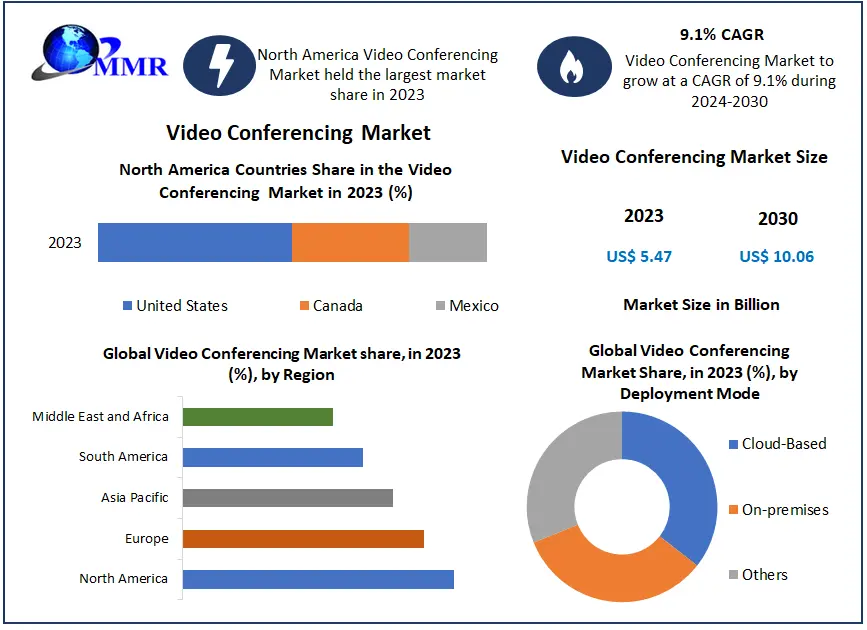
Global Video Conferencing Market size was valued at USD 5.47 Bn in 2023 and is expected to reach USD 10.06 Bn by 2030, at a CAGR of 9.1%.
Video Conferencing Market
Video conferencing facilitates live, visual connections between remote parties, replicating face-to-face meetings over the Internet. It ranges from basic transmission of static images and text to sophisticated platforms enabling full-motion video and high-quality audio exchange among multiple locations. Essential in the Video Conferencing Market, providing integrated desktop and room solutions, vital for Telehealth, customer service, and unified communications in business. With cloud-based services, organizations adopt video conferencing affordably and access AI-powered features for enhanced audio and video performance. Its versatility and accessibility make it a vital tool for bridging geographical barriers and fostering collaboration across diverse settings.
 To know about the Research Methodology :- Request Free Sample Report
The Video Conferencing market is experiencing significant growth driven by factors such as increasing globalization, the rise of remote work, and technological advancements. With the COVID-19 pandemic accelerating the adoption of digital collaboration tools, video conferencing has become essential for businesses across the globe. Technological innovations, including high-speed internet, cloud-based platforms, and AI-powered features, have enhanced accessibility, scalability, and user experience, driving widespread adoption across diverse industries and applications. From healthcare to education, customer service, and entertainment, video conferencing is being utilized for remote consultations, virtual classrooms, customer support interactions, and live events.
The integration of video conferencing into several sectors underscores its versatility and value in facilitating virtual connections and enabling seamless communication across geographical barriers. As organizations prioritize flexibility, collaboration, and productivity in their operations, the demand for innovative video conferencing solutions is expected to persist, driving sustained growth in the industry. The continued evolution of technology, coupled with changing work dynamics and increasing demand for hybrid work environments, is likely to propel the Video Conferencing Market growth, positioning it as a critical component of modern communication and collaboration strategies for businesses of all sizes.
Video Conferencing Market Trend
Integration Of Artificial Intelligence (AI) And Machine Learning (ML) technologies
As businesses worldwide increasingly rely on video conferencing tools to facilitate communication during the ongoing global health crisis, AI and ML have emerged as essential innovations enhancing the efficacy and user experience of virtual meetings. These technologies revolutionize traditional video conferencing by offering innumerable intelligent features and functionalities that boost Video Conferencing Market growth. AI-powered Natural Language Processing (NLP) tools optimize communication by providing voice-to-text transcription for seamless note-taking, language translation for multilingual conversations, and automated report generation for task assignment and action point sharing.
AI-driven scheduling assistants streamline meeting management by leveraging online calendars to schedule, reschedule, and send reminders to participants, ensuring efficient coordination across different time zones. Computer vision capabilities enhance visual experiences by automatically adjusting camera angles, optimizing lighting conditions, and tagging participants individually for focused engagement. AI-driven analytics provide valuable insights into meeting dynamics, duration, and participant behavior, enabling organizations to drive productivity and make informed decisions. Which drives Video Conferencing Market growth. ML-based anomaly detection ensures the privacy and security of sensitive information shared during video conferences, enhancing trust among participants. The integration of AI and ML technologies empowers organizations to transform traditional video conferencing into intelligent, personalized, and secure communication platforms, catering to the evolving needs of remote collaboration and communication.
Benefits Of AI in Video Conferencing
| Benefit | Description |
| Efficient and effective meeting summaries | AI automatically generates summaries of key meeting information, including a written recap, keywords, video highlights, and AI-generated topics. |
| Advanced presentation delivery and engagement | AI enhances presentations with features such as virtual whiteboards, noise cancellation, and background removal. |
| Catch up on meetings quickly | AI-powered live transcription allows latecomers, non-native speakers, and people with hearing difficulties to stay caught up. |
| Distraction-free meetings | AI automatically tracks your movements and keeps you centered in the video frame, reducing distractions. |
| Better presentations | AI moves presenters alongside their screen shares and presentations and even places them in virtual backgrounds. |
| Automatic scheduling | AI automates scheduling by analyzing online calendars and suggesting ideal meeting times. |
| Analytics and continuous meeting improvement | AI provides analytics on meeting productivity, including time spent on agenda items, identification of bottlenecks, and recognition of needed documents. |
Video Conferencing Market Dynamics
Increasing Demand for Remote Work Solutions to Boost Market Growth
As organizations worldwide transition towards remote work setups, spurred by the COVID-19 pandemic and a broader shift towards flexible work arrangements, the need for efficient virtual collaboration tools has soared. Video conferencing platforms have emerged as indispensable tools for facilitating seamless communication and collaboration among remote teams, enabling live, visual connections that simulate face-to-face interaction which boost Video Conferencing Market growth. From small businesses to large enterprises, the ability to conduct virtual meetings, presentations, and discussions in real time has become essential for maintaining productivity and fostering team cohesion across geographically dispersed workforces.
The Video Conferencing Market has witnessed unprecedented growth as businesses seek comprehensive solutions to bridge the physical divide between remote employees. These platforms range from simple transmission of static images and text to sophisticated systems offering full-motion video and high-quality audio transmission between multiple locations. With the rise of hybrid work models blending remote and in-office arrangements, desktop video conferencing has become a core component of unified communications platforms. These platforms, along with standalone cloud-based and on-premises video conferencing solutions, provide to diverse business needs, including telehealth, customer service, and distance learning. The widespread availability of cloud-based services has lowered barriers to entry, allowing organizations to implement video conferencing with minimal upfront investment and leverage emerging AI-powered features to enhance audio and video performance. As the demand for remote work solutions continues to grow, driven by evolving workplace dynamics and the pursuit of enhanced collaboration and flexibility, the Video Conferencing Market is poised for sustained growth, driving innovation and transforming the way teams connect and collaborate in the digital industry.
Incorporating augmented reality (AR) and virtual reality (VR) technologies into a video conferencing platform is a lucrative Opportunity for the Market
Incorporating augmented reality (AR) and virtual reality (VR) technologies into a video conferencing platform revolutionizes digital communication, offering immersive alternatives that enhance engagement and collaboration. AR overlays digital elements onto the real world, while VR creates entirely virtual environments, both providing unique benefits for business communication. Teleconferences rely solely on audio, video conferences incorporate both audio and visual elements, and VR conferences take immersion to the next level by placing users in 3D meeting environments, closely resembling in-person interactions which boost Video Conferencing Market growth. In VR meetings, participants use specialized hardware such as VR headsets to enter a 3D environment, enabling remote teams to engage in collective thinking and strategizing with minimal communication barriers.
AR and VR technology also facilitates seamless team collaboration, allowing dispersed teams to work together in a sensory-rich virtual space, streamlining product development processes and strengthening client relationships. By offering immersive, engaging, and interactive experiences, AR and VR enable businesses to conduct more effective virtual meetings, collaborate seamlessly across distances, and deliver unparalleled client experiences that drive Video Conferencing Market growth. As these technologies continue to evolve, they have been shaping the future of digital communication and remote collaboration.
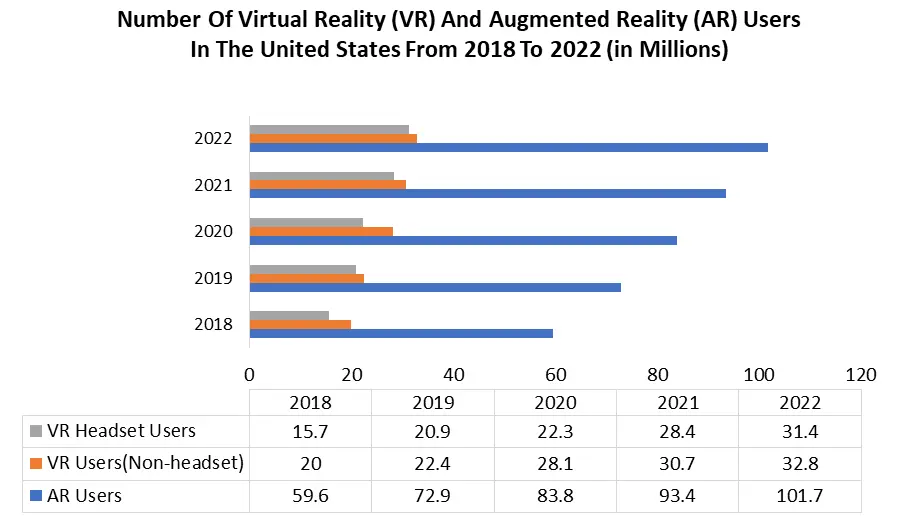
Incorporating augmented reality (AR) and virtual reality (VR) into video conferencing platforms enhances user engagement and immersion. In the United States, the number of VR and AR users is growing steadily, driven by technological advancements and increased adoption of immersive experiences, with millions engaging in these technologies.
Challenge Of Ensuring Data Security and Privacy to hamper Market Growth
The challenge of ensuring data security and privacy in the video conferencing market is further compounded by the rapid expansion of remote work trends, accelerated by the global pandemic. As organizations transition to hybrid or fully remote work models, the reliance on video conferencing solutions has surged, amplifying the exposure of sensitive information across diverse networks and devices. The proliferation of endpoints accessing video conferencing platforms, ranging from laptops and desktops to smartphones and tablets, increases the attack surface for potential security breaches. The emergence of new threat vectors, such as phishing scams targeting video conferencing users, underscores the need for strong cybersecurity measures. In response, video conferencing providers are under pressure to enhance encryption protocols, implement stringent access controls, and fortify their infrastructure against evolving cyber threats. Failure to address these security and privacy concerns not only jeopardizes organizational data integrity but also erodes customer trust and regulatory compliance, posing a challenging restraint to the sustained Video Conferencing Market growth.
Video Conferencing Market Segment Analysis
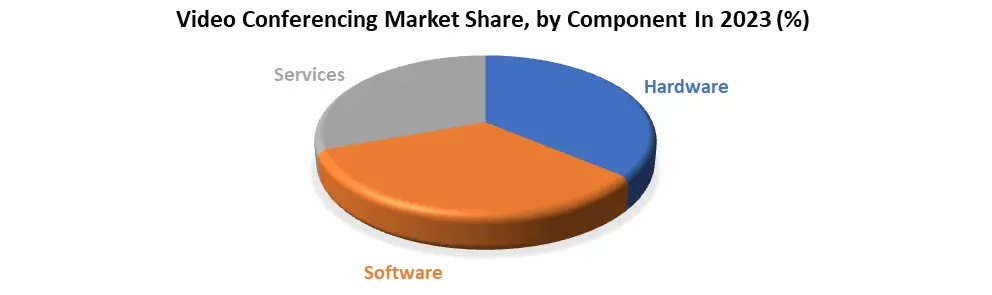
Based on Component, the market is segmented into Hardware, Software and Services. Software dominated the Video Conferencing Market in 2023 and is expected to continue its dominance over the forecast period. Software dominates the video conferencing market primarily due to its versatility, accessibility, and scalability. The software-based platforms offer a wide range of features including screen sharing, virtual backgrounds, and chat functionalities, enhancing user experience and collaboration. The software solutions are more adaptable to evolving technological trends and user needs, allowing for rapid updates and improvements without the need for physical hardware upgrades. The software-centric nature of video conferencing also raises integration with other applications and services, facilitating seamless workflows and enhancing productivity for businesses and individuals alike.
Software exemplified by heavy hitters like Zoom, Microsoft Teams, GoToMeeting, Google Meet, ezTalks Meetings, StarLeaf, and Cisco Webex. These platforms offer a plethora of features aimed at simplifying remote communication and collaboration. From flawless video and crystal-clear audio to instant sharing capabilities, these software solutions provide seamless connectivity for users across various industries. Whether it's enterprises seeking effective client communication, educators facilitating virtual classrooms, or healthcare professionals conducting remote consultations, video conferencing software provides diverse needs. With functionalities such as screen sharing, whiteboarding, HD video and voice, chat, and scheduling, these platforms ensure efficient virtual interactions. Security features such as SSL encryption guarantee secure communications, vital for protecting sensitive information shared during meetings. The flexibility, scalability, and feature-rich nature of software solutions have made them indispensable tools for remote collaboration, leading to their prominent component in the Video Conferencing Market.
Video Conferencing Market Regional Insights
North America dominated the Video Conferencing Market in 2023 and is expected to continue its dominance over the forecast period. The region boasts a highly developed and mature telecommunications infrastructure, characterized by extensive broadband connectivity and advanced networking capabilities. This strong infrastructure provides the foundation for seamless and high-quality video conferencing experiences, facilitating smooth communication and collaboration among businesses, government agencies, educational institutions, and individuals across North America. The region is home to a large concentration of leading technology companies, including pioneers in the field of video conferencing such as Zoom, Cisco Systems, and Microsoft, among others. These companies have played a pivotal role in driving innovation and shaping the landscape of video conferencing solutions, leveraging their expertise and resources to develop cutting-edge technologies that meet the evolving needs of users.
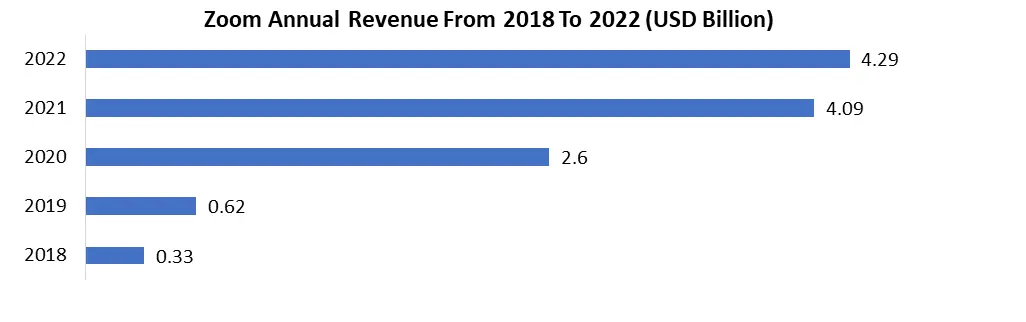
North America benefits from a strong culture of entrepreneurship and innovation, fostering a conducive environment for the adoption and integration of emerging technologies such as video conferencing into various sectors and industries. This culture of innovation, coupled with a highly educated workforce and a vibrant ecosystem of startups and research institutions, positions North America at the forefront of technological advancements that boost Video Conferencing Market Growth. The region's diverse and dynamic business landscape, spanning sectors such as finance, healthcare, information technology, entertainment, and more, presents ample opportunities for the deployment and utilization of video conferencing solutions to drive productivity, efficiency, and collaboration.
North America leadership in the video conferencing market is driven by its proactive regulatory environment and strong commitment to data privacy and security. Regulatory frameworks such as the Health Insurance Portability and Accountability Act (HIPAA) in the United States and the Personal Information Protection and Electronic Documents Act (PIPEDA) in Canada impose stringent requirements for the protection of sensitive information, including data transmitted through video conferencing platforms. Compliance with these regulations is paramount for businesses and organizations operating in North America, driving demand for video conferencing solutions that offer robust encryption, authentication, and access control features to safeguard user data and privacy.
Video Conferencing Market Scope: Inquire before buying
| Global Video Conferencing Market | |||
|---|---|---|---|
| Report Coverage | Details | ||
| Base Year: | 2023 | Forecast Period: | 2024-2030 |
| Historical Data: | 2018 to 2023 | Market Size in 2023: | US $ 5.47 Bn. |
| Forecast Period 2024 to 2030 CAGR: | 9.1% | Market Size in 2030: | US $ 10.06 Bn. |
| Segments Covered: | by Component | Hardware Software Services |
|
| by Deployment Mode | Cloud-Based On-premises Others |
||
| by Enterprise Size | Small and Medium-sized Enterprises (SMEs) Large Enterprises |
||
| by Vertical | Education Healthcare Government and Public Sector Finance and Banking Others |
||
Video Conferencing Market, by Region
North America (United States, Canada and Mexico)
Europe (UK, France, Germany, Italy, Spain, Sweden, Austria and Rest of Europe)
Asia Pacific (China, South Korea, Japan, India, Australia, Indonesia, Malaysia, Vietnam, Taiwan, Bangladesh, Pakistan and Rest of APAC)
Middle East and Africa (South Africa, GCC, Egypt, Nigeria and Rest of ME&A)
South America (Brazil, Argentina Rest of South America)
Video Conferencing Key players
Global
1. Zoom Video Communications (San Jose, California, USA)
2. Cisco Systems (San Jose, California, USA)
3. Microsoft Corporation (Redmond, Washington, USA)
4. Google (Mountain View, California, USA)
5. Adobe Inc. (San Jose, California, USA)
North America
1. LogMeIn (Boston, Massachusetts, USA)
2. Lifesize (Austin, Texas, USA)
3. Avaya Inc. (Durham, North Carolina, USA)
4. Blackboard Inc. (Washington, D.C., USA)
5. BlueStar Inc. (Florence, Kentucky, USA)
6. Fuze Inc. (Boston, Massachusetts, USA)
7. Poly (Santa Cruz, California, USA)
8. Vonage (Holmdel Township, New Jersey, USA)
Europe
1. StarLeaf (Watford, Hertfordshire, England)
2. Pexip (Oslo, Norway)
Asia Pacific
1. Huawei Technologies Co., Ltd. (Shenzhen, China)
2. Tencent (Shenzhen, China)
3. Zoho Corporation (Chennai, Tamil Nadu, India)
Frequently Asked Questions:
1] What is the growth rate of the Global Video Conferencing Market?
Ans. The Global Video Conferencing Market is growing at a significant rate of 9.1% during the forecast period.
2] Which region is expected to dominate the Global Video Conferencing Market?
Ans. North America is expected to dominate the Video Conferencing Market during the forecast period.
3] What is the expected Global Video Conferencing Market size by 2030?
Ans. The Video Conferencing Market size is expected to reach USD 10.06 Billion by 2030.
4] Which are the top players in the Global Video Conferencing Market?
Ans. The major top players in the Global Video Conferencing Market are Zoom Video Communications (San Jose, California, USA), Cisco Systems (San Jose, California, USA), Microsoft Corporation (Redmond, Washington, USA), Google (Mountain View, California, USA), Adobe Inc. (San Jose, California, USA), LogMeIn (Boston, Massachusetts, USA)and Others.
5] What are the factors driving the Global Video Conferencing Market growth?
Ans. Globalization and Business expansion and technological advances are expected to drive market growth during the forecast period.