Travel Retail Market Size by Product, Sector, Sales Channel, Region, Industry-Wide Analysis, Competitive Landscape Assessment & Long-Term Forecast to 2032

9.2%
CAGR (2026-2032)
64.17 USD Bn.
Forecast Market Size
301
Report Pages
123
Market Tables

Overview

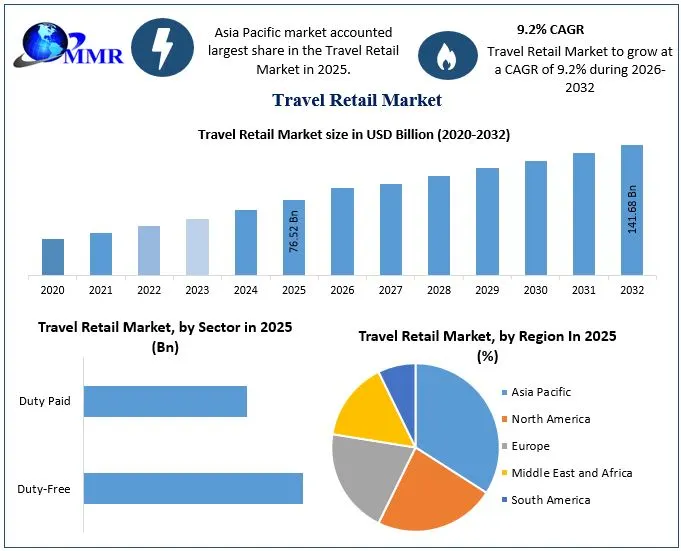
Travel Retail Market size was valued at US$ 76.52 Bn. in 2025 and the total Global Travel Retail revenue is expected to grow by 9.2% from 2026 to 2032, reaching nearly US$ 141.68 Bn.

Travel Retail Market Overview:
The Global Travel Retail Market sells the  products to travelers through airports, airlines, seaports, cruise terminals, railway stations, border crossings, and other travel-related locations. The market represents duty-free and duty-paid retail formats while selling the major product categories including cosmetics and fragrances, wines and spirits, confectionery and fine foods, tobacco, fashion and accessories, electronics, and luxury goods. The market strategic importance as international mobility and passenger traffic continue to strengthen.  Global air passenger demand increased by 10.4% in 2024, surpassing pre-pandemic international traffic levels and supporting greater passenger throughput across major travel hubs. The expansion of airport infrastructure, rising tourism expenditure, and growing demand for premium and travel-exclusive products are further strengthening the commercial importance of travel retail.

The Travel Retail Industry is undergoing a significant transformation as retailers and brands are moving  beyond conventional duty-free shopping toward experiential, digitally enabled, and personalized retail environments.  This modernized experiential shopping includes, Online pre-ordering, click-and-collect services, mobile engagement, data-driven personalization, and immersive brand experiences. This product and service continuum has increasingly being integrated into airport and other travel retail formats. Asia Pacific remains particularly important, accounting for 51.41% of the global travel retail market in 2025.  The Asia pacific Travel Retail Market is  supported by strong travel activity and expanding retail infrastructure across key markets. At the same time, brands are increasingly targeting younger, digitally connected travelers and emerging destinations while emphasizing premiumization, sustainability, and omnichannel engagement. Though the presence of  geopolitical uncertainty, regulatory changes, fluctuating passenger flows, and economic volatility seems to create an obstacle, the Global Travel Retail Market is expected to benefit from continued growth in international travel, expanding tourism ecosystems, and ongoing innovation in the traveler shopping experience.

Travel Retail Market GrowthTo know about the Research Methodology :- Request Free Sample Report.

Travel Retail Market Dynamics:

Rising International Air Travel and Passenger Volumes are Driving Travel Retail Market Growth

The continued expansion of international air travel is increasing passenger footfall across airports and other major travel hubs, creating a larger customer base for travel retailers. Global passenger demand increased 5.3% in 2025, while international passenger demand grew 7.1% year-on-year. The global passenger load factor also reached a record 83.6%, indicating strong utilization of available airline capacity. This sustained growth in passenger traffic is directly supporting opportunities for duty-free and duty-paid retailers across cosmetics and fragrances, luxury goods, fashion, confectionery, and food and beverages. The strong recovery in international mobility is also encouraging airports and operators to expand commercial areas and improve the passenger shopping experience. As international connectivity continues to strengthen, rising traveler footfall is expected to remain a fundamental growth driver for the Global Travel Retail Market.

Increasing Traveler Spending and Premiumization are Creating New Market Opportunities

Now, the market is shifting towards premium and experience-led consumption which is creating attractive opportunities for travel retailers and global consumer brands. IATA's 2025 passenger outlook survey found that 47% of respondents expected to spend more on travel over the following 12 months, while only 8% expected to spend less, indicating continued resilience in consumer travel expenditure. This environment is supporting demand for premium fragrances, cosmetics, luxury accessories, watches, spirits, and exclusive travel-retail products. Retailers are increasingly using airport boutiques, personalized consultations, limited-edition launches, immersive brand experiences, and pre-order services to encourage higher-value purchases. Digital platforms also provide opportunities to engage travelers before they arrive at the terminal and extend the shopping journey beyond the physical store. The combination of stronger travel spending, premiumization, and experiential retail is creating new avenues for revenue growth and customer conversion across the Travel Retail Industry.

Regulatory Restrictions and Changes in Duty-Free Policies are Limiting Market Expansion

The travel market shows sensitivity towards the changes in government policies, taxation structures, customs regulations , and duty - free allowances. The Travel retailers who operates across international borders must comply with different regulations which are governing import, taxation, and transportation of products, particularly in categories such as tobacco, alcohol, cosmetics, and luxury goods. Changes in duty-free purchasing limits or excise taxation can reduce the price advantage available to travelers and potentially affect purchase volumes. In addition, stricter regulations related to tobacco consumption, alcohol sales, product labeling, packaging, and environmental compliance are increasing operational requirements for retailers and brands. Regulatory fragmentation across countries can further complicate inventory management and cross-border operations. As governments continue to balance tourism promotion with taxation, public health, and sustainability objectives, evolving regulatory frameworks are expected to remain a restraint on the expansion of international travel retail operations.

Supply Chain Disruptions and Geopolitical Uncertainty Remain Key Industry Challenges

The Travel Retail Industry continues to face challenges arising from geopolitical tensions, transportation disruptions, inflation, and supply chain constraints that can affect both passenger flows and product availability. Travel retail operators are highly dependent on international mobility, making the industry vulnerable to sudden changes in flight routes, border restrictions, regional conflicts, and shifts in consumer confidence. Supply chain constraints can also affect the timely delivery of premium and seasonal products to airports and other travel hubs, while higher logistics and operating costs can put pressure on retailer margins. IATA reported that airline supply chain challenges remained a major issue in 2025, with aircraft and engine delivery delays and maintenance capacity constraints contributing to significant cost pressures across the aviation ecosystem. Such disruptions can indirectly affect travel retail by limiting passenger capacity and creating uncertainty around traffic volumes.

Travel Retail Market Trends

  • Integration of Digital and Omnichannel Retail Experiences - Travel retailers are increasingly integrating physical stores with digital platforms to create seamless omnichannel shopping journeys. Mobile applications, digital catalogs, QR-based product discovery, online pre-ordering, and click-and-collect services allow travelers to browse and purchase products before reaching the airport or transportation hub. These technologies also enable retailers to collect customer insights and deliver personalized recommendations and promotions. The integration of digital touchpoints with physical stores is becoming an important strategy for improving conversion rates and increasing customer engagement.
  • Growing Premiumization and Luxury Product Demand - The increasing purchasing power of international travelers is supporting demand for premium and luxury products across beauty, fragrances, fashion, watches, jewelry, and spirits. Brands are using travel retail channels to launch exclusive products, limited editions, and destination-specific collections. Premiumization is particularly important because travel retail provides brands with access to a highly diverse international customer base in a concentrated environment, allowing them to strengthen brand visibility while encouraging higher-value purchases.
  • Expansion of Experiential and Immersive Retail - Travel retailers are moving beyond traditional shelf-based shopping by creating immersive environments that encourage consumers to interact with products and brands. Beauty demonstrations, personalized consultations, tasting experiences, interactive displays, and luxury brand showcases are increasingly being introduced in major travel hubs. Experiential retail helps differentiate physical travel retail from conventional e-commerce and encourages travelers to spend more time exploring products before purchasing.
  • Increasing Use of Artificial Intelligence and Data Analytics - Artificial intelligence and advanced analytics are emerging as important tools for improving personalization and operational efficiency. Retailers can use customer and passenger data to understand purchasing behavior, forecast demand, optimize product assortments, and provide targeted recommendations. AI-powered digital assistants and recommendation engines can also improve the shopping journey by helping travelers identify relevant products based on preferences, destination, and travel history.
  • Rise of Sustainable and Responsible Travel Retail - Sustainability is becoming increasingly relevant as consumers and regulators place greater emphasis on environmentally responsible products and operations. Travel retailers and brands are exploring recyclable packaging, refillable beauty products, sustainable materials, reduced plastic usage, and more efficient logistics. Sustainable product lines are also gaining visibility, particularly among younger travelers who increasingly consider environmental and social factors when making purchasing decisions.

Travel Retail Market Segment Analysis:

Based on Sector, the market is divided into Duty-Free and Duty Paid.

The Duty-Free segment dominated the Global Travel Retail Market in 2025 and is expected to maintain its leading position throughout the forecast period. The segment benefits from its established presence across international airports, cruise terminals, border crossings, and other major travel hubs, where travelers are attracted to the tax and duty advantages available on selected products. Cosmetics and fragrances, wines and spirits, tobacco, confectionery, and luxury goods represent important categories within duty-free retail. The continued expansion of international passenger traffic, rising demand for premium products, and increasing investments in airport and travel-hub retail infrastructure are supporting the segment's strong position. Retailers are also enhancing duty-free shopping through digital pre-ordering, click-and-collect services, personalized promotions, and experiential store formats, further strengthening the segment's appeal.

The Duty-Paid segment is expected to register steady growth during the forecast period, supported by the expansion of premium retail formats and the increasing diversification of travel retail beyond traditional duty-free shopping. Duty-paid stores provide greater flexibility in product assortment and allow retailers to target both international and domestic travelers across airports, downtown locations, hotels, and other travel destinations. The segment is benefiting from growing demand for premium fashion, beauty, electronics, food, and lifestyle products. However, Duty-Free is expected to remain the dominant sector through 2032, supported by its established infrastructure, strong international traveler base, and continued appeal for tax-advantaged purchases.

Based on Sales Channel, the market is divided into Airport, Cruise Liner, Railway Station and Border, and Downtown and Hotel Shop.

The Airport segment dominated the Global Travel Retail Market in 2025 and is expected to remain the dominant sales channel throughout the forecast period. Airports offer retailers access to a large concentration of international and domestic passengers, high passenger dwell times, and established commercial infrastructure. The channel is particularly important for cosmetics and fragrances, luxury goods, fashion, food and beverages, and travel-exclusive products. The continued expansion of global air passenger traffic is strengthening the addressable customer base for airport retailers, while airport operators are increasingly expanding commercial spaces and introducing digital technologies to improve passenger engagement. The Airport segment's combination of high passenger footfall, strong purchasing potential, and established retail ecosystems is expected to preserve its leading position through 2032.

The Cruise Liner segment is expected to be the fastest-growing sales channel during the forecast period, supported by the expansion of cruise tourism and increasing spending opportunities onboard cruise vessels. Cruise operators are expanding duty-free stores, luxury boutiques, branded retail spaces, and experiential shopping environments to increase onboard passenger spending. Meanwhile, Downtown and Hotel Shops are benefiting from the growth of destination shopping, luxury tourism, and premium hospitality, while Railway Station and Border retail is supported by increasing regional mobility and cross-border travel. Despite growth across these channels, Airport is expected to remain the dominant channel through 2032, while Cruise Liner is positioned as the fastest-growing channel due to the expanding cruise tourism ecosystem and increasing integration of retail into the overall onboard travel experience.

Based on Sector, the market is divided into Duty-Free and Duty Paid.

The Duty-Free segment dominated the Global Travel Retail Market in 2025 and is expected to maintain its leading position throughout the forecast period. The segment benefits from its established presence across international airports, cruise terminals, border crossings, and other major travel hubs, where travelers are attracted to the tax and duty advantages available on selected products. Cosmetics and fragrances, wines and spirits, tobacco, confectionery, and luxury goods represent important categories within duty-free retail. The continued expansion of international passenger traffic, rising demand for premium products, and increasing investments in airport and travel-hub retail infrastructure are supporting the segment's strong position. Retailers are also enhancing duty-free shopping through digital pre-ordering, click-and-collect services, personalized promotions, and experiential store formats, further strengthening the segment's appeal.

The Duty-Paid segment is expected to register steady growth during the forecast period, supported by the expansion of premium retail formats and the increasing diversification of travel retail beyond traditional duty-free shopping. Duty-paid stores provide greater flexibility in product assortment and allow retailers to target both international and domestic travelers across airports, downtown locations, hotels, and other travel destinations. The segment is benefiting from growing demand for premium fashion, beauty, electronics, food, and lifestyle products. However, Duty-Free is expected to remain the dominant sector through 2032, supported by its established infrastructure, strong international traveler base, and continued appeal for tax-advantaged purchases.

Based on Sales Channel, the market is divided into Airport, Cruise Liner, Railway Station and Border, and Downtown and Hotel Shop.

The Airport segment dominated the Global Travel Retail Market in 2025 and is expected to remain the dominant sales channel throughout the forecast period. Airports offer retailers access to a large concentration of international and domestic passengers, high passenger dwell times, and established commercial infrastructure. The channel is particularly important for cosmetics and fragrances, luxury goods, fashion, food and beverages, and travel-exclusive products. The continued expansion of global air passenger traffic is strengthening the addressable customer base for airport retailers, while airport operators are increasingly expanding commercial spaces and introducing digital technologies to improve passenger engagement. The Airport segment's combination of high passenger footfall, strong purchasing potential, and established retail ecosystems is expected to preserve its leading position through 2032.

Travel Retail Market by Sales Channel

The Cruise Liner segment is expected to be the fastest-growing sales channel during the forecast period, supported by the expansion of cruise tourism and increasing spending opportunities onboard cruise vessels. Cruise operators are expanding duty-free stores, luxury boutiques, branded retail spaces, and experiential shopping environments to increase onboard passenger spending. Meanwhile, Downtown and Hotel Shops are benefiting from the growth of destination shopping, luxury tourism, and premium hospitality, while Railway Station and Border retail is supported by increasing regional mobility and cross-border travel. Despite growth across these channels, Airport is expected to remain the dominant channel through 2032, while Cruise Liner is positioned as the fastest-growing channel due to the expanding cruise tourism ecosystem and increasing integration of retail into the overall onboard travel experience.

Travel Retail Market Regional Insights:

Asia Pacific dominated the Global Travel Retail Market in 2025 and is expected to maintain its leading position throughout the forecast period. The region's dominance is supported by its large and expanding air-travel ecosystem, strong international tourism flows, high passenger volumes, and growing demand for premium and duty-free products. ACI World projected Asia Pacific to reach approximately 3.6 billion passengers in 2025, representing 5.6% year-on-year growth, with Southern and Southeast Asia continuing to expand strongly. The region also benefits from major international travel hubs across China, Japan, Singapore, South Korea, India, and Southeast Asia, as the presence of leading travel retailers such as DFS Group and Lagardère Travel Retail makes it a dominating region in travel retail business. The expansion of airport infrastructure, increasing premium consumption, and rising international connectivity are strengthening the region's travel retail ecosystem. The presence of established operators and major airport hubs, combined with a large and increasingly affluent traveler base, is expected to reinforce Asia Pacific's dominance in the Global Travel Retail Market through 2032.

Other regions are also contributing to the expansion of the Travel Retail Industry, with Europe, North America, Latin America, and the Middle East & Africa each benefiting from distinct travel and tourism dynamics. Europe remains a major mature market, supported by its extensive international tourism network, large airport infrastructure, and strong luxury and premium goods ecosystem; European airports handled a record 2.6 billion passengers in 2025, with international traffic growing 5.6%. North America benefits from high passenger volumes and well-established airport commercial infrastructure, with major hubs across the U.S. and Canada supporting strong retail opportunities; Lagardère Travel Retail expanded its North American footprint through new concessions and contract extensions in airports including Atlanta, Dallas, Detroit, Houston, and San Francisco. Latin America is emerging as an attractive growth market as aviation connectivity and tourism expand; the region's 20 busiest airports handled 440.4 million passengers in 2025, representing 55.4% of total regional passenger traffic, while Brazil and Mexico remained key aviation markets. The Middle East & Africa are also important growth centers, driven by international transit hubs, tourism investment, and airport modernization, with major operators such as Lagardère Travel Retail expanding in Saudi Arabia and Africa. Together, these regions provide a diversified growth base for the global market, while improving connectivity, tourism development, airport investments, and premium consumption create further opportunities through the forecast period.

Duty-Free vs. Duty-Paid Retail: Shift Toward Broader Travel Retail Formats

Duty-Free vs. Duty-Paid Retail(2025-32)

Travel Retail Market Recent Developments:

Date Recent Development
January 15, 2025 Avolta announced the opening of a new flagship travel retail store at Zurich Airport, strengthening its presence in the Swiss travel retail market and expanding its focus on premium shopping experiences for international passengers.
March 4, 2025 Lagardère Travel Retail announced the expansion of its partnership with Budapest Airport, reinforcing its position in European airport retail and expanding its portfolio of duty-free and specialty retail operations.
April 2025 China Tourism Group Duty Free Corporation continued expanding its travel retail ecosystem, with greater emphasis on luxury, beauty, lifestyle products, and digitally enabled shopping experiences, supporting the evolution of China's duty-free sector beyond traditional airport retail.
May 2025 Avolta expanded its digital and omnichannel travel retail initiatives, focusing on personalized passenger engagement, digital pre-ordering, and integrated online-to-offline shopping experiences across its global airport network.
June 2025 Lotte Duty Free strengthened its focus on digital transformation and customer personalization, leveraging data-driven retail strategies and online channels to improve passenger engagement and support the recovery of international travel retail demand in Asia.
September 2025 Heinemann expanded its international travel retail operations and brand portfolio, with continued investment in premium beauty, liquor, confectionery, and luxury categories across major airports and other travel hubs.
2025–2026 Global travel retailers increasingly adopted experiential and omnichannel retail models, integrating physical stores with digital platforms, pre-ordering, loyalty programs, personalized promotions, and immersive brand experiences to increase passenger spending and engagement.
2025–2026 Luxury and beauty brands intensified their presence in travel retail, particularly across major Asian and Middle Eastern travel hubs, as retailers increasingly used airports and other transit locations as strategic channels for international brand discovery and premium consumer engagement.
2025–2026 Travel retail operators increasingly diversified beyond traditional duty-free categories, expanding into food and beverage, fashion, electronics, wellness, and local products to capture a broader share of passenger spending and create more comprehensive travel experiences.

 Retail Travel Market Competitive Landscape:

The Global Travel Retail Market is characterized by a highly competitive and fragmented structure, with competition taking place at global, regional, and local levels. At the global level, established international operators such as DFS Group, Dufry AG, Lagardère Travel Retail, and Lotte Duty Free compete through extensive airport and travel-hub networks, long-term concessions, premium brand portfolios, digital retail capabilities, and strong relationships with airport operators and international brands. Competition is primarily concession-based and location-driven, as securing attractive retail space at major airports, cruise terminals, railway stations, and other high-traffic travel destinations is critical to market positioning. At the regional level, established players such as King Power in Thailand, The Shilla Duty Free and Hyundai Duty Free in South Korea, Ever Rich Duty Free in Taiwan, and Gebr. Heinemann in Europe strengthen competition through strong domestic market knowledge and established relationships with local airports and travel infrastructure operators. Global and regional companies increasingly compete through premiumization, experiential retail, personalization, omnichannel services, exclusive product offerings, concession renewals, and strategic partnerships.

At the local level, competition is more fragmented and is influenced by passenger demographics, tourism patterns, regulatory frameworks, and local consumer preferences. Domestic and specialized operators often compete effectively by leveraging strong relationships with individual airports, airlines, cruise operators, and tourism authorities. In Asia Pacific, global companies compete with established regional specialists such as King Power, The Shilla Duty Free, Hyundai Duty Free, and Ever Rich Duty Free, while Japan Duty Free and other airport-linked operators strengthen competition in Japan. In Europe, international operators such as Dufry AG, Lagardère Travel Retail, and Gebr. Heinemann compete alongside airport-specific and country-level concessionaires. North America features global operators alongside regional concessionaires such as Paradies Lagardère, while Latin America remains comparatively fragmented, with local operators competing with international companies for airport concessions. In the Middle East, major airport-linked operators such as Dubai Duty Free and Qatar Duty Free have strong local and regional positions alongside global players. In Africa, established regional operators such as Tourvest compete with international travel retailers. Overall, the competitive environment can be classified as oligopolistic at major international travel hubs but more fragmented at regional and local levels, with competitive advantage increasingly determined by access to prime concessions, local market expertise, brand exclusivity, passenger experience, digitalization, and the ability to integrate global scale with localized retail offerings. Lagardère's recent expansion across Lima, Auckland, Saudi Arabia, Cambodia, and other markets also demonstrates how global operators increasingly combine international capabilities with regional and local partnerships to strengthen their positions.

Travel Retail Market Scope: Inquire before buying

Global Travel Retail Market
Report Coverage Details
Base Year: 2025 Forecast Period: 2026-2032
Historical Data: 2020 to 2025 Market Size in 2025: US $ 64.17 Bn.
Forecast Period 2026 to 2032 CAGR: 9.2% Market Size in 2032: US $ 118.83 Bn.
Segments Covered: By Product Fashion and accessories
Perfume and cosmetics
Electronics
Food
Confectionery products
Bakery products
Catering
Luxury goods
Watches
Jewelry
Wine & spirits
Tobacco
Others
By Sector Duty-Free
Duty Paid
By Sales Channel Airport
Cruise Liner
Railway Station and Border
Downtown and Hotel Shop

Travel Retail Market, by Region

North America (United States, Canada and Mexico)
Europe (UK, France, Germany, Italy, Spain, Sweden, Austria, Turkey, Russia and Rest of Europe)
Asia Pacific (China, India, Japan, South Korea, Australia, ASEAN and Rest of APAC)
Middle East and Africa (South Africa, GCC, Egypt, Nigeria and Rest of ME&A)
South America (Brazil, Argentina, Columbia and Rest of South America)

Travel Retail Market, Key Players are

North America

  1. Avolta AG (formerly Dufry Group)
  2. Duty Free Americas
  3. 3Sixty Duty Free
  4. Hudson Group
  5. Blue Water Bridge Duty Free

Europe

  1. Lagardère Travel Retail
  2. Gebr. Heinemann
  3. DFS Group
  4. Aer Rianta International
  5. WH Smith
  6. James Richardson Group
  7. Tallink Duty Free
  8. JR/Duty Free
  9. Flemingo International
  10. Avolta AG
  11. Sky Connection
  12. King Power Group (Hong Kong)

Asia-Pacific

  1. China Duty Free Group
  2. Lotte Duty Free
  3. The Shilla Duty Free
  4. Shinsegae Duty Free
  5. King Power International Group (Thailand)
  6. Ever Rich Duty Free Shop
  7. Japan Airport Terminal Co., Ltd.
  8. NAA Retailing
  9. Hyundai Duty Free
  10. DFS Group
  11. T Galleria by DFS
  12. Duty Free Shoppers (DFS)
  13. 3Sixty Duty Free

Middle East & Africa

  1. Dubai Duty Free
  2. Qatar Duty Free
  3. Bahrain Duty Free
  4. Muscat Duty Free
  5. Gulf Air Duty Free

Others

Frequently Asked Questions:

1. Which is the potential market for the Global Travel Retail in terms of the region?
Ans. In APAC region, rising middle-class population and rising travel and tourist sectors in emerging Asian countries are expected to help drive the market.

2. What are the opportunities for new market entrants?
Ans. The key opportunity is new emerging technological advancement in Global Travel Retails market.

3. What is expected to drive the growth of the Travel Retail Market in the forecast period?
Ans. A major driver in the Travel Retail Market is the increasing national and international travelers.

4. What is the projected market size & growth rate of the Travel Retail Market?
Ans. Travel Retail Market size was valued at US$ 76.52 Bn. in 2025 and the total Global Travel Retail revenue is expected to grow by 9.2% from 2026 to 2032, reaching nearly US$ 141.68.

5. What segments are covered in the Travel Retail Market report?
Ans. The segments covered are Product, Sales Channels, Sectors and Region.

Table of Contents

1. Travel Retail Market Introduction 1.1. Study Assumption and Market Definition 1.2. Scope of the Study 1.3. Executive Summary 2. Global Travel Retail Market: Competitive Landscape 2.1. MMR Competition Matrix 2.2. Competitive Landscape 2.3. Key Players Benchmarking 2.3.1. Company Name 2.3.2. Business Segment 2.3.3. End-user Segment 2.3.4. Revenue (2025) 2.3.5. Company Locations 2.4. Leading Travel Retail Market Companies, by market capitalization 2.5. Market Structure 2.5.1. Market Leaders 2.5.2. Market Followers 2.5.3. Emerging Players 2.6. Mergers and Acquisitions Details 3. Travel Retail Market: Dynamics 3.1. Travel Retail Market Trends by Region 3.1.1. North America Travel Retail Market Trends 3.1.2. Europe Travel Retail Market Trends 3.1.3. Asia Pacific Travel Retail Market Trends 3.1.4. Middle East and Africa Travel Retail Market Trends 3.1.5. South America Travel Retail Market Trends 3.2. Travel Retail Market Dynamics by Region 3.2.1. North America 3.2.1.1. North America Travel Retail Market Drivers 3.2.1.2. North America Travel Retail Market Restraints 3.2.1.3. North America Travel Retail Market Opportunities 3.2.1.4. North America Travel Retail Market Challenges 3.2.2. Europe 3.2.2.1. Europe Travel Retail Market Drivers 3.2.2.2. Europe Travel Retail Market Restraints 3.2.2.3. Europe Travel Retail Market Opportunities 3.2.2.4. Europe Travel Retail Market Challenges 3.2.3. Asia Pacific 3.2.3.1. Asia Pacific Travel Retail Market Drivers 3.2.3.2. Asia Pacific Travel Retail Market Restraints 3.2.3.3. Asia Pacific Travel Retail Market Opportunities 3.2.3.4. Asia Pacific Travel Retail Market Challenges 3.2.4. Middle East and Africa 3.2.4.1. Middle East and Africa Travel Retail Market Drivers 3.2.4.2. Middle East and Africa Travel Retail Market Restraints 3.2.4.3. Middle East and Africa Travel Retail Market Opportunities 3.2.4.4. Middle East and Africa Travel Retail Market Challenges 3.2.5. South America 3.2.5.1. South America Travel Retail Market Drivers 3.2.5.2. South America Travel Retail Market Restraints 3.2.5.3. South America Travel Retail Market Opportunities 3.2.5.4. South America Travel Retail Market Challenges 3.3. PORTER's Five Forces Analysis 3.4. PESTLE Analysis 3.5. Technology Roadmap 3.6. Regulatory Landscape by Region 3.6.1. North America 3.6.2. Europe 3.6.3. Asia Pacific 3.6.4. Middle East and Africa 3.6.5. South America 3.7. Key Opinion Leader Analysis For Travel Retail Industry 3.8. Analysis of Government Schemes and Initiatives For Travel Retail Industry 3.9. Travel Retail Market Trade Analysis 3.10. The Global Pandemic Impact on Travel Retail Market 4. Travel Retail Market: Global Market Size and Forecast by Segmentation (in USD Billion) 2025-2032 4.1. Travel Retail Market Size and Forecast, by Product (2025-2032) 4.1.1. Fashion and accessories 4.1.2. Perfume and cosmetics 4.1.3. Electronics 4.1.4. Food 4.1.5. Confectionery products 4.1.6. Bakery products 4.1.7. Catering 4.1.8. Luxury goods 4.1.9. Watches 4.1.10. Jewelry 4.1.11. Wine & spirits 4.1.12. Tobacco 4.1.13. Others 4.2. Travel Retail Market Size and Forecast, by Sector (2025-2032) 4.2.1. Duty-Free 4.2.2. Duty Paid 4.3. Travel Retail Market Size and Forecast, by Sales Channel (2025-2032) 4.3.1. Airport 4.3.2. Cruise Liner 4.3.3. Railway Station and Border 4.3.4. Downtown and Hotel Shop 4.4. Travel Retail Market Size and Forecast, by Region (2025-2032) 4.4.1. North America 4.4.2. Europe 4.4.3. Asia Pacific 4.4.4. Middle East and Africa 4.4.5. South America 5. North America Travel Retail Market Size and Forecast by Segmentation (in USD Billion) 2025-2032 5.1. North America Travel Retail Market Size and Forecast, by Product (2025-2032) 5.1.1. Fashion and accessories 5.1.2. Perfume and cosmetics 5.1.3. Electronics 5.1.4. Food 5.1.5. Confectionery products 5.1.6. Bakery products 5.1.7. Catering 5.1.8. Luxury goods 5.1.9. Watches 5.1.10. Jewelry 5.1.11. Wine & spirits 5.1.12. Tobacco 5.1.13. Others 5.2. North America Travel Retail Market Size and Forecast, by Sector (2025-2032) 5.2.1. Duty-Free 5.2.2. Duty Paid 5.3. North America Travel Retail Market Size and Forecast, by Sales Channel (2025-2032) 5.3.1. Airport 5.3.2. Cruise Liner 5.3.3. Railway Station and Border 5.3.4. Downtown and Hotel Shop 5.4. North America Travel Retail Market Size and Forecast, by Country (2025-2032) 5.4.1. United States 5.4.1.1. United States Travel Retail Market Size and Forecast, by Product (2025-2032) 5.4.1.1.1. Fashion and accessories 5.4.1.1.2. Perfume and cosmetics 5.4.1.1.3. Electronics 5.4.1.1.4. Food 5.4.1.1.5. Confectionery products 5.4.1.1.6. Bakery products 5.4.1.1.7. Catering 5.4.1.1.8. Luxury goods 5.4.1.1.9. Watches 5.4.1.1.10. Jewelry 5.4.1.1.11. Wine & spirits 5.4.1.1.12. Tobacco 5.4.1.1.13. Others 5.4.1.2. United States Travel Retail Market Size and Forecast, by Sector (2025-2032) 5.4.1.2.1. Duty-Free 5.4.1.2.2. Duty Paid 5.4.1.3. United States Travel Retail Market Size and Forecast, by Sales Channel (2025-2032) 5.4.1.3.1. Airport 5.4.1.3.2. Cruise Liner 5.4.1.3.3. Railway Station and Border 5.4.1.3.4. Downtown and Hotel Shop 5.4.2. Canada 5.4.2.1. Canada Travel Retail Market Size and Forecast, by Product (2025-2032) 5.4.2.1.1. Fashion and accessories 5.4.2.1.2. Perfume and cosmetics 5.4.2.1.3. Electronics 5.4.2.1.4. Food 5.4.2.1.5. Confectionery products 5.4.2.1.6. Bakery products 5.4.2.1.7. Catering 5.4.2.1.8. Luxury goods 5.4.2.1.9. Watches 5.4.2.1.10. Jewelry 5.4.2.1.11. Wine & spirits 5.4.2.1.12. Tobacco 5.4.2.1.13. Others 5.4.2.2. Canada Travel Retail Market Size and Forecast, by Sector (2025-2032) 5.4.2.2.1. Duty-Free 5.4.2.2.2. Duty Paid 5.4.2.3. Canada Travel Retail Market Size and Forecast, by Sales Channel (2025-2032) 5.4.2.3.1. Airport 5.4.2.3.2. Cruise Liner 5.4.2.3.3. Railway Station and Border 5.4.2.3.4. Downtown and Hotel Shop 5.4.3. Mexico 5.4.3.1. Mexico Travel Retail Market Size and Forecast, by Product (2025-2032) 5.4.3.1.1. Fashion and accessories 5.4.3.1.2. Perfume and cosmetics 5.4.3.1.3. Electronics 5.4.3.1.4. Food 5.4.3.1.5. Confectionery products 5.4.3.1.6. Bakery products 5.4.3.1.7. Catering 5.4.3.1.8. Luxury goods 5.4.3.1.9. Watches 5.4.3.1.10. Jewelry 5.4.3.1.11. Wine & spirits 5.4.3.1.12. Tobacco 5.4.3.1.13. Others 5.4.3.2. Mexico Travel Retail Market Size and Forecast, by Sector (2025-2032) 5.4.3.2.1. Duty-Free 5.4.3.2.2. Duty Paid 5.4.3.3. Mexico Travel Retail Market Size and Forecast, by Sales Channel (2025-2032) 5.4.3.3.1. Airport 5.4.3.3.2. Cruise Liner 5.4.3.3.3. Railway Station and Border 5.4.3.3.4. Downtown and Hotel Shop 6. Europe Travel Retail Market Size and Forecast by Segmentation (in USD Billion) 2025-2032 6.1. Europe Travel Retail Market Size and Forecast, by Product (2025-2032) 6.2. Europe Travel Retail Market Size and Forecast, by Sector (2025-2032) 6.3. Europe Travel Retail Market Size and Forecast, by Sales Channel (2025-2032) 6.4. Europe Travel Retail Market Size and Forecast, by Country (2025-2032) 6.4.1. United Kingdom 6.4.1.1. United Kingdom Travel Retail Market Size and Forecast, by Product (2025-2032) 6.4.1.2. United Kingdom Travel Retail Market Size and Forecast, by Sector (2025-2032) 6.4.1.3. United Kingdom Travel Retail Market Size and Forecast, by Sales Channel (2025-2032) 6.4.2. France 6.4.2.1. France Travel Retail Market Size and Forecast, by Product (2025-2032) 6.4.2.2. France Travel Retail Market Size and Forecast, by Sector (2025-2032) 6.4.2.3. France Travel Retail Market Size and Forecast, by Sales Channel (2025-2032) 6.4.3. Germany 6.4.3.1. Germany Travel Retail Market Size and Forecast, by Product (2025-2032) 6.4.3.2. Germany Travel Retail Market Size and Forecast, by Sector (2025-2032) 6.4.3.3. Germany Travel Retail Market Size and Forecast, by Sales Channel (2025-2032) 6.4.4. Italy 6.4.4.1. Italy Travel Retail Market Size and Forecast, by Product (2025-2032) 6.4.4.2. Italy Travel Retail Market Size and Forecast, by Sector (2025-2032) 6.4.4.3. Italy Travel Retail Market Size and Forecast, by Sales Channel (2025-2032) 6.4.5. Spain 6.4.5.1. Spain Travel Retail Market Size and Forecast, by Product (2025-2032) 6.4.5.2. Spain Travel Retail Market Size and Forecast, by Sector (2025-2032) 6.4.5.3. Spain Travel Retail Market Size and Forecast, by Sales Channel (2025-2032) 6.4.6. Sweden 6.4.6.1. Sweden Travel Retail Market Size and Forecast, by Product (2025-2032) 6.4.6.2. Sweden Travel Retail Market Size and Forecast, by Sector (2025-2032) 6.4.6.3. Sweden Travel Retail Market Size and Forecast, by Sales Channel (2025-2032) 6.4.7. Austria 6.4.7.1. Austria Travel Retail Market Size and Forecast, by Product (2025-2032) 6.4.7.2. Austria Travel Retail Market Size and Forecast, by Sector (2025-2032) 6.4.7.3. Austria Travel Retail Market Size and Forecast, by Sales Channel (2025-2032) 6.4.8. Rest of Europe 6.4.8.1. Rest of Europe Travel Retail Market Size and Forecast, by Product (2025-2032) 6.4.8.2. Rest of Europe Travel Retail Market Size and Forecast, by Sector (2025-2032) 6.4.8.3. Rest of Europe Travel Retail Market Size and Forecast, by Sales Channel (2025-2032) 7. Asia Pacific Travel Retail Market Size and Forecast by Segmentation (in USD Billion) 2025-2032 7.1. Asia Pacific Travel Retail Market Size and Forecast, by Product (2025-2032) 7.2. Asia Pacific Travel Retail Market Size and Forecast, by Sector (2025-2032) 7.3. Asia Pacific Travel Retail Market Size and Forecast, by Sales Channel (2025-2032) 7.4. Asia Pacific Travel Retail Market Size and Forecast, by Country (2025-2032) 7.4.1. China 7.4.1.1. China Travel Retail Market Size and Forecast, by Product (2025-2032) 7.4.1.2. China Travel Retail Market Size and Forecast, by Sector (2025-2032) 7.4.1.3. China Travel Retail Market Size and Forecast, by Sales Channel (2025-2032) 7.4.2. S Korea 7.4.2.1. S Korea Travel Retail Market Size and Forecast, by Product (2025-2032) 7.4.2.2. S Korea Travel Retail Market Size and Forecast, by Sector (2025-2032) 7.4.2.3. S Korea Travel Retail Market Size and Forecast, by Sales Channel (2025-2032) 7.4.3. Japan 7.4.3.1. Japan Travel Retail Market Size and Forecast, by Product (2025-2032) 7.4.3.2. Japan Travel Retail Market Size and Forecast, by Sector (2025-2032) 7.4.3.3. Japan Travel Retail Market Size and Forecast, by Sales Channel (2025-2032) 7.4.4. India 7.4.4.1. India Travel Retail Market Size and Forecast, by Product (2025-2032) 7.4.4.2. India Travel Retail Market Size and Forecast, by Sector (2025-2032) 7.4.4.3. India Travel Retail Market Size and Forecast, by Sales Channel (2025-2032) 7.4.5. Australia 7.4.5.1. Australia Travel Retail Market Size and Forecast, by Product (2025-2032) 7.4.5.2. Australia Travel Retail Market Size and Forecast, by Sector (2025-2032) 7.4.5.3. Australia Travel Retail Market Size and Forecast, by Sales Channel (2025-2032) 7.4.6. Indonesia 7.4.6.1. Indonesia Travel Retail Market Size and Forecast, by Product (2025-2032) 7.4.6.2. Indonesia Travel Retail Market Size and Forecast, by Sector (2025-2032) 7.4.6.3. Indonesia Travel Retail Market Size and Forecast, by Sales Channel (2025-2032) 7.4.7. Malaysia 7.4.7.1. Malaysia Travel Retail Market Size and Forecast, by Product (2025-2032) 7.4.7.2. Malaysia Travel Retail Market Size and Forecast, by Sector (2025-2032) 7.4.7.3. Malaysia Travel Retail Market Size and Forecast, by Sales Channel (2025-2032) 7.4.8. Vietnam 7.4.8.1. Vietnam Travel Retail Market Size and Forecast, by Product (2025-2032) 7.4.8.2. Vietnam Travel Retail Market Size and Forecast, by Sector (2025-2032) 7.4.8.3. Vietnam Travel Retail Market Size and Forecast, by Sales Channel (2025-2032) 7.4.9. Taiwan 7.4.9.1. Taiwan Travel Retail Market Size and Forecast, by Product (2025-2032) 7.4.9.2. Taiwan Travel Retail Market Size and Forecast, by Sector (2025-2032) 7.4.9.3. Taiwan Travel Retail Market Size and Forecast, by Sales Channel (2025-2032) 7.4.10. Rest of Asia Pacific 7.4.10.1. Rest of Asia Pacific Travel Retail Market Size and Forecast, by Product (2025-2032) 7.4.10.2. Rest of Asia Pacific Travel Retail Market Size and Forecast, by Sector (2025-2032) 7.4.10.3. Rest of Asia Pacific Travel Retail Market Size and Forecast, by Sales Channel (2025-2032) 8. Middle East and Africa Travel Retail Market Size and Forecast by Segmentation (in USD Billion) 2025-2032 8.1. Middle East and Africa Travel Retail Market Size and Forecast, by Product (2025-2032) 8.2. Middle East and Africa Travel Retail Market Size and Forecast, by Sector (2025-2032) 8.3. Middle East and Africa Travel Retail Market Size and Forecast, by Sales Channel (2025-2032) 8.4. Middle East and Africa Travel Retail Market Size and Forecast, by Country (2025-2032) 8.4.1. South Africa 8.4.1.1. South Africa Travel Retail Market Size and Forecast, by Product (2025-2032) 8.4.1.2. South Africa Travel Retail Market Size and Forecast, by Sector (2025-2032) 8.4.1.3. South Africa Travel Retail Market Size and Forecast, by Sales Channel (2025-2032) 8.4.2. GCC 8.4.2.1. GCC Travel Retail Market Size and Forecast, by Product (2025-2032) 8.4.2.2. GCC Travel Retail Market Size and Forecast, by Sector (2025-2032) 8.4.2.3. GCC Travel Retail Market Size and Forecast, by Sales Channel (2025-2032) 8.4.3. Nigeria 8.4.3.1. Nigeria Travel Retail Market Size and Forecast, by Product (2025-2032) 8.4.3.2. Nigeria Travel Retail Market Size and Forecast, by Sector (2025-2032) 8.4.3.3. Nigeria Travel Retail Market Size and Forecast, by Sales Channel (2025-2032) 8.4.4. Rest of ME&A 8.4.4.1. Rest of ME&A Travel Retail Market Size and Forecast, by Product (2025-2032) 8.4.4.2. Rest of ME&A Travel Retail Market Size and Forecast, by Sector (2025-2032) 8.4.4.3. Rest of ME&A Travel Retail Market Size and Forecast, by Sales Channel (2025-2032) 9. South America Travel Retail Market Size and Forecast by Segmentation (in USD Billion) 2025-2032 9.1. South America Travel Retail Market Size and Forecast, by Product (2025-2032) 9.2. South America Travel Retail Market Size and Forecast, by Sector (2025-2032) 9.3. South America Travel Retail Market Size and Forecast, by Sales Channel (2025-2032) 9.4. South America Travel Retail Market Size and Forecast, by Country (2025-2032) 9.4.1. Brazil 9.4.1.1. Brazil Travel Retail Market Size and Forecast, by Product (2025-2032) 9.4.1.2. Brazil Travel Retail Market Size and Forecast, by Sector (2025-2032) 9.4.1.3. Brazil Travel Retail Market Size and Forecast, by Sales Channel (2025-2032) 9.4.2. Argentina 9.4.2.1. Argentina Travel Retail Market Size and Forecast, by Product (2025-2032) 9.4.2.2. Argentina Travel Retail Market Size and Forecast, by Sector (2025-2032) 9.4.2.3. Argentina Travel Retail Market Size and Forecast, by Sales Channel (2025-2032) 9.4.3. Rest Of South America 9.4.3.1. Rest Of South America Travel Retail Market Size and Forecast, by Product (2025-2032) 9.4.3.2. Rest Of South America Travel Retail Market Size and Forecast, by Sector (2025-2032) 9.4.3.3. Rest Of South America Travel Retail Market Size and Forecast, by Sales Channel (2025-2032) 10. Company Profile: Key Players 10.1. Dufry Group 10.1.1. Company Overview 10.1.2. Business Portfolio 10.1.3. Financial Overview 10.1.4. SWOT Analysis 10.1.5. Strategic Analysis 10.1.6. Scale of Operation (small, medium, and large) 10.1.7. Details on Partnership 10.1.8. Regulatory Accreditations and Certifications Received by Them 10.1.9. Awards Received by the Firm 10.1.10. Recent Developments 10.2. Lotte Duty-Free 10.3. The Shilla Duty-Free 10.4. China Duty-Free Group 10.5. Lagardére Travel Retail 10.6. DFS Group 10.7. Gebr Heinemann 10.8. Shinsegae Duty-Free 10.9. King Power International Group (Thailand) 10.10. Ever Rich Duty-Free Shop 10.11. Dubai Duty-Free 10.12. Duty-Free Americas 10.13. Aer Rianta International 10.14. WHSmith 10.15. Japan Airport Terminal Co 10.16. Starboard Cruise Services 10.17. Flemingo International 10.18. 3Sixty Duty-Free 10.19. Hyundai Duty-Free 10.20. NAA Retailing 10.21. Qatar Duty-Free 10.22. Sky Connection 10.23. Tallink Group 10.24. King Power Group (Hong Kong) 10.25. JR/Duty-Free 11. Key Findings 12. Industry Recommendations 13. Travel Retail Market: Research Methodology 14. Terms and Glossary

Custom Market Research Services

We Will Customise The Research For You, In Case The Report Listed Above Does Not Meet With Your Requirements