
Transcranial Doppler Market by Equipment Type, Application, Display Mode, Mode Type, End-User, and Region - Global Market Size Estimation, Industry-Wide Analysis, Competitive Landscape Assessment & Long-Term Forecast to 2032
Overview
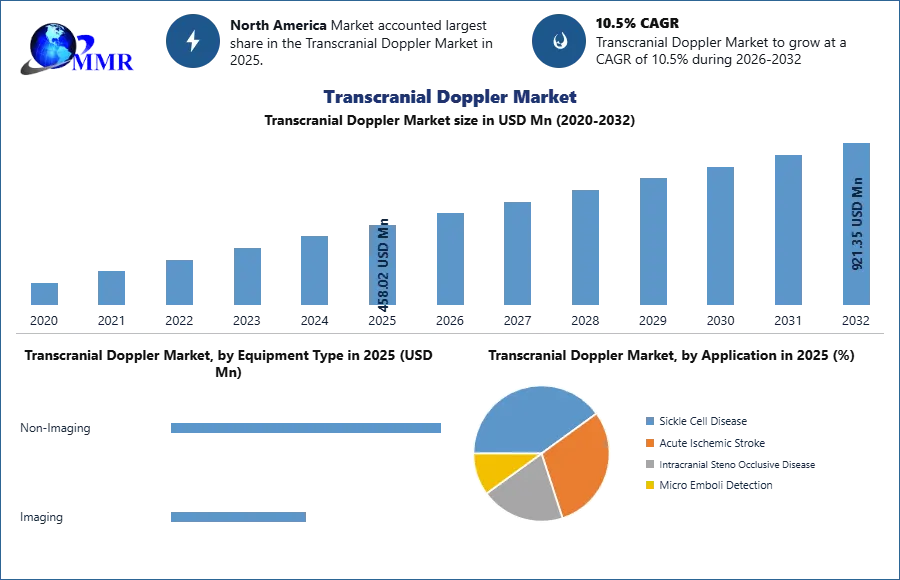
Transcranial Doppler Market size was valued at USD 458.02 Mn. in 2025 and revenue is expected to grow at 10.5%, by 2032.
Transcranial Doppler Market Overview:
Transcranial Doppler ultrasonography is a painless diagnostic that examines blood flow in the brain using sound waves. This test is recommended by doctors to detect a medical problem that affects blood flow to and inside the brain. The test is also used to track the effectiveness of some therapies, such as the dissolution of blockages inside brain arteries. Sound waves are transmitted through the cranial tissues during the test. These sound waves ricochet off moving blood cells within blood arteries, enabling the physician or neurologist to determine their velocity and distance. Acoustic waves are captured and presented on a computer monitor.
To know about the Research Methodology:- Request Free Sample Report
With the introduction of thrombolytic therapy for acute ischemic stroke, the physician would likely benefit from the knowledge of transcranial Doppler ultrasonography, which is a powerful technique for detecting cerebral vascular blockage. This test can also be used to measure the efficacy of thrombolytic therapy.
In this Transcranial Doppler market report, the Transcranial Doppler market's growth reasons, as well as the market's many segments (Equipment Type, End-User, Application, Display Mode, Mode Type, and Region), are discussed. Data has been given by market players, regions, and specific requirements. This market report includes a comprehensive overview of all the significant improvements that are presently prevailing in all market segments. Key data analysis is presented in the form of statistics, info graphics, and presentations. The study discusses the Transcranial Doppler market's Drivers, Restraints, Opportunities, and Challenges. The report helps to assess the market growth drivers and determines how to use these drivers as a tool. The report also helps to rectify and resolve issues related to the global Transcranial Doppler market situation.
Dynamics:
One of the primary trends observed in the global transcranial doppler market is technological improvement. Manufacturers are producing transportable, compact, and flexible transcranial dopplers as an example of technical innovation in response to the increased need for portable systems. By monitoring blood flow rate in the brain and identifying stenosis and emboli, the gadget provides comprehensive diagnostic options for a contemporary neurovascular facility. As a result of technical improvement, the availability of such a diverse variety of transcranial doppler systems is projected to contribute to market growth in the forecast period.
The upsurge in neurological disorders, with approximately 1 million individuals facing head trauma each year, is a critical factor ramping up the market growth, as is the capacity to use it for varying ages, sexual orientations, hypertension, and various movement disorders, the rise in the implementation of this model for evaluating cerebral hemodynamic and diagnosing cerebrovascular abnormalities, and the upsurge in the aging populations, among others, are the key factors that drive the market.
The high cost of neurological surgical procedures and instruments is a key impediment to the Transcranial Doppler industry, particularly in underdeveloped countries with inadequate compensation regulations. In the United States, the estimated price of routine operations to treat aneurysms and artery problems ranges between US$ 40,000 and US$ 55,000. Furthermore, maintenance charges and other accompanying incidental costs raise the overall ownership costs of such devices, restricting their acceptance. Due to economic restrictions, small hospitals and freestanding treatment centers are less likely to invest in costly and complex equipment; this is especially prevalent in underdeveloped nations. Because of the high prices and inadequate reimbursement scenario, only a small number of patients in poorer nations can afford neurological therapy. As a result, healthcare institutions are hesitant to invest in new or sophisticated technology systems, inhibiting market growth.
Transcranial Doppler Market Segment Analysis:
By Application, the Sickle disease segment is expected to grow at a CAGR of 2.8% in the aforementioned forecast period. This ultrasound method is more likely to be used by people who have sickle cell disease. This is a genetic blood illness marked by malformed, stiff, sickle-shaped red blood cells resulting from mutations. According to the National Institute of Health, sickle cell illnesses are by far the most frequent hereditary illnesses in the U. S., afflicting over 72,530 people, prompting the intended client group to embrace transcranial doppler ultrasonography for disease detection. The intended population's growing demands for transcranial Doppler systems for routine monitoring are expected to drive the segment growth.
Furthermore, with a rising number of neurological illnesses globally, there could be an increase in the use of this system for measuring cerebral tissue perfusion and diagnosing cerebral disorders, promoting the entire market's growth.
Transcranial Doppler Market Regional Insights:
North America is expected to be the largest market for transcranial dopplers in neurology. The North American market is primarily driven by factors such as an increasing target patient group for peripheral nerve diseases, greater awareness among brain surgeons about the advantages of interventional neurophysiology devices, and continuing social programs to modernize and expand the healthcare system.
The objective of the report is to present a comprehensive analysis of the Transcranial Doppler market to the stakeholders in the industry. The past and current status of the industry with the forecasted market size and trends are presented in the report with the analysis of complicated data in simple language. The report covers all the aspects of the industry with a dedicated study of key players that include market leaders, followers, and new entrants.
PORTER, PESTEL analysis with the potential impact of micro-economic factors of the market have been presented in the report. External as well as internal factors that are supposed to affect the business positively or negatively have been analyzed, which will give a clear futuristic view of the industry to the decision-makers.
The report also helps in understanding the Transcranial Doppler market dynamics, structure by analyzing the market segments and projecting the Transcranial Doppler market size. Clear representation of competitive analysis of key players by product, price, financial position, product portfolio, growth strategies, and regional presence in the Transcranial Doppler market make the report investor’s guide.
Recent Industry Developments (2025–2026)
| Exact Date | Company | Development | Impact |
|---|---|---|---|
| 09 February 2026 | NeuraSignal, Inc. | The company published new clinical performance data for its NG2 Intelligent Ultrasound system focusing on automated cerebral hemodynamics in Neuro ICU settings. | This development strengthens the adoption of robotic TCD by reducing the need for highly specialized manual operators in critical care. |
| 20 January 2026 | Natus Medical | The company announced a strategic service expansion to integrate AI-assisted flow analysis into its existing transcranial doppler product portfolio. | The move is expected to improve diagnostic accuracy for stroke risk detection and vasospasm monitoring across its global hospital client base. |
| 15 November 2025 | GE HealthCare | The company commercialized upgraded SonoNT software modules for its ultrasound systems to enhance intracranial translucency measurements. | This update simplifies repetitive diagnostic tasks, allowing for more consistent cerebral blood flow assessments in pediatric and adult patients. |
| 12 July 2025 | Mindray Medical | The company launched a new generation of portable TCD-integrated diagnostic units tailored for emergency medicine and point-of-care (POC) applications. | This launch addresses the increasing demand for compact, mobile neuro-monitoring solutions in decentralized healthcare facilities. |
| 05 May 2025 | Rimed Ltd. | The company entered into a strategic distribution partnership to expand its advanced TCD systems into emerging markets in the Asia-Pacific region. | This expansion aims to capture market share in high-growth regions where cerebrovascular disease prevalence is rising rapidly. |
| 18 March 2025 | Atys Medical | The company secured regulatory clearance for its latest ambulatory TCD Holter system featuring enhanced battery life and cloud connectivity. | The new device enables long-term monitoring of cerebral autoregulation, significantly benefiting patients during daily life activities and rehabilitation. |
Transcranial Doppler Market Scope: Inquire before buying
| Transcranial Doppler Market | |||
|---|---|---|---|
| Report Coverage | Details | ||
| Base Year: | 2025 | Forecast Period: | 2026-2032 |
| Historical Data: | 2020 to 2025 | Market Size in 2025: | 458.02 USD Mn |
| Forecast Period 2026-2032 CAGR: | 10.5% | Market Size in 2032: | 921.35 USD Mn |
| Segments Covered: | by Equipment Type | Non-Imaging Imaging |
|
| by Application | Sickle Cell Disease Acute Ischemic Stroke Intracranial Steno Occlusive Disease Micro Emboli Detection |
||
| by Display Mode | B-Mode M-Mode |
||
| by End-user | Hospitals Diagnostics Others |
||
Key players/competitors profile covered in Transcranial Doppler Market report in strategic perspective
Integra LifeSciences
Spiegelberg GmbH & Co. KG
Nihon Kohden Corporation
Elekta
Rimed Ltd
Grass Technologies
CAS Medical Systems (Edwards Lifesciences)
Yokogawa Electric Corporation
Cadwell Industries, Inc.
Natus Medical Incorporated
Covidien (Medtronic)
Atys Medical
Shenzhen Delica Medical Equipment Co., Ltd.
Compumedics Limited
NeuraSignal, Inc.
Viasonix Ltd.
GE HealthCare
Koninklijke Philips N.V.
Mindray Medical International Limited
Siemens Healthineers
Canon Medical Systems Corporation
FUJIFILM Sonosite, Inc.
Spencer Technologies
ELCAT GmbH
Moor Instruments Ltd.