
Train Collision Avoidance System Market By System Architecture, By Component, By Train Protection Technology, By Deployment Type, By Railway Application, By Offering and Regional Insights 2034
Overview
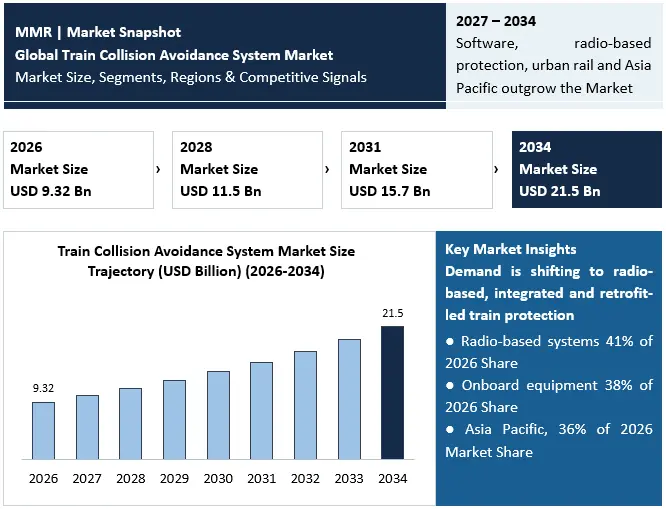
The Global Train Collision Avoidance System Market was valued at USD 9.32 Bn in 2026 and is expected to reach USD 21.5 Bn by 2034, growing at a CAGR of 11.0% during 2027–2034.
Train collision avoidance systems are safety-critical train protection solutions that detect collision risk, supervise speed and movement authority, warn the driver and apply automatic braking when a train approaches a stationary train, a conflicting route or a signal at danger. The market spans onboard protection units, balises and transponders, trackside detection, radio and network equipment, and software and system integration, delivered as Automatic Train Protection (ATP), Positive Train Control (PTC), the European Train Control System (ETCS) and India’s Kavach system, originally developed as the Train Collision Avoidance System (TCAS). The global Train Collision Avoidance System Market, therefore, encompasses train collision avoidance technology, railway safety electronics and train protection software for mainline, freight, urban and industrial railways.
This Train Collision Avoidance System Market analysis supports railway operators, infrastructure authorities, manufacturers, suppliers, contractors and investors. It evaluates equipment pricing, lifecycle costs, procurement trends, installation expenses, infrastructure integration and investment opportunities across technologies, railway applications and countries through 2034.
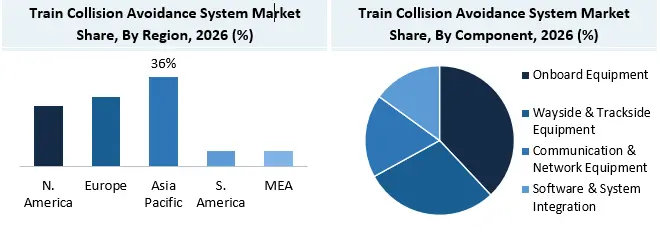
Onboard equipment and radio-based protection accounted for the largest shares of Train Collision Avoidance System Market sales in 2026, at about 38% and XX% of value, respectively, while Asia Pacific led the regional split with about 36%. Train Collision Avoidance System Market growth is moving toward software and system integration, urban rail transit, retrofit and modernization programs, radio-based and satellite-assisted positioning and emerging railway economies, as railway modernisation, train accident prevention mandates and railway digitalization change what operators buy and how they buy it.
Maximize Market Research delivers a comprehensive Train Collision Avoidance System Market Research Report covering global value (USD Bn) and volume (000’Units) by system architecture, component, train protection technology, railway application, deployment type, offering and region, across 5 regions and their countries, together with a competitive landscape, strategic scenarios and growth opportunities.
Train Collision Avoidance System Market Size and Growth: Industry Outlook to 2034
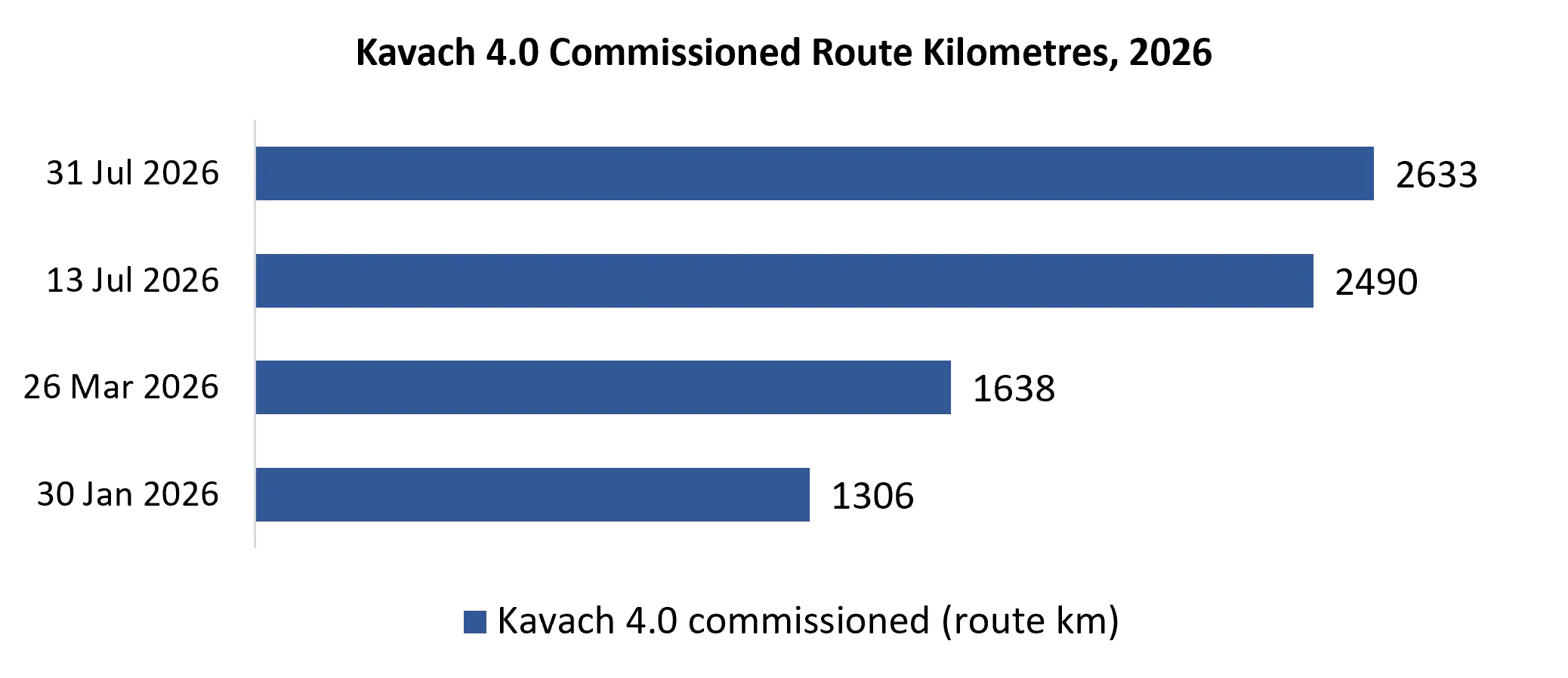
The Train Collision Avoidance System Market is sized at the safety-system level: onboard train protection equipment, wayside and trackside detection, communication and network equipment, and software and system integration supplied for new installations and retrofit programs. Market size is measured as supplier revenue and excludes operator-funded civil works. The market forecast rests on a visible public investment pipeline: India’s Ministry of Railways reported USD 13.38 Billion in safety-related expenditure for FY 2026–27 and Kavach 4.0 deployment across 2,633 route km as of 31 July 2026, supporting railway safety investments across Asia Pacific and the broader Train Collision Avoidance System Market growth outlook.
Train Collision Avoidance System Market Analysis from 2025 to 2034
To know about the Research Methodology :- Request Free Sample Report
Key Findings: Insights Shaping the Global Train Collision Avoidance System Market
Company filings, government program data and railway operator procurement behavior point to the following key market research findings, highlighting Train Collision Avoidance System Market demand, deployment, supply, revenue generated and Train Collision Avoidance System industry value creation through 2034.
1. Onboard equipment leads; software leads growth. Onboard equipment held about 38% of 2026 value and grows at XX%, while software and system integration grow at XX% and communication and network equipment at 12.4%. Safety intelligence is moving from lineside hardware to software-defined onboard and network layers.
2. Radio-based systems lead technologies and grow fastest. Radio-based protection held about 41% of 2026 value and grows at 12.9%, balise- and transponder-based systems held XX% and grow at 10.1%, and track-circuit-based systems held XX% and grow at XX%. Continuous radio supervision supports moving-block operation and higher line capacity.
3. Urban rail and freight outgrow mainline passenger. Urban rail transit grows at 12.8% and freight railways at 11.4%, against 10.0% for mainline passenger railways, which still held the largest application share of about 44% in 2026.
4. Retrofit and modernization is the faster deployment route. Retrofit and modernization held about 42% of 2026 value and grows at XX%, against 10.1% for new installations, as legacy locomotives and signalling networks are brought under train protection.
5. Asia Pacific is the largest and fastest-growing region. It held about 36% of 2026 value and grows at a XX% CAGR, lifting its share to about XX% by 2034. India’s expanding Kavach 4.0 deployment and ongoing trackside infrastructure development, alongside China’s CTCS-based high-speed railway network, are strengthening regional demand for advanced train collision avoidance systems and railway safety technologies.
6. Europe’s ETCS rollout is large but slow. TEN-T core network will miss its 2030 completion deadline, and ETCS covered only about 10% of the TEN-T network (about 12,400 km) and about 19% of the EU rail fleet at the end of 2024, which leaves a long onboard and trackside upgrade opportunity.
7. North America is a mature PTC market and the model is being exported. Interoperable PTC, built under the US Rail Safety Improvement Act of 2008, is moving from build-out to lifecycle upgrades, software updates and transit expansion, while Vale’s July 2026 agreement with Wabtec extends I-ETMS PTC to Brazil’s Carajás and Vitória a Minas railways.
8. The competitive landscape is layered. Global railway signalling majors, specialist train protection and sensor suppliers, Chinese and Japanese signalling groups and certified Indian Kavach OEMs compete on safety certification, interoperability, reliability and delivery capacity.
Train Collision Avoidance System Market Overview:
This Train Collision Avoidance System Market overview and market synopsis summarises the industry landscape, market insights and market research findings: Train Collision Avoidance System market size reached USD 9.32 Bn in 2026, and market analysis shows industry trends toward radio-based, integrated and retrofit-led solutions. Train Collision Avoidance System Market dynamics, market segmentation, key players and the competitive landscape are covered in detail, along with growth prospects, Train Collision Avoidance System Market opportunities, challenges, emerging markets and the market outlook through 2034. The market summary, revenue generated by leading suppliers, growth drivers and market strategies, together with consumer behavior (operator procurement behavior) and market entry considerations, give decision makers a complete view of Train Collision Avoidance System Market demand, supply and investment priorities.
Train Collision Avoidance System Market Trends
1. Rising Train Collision Avoidance System Deployment: Government mandates, accident-prevention targets and growing program funding support the Train Collision Avoidance System Market demand, installations and revenue growth.
2. Shift to Radio-Based and Interoperable Train Protection: Operators are moving from fixed-block, driver-dependent supervision to continuous radio-based train protection. ETCS Level 2, PTC, and Kavach 4.0 use radio links and onboard computers to deliver movement authority, and the Austrian Court of Audit notes that ETCS reduces the minimum headway between trains from about three minutes to about 2.5 minutes, linking safety investment to capacity gains.
3. Locomotive Retrofit as the Volume Driver: Fitting existing fleets is now a larger volume driver than new-build vehicles. Trade press reported in April 2026 that retrofitting a locomotive for ETCS costs about USD 970,000, while Indian Railways’ production units awarded multi-thousand-million onboard Kavach orders during 2026, which shows how installation costs and fleet readiness shape Train Collision Avoidance System Market demand.
4. Price Competition and Domestic Supplier Scale-Up: Tender pricing is reshaping share. In January 2026, HBL Engineering told investors that it won no order from Chittaranjan Locomotive Works’ 6,300-unit loco Kavach tender because other bidders priced lower, while Kernex Microsystems was awarded 3,024 sets. Price-led public tenders and certified manufacturing capacity shape the Train Collision Avoidance System Market's supply and share.
5. Digitalization, AI and Predictive Safety Analytics: Operators are layering condition monitoring, remote diagnostics, AI-assisted risk prediction and railway cybersecurity on top of train protection. These layers turn one-time equipment sales into software, licensing and service revenue and support Train Collision Avoidance System Market growth beyond hardware.
Train Collision Avoidance System Market Drivers:
Railway modernization is the primary demand driver. Governments are replacing lineside-signal and driver-reliant operation with continuous supervision, and the funding is visible: Indian Railways spent USD 430.56 Million on Kavach through June 2026 and allocated USD 229.56 Million for FY 2026–27. Ministry of Railways outlined plans to expand Kavach coverage by about 9,000 route km over two years, reflecting continued investment in railway safety infrastructure and supporting growth opportunities in the Asia Pacific Train Collision Avoidance System Market. Train accident prevention is the stated objective, and every investigation that cites a signal passed at danger, overspeed, or a head-on or rear-end collision strengthens the case for automatic braking.
Regulation and interoperability convert safety policy into procurement. The US Rail Safety Improvement Act of 2008 required PTC on defined main lines, the TEN-T Regulation requires ERTMS on the EU core network by 2030 and radio-based ERTMS across the network by 2050, and Indian Railways has treated Kavach as its National ATP system since July 2020. Mandates of this kind give suppliers multi-year visibility that few other railway technology segments offer.
Capacity and efficiency add a commercial case to the safety case. ETCS and communication-based train control allow trains to run closer together, and Siemens’ Trainguard MT upgrade of New York’s Fulton–Liberty Lines, announced in April 2026, enables trains to run as close as 90 seconds apart. Growing passenger and freight volumes, metro expansion, heavy-haul mining railways such as Vale’s Carajás line and falling costs of electronics, sensors and satellite positioning widen the addressable base.
Train Collision Avoidance System Market Restraints and Challenges:
Installation costs and long payback are the most persistent restraint. Onboard retrofit, trackside balises, radio towers, optical fibre and station data centres must be funded together: Indian Railways’ Kavach program had required 11,547 km of optical fibre, 1,721 telecom towers and station data centres at 1,009 stations by July 2026. Railway infrastructure integration is harder still in Europe, where more than 20 national train control systems coexist with ERTMS; only about 19% of the EU fleet was ETCS-equipped at the end of 2024, and only about 20 of 200 cross-border links had interoperable ETCS.
Technical qualification and certification slow projects. Safety-critical hardware and software must pass SIL assessment, EN 50126, EN 50128 and EN 50129 approval and independent safety certification, and each new baseline triggers re-testing and interoperability trials. Austria’s audit noted that ERTMS-equipped rolling stock sometimes had to be retrofitted again to stay compatible with newer versions. Fleet and trackside work must also move together, because trackside upgrades deliver little benefit if trains are not equipped.
Funding, workforce and supplier capacity add Train Collision Avoidance System Market constraints. Public budgets, import duties, currency movements and semiconductor pricing create project-timing risk, and certified supplier capacity is limited: in India, only a few certified OEMs, including HBL, Kernex and Medha, supply Kavach equipment. Cybersecurity, spectrum availability and operator training requirements also extend lead times.
Train Collision Avoidance System Market Dynamics Analysis:
1. Train Collision Avoidance System Market Demand and Supply Gap Analysis: Indian Railways operated 69,439 route km in FY 2024–25, highlighting substantial railway safety infrastructure requirements and potential demand for certified collision avoidance equipment and signalling modernization.
2. Consumer Behavior Trends and Preference Evolution: Indian Railways operated 7,469 stations in FY 2024–25, highlighting infrastructure complexity and operator requirements for interoperable signalling, reliable train protection, cybersecurity and cost-effective lifecycle maintenance solutions.
3. Technological Advancements and Innovation Impact: ETCS Level 2 enables continuous radio-based movement authority communication, supporting automatic speed supervision, improved train protection, digital signalling integration and reduced dependence on traditional lineside signalling equipment.
4. Regulatory Influences and Regulatory Changes: European railway interoperability requirements establish 2030, 2040 and 2050 infrastructure development milestones, supporting ERTMS deployment, signalling modernization and long-term demand for certified train protection technologies.
5. Competitive Forces and Market Forces: Indian Railways initiated procurement for Kavach installation across 15,000 route km in 2024, creating opportunities for domestic manufacturers while certification, localization and competitive tendering influence supplier positioning.
6. Market Drivers, Growth Catalysts and Market Growth Factors: Indian Railways completed 6,450 km of track renewal and 8,550 turnout renewals during 2024, demonstrating infrastructure modernization that can support demand for advanced signalling and train protection systems.
7. Market Challenges, Market Constraints and Industry Disruptors: Indian Railways reported 1,37,522 track km in FY 2024–25, illustrating the extensive infrastructure requiring safety assessment, while installation complexity, certification requirements and maintenance costs constrain protection system deployment.
8. Market Shifts and Market Segmentation Shifts: Indian Railways introduced 136 Vande Bharat trains by December 2024, highlighting modernization of passenger services and increasing opportunities for onboard protection equipment, signalling integration and railway technology upgrades.
9. Environmental Factors and Socioeconomic Influences: India achieved 99.4% electrification of its broad-gauge railway network by February 2026, supporting sustainable transportation, railway modernization and potential integration of advanced train protection technologies across electrified corridors.
10. Market Trends Analysis, Emerging Trends and Industry Evolution: Indian Railways increased permissible speeds to 130 km/h across 2,000 km during 2024, strengthening requirements for reliable automatic speed supervision, collision prevention and advanced signalling technologies.
11. Competitive Landscape Shifts, Market Fluctuation Analysis and External Market Influences: India's railway modernization included 1,198 stations undergoing redevelopment under the Amrit Bharat Station Scheme by December 2024, creating potential opportunities for signalling suppliers and infrastructure technology providers.
12. Consumer Preferences Evolution and Regulatory Changes: Indian Railways reported 9,000 technicians trained in Kavach technology during 2024, highlighting growing emphasis on workforce readiness, safety compliance, maintenance capabilities and reliable train protection system implementation.
Train Collision Avoidance System Consumer Scenario:
The consumer of a train collision avoidance system is rarely the passenger; it is the railway operator, infrastructure authority or freight owner that buys, installs and maintains it, while passengers, shippers and regulators shape the demand through safety expectations. Understanding this consumer scenario, customer profiling and purchasing behavior is essential for market entry and market strategies.
1. Government Operators Dominate Buying: Government-owned railway operators and infrastructure authorities account for most Train Collision Avoidance System Market demand and buy through public tenders. In 2026, Indian Railways’ production units placed major onboard Kavach equipment orders worth USD 273.97 Million with Kernex Microsystems for 3,024 locomotive sets at Chittaranjan Locomotive Works and USD 190.44 Million with HBL Engineering in May 2026. These contracts, collectively valued at USD 464.41 Million, highlight the concentration of Train Collision Avoidance System Market demand in large-scale railway procurement projects.
2. Procurement Behavior Is Price-Led but Certification-Gated: Buyer’s shortlist only suppliers that meet the technical specification, such as the RDSO Kavach version 4.0 specification, and then award on price and delivery capacity. HBL’s reported loss of the CLW tender to lower-priced bidders shows that price sensitivity is high even where certification is demanding.
3. Freight and Mining Operators Buy for Predictability: Private and industrial railways adopt train protection to improve the predictability and reliability of operations. Vale’s July 2026 agreement with Wabtec to deploy I-ETMS PTC on the Carajás and Vitória a Minas railways, which carry freight and passenger services, illustrates how commercial operators value safety as an operating-efficiency tool.
4. Urban Transit Authorities Buy for Headway and Safety: Metro and light rail authorities treat collision avoidance as part of communication-based train control. Siemens’ April 2026 Trainguard MT upgrade of New York’s Fulton–Liberty Lines, which enables trains to run about 90 seconds apart, shows that transit consumers weigh capacity and safety together.
5. Passenger Confidence and Public Pressure: Passengers do not purchase these systems, but safety perception influences ridership, political attention and budget approvals. Public attention after accidents tends to accelerate approvals and funding for automatic train protection, so consumer sentiment acts as a demand catalyst rather than a direct buying decision.
6. Workforce Readiness and Customer Engagement: Adoption depends on operator capability: Indian Railways has trained over 40,000 personnel on Kavach. Customer engagement dynamics therefore extend beyond equipment delivery to training, field trials, maintenance contracts and software updates, which makes service quality a differentiator in repeat purchases.
7. Retrofit Economics Shape Purchasing Decisions: Operators with large legacy fleets weigh retrofit cost per locomotive against replacing vehicles. With ETCS retrofit costing about USD 970,000 per locomotive according to April 2026 trade press, buyers phase fleet fitting by corridor priority, which spreads Train Collision Avoidance System Market revenue over several years.
Train Collision Avoidance System Market Innovations:
The radio-based continuous supervision, satellite-assisted train positioning, AI-assisted collision risk prediction, cybersecure and interoperable platforms, and digital twin-based testing. Kavach 4.0 illustrates the pace of deployment. Upgraded Kavach has also completed 160 kmph trials with a Vande Bharat train, extending the system toward higher-speed services.
Hardware-in-the-loop and software-in-the-loop testing, digital twins and sensor fusion compress validation cycles, and interest in open, modular hardware is rising: in November 2025, South Central Railway, IRISET and IIT Hyderabad signed an MoU to develop modular hardware interoperability for Kavach.
Under the European framework, ETCS and ERTMS must meet the technical specifications for interoperability, and rolling stock and trackside equipment require authorization before service. In the United States, PTC systems must be interoperable between railroads and are overseen by the Federal Railroad Administration, while in India Kavach equipment is built to RDSO specifications and certified to safety integrity level 4. Software, cybersecurity and communication standards are now integral to these approvals.
Train Collision Avoidance Technology Landscape:
Technology defines how a train is protected. Automatic Train Protection (ATP) supervises speed against permitted limits and brakes automatically if the driver fails to respond. ETCS, the signalling and control component of ERTMS, supervises position and speed and checks authority to proceed, and Level 2 implementations use radio to exchange movement authority. Positive Train Control, used by North American railroads, enforces speed restrictions and movement authorities and prevents train-to-train collisions. Kavach is India’s indigenous ATP, combining onboard units, RFID tags on the track, station units and radio towers. Radio-based systems held about 41% of 2026 value, balise and transponder-based about XX%, track-circuit-based about 17% and other technologies, including satellite-assisted solutions, about XX%.
Automatic Train Protection (ATP) and ETCS: Speed Supervision, Movement Authority and Emergency Braking
Automatic Train Protection systems held a central role in the 2026 market due to they combine speed supervision, movement authority monitoring and automatic emergency braking in one safety loop. Fixed-block ATP uses track circuits or axle counters and balise data, while moving-block applications use continuous radio to calculate safe separation. Integration with interlocking and signalling is decisive: ATP must read route and signal states from electronic interlockings, which is why interlocking compatibility is a procurement criterion in Kavach, ETCS and PTC projects.
ETCS adoption is progressing unevenly. Belgium completed 100% ETCS deployment across its national network in December 2025, the first EU member state to do so, whereas the European Court of Auditors expects the TEN-T core network to miss its 2030 deadline and the European ERTMS Coordinator’s 2026 work plan describes deployment as significantly behind schedule and structurally uneven. This divergence creates a long, multi-country onboard and trackside upgrade pipeline for ETCS suppliers through 2034.
Radio-Based, GNSS and Balise Technologies:
Radio-based protection depends on reliable train-to-ground and train-to-train links, frequency allocation and interference management. Satellite positioning with odometry and inertial sensors improves location data on remote corridors and reduces the number of physical balises, but tunnels and dense urban areas still require redundancy. Balise, RFID and transponder detection supply precise position references and remain essential for fallback modes, while track circuits and axle counters detect train occupancy.
Global Train Collision Avoidance System Market Segment Analysis:
By System Architecture, integrated train protection systems led with about 47% of 2026 value, followed by infrastructure-assisted systems at XX% and standalone onboard systems at XX%. Integrated architectures grow fastest at 12.6% CAGR because operators want one safety loop spanning onboard, trackside and communication layers, whereas standalone onboard systems grow at 7.6%.
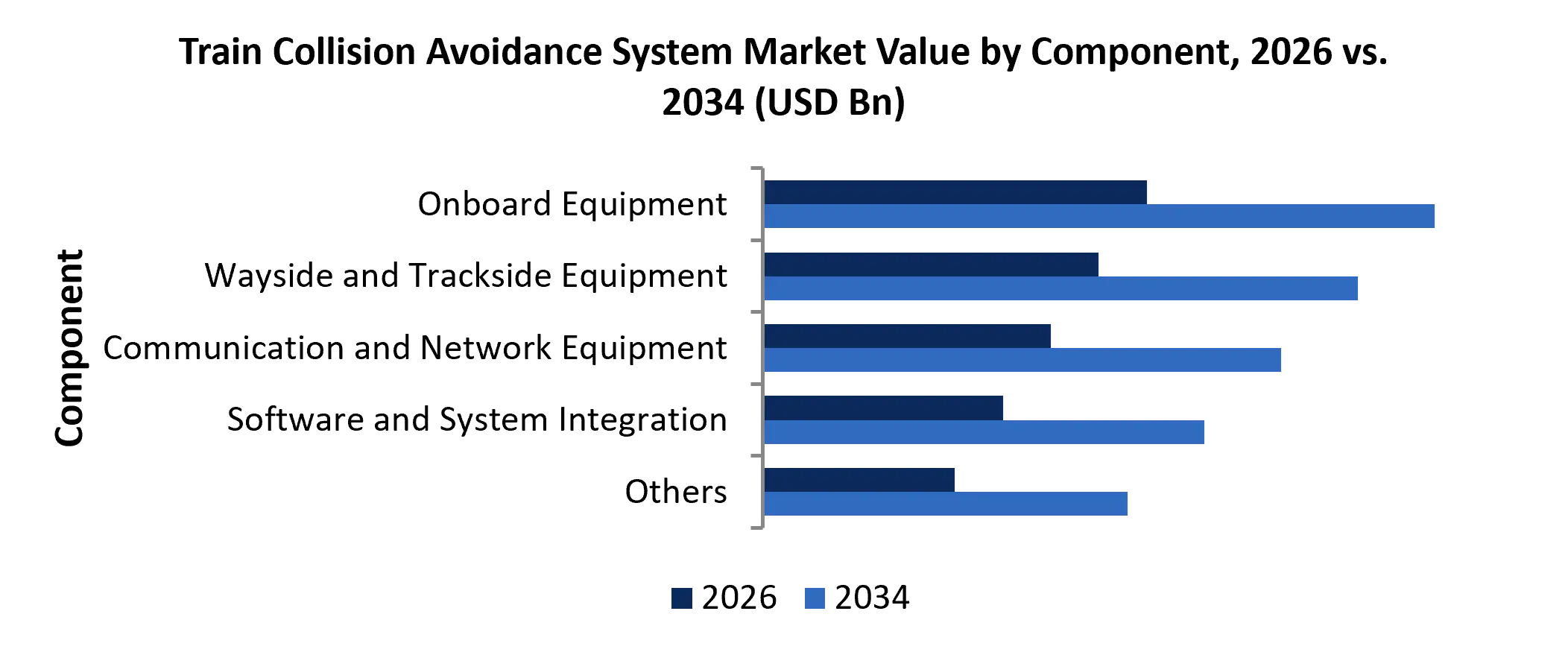
By Component, onboard equipment led with about 38% of the 2026 value, followed by wayside and trackside equipment at XX%, communication and network equipment at XX% and software and system integration at 15%. Software and system integration is the fastest-growing component at XX% CAGR, ahead of communication and network equipment at 12.4%, onboard equipment at XX% and wayside and trackside equipment at 9.0%.
By train Protection Technology, radio-based systems led with about 41% of 2026 value, followed by balise and transponder-based systems at XX%, track-circuit-based systems at 17% and other primary technologies at 8%. Radio-based systems grow at XX% CAGR, other technologies, including satellite-assisted systems, at XX%, balise and transponder-based systems at XX% and track-circuit-based systems at 6.4%.
By Railway Application, mainline passenger railways led with about 44% of 2026 value, followed by freight railways at XX%, urban rail transit at 22% and industrial and dedicated railways at XX%. Urban rail transit is expected to register the fastest growth, followed by freight railways, mainline passenger railways, and industrial and dedicated railways.
Train Collision Avoidance System Market Regional Outlook:
The Asia Pacific Train Collision Avoidance System Market held the largest share, about 36% of global value in 2026, and is also expected to be the fastest-growing region at a XX% CAGR through 2034, rising to about XX% of value. In April 2026, Indian Railways approved USD 151.61 Million for railway safety and signalling modernisation projects. These included USD 23.20 Million for Kavach 4.0 installation on 232 locomotives, USD 44.54 Million for optical fibre upgrades across 3,200 route km, and USD 64.22 Million for electronic interlocking modernisation at 49 stations. China adds scale through its CTCS-based high-speed and conventional network and domestic signalling groups, while Japan and South Korea contribute advanced ATP and communication-based train control.
Europe held about 28% of 2026 value and is expected to grow at about 9.5% CAGR. Germany, France, the United Kingdom, Italy and Spain lead demand through ETCS and ERTMS programs, and the region shows both the scale and the difficulty of cross-border interoperability. The North America Train Collision Avoidance System Market held about XX% of 2026 value and grows at about 8.7% CAGR as interoperable PTC moves into the lifecycle upgrade phase. The Middle East and Africa held about XX% of 2026 value and grow at XX% on new-build railways and metros, while South America held about 6% and grows at about 10.8% on freight and mining railways, as seen in Vale’s July 2026 PTC agreement.
| Region | 2026 share | 2026 (USD Bn) | 2034 (USD Bn) | CAGR | Notes |
| North America | 24.0% | XX | XX | 8.7% | US PTC (I-ETMS) lifecycle upgrades, transit PTC, Canada and Mexico freight; mature, software-led |
| Europe | XX% | XX | XX | XX | Germany, UK, France, Italy and Spain; ETCS/ERTMS, TEN-T 2030 core network, national ATP migration |
| Asia Pacific | XX% | XX | XX | XX | India Kavach, China CTCS, Japan and South Korea; largest and fastest-growing region |
| Middle East & Africa | XX% | XX | XX | XX | UAE, Saudi Arabia, Turkey, South Africa and Egypt; new-build railways, freight and metro projects |
| South America | XX% | XX | XX | 10.8% | Brazil leads; heavy-haul and mining freight (Vale PTC), Argentina, Chile and Colombia retrofit |
Leading Train Collision Avoidance System Manufacturers: Competitive Landscape and Train Collision Avoidance System Market Key Players
The Train Collision Avoidance System Market competitive landscape includes several distinct groups rather than a single set of comparable companies. Global railway signalling and rolling stock groups such as Siemens Mobility, Alstom, Hitachi Rail, Thales, Wabtec, Mitsubishi Electric and Knorr-Bremse supply ATP, ETCS, PTC and communication-based train control. Chinese and Japanese signalling groups, including CRSC, Beijing Hollysys, CASCO Signal, Nippon Signal, Kyosan Electric and Toshiba Infrastructure Systems & Solutions, serve large domestic programs. Indian manufacturers, led by the certified Kavach OEMs Kernex Microsystems, HBL Engineering and Medha Servo Drives, together with Bharat Electronics Limited and the local operations of global groups, supply the India Kavach System. Specialist component, sensor and software providers such as Frauscher, Kontron Transportation, duagon, MERMEC, Rail Vision and Piper Networks complete the ecosystem.
Global Train Collision Avoidance System Market Recent Developments, Product Launches and Industry News | 2026
| Date | Company / Source | Key Development | Impact on Train Collision Avoidance System Market |
| Jan 26 | Kernex Microsystems / CLW | Chittaranjan Locomotive Works awarded Kernex USD 273.97 Million for supply and commissioning of 3,024 on-board Kavach locomotive sets to RDSO version 4.0. | Shows the scale of onboard Kavach demand and the role of price-led tenders in Train Collision Avoidance System Market share. |
| Jan 26 | European Court of Auditors | Concluded that the TEN-T core network will not be completed by its 2030 deadline and highlighted poor coordination in ERTMS deployment. | Extends ETCS upgrade timelines and keeps retrofit and onboard-unit demand active beyond 2030. |
| Jan 26 | Indian Railways | Commissioned a record 472.3 route km of Kavach 4.0 in a single day, taking version 4.0 coverage to 1,306.3 route km across five zones. | Demonstrates accelerating trackside deployment and supports Asia Pacific railway safety growth. |
| Apr 26 | Siemens Mobility / L.K. Comstock | Announced the Trainguard MT CBTC upgrade of New York’s Fulton–Liberty Lines, enabling trains about 90 seconds apart. | Highlights urban rail transit demand for communication-based train control with collision protection. |
| May 26 | HBL Engineering / CLW | Secured a Kavach onboard locomotive equipment contract valued at USD 0.19 Billion. | Confirms the competitive position of certified domestic Kavach OEMs. |
| Jul 26 | Vale / Wabtec | Vale agreed to implement Wabtec’s I-ETMS Positive Train Control on the Carajás and Vitória a Minas railways in Brazil. | Extends North American PTC technology to South American freight and mining railways. |
Train Collision Avoidance System Competitive Landscape Analysis
1. Competitor Analysis, Company Revenue and Train Collision Avoidance System Market Share: The report evaluates leading manufacturers based on revenue, net sales, market share, profitability, R&D investments, financial performance, and competitive positioning using company filings and industry data.
2. Competitor Profiling, Industry Rivals Examination and Competitive Positioning: Competitive analysis examines global manufacturers, regional suppliers, and Indian Kavach developers, focusing on technological capabilities, certification, interoperability, product innovation, pricing strategies, and competitive advantages across railway safety markets.
3. Rivalry Intensity, Market Rivalry Intensity and Industry Player Dynamics: Market competition is influenced by certification requirements, government tenders, localization policies, manufacturing capacity, and technological advancements, while software integration, cybersecurity, and railway modernization strengthen competitive rivalry among suppliers.
4. Market Player Strategies, Competitive Benchmark Analysis and Rival Market Share: Leading companies strengthen market positioning through technological innovation, strategic partnerships, localized manufacturing, acquisitions, and portfolio expansion, while competitive benchmarking evaluates market share, operational capabilities, product differentiation, and revenue growth.
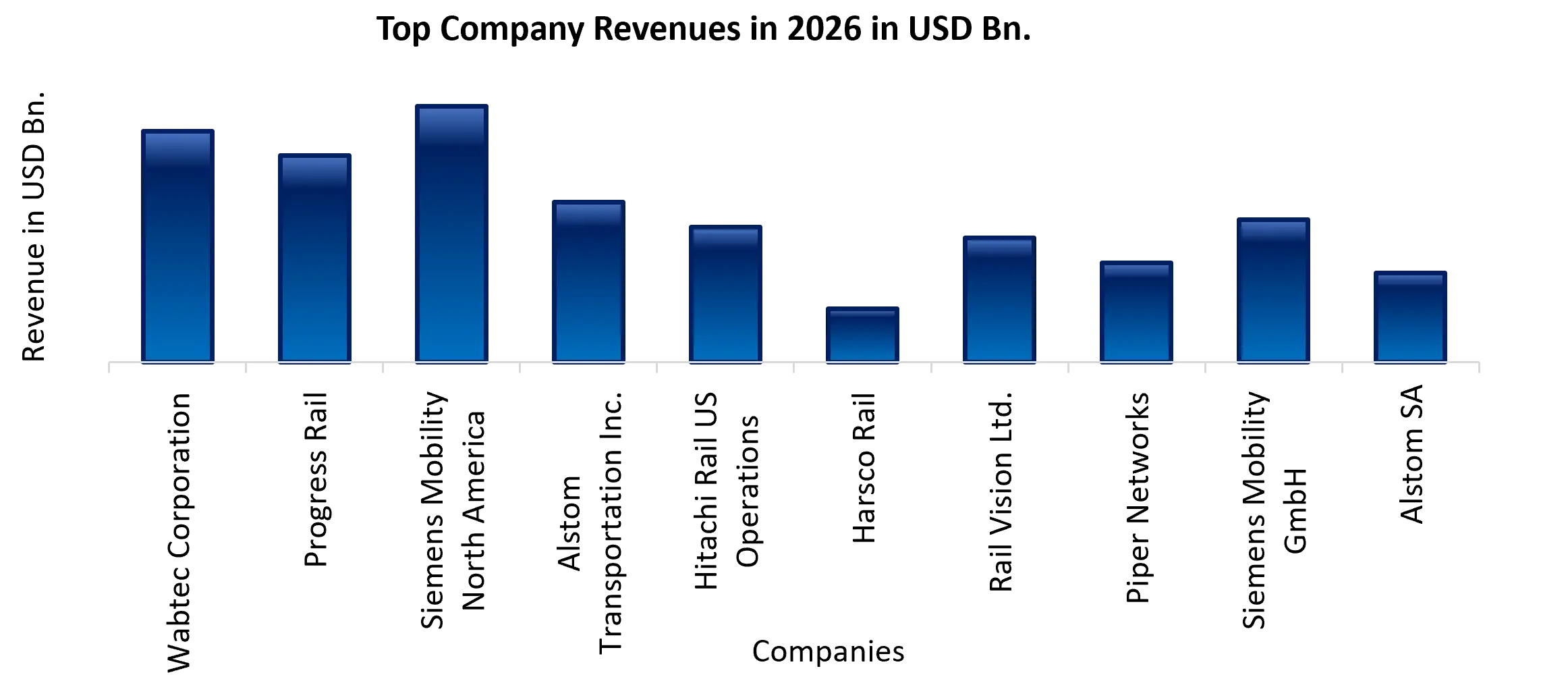
5. Strategic Analysis and Competitive Ecosystem: The competitive ecosystem includes multinational signalling companies, regional technology providers, and domestic manufacturers competing through pricing, technology licensing, strategic alliances, product innovation, and infrastructure modernization opportunities across global railway networks.
Global Train Collision Avoidance System Market Scope
| Global Train Collision Avoidance System Market |
|||
|---|---|---|---|
| Report Coverage | Details | ||
| Base Year: | 2026 | Forecast Period: | 2027-2034 |
| Historical Data: | 2021 to 2026 | Market Size in 2026: | USD 9.32 Billion |
| Forecast Period 2027 to 2034 CAGR: |
11.0% | Market Size in 2034: | USD 21.5 Billion |
| Train Collision Avoidance System Market Segments Covered: |
By System Architecture | Standalone Onboard Systems Infrastructure-Assisted Systems Integrated Train Protection Systems Others |
|
| By Component | Onboard Equipment Wayside and Trackside Equipment Communication and Network Equipment Software and System Integration Others |
||
| By Train Protection Technology | Radio-Based Systems Balise and Transponder-Based Systems Track-Circuit-Based Systems Others |
||
| By Deployment Type | New Installations Retrofit and Modernization |
||
| By Railway Application | Mainline Passenger Railways Freight Railways Urban Rail Transit Industrial and Dedicated Railways Others |
||
| By Offering | Hardware Software Services |
||
Global Train Collision Avoidance System Market, By Region
North America (United States, Canada, Mexico)
Europe (Germany, United Kingdom, France, Italy, Spain, Netherlands, Switzerland, Sweden, Denmark, Belgium, Austria, Poland, Rest of Europe)
Asia Pacific (China, Japan, India, South Korea, Australia, New Zealand, Singapore, Taiwan, Thailand, Malaysia, Indonesia, Vietnam, Philippines, Rest of Asia Pacific)
Middle East and Africa (United Arab Emirates, Saudi Arabia, Israel, Turkey, South Africa, Egypt, Nigeria, Algeria, Morocco, Angola, Kenya, Ghana, Rest of Middle East and Africa)
South America (Brazil, Argentina, Chile, Colombia, Rest of South America)
Key players/Competitors profiles covered in the Train Collision Avoidance System Market report from a strategic perspective
North America
1. Wabtec Corporation (United States)
2. Progress Rail (United States)
3. Siemens Mobility North America (United States)
4. Alstom Transportation Inc. (United States)
5. Hitachi Rail US Operations (United States)
6. Harsco Rail (United States)
7. Rail Vision Ltd. (Israel; North American Market Presence)
8. Piper Networks (United States)
Europe
9. Siemens Mobility GmbH (Germany)
10. Alstom SA (France)
11. Hitachi Rail (Italy/United Kingdom)
12. Thales Ground Transportation Systems (France)
13. Knorr-Bremse AG (Germany)
14. CAF Signalling (Spain)
15. MERMEC S.p.A. (Italy)
16. Frauscher Sensor Technology (Austria)
17. Kontron Transportation (Austria)
18. duagon AG (Switzerland)
19. voestalpine Railway Systems (Austria)
20. Vossloh AG (Germany)
Asia Pacific
21. CRSC – China Railway Signal & Communication Corporation (China)
22. Beijing Hollysys Co., Ltd. (China)
23. CASCO Signal Ltd. (China)
24. Nippon Signal Co., Ltd. (Japan)
25. Kyosan Electric Manufacturing Co., Ltd. (Japan)
26. Mitsubishi Electric Corporation (Japan)
27. Toshiba Infrastructure Systems & Solutions (Japan)
28. Hitachi, Ltd. (Japan)
29. Hyundai Rotem Company (South Korea)
30. LS ELECTRIC Co., Ltd. (South Korea)
31. Bharat Electronics Limited (India)
32. Medha Servo Drives Pvt. Ltd. (India)
33. HBL Engineering Limited (India)
34. Kernex Microsystems (India) Limited (India)
35. Siemens Limited (India)
36. Alstom Transport India Limited (India)
Middle East & Africa
37. Siemens Mobility Middle East Operations (United Arab Emirates)
38. Alstom Middle East Operations (United Arab Emirates)
39. Hitachi Rail Middle East Operations (United Arab Emirates)
40. Wabtec South Africa Operations (South Africa)
South America
41. Alstom Brasil Energia e Transporte Ltda. (Brazil)
42. Siemens Mobility Brazil Operations (Brazil)
43. Wabtec Brazil Operations (Brazil)
44. Hitachi Rail South America Operations (Brazil)
Others
Frequently Asked Questions
1. What is the Train Collision Avoidance System Market Size?
Ans. MMR values the global Train Collision Avoidance System Market at USD 9.32 Bn in 2026, with USD 9.3 Bn expected in 2026 and USD 21.5 Bn by 2034, at a CAGR of 11.0% during 2026–2034.
2. What Drives Train Collision Avoidance System Market Growth?
Ans. Growth comes from railway modernization, accident-prevention mandates such as Kavach, PTC and ETCS, locomotive retrofit programs, urban rail expansion, radio-based and satellite-assisted technologies, and rising software and service content.
3. Which region and country is the largest Train Collision Avoidance System Market?
Ans. Asia Pacific held the largest share in 2026, about 36% of value, and is also the fastest-growing region at XX% CAGR. India, through Kavach, and China, through CTCS, lead regional demand.
4. Which Train Collision Avoidance System segments are growing fastest?
Ans. Onboard equipment is the largest component at about 38% of 2026 value, but software and system integration grow fastest at XX% CAGR. Radio-based systems lead technologies at XX%, urban rail transit leads application growth at 12.8%, and retrofit and modernisation grow at XX%.
5. Who are the leading Train Collision Avoidance System manufacturers?
Ans. Leading names include Siemens Mobility, Alstom, Hitachi Rail, Thales, Wabtec, Knorr-Bremse, CRSC, Mitsubishi Electric, Nippon Signal, Kyosan Electric, Kernex Microsystems, HBL Engineering, Medha Servo Drives and Bharat Electronics Limited, among others profiled in the report.
6. What is Kavach and how does it differ from ETCS and PTC?
Ans. Kavach is India’s indigenous Automatic Train Protection system, originally developed as the Train Collision Avoidance System, which uses onboard units, RFID tags, station units and radio. ETCS is the European standard within ERTMS and Positive Train Control is the North American approach; all three supervise speed and movement authority and apply automatic braking, but they differ in standards, architecture and interoperability.
7. What is the Train Collision Avoidance System Market outlook to 2034?
Ans. The market outlook to 2034 is positive, with growth led by Asia Pacific, software, urban rail and retrofit, and with a large remaining installation pipeline in India, Europe and emerging railway economies.