
Tire Filler Market Size by Product, End-Use Industry, Region, Industry-Wide Analysis, Competitive Landscape Assessment & Long-Term Forecast to 2032
Overview
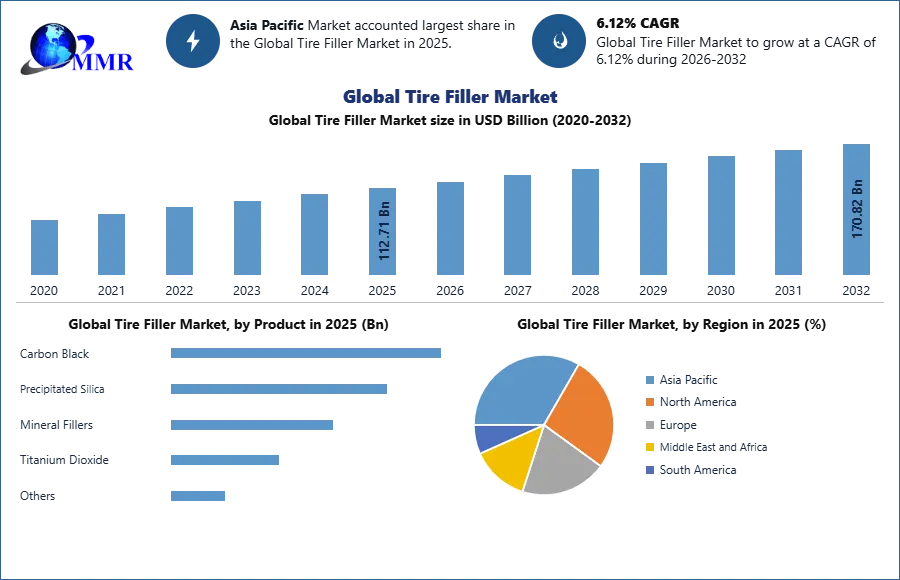
Tire Filler Market was valued nearly US$ 112.71 Bn in 2025. Tire Filler Market size is estimated to grow at a CAGR of 6.12% & is expected to reach at US$170.82 Bn. by 2032.
Global Tire Filler Market Overview:
Tire fillers are compounds that are used to seal the tire's entry, preventing air & fluid from entering the tube. Rubber tire are black in color and give the tire wall suppleness as well as the capacity to change shape in cold temperatures. Rubber is an excellent temperature-resistant material. Tire filler adds strength & longevity to the tire's surface. A Tire fillers are an important part of the manufacturing process since they are a key component in the creation of tire. Tire fillers' major functions are to provide efficiency standards & to improve performance levels.
Carbon black, Silica, and amorphous precipitated silica are used as tire fillers to reinforce the rubber tube & improve vehicle performance. To improve tire properties such as tear resistance, abrasion resistance, and tensile strength, a filler is employed. Silica's main purpose is to boost the tire's rolling capacity. Tire fillers have disadvantages as well, such as sealants harming the tire wall due to improper application, necessitating tire replacement.
 To know about the Research Methodology :- Request Free Sample Report
Automobile Manufacturing:
Throughout the years, the automobile industry has matured into a mature and well-established industry. Vehicle manufacturing & innovation have contributed to the industry's prosperity. Automobile companies have made significant contributions to the global economy through creating jobs, paying a significant amount of taxes, and earning a significant amount of foreign money. There are several automobile manufacturing companies all around the world that produce a large number of vehicles.
Tata Motors is Asia's largest automobile manufacturer and the world's 17th largest. Automobiles, trucks, vans, buses, and other vehicles are produced by this company. Tata Motors had the highest sales and was well-liked across the country in the year 2018. This group is dedicated to foreseeing & delivering the world's best commercial and passenger vehicles, as well as the best customer experiences.
| Tata Motors | |
| Establishment Year | 1945 |
| Employee Strength | 60,000 |
| Company Turnover | $ 42 Billion |
| Vehicle Sold Service | >9 Mn |
| Sales & Service Point | >6,600 Mn |
In more than 175 countries, Tata Motors can be found on and off the road. Tata Motors sells vehicles, buses, and trucks in 20 countries, including India, the UK, South Korea, Thailand, South Africa, & Indonesia.
The Automobile Industry:
The automobile industry is in the midst of a major revolution. In the coming years, the automotive industry will be renamed the mobility industry, encompassing the next generation of products & services that enable people and goods transportation, as well as new technologies in material and digital sciences & business models such as ride-sharing and shared ownership.
Each of these occurrences is sufficiently disruptive to need modifications in corporate tactics. When they are united, however, they produce a complete transformation. It's not only for current players, either. New, non-traditional companies are emerging in the IT sector. Companies that do not adapt rapidly enough risk falling behind and being unable to compete, perhaps causing a substantial shift in the industry's environment, participants, and power dynamics.
The new & rapidly growing mobility industry:
The mobility sector necessitates a broader view of how consumers will interact with their automobiles. This change is being driven by four different, observable technology sectors, all of which shifted from the future to the present in 2016. Connectivity has the advantage of having the most time spent in the car and is the most acquainted to the consumer. On-Star, for example, is a popular "help button" from General Motors that provides directions to emergency services. Redefined mobility: As a result of the popularity of ride-sharing services like Uber, the fundamental essence of what we consider "mobility" is evolving. The majority of big manufacturers are thinking about how these trends will affect new product development and design. This will affect the physical evolution of vehicles as well as the software that runs on them.
Tire Industry:
Tire consumption is increasing at an exponential rate, owing to increased demand for vehicle production to meet the spike in vehicle demand across all segments. As a result, automotive manufacturing ultimately determines tire demand. Increased vehicle production in developing nations & increased competition among tire producers are driving the global automotive tire industry. However, constraints such as fluctuating raw material prices and rising demand for tire remolding are projected to stifle market expansion. Furthermore, advances in technology and fuel efficiency, as well as an increase in the usage of electric vehicles, are likely to open up various potential for market expansion.
Market Trends for Tire Fillers:
The vehicle industry is driving the tire filler market. A tire is an important component of every vehicle. As a result, tire fillers are the basic components and chemicals that increase the tensile strength and durability of the final product.
The expansion of the tire filler market has been linked to SUV innovation. Vehicles are used as a form of transportation, and they use tire to offer motion, whether by air or by road. Hence the car and transportation industries will drive the tire filler market throughout the projected period. Increased global car sales are indirectly fueling the tire filler business. Increased disposable money and modernization are also key factors in the sale of automobiles. Tire producers are working on enhancing tire performance and increasing gripping capability on the road as the frequency of road accidents rises. Furthermore, to avoid tire explosions, car and bike racing sports require increased tensile strength in the vehicle due to the high speed of the competition. As a result, the aforementioned considerations open the door for manufacturers to enter the market.
Market Segments for Tire Fillers:
The product sector includes carbon black, precipitated silica, mineral filler, and titanium dioxide. Precipitated silica dominates the tire filler market. Precipitate silica has a market share of xx billion dollars and is predicted to grow at a CAGR of 7.9% over the next five years. Rubber and polymers become more pliable and perform better when silica is added. An important factor is rising product demand in tire manufacturing for large cars and trucks used in the transportation of commodities.
Automotive, aerospace, military & defence, consumer products, and other end-user sectors make up the segment (Including agriculture). The automobile industry dominates the tire filler market, followed by the aircraft industry. With a 7.10% CAGR, the vehicle sector has a market share of $ xx billion dollars.
Regional Insights :
APAC is the region driving the industry forward due to its rising population and high demand for premium vehicles. Demand for cars & SUVs is boosted by people's disposable income and purchasing power. In the expected period, the most populous nations in APAC, such as China, India, Japan, and Indonesia, will drive the market's growth. North America is the engine that propels high-tech investment and the advanced vehicle industry forward. New vehicles are emerging as the market works toward the expansion of the automobile sector. The market is projected to drive the tire filler market.
The objective of the report is to present a comprehensive analysis of the Tire Filler Market to the stakeholders in the End-Use Industry. The past and current status of the End-Use Industry with the forecasted Market size and trends are presented in the report with the analysis of complicated data in simple language. The report covers all the aspects of the End-Use Industry with a dedicated study of key players which include Market leaders, followers, and new entrants.
PORTER, PESTEL analysis with the potential impact of micro-economic factors of the Market have been presented in the report. External as well as internal factors that are supposed to affect the business positively or negatively have been analyzed, which will give a clear futuristic view of the End-Use Industry to the decision-makers.
The report also helps in understanding the Tire Filler Market dynamics, structure by analyzing the Market segments and project the Tire Filler Market size. Clear representation of competitive analysis of key players by Product, price, financial position, Product portfolio, growth strategies, and regional presence in the Tire Filler Market make the report investor’s guide.
Tire Filler Market Scope: Inquiry Before Buying
| Global Tire Filler Market | |||
|---|---|---|---|
| Report Coverage | Details | ||
| Base Year: | 2025 | Forecast Period: | 2026-2032 |
| Historical Data: | 2020 to 2025 | Market Size in 2025: | 112.71 USD Billion |
| Forecast Period 2026-2032 CAGR: | 6.12% | Market Size in 2032: | 170.82 USD Billion |
| Segments Covered: | by Product | Carbon Black Precipitated Silica Mineral Fillers Titanium Dioxide Others |
|
| by Distribution Channel | Online Retail Offline Retail OEM Direct |
||
| by Vehicle Propulsion Type | Internal Combustion Engine (ICE) Vehicles Electric Vehicles (EVs) Hybrid Vehicles |
||
| by End-Use Industry | Automotive Aerospace Military & Defense Industrial & Construction Others |
||
Tire Filler Market, by Region
North America (United States, Canada and Mexico)
Europe (UK, France, Germany, Italy, Spain, Sweden, Austria and Rest of Europe)
Asia Pacific (China, South Korea, Japan, India, Australia, Indonesia, Malaysia, Vietnam, Taiwan, Bangladesh, Pakistan and Rest of APAC)
Middle East and Africa (South Africa, GCC, Egypt, Nigeria and Rest)
Major Players operating in the Global Tire Filler Market are:
- Cabot Corporation
- Birla Carbon
- Orion Engineered Carbons S.A.
- Tokai Carbon Co., Ltd.
- PCBL Limited
- Continental Carbon Company
- Sid Richardson Carbon & Energy Co.
- Mitsubishi Chemical Corporation
- Jiangxi Black Cat Carbon Black Inc., Ltd.
- Longxing Chemical Stock Co., Ltd.
- Omsk Carbon Group
- Asahi Carbon Co., Ltd.
- Denka Company Limited
- Evonik Industries AG
- Solvay S.A.
- PPG Industries, Inc.
- Huber Engineered Materials
- Tokuyama Corporation
- Tosoh Silica Corporation
- Tata Chemicals Ltd.
- PQ Corporation
- Imerys S.A.
- Omya AG
- KaMin LLC
- Active Minerals International, LLC
- Black Bear Carbon B.V.
- Scandinavian Enviro Systems AB
- Pyrolyx AG
- Bolder Industries, Inc.
- Pyrum Innovations AG
FAQ’S:
1) What is the value of the Global Tire Filler Market in 2025?
Answer: The Global Tire Filler Market was accounted for USD 112.71 Bn in the year 2025.
2) Which End-Use Industry segment is dominating the Global Tire Filler Market?
Answer: Automotive segment is the dominating End-Use Industry segment in the market.
3) Which are the Top players in the Global Tire Filler Market?
Answer: Cabot Corporation, Birla Carbon, Orion Engineered Carbons S.A, Tokai Carbon Co., Ltd.PCBL Limited and Others.
4) Which region has the largest share in Global Tire Filler Market in 2025?
Answer: APAC region holds the highest share in 2025.