
Global Swabbing Robots Market by Offering, Robot Type, Automation Level, Robot Architecture, Mobility, System Integration, End User, and Region – Global Market Size Estimation, Industry Analysis, Growth Opportunities, Competitive Landscape Assessment & Long-Term Forecast to 2034
Overview
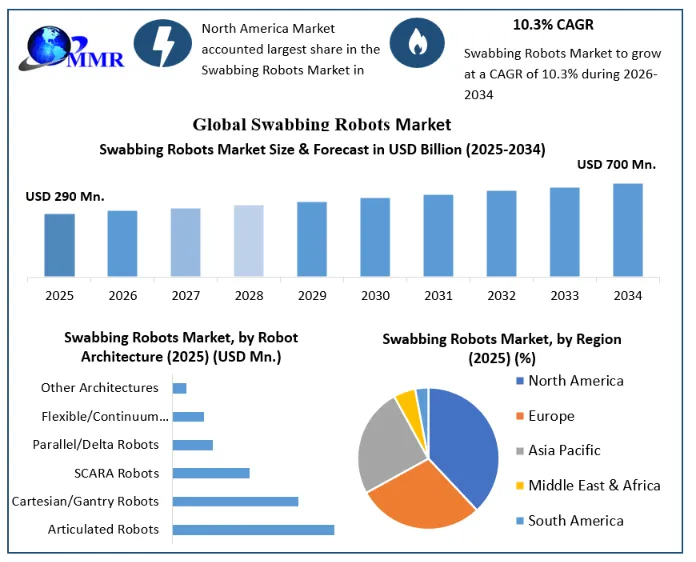
The Global Swabbing Robots Market was valued at USD 290 Million in 2025 and is projected to reach USD 700 Million by 2034, growing at a CAGR of 10.3% during the forecast period 2026–2034.
Global Swabbing Robots Market Overview
The Swabbing Robots Market focuses on automated robotic systems designed for biological specimen collection, surface sampling, and contamination monitoring across healthcare, pharmaceutical, and industrial applications. Increasing demand for robotic specimen collection, laboratory automation, and automated swabbing systems supports market growth. These technologies improve sampling precision, reduce manual intervention, and strengthen contamination control in diagnostic laboratories, pharmaceutical manufacturing, and quality testing facilities.
The Swabbing Robots Market experiences technological advancements through AI-powered robotics, machine vision, precision sensors, and automated sample handling systems. Hospitals, diagnostic laboratories, pharmaceutical manufacturers, biotechnology companies, and research institutions represent key buyers. Growing demand for surface sampling robots, pharmaceutical cleaning validation, and robotic testing solutions creates opportunities for automation providers. North America holds a leading market position, supported by advanced healthcare infrastructure, pharmaceutical research, and laboratory automation investments.
The competitive landscape includes Lifeline Robotics, ABB Robotics, Universal Robots, and FANUC, which provide specialized swabbing solutions or robotic technologies suitable for automated sampling. For example, Lifeline Robotics develops robotic throat-swabbing technology for specimen collection applications. Maximize Market Research (MMR) evaluates market size, robotic technologies, application demand, regional growth, and competitive positioning. The research identifies opportunities in AI-enabled swabbing robots, automated specimen collection, contamination monitoring, and industrial robotic sampling solutions through 2034.
Swabbing Robots Market Share and Analysis
To know about the Research Methodology :- Request Free Sample Report
Global Swabbing Robots Market Dynamics
Increasing Demand for Automated Specimen Collection and Laboratory Testing Accelerates Market Growth
The Swabbing Robots Market experiences growing demand as healthcare facilities, diagnostic laboratories, and pharmaceutical manufacturers adopt automated specimen collection and precision sampling technologies. Increasing requirements for contamination-free testing, consistent sample quality, and reduced manual intervention support the adoption of robotic swabbing systems and AI-powered specimen collection robots. Automated systems equipped with 6-axis robotic arms, force sensors, and machine vision technology enable controlled sampling movements and repeatable operating procedures. Growing investment in laboratory automation, robotic diagnostic testing, and pharmaceutical quality control strengthens market demand.
High Initial Investment and Complex System Integration Limit Widespread Adoption
The Swabbing Robots Market faces restraints due to high equipment acquisition costs, specialized robotic components, and integration requirements. Automated swabbing solutions incorporate robotic manipulators, precision end effectors, control software, and advanced sensing systems, increasing installation and maintenance expenses. Industrial robotic arms used in customized sampling applications may involve investments of USD 20,000–100,000 or more, depending on payload capacity, configuration, and automation requirements, excluding complete system integration. Limited budgets among smaller laboratories and healthcare facilities restrict the adoption of automated swabbing robots and robotic sample collection equipment. Additional expenses associated with calibration, software integration, and operator training influence purchasing decisions.
Expanding Pharmaceutical Cleaning Validation and Industrial Hygiene Applications Create Growth Opportunities
The Swabbing Robots Market presents opportunities through increasing adoption of automated surface sampling robots, pharmaceutical cleaning validation systems, and robotic contamination monitoring solutions. Pharmaceutical manufacturers use automated swabbing technologies to improve sampling consistency across manufacturing equipment, cleanrooms, and controlled production environments. Robotic surface sampling systems support standardized sampling areas, including 10 cm × 10 cm test surfaces, commonly used in cleaning validation procedures where applicable. Increasing demand for automated hygiene inspection in food processing, biotechnology, and medical device manufacturing creates opportunities for industrial swabbing robots, robotic surface testing equipment, and laboratory automation software. Integration with digital sample tracking and laboratory information management systems further supports market expansion.
Maintaining Sampling Accuracy and Meeting Regulatory Validation Requirements Increase Technical Challenges
The Swabbing Robots Market faces challenges related to robotic movement accuracy, sample integrity, cross-contamination prevention, and regulatory compliance. Automated specimen collection requires controlled contact force, precise positioning, and adaptable robotic movement to accommodate variations in sampling surfaces and biological characteristics. Robotic swabbing systems incorporate force-feedback sensors, sterile disposable collection tools, and automated positioning mechanisms to improve repeatability. Certain industrial robotic platforms offer positioning repeatability of ±0.02 mm to ±0.1 mm, depending on robot design, although positioning accuracy alone does not establish sampling effectiveness. Manufacturers also address equipment validation, cleaning protocols, and application-specific safety requirements to strengthen the reliability of AI-enabled swabbing robots and automated sample collection technologies.
Global Swabbing Robots Market Segmentat Analysis
Swabbing Robots Market, by Offering
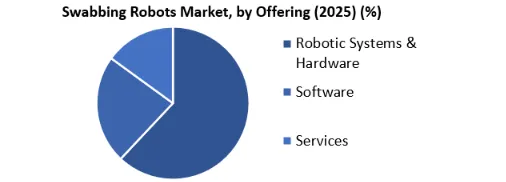
The Swabbing Robots Market is segmented into Robotic Systems & Hardware, Software, and Services, supported by increasing demand for automation, precision sampling, and contamination control across healthcare, pharmaceutical, biotechnology, and industrial applications. Robotic Systems & Hardware includes robotic arms, automated swabbing equipment, sensors, end effectors, and sample-handling mechanisms that enable accurate and repeatable sample collection. Software supports robotic motion control, AI-based navigation, sample tracking, laboratory information management system (LIMS) integration, and automated testing workflows. Services includes installation, system integration, calibration, maintenance, technical support, and operator training. Growing adoption of automated swabbing robots, robotic sample collection systems, laboratory automation solutions, and AI-powered sampling technologies strengthens demand across all offering segments.
Swabbing Robots Market by Robot Type
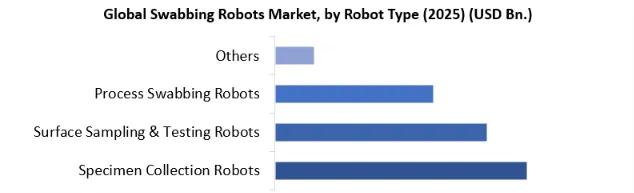
The Swabbing Robots Market is categorized into Process Swabbing Robots, Specimen Collection Robots, Surface Sampling & Testing Robots, and Others, based on sampling applications and operational requirements. Process Swabbing Robots support automated swab collection during cleaning validation, manufacturing quality control, and contamination monitoring in pharmaceutical and industrial facilities. Specimen Collection Robots enable controlled biological sample collection for diagnostic testing, clinical screening, and laboratory applications, reducing manual intervention and improving sampling consistency. Surface Sampling & Testing Robots assist with environmental monitoring, microbial contamination assessment, and hygiene verification across cleanrooms, healthcare facilities, and food processing environments. Others includes specialized robotic swabbing systems developed for research and customized inspection applications. Increasing demand for robotic specimen collection, automated surface swabbing, pharmaceutical cleaning validation robots, and contamination detection systems supports technological development and growth opportunities in the Global Swabbing Robots Market through 2034.
Global Swabbing Robots Market Regional Analysis
North America holds a leading position in the Global Swabbing Robots Market, supported by advanced healthcare infrastructure, pharmaceutical research, and increasing adoption of laboratory automation technologies. The United States drives regional demand for robotic specimen collection systems, AI-powered swabbing robots, and automated diagnostic testing solutions. Investments in medical robotics, biotechnology, and contamination control strengthen market development across healthcare and industrial applications.
Europe maintains a significant position in the Swabbing Robots Market, supported by pharmaceutical manufacturing, biotechnology research, and stringent quality control requirements. Germany, the United Kingdom, and France contribute to demand for automated surface sampling robots, pharmaceutical cleaning validation systems, and robotic laboratory equipment. Increasing integration of collaborative robotics, precision sensors, and automated testing technologies supports regional market expansion.
Asia Pacific presents strong growth opportunities in the Global Swabbing Robots Market, driven by healthcare modernization, industrial automation, and expanding pharmaceutical manufacturing capabilities. China, Japan, South Korea, and India support demand for robotic swabbing systems, automated specimen collection robots, and contamination monitoring technologies. Growing investments in smart laboratories, robotics manufacturing, and biotechnology infrastructure strengthen regional market potential.
The Middle East & Africa represents an emerging market for swabbing robots and automated laboratory sampling solutions, supported by healthcare infrastructure development and increasing investment in diagnostic testing facilities. Saudi Arabia, the UAE, and South Africa contribute to demand for robotic specimen collection, medical laboratory automation, and automated contamination detection systems. Expanding pharmaceutical production and healthcare modernization create opportunities for advanced robotic sampling technologies.
South America experiences increasing interest in the Swabbing Robots Market, supported by pharmaceutical manufacturing, diagnostic laboratory development, and industrial quality control requirements. Brazil, Argentina, and Chile contribute to demand for automated swabbing robots, robotic surface sampling systems, and laboratory automation equipment. Growing adoption of advanced medical technologies and contamination monitoring solutions supports market development across healthcare, biotechnology, and food processing industries.
Global Swabbing Robots Market Recent Developments
| Date | Company / Organization | Development Type | Brief Information |
| 8 October 2026 | UK Atomic Energy Authority (UKAEA) | Procurement Tender | UKAEA issues a tender for the development, testing, and delivery of robotic software for surface characterization and automated swabbing using the Spot quadruped robot. The project supports remote contamination monitoring and robotic sampling of complex surfaces. |
| 7 October 2026 | Flokontrol Industrial Automation | Product Launch | Flokontrol introduces its patented Blank Side Swabbing Robot featuring dual-nozzle technology for glass manufacturing. The system supports automated mould lubrication, precise swabbing operations, and improved production consistency. |
| 9 September 2026 | Flokontrol Industrial Automation | Product Launch | Flokontrol presents its multifunctional Blow Side Robot, integrating robotic swabbing, mould changing, sample collection, temperature measurement, and weighing into a single automated glass manufacturing platform. |
| 30 March 2026 | Socabelec | Product Promotion & Market Development | Socabelec announces its participation in China Glass 2026, showcasing its Swabbing Robot for automated mould lubrication in glass container production. The initiative strengthens international visibility for industrial swabbing automation solutions. |
| 3 February 2026 | Sellafield Ltd. & Robotics and AI Collaboration (RAICo) | Technology Development & Strategic Collaboration | Sellafield and RAICo demonstrate a patent-pending robotic contamination swabbing tool mounted on a quadruped robot. The technology enables remote surface sampling in hazardous nuclear environments and supports improvements in operational safety. |
Global Swabbing Robots Market Competitive Landscape
The Global Swabbing Robots Market features an emerging and specialized competitive landscape driven by increasing demand for automated specimen collection, industrial surface sampling, contamination monitoring, and precision robotic technologies. Competition includes specialized swabbing robot manufacturers, medical robotics developers, laboratory automation companies, and industrial robotics suppliers. Key participants include Lifeline Robotics, Socabelec, Flokontrol Industrial Automation, ABB Robotics, FANUC, and Universal Robots, which contribute through dedicated swabbing systems or adaptable robotic platforms. Companies compete through sampling accuracy, robotic flexibility, automation efficiency, system integration, and operational safety. Increasing adoption of AI-powered swabbing robots, robotic specimen collection systems, and automated contamination testing technologies encourages product differentiation and technological innovation.
Novaxion, Socabelec, Heye International, XPAR Vision, Bucher Emhart Glass, and Flokontrol represent important competitors in industrial swabbing automation, particularly glass container manufacturing. Novaxion focuses on automated mould lubrication and robotic swabbing solutions, while Socabelec develops customized swabbing robots for glass production lines. Heye International provides automated blank-side swabbing technologies, and Bucher Emhart Glass offers robotic systems that support glass-forming operations. For example, Flokontrol introduces its dual-nozzle Blank Side Swabbing Robot in 2026, incorporating separate lubricant application systems for moulds and neck rings. These developments strengthen competition in industrial swabbing robots, precision robotic lubrication, and automated manufacturing solutions.
North America and Europe remain important markets for medical robotics innovation and specialized industrial automation, while Asia Pacific presents opportunities through expanding manufacturing capacity, laboratory infrastructure, and robotic technology adoption. Competition increasingly emphasizes AI integration, machine vision, robotic motion control, advanced sensors, and customized automation systems. Maximize Market Research (MMR) evaluates the competitive landscape through company portfolios, technological capabilities, product development, regional presence, strategic partnerships, and market positioning. The analysis identifies opportunities in automated surface sampling, robotic specimen collection, pharmaceutical contamination monitoring, and industrial swabbing automation through 2034.
The Scope of Global Swabbing Robots Market: Inquire before buying
| Global Swabbing Robots Market | |||
|---|---|---|---|
| Report Coverage | Details | ||
| Base Year: | 2025 | Forecast Period: | 2026-2034 |
| Historical Data: | 2020 to 2025 | Market Size in 2025: | USD 290 Million |
| Forecast Period 2026-2034 CAGR: | 10.3% | Market Size in 2034: | USD 700 Million |
| Segments Covered: | by Offering | Robotic Systems & Hardware Software Services |
|
| by Robot Type | Process Swabbing Robots Specimen Collection Robots Surface Sampling & Testing Robots Others |
||
| by Automation Level | Fully Autonomous Semi-Autonomous Remote-Controlled/Telerobotic |
||
| by Robot Architecture | Articulated Robots Cartesian/Gantry Robots SCARA Robots Parallel/Delta Robots Flexible/Continuum Robots Other Architectures |
||
| by Mobility | Fixed Mobile |
||
| by System Integration | Standalone Machine/Production-Line Integrated |
||
| by End User | Glass & Container Manufacturers Hospitals & Healthcare Facilities Diagnostic Laboratories Food & Beverage Manufacturers Food Safety & Testing Laboratories Pharmaceutical & Biotechnology Companies Industrial Manufacturers Contract Testing & Research Laboratories Academic & Research Institutions Others |
||
Global Swabbing Robots Market, By Region
North America (United States, Canada and Mexico)
Europe (UK, France, Germany, Italy, Spain, Sweden, Austria and Rest of Europe)
Asia Pacific (China, South Korea, Japan, India, Australia, Indonesia, Malaysia, Vietnam, Taiwan, Bangladesh, Pakistan and Rest of APAC)
Middle East and Africa (South Africa, GCC, Egypt, Nigeria and Rest of ME&A)
South America (Brazil, Argentina Rest of South America)
key players / competitors profiles covered in the Global Swabbing Robots Market report in strategic perspective
1. Novaxion
2. Medtronic
3. ConMed
4. Stryker
5. Boston Scientific
6. Zimmer Biomet
7. Johnson & Johnson
8. Mazor Robotics
9. Amazon
10. Heye International
11. Socabelec
12. XPAR Vision
13. Bucher Emhart Glass
14. Flokontrol
15. Lifeline Robotics
16. KUKA
17. Condat
18. Vetropack Group
19. Brain Navi Biotechnology Co., Ltd.
20. Orora
21. Cheng San Engineering & Trading Pte Ltd.
22. Zhen Robotics
23. Curexo Technology Corporation
24. Shandong Sanjin Glass Machinery
Frequently Asked Question
1. What is the market size of the Global Swabbing Robots Market?
The market is valued at USD 290 Million in 2025 and is projected to reach USD 700 Million by 2034, growing at a CAGR of 10.3%.
2. What drives the growth of the Swabbing Robots Market?
Increasing laboratory automation, robotic specimen collection, contamination monitoring, and demand for precision sampling drive market growth.
3. Which region dominates the Global Swabbing Robots Market?
North America holds a leading market position, supported by advanced healthcare infrastructure, pharmaceutical research, and robotic automation adoption.
4. What are the major segments of the Swabbing Robots Market?
The market is segmented by Offering, Robot Type, Automation Level, Robot Architecture, Mobility, System Integration, End User, and Region.
5. Who are the key players in the Global Swabbing Robots Market?
Key players include Novaxion, Socabelec, Heye International, Flokontrol, Lifeline Robotics, KUKA, and Brain Navi Biotechnology.