
Supercapacitor Market – Global Market Size, Strategic Growth Drivers, Risk Assessment Framework, Regulatory Landscape Review, Competitive Intensity Mapping & Long-Term Industry Outlook to 2032
Overview
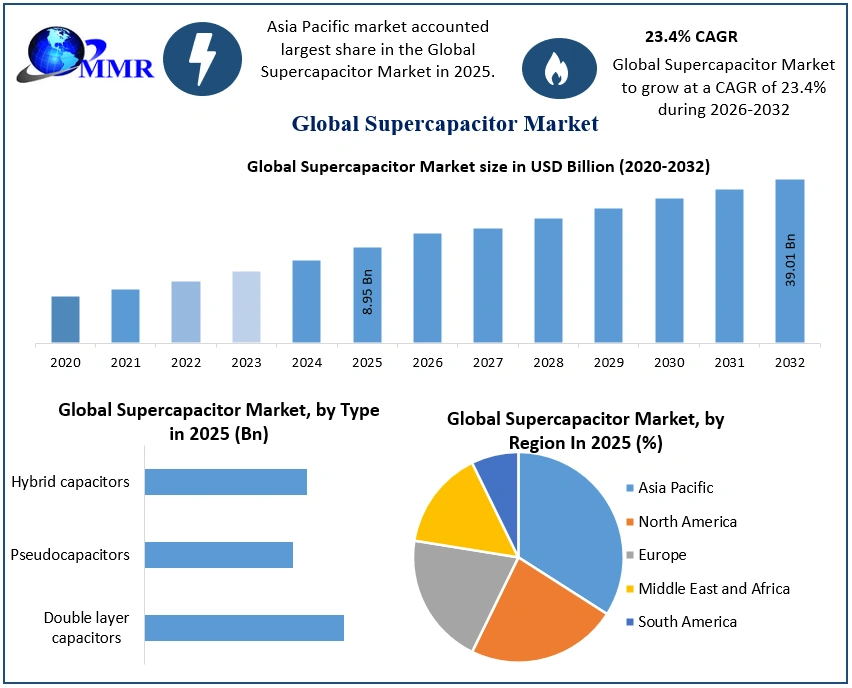
The Supercapacitor Market size was valued at USD 8.95 Billion in 2025 and the total Supercapacitor revenue is expected to grow at a CAGR of 23.4% from 2025 to 2032, reaching nearly USD 39.01 Billion by 2032.
Supercapacitor Market Overview
The supercapacitor is a two-terminal passive electronic device, which provides very high capacitance as compared to the normal capacitor. A single supercapacitor stores far more energy than a conventional capacitor with a solid dielectric. Storage capacity lags that of batteries. For electronic design engineers, other important supercapacitor characteristics include high power densities and very long lifetimes regardless of the number of charge cycles. This is a distinct advantage over batteries.
Supercapacitors are also known as ultracapacitors and electrochemical capacitors. It combines of properties of capacitors and batteries into one component. The Vikram Sarabhai Space Center (VSSC) of the Indian Space Research Organization (ISRO) created the technology for processing supercapacitors (2.5 V) of variable capacitance values, such as 5 F, 120 F, 350 F, and 500 F to meet specific space and societal needs. Tesla acquired the Californian supercapacitor manufacturer in 2019, prompting speculation that its electric vehicles may use 'supercaps' for top acceleration. Elon Musk appears to have moved on and sold Maxwell to UCAP Power after two years, but Tesla has kept the company's dry electrode technology.
China dominated the global supercapacitor market, with 1.4K shipments imported by 254 world importers from 226 Chinese suppliers. The primary importing nations were India (3,453 shipments), Mexico (441), and the United States (267) in 2023. India, the largest global importer, sourced supercapacitors mainly from the United Kingdom, China, and Singapore. Also, the United States and the United Kingdom were significant suppliers to both the world and Indian markets, reflecting the strategic importance of these nations in the supercapacitor trade network.
To know about the Research Methodology :- Request Free Sample Report
Supercapacitor Market Dynamics:
The growing need for high-performance electronics devices are major key driving the growth of the market. Supercapacitor provides benefits such as supply peak power and backup power, extended battery life and battery run time, reduced battery weight, size, and cost, low/high-temperature operation, and reduced space requirements, higher reliability of performance and virtually unlimited cycle life ultimately propelling the growth of the market. Furthermore, the demand for supercapacitors in automotive, electronic, renewable energy, defense, railways and power industries and the development of prototype supercapacitor batteries are expected to witness high growth during the forecast period. Communication systems in telecommunications and space have fueled demand for supercapacitors in recent years. Skeleton, obtained a USD 61 million grant from Germany in March 2021 to automate supercapacitor production at its site in Grossroehrsdorf, Saxony.
Nevertheless, a higher self-discharge rate is the major restraining factor that could hamper the growth of the market. Also, low voltage per cell, low energy density compared to the battery and its inability to be used in AC and high-frequency circuits could hinder the growth of the market.
Increasing Demand for Energy Storage Solutions to Drive the Market Growth
The Supercapacitor Market is witnessing substantial growth due to the rising demand for efficient energy storage solutions. As industries and consumers seek cleaner and more sustainable alternatives to traditional batteries, supercapacitors offer a compelling solution. Their ability to rapidly store and release energy, coupled with a longer lifecycle compared to batteries, positions them as a key player in the energy storage landscape. Applications in electric vehicles, renewable energy systems, and electronic devices are driving the market forward, as companies look to enhance energy efficiency and reduce reliance on conventional power sources.
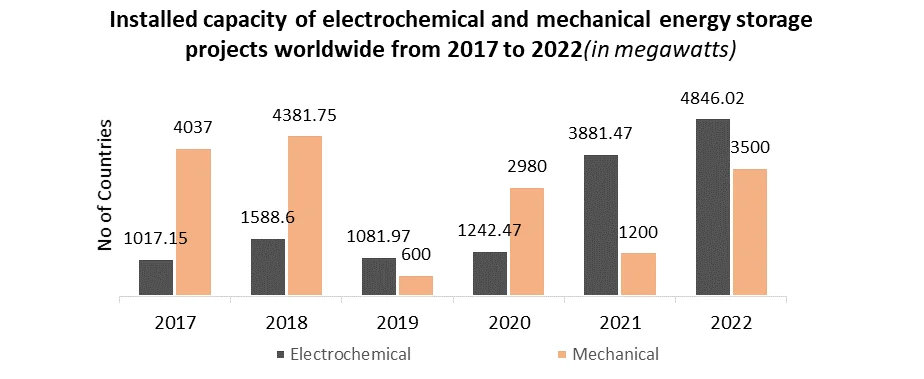
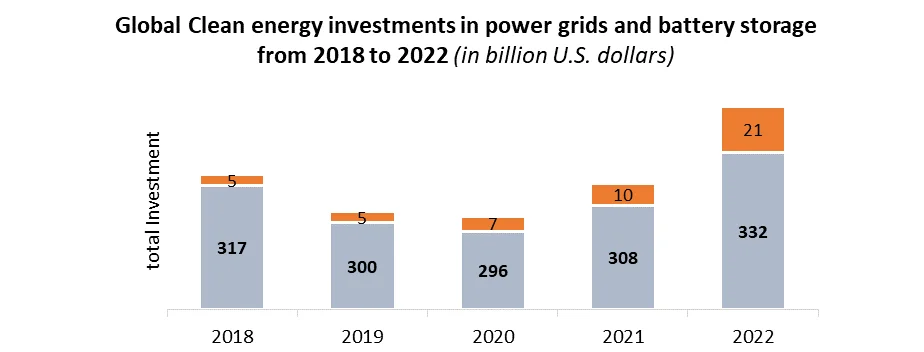
The energy landscape in 2025 reflects a growing demand for clean energy and storage, driven by increased adoption of technologies like solar photovoltaics (PV) and electric vehicles (EVs). Organizations are embracing clean energy solutions, supported by economic benefits from the Inflation Reduction Act in the U.S. and stakeholder pressure for sustainability. The Supercapacitor Market is witnessing a surge in corporate clean energy procurement, with power purchase agreements being a popular choice.
The projected addition of 500 GW of solar and wind by 2030 in the U.S. necessitates significant energy storage growth. The global energy storage installations are to reach 411 GW by 2030, playing a crucial role in balancing supply and demand on the grid. However, structural challenges such as interconnection delays and transmission system limitations pose threats to the clean energy buildout, emphasizing the need for strategic planning by organizations to navigate these complexities and maximize the value of clean energy investments.
Advancements in Technology and Material Innovation to Create Lucrative Opportunity for Industry Growth
Technological advancements and ongoing material innovations are driving the Supercapacitor Market. Researchers and manufacturers are constantly exploring new materials and designs to improve the performance, energy density, and cost-effectiveness of supercapacitors. The development of hybrid supercapacitors, combining the best features of batteries and traditional supercapacitors, has expanded their range of applications. Supercapacitors have energy densities of around 8-10 Wh/kg. The energy density is far below the 200 Wh/kg of a typical Li-ion battery.
Closing the gap between the energy densities of supercapacitors and batteries has been the basis of a large body of research worldwide, much of which focuses on advanced materials and construction. As breakthroughs in nanotechnology and graphene-based materials emerge, the industry is poised for significant growth, offering enhanced energy storage capabilities and contributing to the evolution of smart grids, portable electronics, and other energy-intensive sectors. These innovations continue to propel the supercapacitor industry forward, fostering a landscape of increased efficiency and sustainability.
The use of advanced materials, such as activated carbon or conductive polymers, contributes to the overall expense of manufacturing supercapacitors. This cost factor is a significant barrier, particularly in price-sensitive markets and industries. Efforts to optimize manufacturing processes, explore cost-effective materials, and scale up production capacities are essential to make supercapacitors more economically competitive and promote their integration into a wider range of applications.
The supercapacitors excel in rapid charge and discharge cycles, and their energy storage capacity per unit mass or volume is significantly lower than that of lithium-ion batteries. This limitation hinders their widespread adoption in applications requiring high energy density, such as electric vehicles and certain portable electronics. Researchers are actively exploring advanced materials and designs to enhance the energy density of supercapacitors, but this remains a key challenge to address for broader market acceptance.
Supercapacitor Market Segment Analysis:
By Type
Based on type, the hybrid capacitors segment held the largest Supercapacitor Market share in 2025. Hybrid capacitors’ unique blend of high power and energy density has made them desirable in various applications. They are widely used in electric vehicles and hybrid electric vehicles, where they contribute to enhanced performance and efficiency. Their rapid charge/discharge capability makes them ideal for regenerative braking systems, where they quickly capture and store energy during braking for later use. In renewable energy systems, hybrid capacitors store energy generated from solar panels or wind turbines, providing a stable power supply when sunlight or wind is not available. They are also being explored for use in grid energy storage due to their long lifespan and high cycling stability.
The future of hybrid capacitors looks promising. With continued research and development, improvements in energy and power density, efficiency, and cost-effectiveness are expected. Hybrid capacitors could play a crucial role in our transition towards more sustainable energy systems, offering a high-performing, reliable, and eco-friendly solution for energy storage. Mobile phones, laptops, wearable gadgets, LED torches, thermal printers, barcode scanners, and GPS chips are all examples of hybrid capacitors in consumer electronics. Manufacturing these capacitors necessitates a large investment in research and development.
By End User
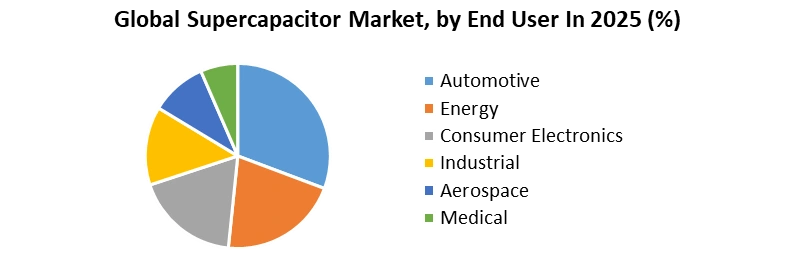
Based on industry, the supercapacitor market is segmented into Consumer Electronics, Industrial, Automotive, Energy, Medical, and Aerospace and defense. The recycled Corrugates segment is expected to hold the highest market share of xx% by 2032. Owing to its widespread use in the packaging of light products such as cosmetics, consumer electronics, and fast food. Cardboard may be recycled five to seven times and is a relatively simple and easy-to-recycle material.
The rising use of fossil fuels and the resulting rise in environmental harm have fueled the advancement of fuel-efficient automobiles. A severe existential challenge facing the planet Earth has given rise to hybrid electric vehicles (HEVs), which have developed from their incipient stage and are shown promise as a solution. Additionally, when needed to produce peaking power, the batteries' efficiency is reduced. Instead, supercapacitors have smaller energy storage capacity but withstand peaking power. Designing a clever method to manage the energy balance between a supercapacitor and a battery is the main goal of this research.
Different topologies are used to study the battery-supercapacitor energy storage system in great detail. Nitrogen oxides (NOx), carbon monoxide (CO), hydrocarbons (HC), and other harmful gases are less released when a battery-supercapacitor energy storage system is integrated. Additionally, it lowers the load on the battery, extending its life and improving its performance in HEVs. Such factors are expected to drive the Automobile industry segment growth in the market.
Supercapacitor Market Regional Insights:
The Asia-Pacific held largest the Supercapacitor Market share in 2025. China's automotive industry is quickly expanding, and the country is becoming increasingly influential in the global automotive market. The Chinese government considers the automobile industry, which includes the car components business, to be one of its core sectors. China's vehicle output is expected to exceed 30 million units by 2020 and 35 million units by 2025, according to the Chinese central government. Electric vehicles are becoming more popular around the world, with China being the most aggressive adoption. To enhance the country's transportation sector, China's 13th Five-Year Plan encourages green mobility options such as hybrid and electric automobiles. The country is a pioneer in developing innovative technology to enable electric automobiles.
Cap-XX Limited, based in Australia, principally makes electronic capacitors, particularly supercapacitors, with high energy and power density in small flat packages. CAP-XX purchased Murata's supercapacitor production lines in December 2019 and transferred them from Japan to Australia (Sydney). This is likely to improve Murata's DMT series of supercapacitors, which are designed for demanding applications including solid-state drives and automotive applications.
Skeleton Technologies Inc. teamed up with Taltech and Tartu University to create flexible ultracapacitors in April 2020. The European Space Agency is backing the initiative (ESA). The new forms of ultracapacitors are being created specifically for space technology since they are flexible, light, and robust all at the same time. Curved Graphene is being used by researchers to create bendable electrodes that can be bent into any shape.
The European supercapacitor market is expected to grow at a significant CAGR during the forecast period. This is due to the rise of the automotive sector. Electric vehicles are rapidly gaining popularity in the region, which is home to one of the world's top automakers. Regional manufacturers are seeing new prospects as a result of the auto industry's ongoing environmental efforts. Skeleton Technologies, was awarded a contract to supply high-energy ultracapacitor modules to power hydrogen buses in the United Kingdom in October 2020.
Eurelectric’s Decarbonisation Speedways study estimates that storage will offer around 191 GW of flexible capacity by 2030 and up to 486 GW in 2050. This is huge increase from today’s 60 GW. In 2022, battery storage reached only 9 GWh. This represents 0,009% of the 108 TWh needed in 2040. Meanwhile, the financing required to support a major step-up in energy storage systems leading up to 2050 is estimated at between €100 and 300 billion.
The objective of the report is to present a comprehensive analysis of the Global Supercapacitor Market to the stakeholders in the industry. The past and current status of the industry with the forecasted Market size and trends are presented in the report with the analysis of complicated data in simple language. The report covers all the aspects of the industry with a dedicated study of key players that include Market leaders, followers, and new entrants.
PORTER, PESTEL analysis with the potential impact of micro-economic factors of the Market have been presented in the report. External as well as internal factors that are supposed to affect the business positively or negatively have been analyzed, which will give a clear futuristic view of the industry to the decision-makers.
The report also helps in understanding the Global Supercapacitor Market dynamics, and structure by analyzing the Market segments and projecting the Global Supercapacitor Market size. Clear representation of competitive analysis of key players by Type, price, financial position, Type portfolio, growth strategies, and regional presence in the Global Supercapacitor Market make the report an investor’s guide.
Supercapacitor Market Scope: Inquire before buying
| Global Supercapacitor Market | |||
|---|---|---|---|
| Report Coverage | Details | ||
| Base Year: | 2025 | Forecast Period: | 2026-2032 |
| Historical Data: | 2020 to 2025 | Market Size in 2025: | USD 8.95 Bn. |
| Forecast Period 2026 to 2032 CAGR: | 23.4% | Market Size in 2032: | USD 39.01 Bn. |
| Segments Covered: | by Type | Double layer capacitors Pseudocapacitors Hybrid capacitors |
|
| by Electrode Material | Carbon Metal Oxide Conducting Polymers Composites |
||
| by End User | Automotive Energy Consumer Electronics Industrial Aerospace Medical |
||
Supercapacitor Market, by Region
North America (United States, Canada and Mexico)
Europe (UK, France, Germany, Italy, Spain, Sweden, Austria and Rest of Europe)
Asia Pacific (China, South Korea, Japan, India, Australia, Indonesia, Malaysia, Vietnam, Taiwan, Bangladesh, Pakistan and Rest of APAC)
Middle East and Africa (South Africa, GCC, Egypt, Nigeria and Rest of ME&A)
South America (Brazil, Argentina Rest of South America)
Supercapacitor Market, Key Players are:
North America
1. Inmatech
2. UCAP Power
3. Kilowatt Labs
4. Sila Nanotechnologies
5. Capacitech Energy
6. Atlas Power Technologies
7. Xs Power Batteries
8. Lomiko Metals
Europe
9. Napptilus Battery Labs
10. Skeleton Technologies
11. UP Catalyst
12. NAWA Technologies
13. Novac
14. C2C-NewCap
15. Yunasko
16. Haydale Graphene Industries
Asia Pacific
17. Cap-XX
18. Ningbo CRRC New Energy Technology
19. VINATech Company
20. Godi
21. Taiyo Yuden
22. Murata Manufacturing Company
23. Nippon Chemi-Con Corporation
24. LS Materials
25. SPEL Technologies
Frequently Asked Questions:
1] What is the growth rate of the Global Supercapacitor Market?
Ans. The Global Supercapacitor Market is growing at a significant rate of 23.4 % during the forecast period.
2] Which region is expected to dominate the Global Supercapacitor Market?
Ans. APAC is expected to dominate the Supercapacitor Market during the forecast period.
3] What is the expected Global Supercapacitor Market size by 2032?
Ans. The Supercapacitor Market size is expected to reach USD 39.01 Bn by 2032.
4] Which are the top players in the Global Supercapacitor Market?
Ans. The major top players in the Global Supercapacitor Market are Maxwell Technologies, Inc. (USA), AVX Corp (USA), Axion Power International, Inc. (USA) and others.
5] What are the factors driving the Global Supercapacitor Market growth?
Ans. With advancements in materials science and manufacturing techniques, supercapacitors are poised to play a pivotal role in shaping the future of energy storage, driving innovation, and fostering sustainability across industries.
6] Which country held the largest Global Supercapacitor Market share in 2025?
Ans. China held the largest Supercapacitor Market share in 2025.