
Solar Photovoltaic Glass Market - Industry Structure Evaluation, Demand Drivers Analysis, Regional Growth Analysis and Identification, Competitive Positioning Review & Global Market Size Forecast to 2032
Overview
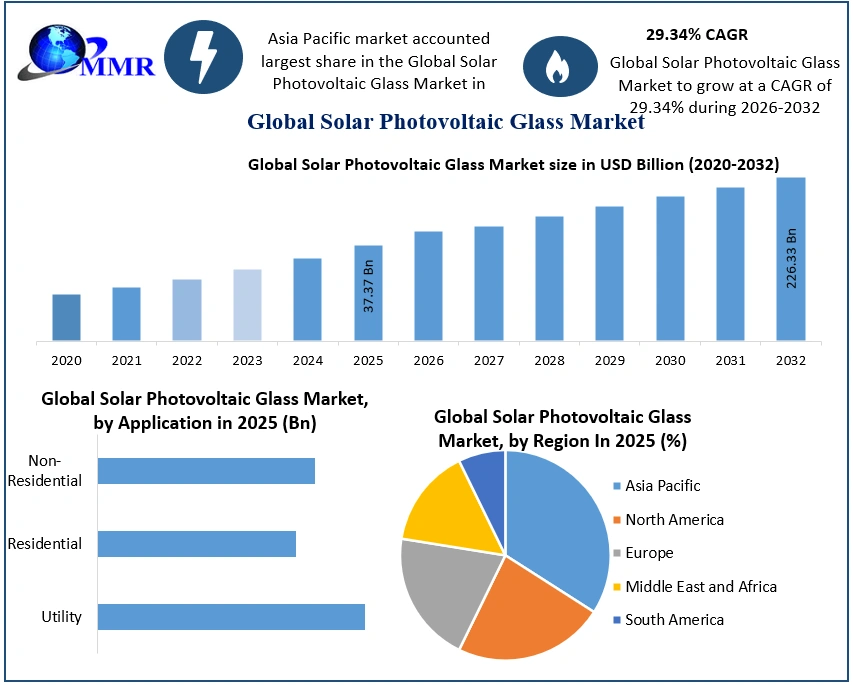
The Solar Photovoltaic Glass Market size was valued at USD 37.37 Billion in 2025 and the total Solar Photovoltaic Glass revenue is expected to grow at a CAGR of 29.34% from 2026 to 2032, reaching nearly USD 226.33 Billion by 2032.
Solar Photovoltaic Glass Market Overview:
The global volume of Solar Photovoltaic Glass Market is expected to grow from 4842.91 Mn. Sq. meter in 2025 and expected to grow at 29.53% by 2032. Global solar PV manufacturing capacity has progressively moved from the US, Europe, and Japan to China over the last decade. Ten times more than Europe, China has invested over USD 50 billion in new PV supply capacity. China now accounts for more than 80% of all solar panel manufacturing processes. This is more than twice China's proportion of the world's PV demand. In addition, the country is home to 10 of the world's top providers of machinery for making solar PV.
China has played a significant role in lowering solar PV costs globally, which has many benefits for the transition to sustainable energy. However, the degree of geographic concentration in global supply chains also increases possible issues and same are analyzed in the report by region. Solar Photovoltaic glass uses solar cells to convert solar energy into electricity. To generate power for a complete building, it is put within the roof or façade areas of structures.
MMR Solar Photovoltaic Glass Market Report Offers
The Solar Photovoltaic Glass Market report offers an in-depth analysis of the market with comprehensive import-export data from 2021 to 2025, providing stakeholders a clear view of trade dynamics and market trends. It includes detailed pricing information for Solar Photovoltaic Glass from 2020 to 2025, measured million square meters, and volume data in million square meters, region, and country-wise. This historical pricing data is invaluable for analyzing cost trends and market fluctuations.
Furthermore, the report features a forecast of the Solar Photovoltaic Glass Market size, projected in million square meters from 2021 to 2032, allowing readers to gain insights into the market's growth trajectory, potential demand for different types of Solar Photovoltaic Glass, and the overall market outlook. This crucial information enables informed business decisions and strategic planning in the Solar Photovoltaic Glass Market. Additionally, the report provides key competitive landscape insights, regulatory updates, and technological advancements, making it an essential tool for anyone looking to navigate and succeed in this dynamic market.
To know about the Research Methodology :- Request Free Sample Report
Solar Photovoltaic Glass Market Dynamics:
PV Glass to Increase owing to Wide Application Potential:
The industry expects an infusion of potential technology segments to make their entry into the renewables market soon in the near future as new solar panel technologies drive the transformation of the booming solar energy environment. Some of the innovators have made significant progress in overcoming the fundamental space need by developing ground-breaking innovations like solar shingles and floating solar panels.
Photovoltaic glass is increasingly being considered as one of the promising technologies on the horizon of solar panel. Because of its transparency, which enables it to support direct electricity generation from windows and blinds, this ground-breaking technology has drawn attention. It is thus more likely to experience demand coming from both residential, and commercial sectors. The sunroofs on cars and even the screens of smartphones are anticipated to be viable application areas for photovoltaic glass market players.
High Demand of Solar PV Glass In Asian Countries:
During the forecast period, Asia Pacific is expected to overtake North America as the largest market. Urbanization and population are growing fast in developing countries such as China, Pakistan, India, South Korea, Indonesia, Malaysia, and Japan. Many of the basic infrastructure systems and electrical grids in these developing nations are unreliable. Owing to this factor, industry participants are anticipated to spend in these nations, which will accelerate the development of PV glass installations and distribution grids.
According to MMR, the installed solar PV capacity in the Asia Pacific region may triple to 1,500 GW by 2029 as a result of countries in this region being compelled by their carbon-neutral ambitions to invest heavily in renewable energy sources. Owing to land constraints and distributed solar's increasing competitiveness versus growing prices, analysts predict that by 2029, distributed solar will make up 52% of all new installations in the top 10 Asia-Pacific economies. New solar and wind policies for projects without subsidies were disclosed by China. The policy was implemented in an effort to take advantage of the sharp decline in building prices, as well as to clear up payment backlog problems and gridlock projects. Government policies that support increasing solar PV system installed capacity and supplying the grid with renewable energy.
The development of solar PV glass is being driven by the global industrialization boom, improvement in the economic climate, and increase in infrastructure construction. According per the research, between 2016 and 2040, the world needs to invest $94 trillion on infrastructure. This is 19% more than what would be delivered if current trends continued. With the expansion of infrastructure and industrialization, which is boosting the Solar Photovoltaic Glass Market.
Lack of proper infrastructure in developing countries
Infrastructure issues are a major problem for emerging countries. Infrastructure is the medium, the tools and techniques of executing a project or programme or strategy. Demand for infrastructural development is higher and resources used in provision of infrastructure are limited in developing countries. In developing countries in Asia and Africa, lack of power infrastructure is a significant issue as it requires a considerable investment. A fair share of the rural population still has no access to power. Furthermore, in some areas power supply is unreliable and blackouts are frequent due to various reasons including insufficient supply. In developing regions, rural communities are far away from national grids or even not connected. So, alternative power generation sources such as diesel generators are common. Given that the upfront cost seems relatively higher in the short term compared to buying diesel generators, but in the long run, solar power is more economical.
Solar Photovoltaic Glass Market Trends:
Development of Off-Grid Electricity Systems:
The development of off-grid electricity systems offers producers in the photovoltaic glass market space tremendous growth opportunities. Off-grid technology is considered as the most practical way to fixing electricity concerns in deep pockets across important developing countries in the world, where more than a billion people live without access to electricity. This includes offering fundamental heating and lighting services to some of the most rural regions of the globe where grid connections are impractical.
Off-grid electricity systems are commonly powered by solar energy, and countries like China and a few others in the South East Asia Pacific region have taken benefit of the potential of small-scale solar technology applications to bring electricity to residents in isolated rural locations. In contrast to off-grid systems, which are simpler and less expensive to implement and can use local renewable energy sources to provide electricity, transmission lines need more time and resources to be installed in mountainous and forest areas as well as small islands, for example, where machinery access is difficult.
Growth Of Green Building Constructions:
The development of green building construction methods, which increasingly include solar PV glasses as a component of sustainable building, also aids the growth of the global solar PV glass market. The green construction market is showing promising growth, and photovoltaics are a major part of this. Global trends are seeing all industries edging towards making the switch from fossil fuels to renewable energy. Green buildings are becoming popular, as the demand for workplaces, homes, and commercial spaces that are carbon neutral or that can generate and rely on their own renewable energy supply increases.
Photovoltaics offer the opportunity to give buildings the capability to generate their own renewable power, which is why green construction is incorporating them into building design. In addition, photovoltaics are being used to power the construction of green buildings, making them truly green along every step of the way. Green buildings by definition should be environmentally responsible in their structure and in the processes that are used to build them.
Solar Photovoltaic Glass Market Segment Analysis:
Based on the Application segment, the global Solar Photovoltaic Glass industry is segmented by Utility, Residential, Non-Residential. In 2025, Utility segment commanded the largest share nearly 50% of the Solar Photovoltaic Glass Market. The growth of utility segment of the market can be attributed to growing installation of utility-scale solar power plants across the globe that have been producing reliable and clean energy with stable fuel costs for over two decades. While the utility-scale solar energy represents a small percentage of the worldwide power generation at present, the installations of solar power plants are developing rapidly across the globe for both, utility as well as distributed power generation applications. Growing installations of utility-scale solar power plants and rising government investments for binding solar energy are expected to drive the growth of the utility application segment of the global Solar Photovoltaic Glass Market between 2025 and 2032.
Governments offer tax breaks and incentives to businesses building solar farms that will pump electricity into the grid. For instance, in China, the budget for rebates on renewable energy was raised to USD 840 million for 2021, with roughly 55% of that amount going to the solar power sector. Even in less developed nations, a similar trend is being seen in an effort to lessen the burden of importing fossil fuels. Likewise, the report will provide an accurate prediction of the contribution of the various segments to the growth of the Solar Photovoltaic Glass Market size.
Based on the End User segment, the global Solar Photovoltaic Glass industry is segmented by Crystalline Silicon PV Modules and Thin Film PV Modules. They offer a long lifespan and can withstand various environmental conditions, making them suitable for diverse locations. Cost-effectiveness has improved with advancements in manufacturing and economies of scale, while the wide availability of raw materials ensures steady production. Strong market presence and continuous R&D investments have further enhanced their efficiency and performance, solidifying their dominance in the market.
Solar Photovoltaic Glass Industry Ecosystem

Solar Photovoltaic Glass Market Regional Insights:
In 2025, Asia-Pacific commanded the largest 44.89% share of the Solar Photovoltaic Glass Market and is expected to grow at the highest CAGR of 32.48% during the forecast period. Developing countries, like India, China, Japan, Indonesia, South Korea, and Malaysia, are facing rapid growth in urbanization and population. These developing countries have a large number of variable power grids and fundamental infrastructure systems. This factor is expected to compel industry participants to invest in these countries, thereby boosting the growth of PV glass installations and distribution grids.
China held more than 60.75% of the APAC solar PV glass market share in 2025 and will continue its dominance till 2032. China stands as the major producer, exporter and consumer of PV systems and strives to conduct R&D initiatives to improve efficiency and costs of panels. China was valued US$ 8123.43 Mn. in 2025 and is expected to reach at xx Mn. by 2032 at a CAGR of xx% over forecast period.
Europe stood second largest in the Solar Photovoltaic Glass Market with a market value of US$ 6490.46 million in 2025, the regional market is expected to register a CAGR of xx% during the 2026-2032. The region is considered by a high number of solar energy systems, which are used for water heating, space heating, district heating & cooling, and power generation.
The highly developed infrastructure along with the diligent efforts of the regional government to help and employ renewable energy technologies is expected to positively drive the European market over 2026-2032. The UK industry is expected to see exponential increase in revenue over the next few years, driven by continued government initiatives to promote rooftop installation and strict rules against carbon emissions. The primary goals of the government are to switch to PV for generation and stop using dirty fossil fuels.
Global Solar Photovoltaic Glass Market Regulations
European Climate Law and EU Emissions Trading System (EU ETS): The market for solar photovoltaic glass will grow as a result of strict government regulations requiring the installation of sustainable energy sources to reduce carbon footprints. By 2025, the U.K. government wants to have all of its conventionally burning power plants replaced with greener alternatives. According to Germany's Climate Change Act of 2008, carbon footprints must be reduced by 40% from 1990 levels in 2020.
IEC 61730: Photovoltaic Module Safety Qualification: Solar photovoltaic energy systems CENELEC TC 82 produced the specification, which was released in January 2016. Solar systems that are integrated into buildings and have photovoltaic modules used as building materials are covered by EN 50583. En 50583 comprises of Part 1 BIPV modules and Part 2 BIPV systems since the concept of BIPV includes photovoltaic modules and their mounting and electrical systems.
Below tableis provided in the fienal report. This information provided about the Solar Photovoltaic Glass volume data.
Solar Photovoltaic Glass Market Scope: Inquire before buying
| Global Solar Photovoltaic Glass Market | |||
|---|---|---|---|
| Report Coverage | Details | ||
| Base Year: | 2025 | Forecast Period: | 2026-2032 |
| Historical Data: | 2020 to 2025 | Market Size in 2025: | USD 37.37 Billion. |
| Forecast Period 2026 to 2032 CAGR: | 29.34 % | Market Size in 2032: | USD 226.33 Billion. |
| Segments Covered: | By End User | Crystalline Silicon PV Modules Thin Film PV Modules |
|
| by Type | Anti-Reflective (AR) Coated Transparent Conductive Oxide (TCO) Coated Tempered Others |
||
| by Application | Utility Residential Non-Residential |
||
Solar Photovoltaic Glass Market by Region:
North America - United States, Canada, and Mexico
Europe - United Kingdom, France, Germany, Italy, Spain, Sweden, Russia, and the Rest of Europe
Asia Pacific - China, South Korea, Japan, India, Australia, ASEAN, and the Rest of APAC
Middle East and Africa - South Africa, GCC, and the Rest of ME&A
South America - Brazil, Argentina Rest of South America
Leading Solar Photovoltaic Glass Market Key Players:
Solar Photovoltaic Glass companies are enhancing their market positions through substantial growth, strategic partnerships, and technological advancements. Their focus is on improving glass efficiency, scaling production, and integrating innovations into new solar applications. These efforts are designed to meet the increasing global demand for high-performance and sustainable solar energy solutions.
1. AGC Solar (Japan)
2. Taiwan Glass Ind. Corp. (Taiwan)
3. Nippon Sheet Glass Co., Ltd. (Japan)
4. Xinyi Solar Holdings Ltd. (China)
5. Hecker Glastechnik GmbH & Co. KG (Germany)
6. Sisecam Flat Glass (Turkey)
7. Emmvee Toughened Glass Private Limited (India)
8. Saint-Gobain Solar (France)
9. Guardian Glass (Thailand)
10. Borosil Glass Works Ltd. (India)
11. Flat Glass Co., Ltd. (China)
12. Henan Huamei Cinda Industrial Co., Ltd. (China)
13. Interfloat Corporation (Germany)
14. Guangdong Golden Glass Technologies (China)
15. Targray Technology International
16. Onyx Solar Group LLC
17. AGC Glass Europe
18. ViaSolis
19. Polysolar
20. Nippon Sheet Glass Co., Ltd.
21. Changzhou Huamei Photoelectric New Material Co.,Ltd
FAQs:
1. What are the growth drivers for the Solar Photovoltaic Glass market?
Ans. Rapid Infrastructural Development and Industrialization Will Boost The Solar Photovoltaic Glass Market.
2. What are the factors restraining the global Solar Photovoltaic Glass market growth during the forecast period?
Ans. high cost involved with installation, storage, and purchase of solar devices is expected to be the major factors restraining the global Solar Photovoltaic Glass market growth during the forecast period.
3. Which region is expected to lead the global Solar Photovoltaic Glass market during the forecast period?
Ans. Asia-Pacific is expected to lead the global Solar Photovoltaic Glass market during the forecast period.
4. What is the projected market size and growth rate of the Solar Photovoltaic Glass Market?
Ans. The Solar Photovoltaic Glass Market size was valued at USD 37.37 Billion in 2025 and the total Solar Photovoltaic Glass revenue is expected to grow at a CAGR of 29.34% from 2026 to 2032, reaching nearly USD 226.33 Billion by 2032.
5. What segments are covered in the Solar Photovoltaic Glass Market report?
Ans. The segments covered in the Solar Photovoltaic Glass market report are Application, Type , End User and Region.