
Smart Airport Market Size by Product Type, Application, Airport Size, Operation, End User, Region – Revenue Pool Analysis, Margin Structure Assessment, Capital Flow Trends, Competitive Benchmarking & Forecast to 2032
Overview
Global Smart Airport Market size was valued at USD 7.55 Billion in 2025 and the total Global Smart Airport Revenue is expected to grow at a CAGR of 16.1 % from 2026 to 2032, reaching nearly USD 21.46 Billion in 2032.
Smart Airport Market Overview:
Smart Airports based on the use of intelligent systems such as sensors and devices configured for specific purposes in different areas in order to control, manage and plan their operations in a centralised digital environment. Smart Airports rely on the use of connected technologies such as Internet of Things (IoT) devices, GPS and sensors to perform planning and operations tasks digitally and support operational staff, optimising passenger flows and the activities of the airport staff across the airport.
The Smart Airport Market is a rapidly evolving sector within the aviation industry, driven by advancements in technology and the growing demand for enhanced passenger experiences, operational efficiency, and security. Governments in developed countries are designing and developing smart airports with the collaborations of key companies. The advanced technologies installed at airports simplify the passenger travelling experience at the airports. Smart airports invest in innovative airside technologies gain a competitive edge by offering superior operational efficiency, safety standards, and passenger-centric services. Airports, global, have started diversifying their financial gain and are spending huge amount to implement non-aeronautical operations, such as providing parking facilities, lounges, conference rooms, and boarding and lodging facilities.
1.Dubai Airport makes use of a smart tunnel which, thanks to facial recognition and AI, allows passengers to pass through passport control in just 15 seconds without any human intervention.
2.Singapore Changi Airport was awarded the title of World’s Best Airport in 2023 at the World Airport Awards. Changi Airport also won awards for the World’s Best Airport Dining and World’s Best Airport Leisure Amenities. It’s the 12th time that Singapore Changi Airport has won the title.
3.Hamad International Airport is an award-winning complex known for some of the world’s best airport shopping, luxury pop-ups, and exemplary dining options. It’s also been described as one of the most luxurious and architecturally significant airport complex designs in the world.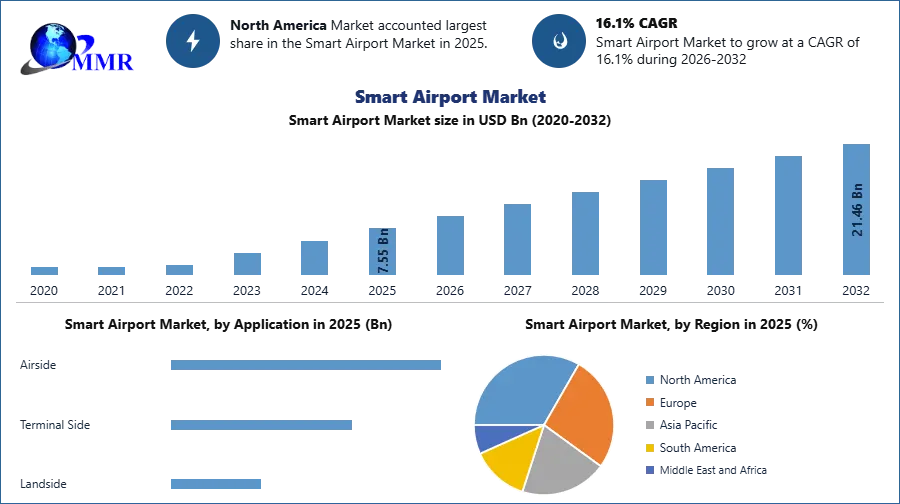 To know about the Research Methodology :- Request Free Sample Report
Smart Airport Market Dynamics:
Driving Forces and Innovations Shaping Growth of the Smart Airports Industry
The increased demand for real-time information throughout the world is one of the primary factors driving the growth of the smart airports industry. The use of sophisticated technology allows for the use of renewable energy sources to minimize pollution and accomplish sustainable goals, while a spike in air travel by passengers all over the world for speedier transportation and travel benefits accelerates market growth.
The increasing adoption of AI technologies by businesses of all sizes is the major driver for the global smart airports market. AI-driven solutions optimize ground handling and baggage management, reducing delays and errors. Efficiency gains in areas such as security screening for improving the overall passenger experience and maintaining the attractiveness of air travel. As airports strive to enhance efficiency, the smart airport market is set to grow.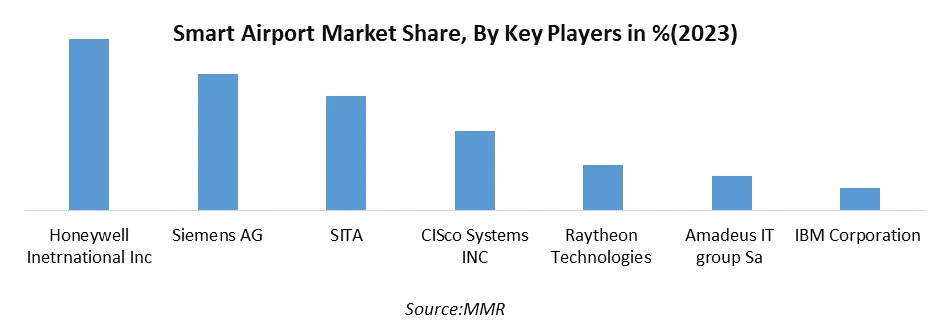 Transformative Technologies and Innovations Driving Industry Growth
The Internet of Things (IoT) is considered a notable trend that is driving market growth. The emerging technologies lead the airport industry towards Smart airports. Latest smart technology airport solutions practice smart gates, check-in, baggage monitoring, facial recognition, biometric identifications, and airport terminal navigation through mobile devices, IP-based security, and data analytics, data mining to study passenger behaviour, AI adaptations, and many other operational quality enhancements.
Similarly, airports are installing automated baggage handling systems to ease the pressure on airport ground support personnel, helping airports, airlines, and ground handlers achieve passenger satisfaction. Most airports in Europe and Asia have already installed automated baggage handling systems.
Navigating the Complexities of Privacy and Regulation in the Evolution of Smart Airports
Passenger privacy is at risk because of the usage of biometric technology like as facial recognition. Smart airports face a problem in finding the right balance of convenience and privacy. Aviation is one of the highly regulated industries mainly owing to the risks associated with its operations. A multitude of bilateral, national, and international regulations and standards bind the actions of aviation stakeholders, such as system manufacturers, service providers, and airports. Emerging technologies such as block chain and artificial intelligence could disrupt the market, resulting in the emergence of new competitors or a fundamental shift in the competitive landscape.
A smart blend of leisure, dining, and retail offers to encourage passengers to spend more time at the airport before departure is an integral part of the smart airport before departure is an integral part of the smart airport concept. The biggest challenge is understanding the needs and preferences of passengers and offering personalized services in the absence of collaborated data.
Smart Airport Market Segmentation:
By application, Airside holds largest market share of 44.30 %. Smart airports utilize various technologies such as airport collaborative decision-making (A-CDM) systems, advanced surface movement guidance and control systems (A-SMGCS), and automated weather monitoring to enhance the efficiency of airside operations. The systems help optimize runway and gate allocation, reduce taxiing times, and improve overall aircraft movements. Smart airports deploy automated ground handling equipment, such as baggage handling systems, aircraft towing vehicles, and fuelling systems, to streamline aircraft turnaround times. The technologies minimize delays, reduce fuel consumption, and enhance operational safety.
Advanced ATC systems, including radar surveillance, communication networks, and navigation aids, ensure safe and efficient aircraft movements within the airport airspace and on the ground. Smart airports integrate these systems with data analytics and predictive modelling to optimize airspace capacity and manage traffic flow. Efficient airside operations contribute to a seamless passenger experience, with reduced boarding times, minimal delays, and enhanced punctuality. Smart airports leverage data-driven insights to provide personalized services, such as gate notifications and baggage tracking, enhancing passenger satisfaction and loyalty.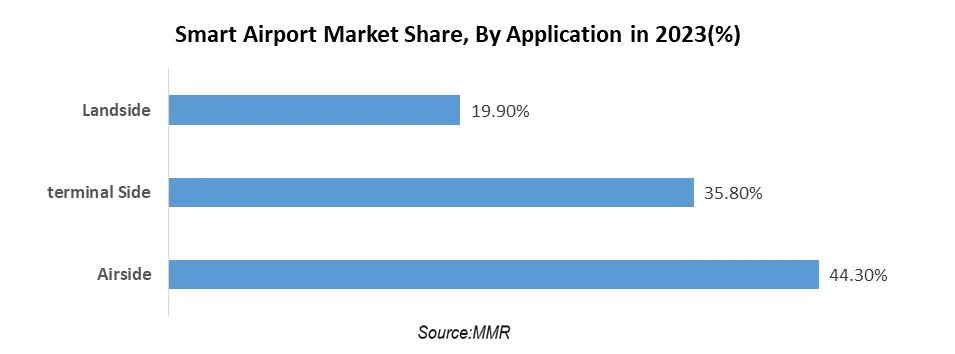
Smart Airport Market Regional Insight:
North America dominates the global smart airport market share of 37 %. The United States is projected to dominate the Smart AirPort Market through the Forecast Period. Source in the US, airports have introduced RFID/NFC-based luggage tracking, automated immigration systems, smart security gates, and mobile Products Type providing notification, among others. The Miami International Airport (MIA) has developed a mobile Product Type provider updates on flight timings, gate numbers, and customized information regarding others.
MIA is considered a leading player in terms of adopting mobile technologies, including broadly distributed Bluetooth beacons, which collect data to improve passenger satisfaction and the efficiency of airport operations. The US Federal Aviation Administration (FAA) awarded USD 20 million from President Biden's Bipartisan Infrastructure Law to 29 airport-owned traffic control towers nationwide. The investment was used to upgrade and build control towers in small towns and regional airports.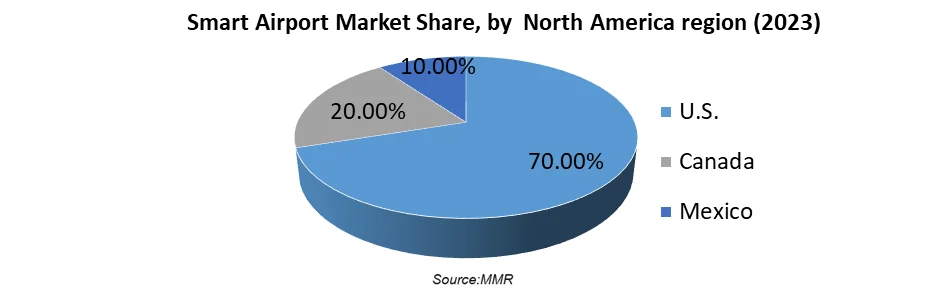 The presence of global brands in the airport optimization industries such as IBM, SITA, and Cisco Systems INC. as well as the presence of the biggest international airport- Hartsfield-Jackson Atlanta International Airport (ALT) are significant factors driving the market growth in North America.
In Canada, many airports are adopting Geo-location to reduce passenger traffic by providing navigation from boarding to terminal gates. Various other products such as Track and Trace help passengers to track their baggage and to be connected with their luggage throughout the journey.
Smart Airport Market Recent Industry Developments (2025–2026)
| Date | Company | Development | Impact |
|---|---|---|---|
| 15 January 2025 | Siemens AG and Amadeus IT Group | The companies formed a strategic partnership to integrate airport hardware technology with cloud-based travel IT platforms. | The collaboration aims to streamline passenger processing and significantly improve operational efficiency across global hubs. |
| 12 March 2025 | Honeywell International Inc. | Launched a new Edge-as-a-Service solution designed for real-time data collection and analysis at airport terminals. | The solution optimizes resource allocation and passenger flow by processing critical data at the network edge. |
| 08 April 2025 | Huawei | Introduced the Smart Airport Intelligent Operation Center (IOC), a platform merging AI, IoT, and big data for 360-degree visibility. | Implementation is expected to improve flight punctuality by 5% through precise forecasting and automated ground handling. |
| 22 April 2025 | Schiphol Group | Announced a €1.5 billion investment plan focused on modernizing Amsterdam Airport Schiphol with smart technologies. | The funding will scale digital infrastructure and sustainable automation to expand the airport’s long-term capacity. |
| 14 May 2025 | Hyundai Motor Group | Partnered with Incheon International Airport to deploy AI-powered automatic charging robots (ACRs) for electric vehicles. | This initiative advances landside automation, providing autonomous, human-free charging services for airport visitors. |
| 02 January 2026 | European Union | Mandated the installation of 2,500 new biometric e-gates across 27 member states as part of the Entry/Exit System (EES). | This regulatory move accelerates the mass adoption of biometric security systems throughout the European aviation market. |
Smart Airport Market Scope: Inquire before buying
| Smart Airport Market | |||
|---|---|---|---|
| Report Coverage | Details | ||
| Base Year: | 2025 | Forecast Period: | 2026-2032 |
| Historical Data: | 2020 to 2025 | Market Size in 2025: | 7.55 USD Bn |
| Forecast Period 2026-2032 CAGR: | 16.1% | Market Size in 2032: | 21.46 USD Bn |
| Segments Covered: | by Product Type | Airport 2.0 Airport 3.0 Airport 4.0 |
|
| by Airport Size | Large Medium Small |
||
| by Operation | Aeronautical Non-aeronautical |
||
| by Application | Airside Terminal Side Landside |
||
| by End User | Implementation Upgrades & Services |
||
Smart Airport Market by Region
North America (United States, Canada and Mexico)
Europe (UK, France, Germany, Italy, Spain, Sweden, Austria and Rest of Europe)
Asia Pacific (China, South Korea, Japan, India, Australia, Indonesia, Malaysia, Vietnam, Taiwan, Bangladesh, Pakistan and Rest of APAC)
Middle East and Africa (South Africa, GCC, Egypt, Nigeria and Rest of ME&A)
South America (razil, Argentina Rest of South America)
Smart Airport Market Key Players
1. Honeywell International Inc.
2. Siemens AG
3. Cisco Systems, Inc.
4. IBM Corporation
5. Thales Group
6. SITA
7. Amadeus IT Group
8. NEC Corporation
9. Collins Aerospace (formerly Rockwell Collins)
10. Indra Sistemas
11. Huawei Technologies Co., Ltd.
12. Raytheon Technologies Corporation
13. FACC AG
14. Leidos Holdings, Inc.
15. Bosch Security Systems
16. Hitachi, Ltd.
17. AirIT
18. Vanderlande Industries
19. Unisys Corporation
20. Smiths Detection