
Security as a Service Market – Global Market Size, Strategic Growth Drivers, Risk Assessment Framework, Regulatory Landscape Review, Competitive Intensity Mapping & Long-Term Industry Outlook to 2032
Overview
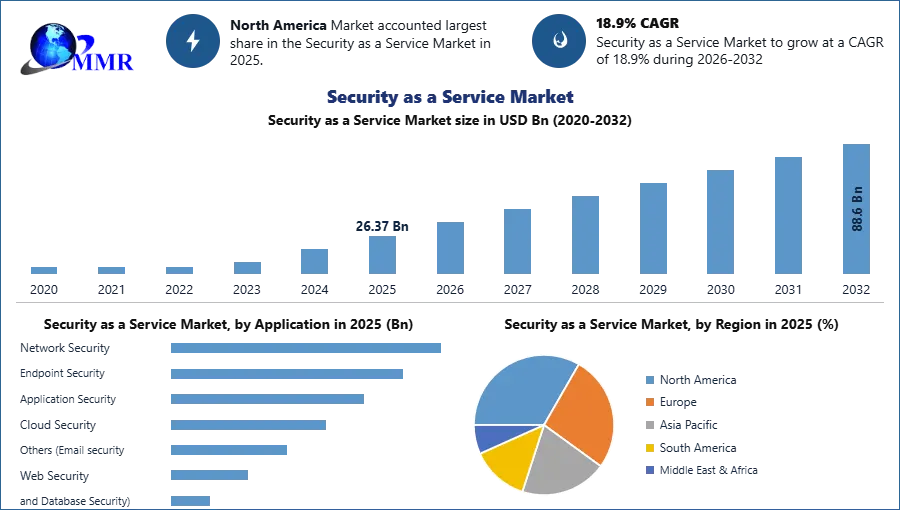
Security as a Service Market was valued at USD 26.37 Billion in 2025, and it is expected to reach USD 88.6 Billion by 2032, exhibiting a CAGR of 18.9 % during the forecast period (2025-2032)
Security as a service, often known as SaaS, is an outsourcing model used for security management in various enterprises. The security as a service approach, in conjunction with scalable and configurable solution offerings, may be installed on a monthly rental basis. Anti-virus, intrusion detection, authentication, anti-malware/spyware, penetration testing, and security event management are examples of security solutions. In order to deliver cloud-based security services to various enterprises, SaaS solution providers integrate their cloud security services into corporate networks. Because of its low cost and simplicity of management, SaaS is being deployed in a wide range of businesses.
Several firms have begun to deploy IoT-based solutions in order to improve operational efficiencies. IoT solution vendors are implementing security as a service to decrease cyber-attacks, identify risks, and repair flaws before releasing their products to the market. Furthermore, as the use of security services in IoT grows, the demand for security as a service solutions is likely to develop dramatically and present significant growth potential in the near future.
Security as a Service Market Research Methodology
The research report relies heavily on both primary and secondary data sources. The research process entails the investigation of various factors affecting the industry, such as government policy, market environment, competitive landscape, historical data, current market trends, technological innovation, upcoming technologies, and technical progress in related industries, as well as market risks, opportunities, market barriers, and challenges. All conceivable elements influencing the markets included in this research study have been considered, examined in depth, validated through primary research, and evaluated to provide the final quantitative and qualitative data. The market size for top-level markets and sub-segments is normalised, and the impact of inflation, economic downturns, regulatory & policy changes, and other variables is factored into the market forecast. This data is combined and added with detailed inputs and analysis, and presented in the report.
 To know about the Research Methodology :- Request Free Sample Report
Security as a Service Market Dynamics
SMEs are increasingly in need of cloud-based security solutions:
Cloud implementation enables businesses to integrate supplemental infrastructure technologies, such as software-defined perimeters, to construct resilient and secure platforms. Several governments establish unique recommendations and laws for cloud platform security, which promotes the global cyber security market growth. SMEs are continuously looking for ways to update their applications and infrastructures by utilising cloud-based platforms such as Software-as-a-Service (SaaS) and Infrastructure-as-a-Service (IaaS) (IaaS). Most SMEs across verticals become a key target for fraudsters looking to exploit security flaws. Traditional appliance-based firewalls and security gateways cannot protect cloud-based apps against assaults including malware, ransomware, phishing, and DNS data exfiltration.
As SMEs focus on cloud platform adoption, security administrators in these SMEs drive the demand for cloud-based security as a service solutions to improve performance and protect online and mobile apps, as well as key network infrastructures. Cloud-based security as a service solutions reduce the need to deploy a stack of security equipment on-premises and can safeguard applications, data, users, and devices using cloud services. As SMEs aim to handle data and information security concerns in the cloud, demand for cloud-based security as a service solutions is likely to rise, creating market potential prospects.
Bring Your Own Device and Carry Your Own Device trends are rapidly expanding:
With the advent of new platforms, BYOD regulations, CYOD trends, business apps, and other technologies during the last five years, the IT infrastructure has gotten more complicated and varied. Rapid improvements in mobile computing have increased the adoption of the BYOD and CYOD trends in workplace settings. These trends provide work freedom and greater employee productivity by allowing employees to access corporate data using their devices from anywhere, at any time. As a result, it is critical to protect the confidentiality and integrity of corporate data from possible threats.
The Bring Your Own Device (BYOD) strategy is growing popularity among SMEs and large companies, and it is altering how users access corporate data. Organizations are deploying their workers as BYOD-related technology improves. Organizations are subscribing to security services to safeguard devices such as smartphones, tablets, desktops, and laptops from cyber dangers as the BYOD model is adopted. With the increased usage of BYOD, businesses must safeguard devices both inside the workplace and those with remote access to the corporate network. This aspect has raised expenditure on security services substantially, which is expected to support the expansion of the security as a service industry.
Organizations' concerns about cloud-based security: Due to security concerns, several enterprises are cautious about the overall degree of adoption of cloud-based security solutions. According to Rights Cale's 2019 state of the cloud study, security is one of the top worries for businesses around the world. Despite the cost advantages of cloud-based security, enterprises prefer to handle their data and applications on-premises. IT professionals who are accustomed to engaging with on-premises security solutions generally have more reservations about migrating to cloud-based security because they fear losing ownership and control.
Cyberattacks are becoming more common in today's complicated IT security environment. There is also a widespread view that cloud-based standards are insufficiently developed to meet IT security expectations. Despite a surge in the deployment of cloud-based security solutions, companies' understanding of possible risks and dangers connected with these solutions remains low. The cloud migration apprehension of enterprises is limiting the growth of the security as a service sector.
Difficulties in designing and deploying a security as a service solution:
The deployment of the security as a service paradigm on new or existing infrastructure presents a number of design and implementation problems. The paradigm requires enterprise IT teams to rethink network security in order to transition from a network perimeter-based strategy to a user-based and application-based security model. Redesigning and redeploying online and mobile apps may be time-consuming and exhausting. Most networks are not built with cybersecurity in mind, and transitioning to a cybersecurity paradigm necessitates a thorough network study of network infrastructure, services, and traffic. Re-designing networks using the security as a service approach necessitates a thorough understanding of each user, device, application, and resource.
Security as a service is not entirely impenetrable. They do not solve all difficulties, such as DDoS attacks, human mistakes, and misconfigured equipment. To fully adopt security as a service, IT teams must disconnect application access from network access, therefore replacing network-centric firewalls with NGFWs to secure the whole network. However, most security as a service solutions concentrate on role-based user access, micro perimeters, and user analytics while disregarding resource vulnerabilities to different cyber dangers.
Security as a Service Market Segment Analysis
Based on the Component, the market is segmented into Solution and Services. The solution segment is expected to grow rapidly at a CAGR of xx% during the forecast period. Security as a service process provides a number of solutions to enterprises. Identity and access management (IAM) solution is expected to witness high growth at a CAGR of 12.9% during the forecast period. Nowadays, many security enterprises are enhancing and developing their service-based offerings. These offerings include cloud mobile, email threat management, and web security. Growing adoption of IAM solutions in the organizational process to identify, authenticate, and authorize persons or groups of people to have appropriate access to technology resources is propelling the growth of the market. These are the key factor that drives the growth of the solution segment in the global market during the forecast period.
Based on the Application, the market is segmented into Network Security, Endpoint Security, Application Security, Cloud Security, and Others (Email security, Web Security, and Database Security). The network Security segment is expected to hold the largest market share of xx% by 2029. Network security is the method of adopting software security measures to secure network infrastructure from malfunction, unauthorized access, modification, inappropriate disclosure, and misuse. It is an essential tool to create a safe platform for programmers, computers, and users, to execute their legalized important purposes within an environment. Increasing adoption of network security services in organizations to secure a network from potential threats by analyzing and collecting a variety of network security event information is attributed to the growth of the market. These are the key major factor that drives the growth of the network security segment in the global market during the forecast period.
Based on the Industry, the market is segmented into Banking, Financial Services, and Insurance, Government and Defense, Retail, Healthcare, IT and Telecom, Energy and Utilities, Manufacturing, and Others. Manufacturing segment is expected to grow rapidly at a CAGR of xx% during the forecast period. An increasing demand for security as a service in manufacturing industries is due to the manufacturing industry is completely unprepared for a cyber-attack. A cyber-attack has been launched against more than 60% of UK manufacturing companies. This excludes companies that are unaware of their threats or fail to notify a breach. And more than a third of them have been financially impacted. Due to this major factor, the demand for security as a service is increasing in manufacturing industries. These are the factor that drives the growth of the manufacturing segment in the global market during the forecast period 2022-2029.
Security as a Service Market Regional Insights
North America dominates the Global Security as a Service market during the forecast period. North America is expected to hold the largest market shares of xx% by 2032. During the forecast period, North America is expected to surpass Europe as the leading revenue-generating market for security as a service solution and service providers. Increased Internet of Things (IoT), cloud use, and the Bring Your Own Device (BYOD) trend, as well as rising internal and external threats, are expected to drive market growth in North America.
The US and Canada are major key contributors behind the growth of the market. The growth is attributed to the presence of advanced infrastructure, growing adoption of cloud-based security measures, and a vast presence of enterprise data centers across the region. According to research, approximately 64% of data breaches are reported in the US to date, which results in more demand for security solutions in various organizations across the country. Also, massive presence security services providers are driving the growth of the market in the region. As security as a service solutions enable proactive security measures against emerging cyber-attacks, the Europe security as a service industry is gaining pace. SMEs and large-scale enterprises in Europe have grown increasingly conscious of the growing threat of cybercrime and have begun to implement security as a service solutions and services to tackle it.
Security as a Service Market Recent Industry Developments (2025–2026)
| Date | Company | Development | Impact |
|---|---|---|---|
| 25 February 2026 | Allot Ltd. | The company announced a structural transition to a cybersecurity-first strategy, reporting that its Security-as-a-Service (SECaaS) revenue grew by 70% year-over-year in Q4 2025. | The shift resulted in the company's highest profitability in over a decade, with 2026 revenue guidance raised to $113–$117 million. |
| 19 February 2026 | General Services Administration (GSA) | The GSA authorized a new wave of FedRAMP-certified SECaaS offerings specifically designed for federal agencies to transition from on-premise hardware to cloud-based security proxies. | This initiative aims to reduce operational overhead for government agencies while improving scalability for Identity and Access Management (IAM) and disaster recovery. |
| 06 October 2025 | DeepStrike | The company commercialized its Continuous Penetration Testing-as-a-Service (PTaaS) model, specifically targeting agile DevOps and rapid software release cycles. | This milestone addresses the 2025 landscape where 82% of organizations plan to outsource security to achieve 24/7 offensive security coverage. |
| 20 July 2025 | Compax Ventures / Allot | Compax Ventures selected Allot as its strategic cybersecurity partner to provide built-in security capabilities for its MVNO (Mobile Virtual Network Operator) customers. | The partnership allows for network-native security delivery to millions of mobile subscribers without requiring end-user software installation. |
Security as a Service Market Report Scope:
The Security as a Service Market research report covers product classification, product application, development trend, product technology, competitive landscape, industrial chain structure, industry overview, national policy and planning analysis of the industry, and the most recent dynamic analysis, among other things. The report discusses the global market's drivers, opportunities, and limitations. It discusses the influence of various drivers, trends, and restraints on market demand during the forecast period. The research also outlines market potential on a global scale. The research includes the production time, base distribution, technical characteristics, research and development trends, technology sources, and raw material sources of main Security as a Service Market firms in terms of production bases and technologies. The more precise study also contains the primary market and consumer application sectors, significant regions and consumption, major producers, distributors, raw material suppliers, equipment providers, and their contact information, as well as an industry chain relationship analysis. This report's study also contains product specifications, manufacturing processes, cost structure, and data information organised by area, technology, and application.
Security as a Service Market Scope: Inquire before buying
| Security as a Service Market | |||
|---|---|---|---|
| Report Coverage | Details | ||
| Base Year: | 2025 | Forecast Period: | 2026-2032 |
| Historical Data: | 2020 to 2025 | Market Size in 2025: | 26.37 USD Bn |
| Forecast Period 2026-2032 CAGR: | 18.9% | Market Size in 2032: | 88.6 USD Bn |
| Segments Covered: | by Component | Solution Services |
|
| by Industry | Banking, Financial Services, and Insurance, Government and Defense Retail Healthcare IT and Telecom Energy and Utilities Manufacturing Others |
||
| by Deployment Mode | On-Premises Hybrid PrivateCloud PublicCloud |
||
| by Organization Size | LargeEnterprises SmallAndMediumEnterprises(SMEs) MicroEnterprises |
||
| by Application | Network Security Endpoint Security Application Security Cloud Security Others (Email security, Web Security, and Database Security) |
||
Security as a Service Market, by Region
North America (United States, Canada and Mexico)
Europe (UK, France, Germany, Italy, Spain, Sweden, Austria and Rest of Europe)
Asia Pacific (China, South Korea, Japan, India, Australia, Indonesia, Malaysia, Vietnam, Taiwan, Bangladesh, Pakistan and Rest of APAC)
Middle East and Africa (South Africa, GCC, Egypt, Nigeria and Rest of ME&A)
South America (Brazil, Argentina Rest of South America)
Security as a Service Market Key Players
1.McAfee
2.Trend Micro
3.Zscaler
4.International Business Machines Corporation
5.Microsoft
6.Clearswift
7.Alert Logic
8.Cygilant
9.Barracuda Networks
10.Panda Security
11.Stratejm
12.Radware
13.Mindsight
14.Sentinel Technologies
15.Happiest Minds
16.Okta
17.ProofPoint
18.Qualys
19.Symantec
20.Sophos
21.Egress Technologies
22.Forcepoint
23.Fortinet
24.Kaspersky Lab
25.CipherCloud
26.DXC Technology
27.Cisco
28.AT&T
29.Axcient