
Scaffold Technology Market Size by Type, Disease Type, Application, End-User, Region – Revenue Pool Analysis, Margin Structure Assessment, Capital Flow Trends, Competitive Benchmarking & Forecast to 2034
Overview
The Scaffold Technology Market size was valued at USD 1.80 Billion in 2025 and the total Scaffold Technology revenue is expected to grow at a CAGR of 8.4% from 2026 to 2034, reaching nearly USD 3.73 Billion.
The global Scaffold Technology market report is a comprehensive analysis of the industry, market, and key players. The report has covered the market by demand and supply-side by segments. The global Scaffold Technology report also provides trends by market segments, technology, and investment with a competitive landscape.
Scaffold Technology Market Snapshot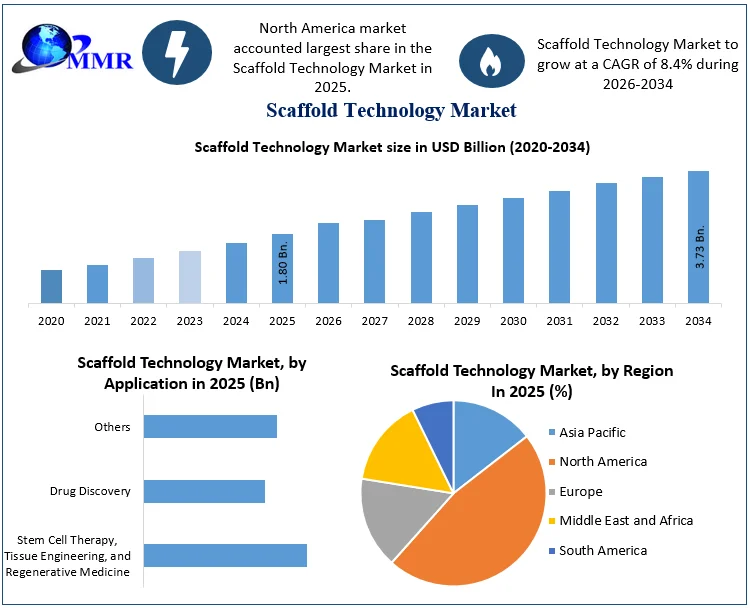
To know about the Research Methodology :- Request Free Sample Report
Scaffold Technology Market Overview:
Scaffolds are mechanisms designed to aid cellular interaction in the formation of new functioning cells and tissues for medical applications. Maybe there are transient or permanent matrices that enable tissue development chemically, mechanically, and biologically. 3D culture assays such as cell to cell interactions, high throughput scanning, cell to matrix interactions, transfections, and cell migration assays all use scaffold technology. Scientists believe that these scaffolds might one day aid in the architecture of major and large body organs.
Scaffold Technology Market Dynamics:
Drivers:
Tissue engineering and cell therapy have benefited greatly from advancements in 2D to 3D cell culture techniques. Spheroids increase the effectiveness of mesenchymal stem cells, resulting in improved tissue regenerative, reparative, and anti-inflammatory outcomes, as well as higher post-transplant survival rates. The adoption of 3D scaffold cultures has benefited as a result of this. By supplying relevant knowledge about diseased cells and guiding the market, the 3D model of cell cultivation allows for the study of phenotypic heterogeneity of cancerous cells and heterotypic crosstalk between cell types.
The industry is increasing due to rising demand for body regeneration and an increase in organ transplantation around the world. Biomimetic tissue structures created by scaffold creation result in 3D organ type constructions that improve the transplantation process, boosting the market growth.
The industry is being propelled forward by the introduction of biological scaffolds with distinguishing characteristics such as inertness, biodegradability, and the ability to generate fluorescence for imaging. Besides that, leading players' new releases are helping the industry. Meril Life Sciences, for particular, obtained FDA clearance in August for its biological scaffold “MeRes100 BRS,” which is used to treat coronary artery lesions.
Scaffold Technology Market Segment Analysis:
Based on Type, Hydrogels have emerged as a leading market, accounting for 42.2 per cent of market share in 2025. Soon, ongoing technical developments in the microfabrication of hydrogels are anticipated to augment segment development. Companies are now announcing new hydrogels for cell transplantation, drug depots, and a restenosis buffer.
Based on Disease, Type, the musculoskeletal industry segment has the highest revenue share because of increasing cases of orthopedic injuries. More than 15 million fractures occur per year in the United States alone, including 2 million osteoporosis and 1.6 million acute fractures.
The neurology market segment is projected to rise at the fastest pace. This is attributed to the ever-increasing need for neurological research and development facilities.
Based on Application, The global scaffold technology market is divided into stem cell therapy, regenerative medicine, and tissue engineering, drug development, and others depending on use. The stem cell therapy division will generate the most sales in 2025. The widespread use of scaffolds in cosmetic procedures, soft tissue replacements, tumor repairs, and wound healing accounts for this elevated percentage.
Based on End User, the biotechnology and pharmaceutical industry sector accounted for the greatest share of sales. The widespread use of scaffolds in drug screening and target validation trials is to blame for such a large share. The segment's growth is mainly attributed to these industries' widespread use of scaffold technology in tissue engineering fields such as periodontal reconstruction, cartilage production, bone formation, nasal and auricular malformation repair, tendon repair, and heart valves.

Furthermore, these businesses use automation to distribute medicines and other changes. The segment's development is largely due to an increase in grafting technology procedures such as biological scaffolds in hospital settings and an increase in cardiovascular surgeries.
Scaffold Technology Market Recent Development
| Date | Company | Development | Impact |
|---|---|---|---|
| 25 February 2025 | CollPlant Biotechnologies | The company achieved a milestone in its ongoing development and commercialization agreement with AbbVie, securing a $2 million milestone payment. | This achievement advances the integration of its proprietary rhCollagen scaffold technology into commercial dermal and soft tissue fillers. |
| 20 October 2025 | CollPlant Biotechnologies | Mayo Clinic researchers successfully utilized CollPlant's plant-derived rhCollagen-based bioink Collink.3D to engineer the first fully humanized 3D bioprinted skin model. | The successful validation establishes a highly scalable, animal-free alternative for preclinical research and pharmaceutical toxicity testing. |
| 11 February 2026 | StimLabs | The company announced that the U.S. FDA granted 510(k) clearance for Geistlich’s DermaForm, a specialized Collagen Scaffold Particulate wound care device. | The commercial clearance significantly expands clinical tools for protecting and managing complex, chronic wounds via extracellular matrix solutions. |
| 18 February 2026 | CollPlant Biotechnologies | The company officially launched BioFlex, a ready-to-print kit engineered specifically for Digital Light Processing (DLP) 3D bioprinting applications. | The system provides researchers with an optimized biodegradable polymer matrix to enhance the biofabrication of complex tissue models and transplantable organs. |
| 27 May 2026 | CGBIO | The firm signed an exclusive commercialization agreement with DePuy Synthes to advance clinical development and market pathways for the NOVOSIS bone graft substitute in North America and Australia. | The integration of its proprietary ceramic scaffold technology provides a structurally sound environment to accelerate global adoption in the orthopedics sector. |
Scaffold Technology Market Regional Insights:
The scaffold technology industry is projected to be dominated by North America. The region's growing demand can be credited to the region's well-developed infrastructure, recent advances in stem cell research and regenerative medicine, the presence of innovative technology companies, ongoing studies, and the involvement of major market players.
The demand in Asia-Pacific, on the flip side, is expected to expand at a faster pace due to increased expenditures in healthcare infrastructure and heavily regulated policies that encourage the use of such technologies. Increasing public consciousness about the use of organ transplants also contributes to the regional market's expansion. Furthermore, one of the main factors driving the demand is the increase in alcohol consumption and the population of smokers in the area.
The objective of the report is to present a comprehensive analysis of the global Scaffold Technology market to the stakeholders in the industry. The past and current status of the industry with the forecasted market size and trends are presented in the report with the analysis of complicated data in simple language. The report covers all the aspects of the industry with a dedicated study of key players that include market leaders, followers, and new entrants.
PORTER, SVOR, PESTEL analysis with the potential impact of micro-economic factors of the market have been presented in the report. External as well as internal factors that are supposed to affect the business positively or negatively have been analyzed, which will give a clear futuristic view of the industry to the decision-makers.
The report also helps in understanding the global Scaffold Technology market dynamics, structure by analyzing the market segments and project the global Scaffold Technology market size. Clear representation of competitive analysis of key players by product, price, financial position, product portfolio, growth strategies, and regional presence in the global Scaffold Technology market make the report investor’s guide.
Scaffold Technology Market Key Developments:
Researchers from the University of California and the Institute of Engineering of Medicine used 3D printed scaffolds to build a spinal cord in January 2021.
Ligand produced a peptide scaffold as a potential antidote and vaccine for COVID-19 in April 2021. The scaffold was created with AI and supercomputing to imitate the virus's immune binding and attaching components. As a result, synthetic structures with advantages including fast prototyping and effective scale-up may be used to develop therapeutics for SARS-CoV-2.
CELLINK GLOBAL joined the TRIANKLE consortium in November 2021 to create novel custom gelatine and collagen-based implants for ankle joint tissue reconstruction using 3D printing technology.
Wake Forest Institute for Regenerative Medicine (WFIRM) scientists created a hybrid tissue construct that can be used for cartilage regeneration in November 2021.
Bio-Techne Corporation launched Cultrex UltiMatrix Reduced Growth Factor Basement Membrane Extract (RGF BME) for culturing pluripotent stem cells and organoids in March 2021.
Scaffold Technology Market Scope: Inquire before buying
| Scaffold Technology Market | |||
|---|---|---|---|
| Report Coverage | Details | ||
| Base Year: | 2025 | Forecast Period: | 2026-2034 |
| Historical Data: | 2020 to 2025 | Market Size in 2025: | USD 1.80 Bn. |
| Forecast Period 2026 to 2034 CAGR: | 8.4% | Market Size in 2034: | USD 3.73 Bn. |
| Segments Covered: | by Type | Hydrogels Polymeric Scaffolds Micropatterned Surface Microplates Nanofiber Based Scaffolds Wound Healing 3D Bioprinting Immunomodulation |
|
| by Disease Type | Orthopedics, Musculoskeletal, & Spine Cancer Skin & Integumentary Dental Neurology Cardiology and Vascular Urology GI, Gynecology Others |
||
| by Application | Stem Cell Therapy, Tissue Engineering, and Regenerative Medicine Drug Discovery Others |
||
| by End-User | Biotechnology and Pharmaceutical Industries Research Laboratories and Industries Hospitals and Diagnostic Centers Others |
||
Scaffold Technology Market, by Region
North America (United States, Canada and Mexico)
Europe (UK, France, Germany, Italy, Spain, Sweden, Austria, Turkey, Russia and Rest of Europe)
Asia Pacific (China, India, Japan, South Korea, Australia, ASEAN and Rest of APAC)
Middle East and Africa (South Africa, GCC, Egypt, Nigeria and Rest of ME&A)
South America (Brazil, Argentina, Columbia and Rest of South America)
Scaffold Technology Market Key Players:
1. Tissue Engineering & Regenerative Medicine Scaffold Developers
These companies develop scaffold-based products and technologies used for tissue repair, regeneration, and regenerative medicine applications.
North America
1. Organogenesis Holdings Inc. – United States
2. Integra LifeSciences Holdings Corporation – United States
3. Vericel Corporation – United States
Europe
1. Smith+Nephew plc – United Kingdom
2. Geistlich Pharma AG – Switzerland
Asia Pacific
1. Gunze Limited – Japan
2. Cyfuse Biomedical K.K. – Japan
2. Biomaterials & Scaffold Material Manufacturers
These companies produce natural and synthetic biomaterials used to manufacture tissue engineering scaffolds.
North America
1. Corning Incorporated – United States
2. DSM Biomedical Inc. – United States
Europe
1. Evonik Industries AG – Germany
2. GELITA AG – Germany
3. Polyganics B.V. – Netherlands
Asia Pacific
1. Nippi Incorporated – Japan
2. Koken Co., Ltd. – Japan
3. 3D Cell Culture & Research Scaffold Providers
These companies develop scaffold platforms for cell culture, stem cell research, drug screening, and biomedical research applications.
North America
1. Thermo Fisher Scientific Inc. – United States
2. Corning Incorporated – United States
3. Bio-Techne Corporation – United States
Europe
1. Merck KGaA – Germany
2. Sartorius AG – Germany
Asia Pacific
1. FUJIFILM Corporation – Japan
4. Stem Cell & Advanced Tissue Engineering Companies
These companies utilize scaffold technologies in stem cell therapies, tissue regeneration, and advanced biomedical engineering applications.
North America
1. Vericel Corporation – United States
2. Organogenesis Holdings Inc. – United States
Europe
1. Bone Therapeutics SA – Belgium
2. Smith+Nephew plc – United Kingdom
Asia Pacific
1. Cyfuse Biomedical K.K. – Japan
2. Gunze Limited – Japan
5. Bioprinting & Next-Generation Scaffold Technology Companies
These companies develop advanced scaffold platforms, biofabrication technologies, and 3D bioprinting solutions for regenerative medicine.
North America
1. 3D Systems Corporation – United States
2. CELLINK USA LLC (BICO Group) – United States
Europe
1. BICO Group AB – Sweden
2. RegenHU SA – Switzerland
Asia Pacific
1. Cyfuse Biomedical K.K. – Japan
Frequently Asked Questions:
1. Which region has the largest share in Global Scaffold Technology Market?
Ans: North America region held the highest share in 2025.
2. What is the growth rate of Global Scaffold Technology Market?
Ans: The Global Scaffold Technology Market is growing at a CAGR of 8.4% during forecasting period 2026-2034.
3. What is scope of the Global Scaffold Technology market report?
Ans: Global Scaffold Technology Market report helps with the PESTEL, PORTER, COVID-19 Impact analysis, Recommendations for Investors & Leaders, and market estimation of the forecast period.
4. Who are the key players in Global Scaffold Technology market?
Ans: The important key players in the Global Scaffold Technology Market are – Thermo Fisher Scientific, Inc., Merck KGaA, Molecular Matrix, Inc., Pelobiotech, Tecan Trading, 3D Biotek, Becton, Dickinson, and Company, Medtronic,
5. What was the Global Scaffold Technology Market size in 2025?
Ans: The Global Scaffold Technology Market size was USD 1.80 Billion in 2025.