
Satellite-Based Earth Observation Market Size by Application, End User, Satellite Orbit, Region – Segment-Level Market Assessment, Growth Opportunity Analysis, Competitive Mapping & Forecast to 2032
Overview
Satellite-Based Earth Observation Market was USD 4318.51 Mn in 2025 and is expected to reach USD 5876.9 Mn grow at a CAGR of 4.5% during the forecast period.
Satellite-Based Earth Observation Market Overview
Satellite-based Earth Observation (EO) is a process done with the help of satellites, which revolve around the planet to identify environmental changes, map-making and gather the information related to chemical, physical and biological aspects of the earth system.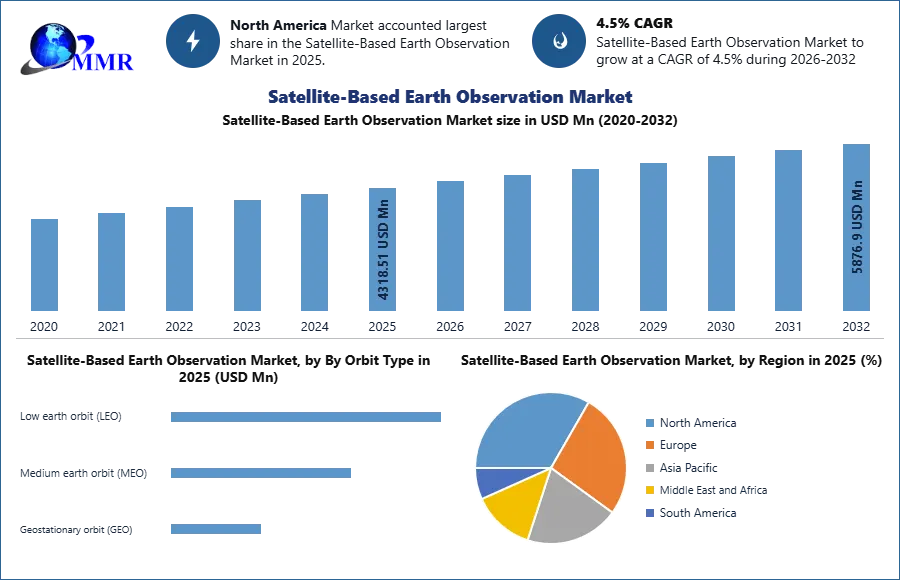
To know about the Research Methodology :- Request Free Sample Report
This gathered information is used to detect damage during floods, tsunamis, and other natural disasters, agricultural and usage, petroleum and mineral deposits, availability of water sources etc. Where many industries like defense and intelligence, infrastructure and engineering, natural resource management, energy and power, and disaster management use this gathered information by satellites to make the decision regarding various segments, which in return is expected to drive the growth of Satellite-Based Earth Observation Market during the forecast period.
The report provides a detailed study of key market dynamics, market segmentation and regional analysis. The market study contains detailed insights about how the Global Satellite-Based Earth Observation Market is anticipated to grow during the forecast period.
Satellite-Based Earth Observation Market Dynamics
The satellites are equipped with high-resolution cameras and advanced remote-sensing technology to get high satellite-based earth observation images. These improvements in satellite technology led the Satellite-Based Earth Observation Market to grow globally. Further, this data is used by defense, science, research and development organizations, and private users to lower technology barriers, which in turn is expected to boost the Satellite-Based Earth Observation Market globally.
Similarly, surveyors, farmers, miners, fishers, engineers, and other decision-makers along with Google Inc. use these data collected by satellites in mapping and location services to boost the Satellite-Based Earth Observation Market globally.
In addition to this, the government has invested about $10 billion in 2021 for the EO program in the civil and meteorology sector, which is likely expected to drive the growth of the Satellite-Based Earth Observation Market during the forecast period.
The ‘Group on Earth Observation System of Systems’ is system is incorporated to resolve the challenges arising due to its high investment cost and the incoordination among different databases continue due to the isolation of various satellites from one another, which is expected to hamper the Satellite-Based Earth Observation Market during the forecast period. Thus to resolve these challenges the system offers a single internet access point to all the users to get the information directly to the users across the various domains.
Recent Developments:
In February 2026, Airbus signed a new framework agreement with Synspective Inc. to access its growing SAR radar satellite constellation, improving global revisit rates and expanding radar imaging where frequent coverage is needed (e.g., equatorial regions). This broadens Airbus’s Earth observation offerings by combining different radar assets.
Satellite-Based Earth Observation Market Segmentation Analysis
By Satellite Orbit: The Low Earth Orbit (LEO) segment led the market in 2025, valued at USD 2.1 billion, driven by the rapid deployment of small satellites and CubeSats offering high-resolution imagery and frequent revisit times. Cost-effective launches, including rideshare missions, and real-time monitoring applications in agriculture, defense, and disaster management are accelerating demand. Meanwhile, the Geostationary Orbit (GEO) segment is projected to grow at a CAGR of 6.8% during 2025–2032. GEO satellites provide continuous, wide-area monitoring, making them ideal for weather forecasting and climate analysis. Manufacturers should invest in advanced sensors and integrated GEO-LEO data fusion platforms to enhance analytical capabilities.
By Application:
The defense & intelligence segment led the market in 2025, valued at USD 1.3 billion, driven by rising geopolitical tensions and the growing need for enhanced situational awareness. Governments are investing in high-resolution, real-time Earth observation (EO) data for border surveillance, reconnaissance, and threat detection. Integration of AI and machine learning improves data processing and converts imagery into actionable intelligence.
Meanwhile, the environmental & climate monitoring segment is projected to grow at a CAGR of 7% during 2025–2032, fueled by climate change concerns. Demand for multispectral and hyperspectral imaging is increasing, encouraging manufacturers to strengthen advanced analytics and secure platforms.
Satellite-Based Earth Observation Market Regional Analysis
North America held the largest share of xx% in the Satellite-Based Earth Observation Market in 2025, supported by strong government funding, advanced satellite infrastructure, and high adoption of remote sensing technologies across defense, agriculture, energy, climate monitoring, and disaster management applications. The region, particularly the United States, benefits from continuous R&D investments, modernization of defense capabilities, and the presence of major commercial satellite operators, which collectively strengthened its revenue contribution. Looking ahead, North America is expected to maintain its dominant position during the forecast period, driven by sustained research activities and increasing satellite integration across multiple industrial sectors.
At the same time, emerging economies such as Vietnam, Malaysia, Kazakhstan, and South Africa are expanding their autonomous space programs, contributing to broader market expansion. Government initiatives aimed at developing advanced satellite imaging systems for institutional and commercial applications are further supporting global demand.
Additionally, nearly 50 countries are anticipated to launch their own satellites during the forecast period, with Morocco and Pakistan among the latest entrants in Earth observation satellite deployment. Furthermore, collaboration between Geographic Information System (GIS) providers, mobile device manufacturers, and leading remote sensing satellite operators across the United States, Europe, China, and India is enhancing data accessibility and analytics capabilities, thereby accelerating overall market growth during the forecast period.
Global Satellite-Based Earth Observation Market Scope: Inquire before buying
| Satellite-Based Earth Observation Market | |||
|---|---|---|---|
| Report Coverage | Details | ||
| Base Year: | 2025 | Forecast Period: | 2026-2032 |
| Historical Data: | 2020 to 2025 | Market Size in 2025: | 4318.51 USD Mn |
| Forecast Period 2026-2032 CAGR: | 4.5% | Market Size in 2032: | 5876.9 USD Mn |
| Segments Covered: | By Orbit Type | Low earth orbit (LEO) Medium earth orbit (MEO) Geostationary orbit (GEO) |
|
| by Technology | Optical (electro optical) Synthetic aperture radar (SAR) Hyperspectral & multispectral Thermal infrared sensors LiDAR systems Others |
||
| by End Use | Government & defense Commercial Research & academia Others |
||
| by Application | Agriculture & forestry Defense & intelligence Environmental & climate monitoring Urban & infrastructure planning Energy, mining & natural resources Maritime & transportation Others |
||
Satellite-Based Earth Observation Market, by Region
North America (United States, Canada and Mexico)
Europe (UK, France, Germany, Italy, Spain, Sweden, Austria and Rest of Europe)
Asia Pacific (China, South Korea, Japan, India, Australia, Indonesia, Malaysia, Vietnam, Taiwan, Bangladesh, Pakistan and Rest of APAC)
Middle East and Africa (South Africa, GCC, Egypt, Nigeria and Rest of ME&A)
South America (Brazil, Argentina Rest of South America)
Key Players/Competitors Profile, Covered in Satellite-Based Earth Observation Market Report, From A Strategic Perspective
- Airbus Defence and Space
- Maxar Technologies Inc.
- L3Harris Technologies Inc.
- MDA Space Ltd.
- ICEYE Oy
- Capella Space Inc.
- Planet Labs PBC
- China Siwei Surveying and Mapping Technology Co., Ltd.
- ImageSat International N.V.
- Synspective Inc.
- Satellogic
- Thales Alenia Space
- Northrop Grumman
- Lockheed Martin Space
- Boeing Defense, Space & Security
- Leonardo S.p.A.
- Satrec Initiative
- York Space Systems
- RUAG Space
- GHGSat
- HawkEye 360
- Elecnor Deimos
- Israel Aerospace Industries
- OHB SE
- Ball Aerospace