
Rotary Blasthole Drilling Rig Market – Industry Structure Evaluation, Demand Drivers Analysis, Regional Growth Analysis and Identification, Competitive Positioning Review & Global Market Size Forecast to 2034
Overview
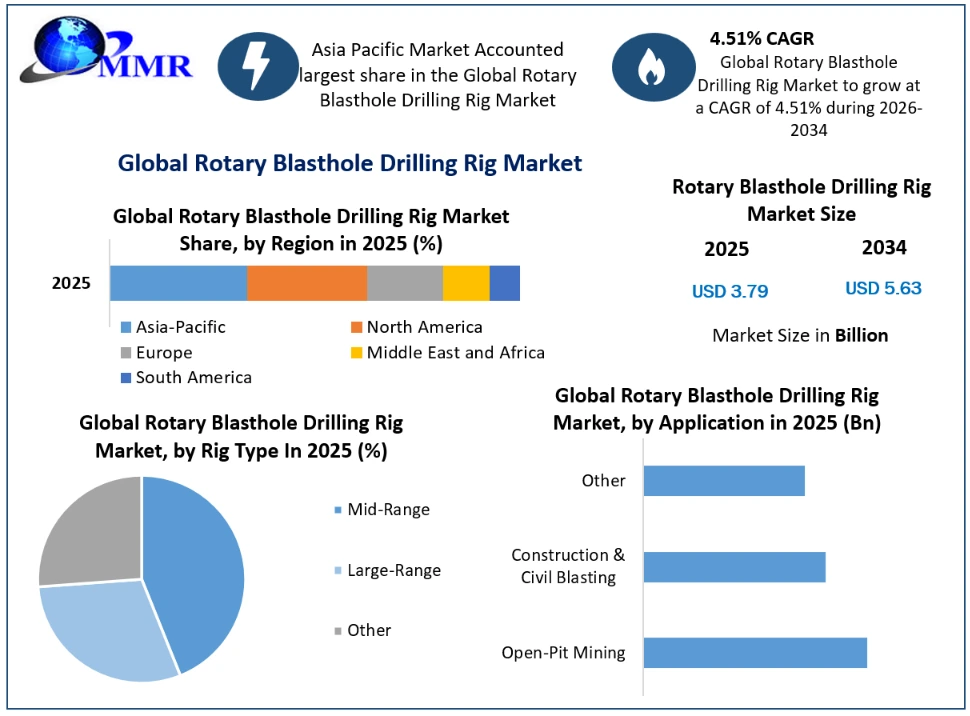
The Rotary Blasthole Drilling Rig Market size was valued at USD 3.79 Billion in 2025 and the total Rotary Blasthole Drilling Rig revenue is expected to grow at a CAGR of 4.51% from 2026 to 2034, reaching USD 5.63 Billion by 2034.
Global Rotary Blasthole Drilling Rig Market Overview:
The Global Rotary Blasthole Drilling Rig Market encompasses heavy-duty surface drilling machinery engineered to bore precise, large-diameter blastholes into rock formations for controlled explosive placement and rock fragmentation across open-pit mining, quarrying, and civil infrastructure operations. The industry serves as the foundational front-end production link in surface mineral extraction—directly governing downstream blasting efficiency, rock fragmentation quality, shovel diggability, and crusher throughput. Available across mid-range and large-range configurations spanning drill diameters from below 150 mm up to 311 mm and above, modern rotary blasthole rigs are offered in crawler-mounted and wheel-mounted designs powered by diesel, electric, and hybrid drivetrains. Demand across global mining hubs is increasingly shifting from conventional operator-controlled diesel units toward high-pulldown, semi-automated, and fully autonomous electric drilling fleets that maximize hole accuracy, extend bit and component lifecycles, enhance operator safety, and lower overall drilling cost per tonne.
Rotary Blasthole Drilling Rig Market Growth Outlook
To know about the Research Methodology:-Request Free Sample Report
Global Rotary Blasthole Drilling Rig Market Dynamics
Growth in the Global Rotary Blasthole Drilling Rig Market—Valued at USD 3.79 Billion in 2025 and the total Rotary Blasthole Drilling Rig revenue is expected to grow at a CAGR of 4.51% from 2026 to 2034, reaching USD 5.63 Billion by 2034.—is primarily driven by rising global extraction of base metals, iron ore, coal, and energy-transition minerals such as copper and lithium across large-scale surface mines. Declining ore grades and deeper overburden layers require higher-capacity rotary blasthole rigs capable of drilling wider diameters (250 mm to 311+ mm) and deeper benches with greater penetration efficiency to keep cost per tonne competitive.
At the same time, mining operators are aggressively modernizing aging diesel fleets toward electric-powered and hybrid-powered rotary rigs alongside semi-autonomous and fully autonomous drilling systems to cut fuel expenditure, lower site-level carbon emissions, improve hole straightness and rock fragmentation, and remove operators from hazardous bench edges. However, market expansion faces notable restraints from high upfront capital expenditure—especially for large-range electric and autonomous configurations—and cyclical commodity price swings that periodically delay greenfield mine approvals and fleet replacement budgets. Operational challenges further include power-grid and charging infrastructure limitations at remote open-pit sites, strict noise, dust, and engine emission standards, and a shortage of skilled technicians capable of maintaining complex digital, hydraulic, and high-voltage drilling systems. Nevertheless, expanding brownfield mine expansions, growing adoption of Equipment-as-a-Service (EaaS) and contract drilling models, and predictive maintenance telematics present substantial long-term opportunities for OEMs and aftermarket service providers.
Global Rotary Blasthole Drilling Rig Market Segment Analysis
By Rig Type: Mid-range rotary blasthole drilling rigs balance drilling depth, portability, and pulldown force, making them versatile across medium-scale open-pit mines, quarries, and multi-bench production operations where maneuverability and cost control are key. Large-range rotary blasthole drilling rigs deliver high pulldown force, rotary torque, and deep-hole capability for high-volume overburden and ore bench production in major surface mines. Other specialized rotary blasthole drilling rigs cover custom-engineered or application-specific configurations designed for unique geological profiles, confined benches, or specialized drilling tasks.
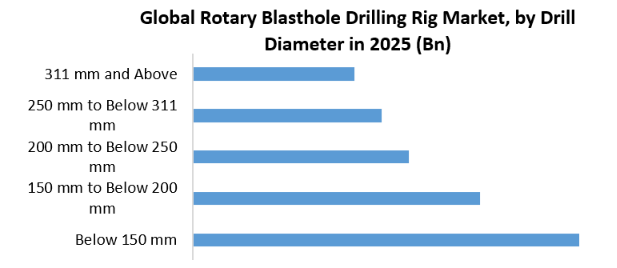
By Drill Diameter: Below 150 mm drill diameters suit smaller benches, controlled blasting, and quarry or construction operations that prioritize precision fragmentation and lower explosive consumption. The 150 mm to below 200 mm and 200 mm to below 250 mm ranges serve mid-sized surface mines and active quarries needing higher penetration rates and wider blast patterns without sacrificing mobility. The 250 mm to below 311 mm and 311 mm and above brackets are tailored to large-scale surface mining operations—such as major iron ore, copper, and coal mines—where wide borehole spacing and high material movement volumes drive down cost per tonne.
By Application: Open-pit mining represents the core demand driver—spanning coal mining, metal ore mining, and other mineral mining—where continuous production benches require high-availability blasthole drilling to maintain stripping and ore extraction schedules. Quarrying—covering limestone quarrying, granite and dimension stone quarrying, aggregates quarrying, and other quarrying applications—relies on consistent hole straightness and rock fragmentation to feed cement plants, stone processors, and aggregate crushers. Construction and civil blasting, alongside other applications such as highway cutting, dam foundations, and site excavation, generate steady project-driven demand for reliable rock-breaking equipment.
By Power Source: Diesel-powered rotary blasthole drilling rigs remain widely deployed due to their operational autonomy, refueling flexibility, and suitability for remote or expanding pit benches lacking high-voltage infrastructure. Electric-powered rotary blasthole drilling rigs are gaining traction in established mines with reliable grid or mine-power access because they lower energy costs per metre drilled, reduce onboard engine maintenance, and cut direct emissions. Hybrid-powered rotary blasthole drilling rigs combine electric drive or energy storage with engine support to balance fuel savings and operational flexibility, while other power configurations address niche or site-specific energy setups.
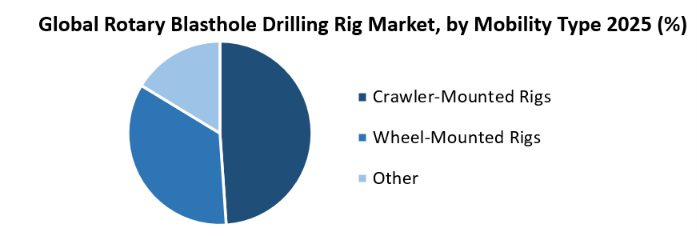
By Mobility Type: Crawler-mounted rigs dominate demanding mining and quarrying terrain by providing superior ground stability, high tractive effort, and safe grade climbing across uneven benches and loose rock. Wheel-mounted rigs offer faster road transit and relocation between dispersed sites, making them attractive for contractors, quarries, and civil blasting projects with frequent site moves. Other mobility configurations encompass specialized carriers or custom chassis setups engineered for specific site access or operational constraints.
By Automation Level: Operator-controlled rigs rely on direct on-board or tethered operator input and remain common where benches change frequently or fleet sizes are smaller. Semi-automated rigs introduce automated drilling cycles, depth control, and rod-handling assistance to boost hole consistency while keeping operators in a supervisory role. Fully autonomous rigs execute planned drill patterns with minimal human intervention, supporting higher utilization, improved safety by removing personnel from hazardous bench edges, and consistent performance across large fleets.
By End User: Mining companies—across coal mining companies, metal mining companies, and other mineral mining companies—form a primary buyer group procuring rigs for long-term multi-bench production and fleet modernization. Quarry operators purchase rigs suited to steady aggregate, cement-grade limestone, or dimension stone output, while drilling and blasting contractors deploy versatile fleets across multiple client sites under service or production contracts. Construction and infrastructure contractors, together with other end users, acquire equipment to support civil earthworks, infrastructure corridors, and specialized industrial projects.
Global Rotary Blasthole Drilling Rig Market Regional Insights:
Asia Pacific represents the largest and fastest-growing regional market for rotary blasthole drilling rigs, anchored by massive coal, iron ore, copper, and aggregates production across China, India, Australia, and Indonesia, alongside major infrastructure and quarrying investments. Australia stands out as a global hub for autonomous and large-range blasthole rig deployment in Pilbara iron ore operations, while China and India drive high unit volume across both domestic OEMs and multinational fleet expansions.
North America holds a leading revenue share—supported by large-scale surface mining across the United States, Canada, and Mexico, mature aggregates and limestone quarrying networks, and strong early adoption of electric and autonomous drilling fleets. South America accounts for a vital share of large-range rig demand, propelled by high-altitude copper, iron ore, and lithium mining projects across Chile, Peru, and Brazil that prioritize high-torque, zero-emission electric rigs.
Europe maintains steady demand led by aggregates and dimension stone quarrying, strict EU Stage V emission mandates, and rapid electrification in Nordic and Western European mining hubs, while the Middle East & Africa experiences accelerating procurement tied to gold, copper, platinum, diamond, and phosphate mining expansions alongside mega-infrastructure civil blasting across South Africa, Saudi Arabia, and West Africa.
Global Rotary Blasthole Drilling Rig Market Competitive Landscape
The global rotary blasthole drilling rig market is consolidated at the top among Tier-1 multinational mining equipment OEMs and moderately fragmented across mid-range and regional quarry rig manufacturers. Industry leaders—including Caterpillar Inc., Epiroc AB, Sandvik AB, Komatsu Mining Corp., Liebherr Group, BAUER Maschinen GmbH, and Furukawa Rock Drill—compete on pulldown force, rotary torque, drill diameter versatility, autonomous fleet integration, and global aftermarket parts and field-service coverage. Meanwhile, specialized and regional manufacturers such as Schramm, Inc., Gill Rock Drill Company, Sunward Intelligent Equipment, Kaishan Group, XCMG Group, SANY Group, Nanchang Kamach Mining, Revathi Equipment Limited, PRD Rigs, and BEML Limited capture strong share in mid-range, crawler-mounted, and cost-competitive quarry and contractor segments. Strategic activity centers heavily on launching battery-electric and cable-electric large-range blasthole rigs (such as Sandvik’s DR416iE and Epiroc’s electric Pit Viper series), embedding AI-driven auto-leveling and auto-drilling software, and securing multi-year service and spare-parts contracts that generate high-margin recurring aftermarket revenue.
The objective of the report is to present a comprehensive analysis of Global Market including all the stakeholders of the industry. The past and current status of the industry with forecasted market size and trends are presented in the report with the analysis of complicated data in simple language.The report covers all aspects of the industry with a dedicated study of key players that includes market leaders, followers and new entrants by region. PORTER, SVOR, PESTEL analysis with the potential impact of micro-economic factors by region on the market are presented in the report. External as well as internal factors that are supposed to affect the business positively or negatively have been analyzed, which will give a clear futuristic view of the industry to the decision-makers.
The report also helps in understanding Global Rotary blasthole drilling rig Market dynamics, structure by analyzing the market segments and project the Global Rotary blasthole drilling rig Market size. Clear representation of competitive analysis of key players By Type, Price, Financial position, Product portfolio, Growth strategies, and regional presence in the Global Rotary blasthole drilling rig Market make the report investor’s guide.
Global Rotary Blasthole Drilling Rig Market Recent Developments:
| Date | Company | Development | Impact |
|---|---|---|---|
| 20 March 2026 | Epiroc | Epiroc secured a SEK 380 million order in Africa for a fleet of Pit Viper 275 E cable-electric blasthole drill rigs configured for fully autonomous operation. | The deployment advances zero-exhaust-emission surface drilling and autonomous mining safety across large-scale mining operations through 2027. |
| 23 April 2026 | Sandvik | Sandvik Mining delivered a DR410i rotary blasthole drill rig equipped with AutoMine® Surface Drilling to Mariana Minerals' Copper One mine in Utah. | The autonomous surface rig supports high-efficiency blasthole drilling and operator safety at a greenfield copper development site. |
| 24 April 2026 | Sandvik | Sandvik won an order from Glencore to supply three DR413i rotary blasthole drill rigs for the restart of the Bajo de la Alumbrera copper mine in Argentina. | The contract supports large-scale copper production resumption and heavy-duty rotary drilling productivity in South America. |
| 15 July 2026 | Epiroc | Epiroc launched the Pit Viper 276 rotary blasthole drill rig for soft rock applications, offering multi-pass hole depths up to 239 ft (73 m) and higher torque. | The rig expands deep-hole drilling capacity, scalable automation, and lower total cost of ownership in soft-rock surface mining. |
| 02 November 2026 | Epiroc | Epiroc announced the portfolio reclassification of its Pit Viper 271 XC and Pit Viper 275 XC drills to Pit Viper 291 and 295 starting in Q4 2026. | The alignment standardizes high-pulldown rotary blasthole rig nomenclature and product positioning for surface mining customers. |
Scope of the Report Global Rotary Blasthole Drilling Rig Market: Inquire before buying
| Global Rotary Blasthole Drilling Rig Market | |||
|---|---|---|---|
| Report Coverage | Details | ||
| Base Year: | 2025 | Forecast Period: | 2026-2034 |
| Historical Data: | 2020 to 2025 | Market Size in 2025: | USD 3.79 Bn. |
| Forecast Period 2026 to 2034 CAGR: | 4.51% | Market Size in 2034: | USD 5.63 Bn. |
| Segments Covered: | by Rig Type | Mid-Range Rotary Blasthole Drilling Rigs Large-Range Rotary Blasthole Drilling Rigs Other Specialized Rotary Blasthole Drilling Rigs |
|
| by Drill Diameter | Below 150 mm 150 mm to Below 200 mm 200 mm to Below 250 mm 250 mm to Below 311 mm 311 mm and Above |
||
| by Application | Open-Pit Mining Coal Mining Metal Ore Mining Other Mineral Mining Quarrying Limestone Quarrying Granite & Dimension Stone Quarrying Aggregates Quarrying Other Quarrying Applications Construction & Civil Blasting Other |
||
| by Power Source | Diesel-Powered Rotary Blasthole Drilling Rigs Electric-Powered Rotary Blasthole Drilling Rigs Hybrid-Powered Rotary Blasthole Drilling Rigs Other |
||
| by Mobility Type | Crawler-Mounted Rigs Wheel-Mounted Rigs Other |
||
| by Automation Level | Operator-Controlled Rigs Semi-Automated Rigs Fully Autonomous Rigs |
||
| by End User | Mining Companies Coal Mining Companies Metal Mining Companies Other Mineral Mining Companies Quarry Operators Drilling & Blasting Contractors Construction & Infrastructure Contractors Other End Users |
||
Global Rotary Blasthole Drilling Rig Market by Region:
North America (United States, Canada and Mexico)
Europe (UK, France, Germany, Italy, Spain, Sweden, Austria and Rest of Europe)
Asia Pacific (China, South Korea, Japan, India, Australia, Indonesia, Malaysia, Vietnam, Taiwan, Bangladesh, Pakistan and Rest of APAC)
Middle East and Africa (South Africa, GCC, Egypt, Nigeria and Rest of ME&A)
South America (Brazil, Argentina Rest of South America)
Global Rotary Blasthole Drilling Rig Market Key Players are:
• North America
1. Caterpillar Inc.
2. Komatsu Mining Corp.
3. Schramm, Inc.
4. Gill Rock Drill Company, Inc.
5. Boart Longyear
6. J.H. Fletcher & Co.
7. Major Drilling Group International Inc.
8. Sandvik Mining and Rock Solutions
9. Epiroc AB
Others
• Europe
10. Sandvik AB
11. Epiroc AB
12. BAUER Maschinen GmbH
13. Liebherr Group
14. Furukawa Rock Drill
15. Komatsu Europe International N.V.
16. Atlas Copco
17. Eurofor Group
18. Metso Corporation
Others
• Asia Pacific
19. Nanchang Kamach Mining Co., Ltd.
20. Sunward Intelligent Equipment Co., Ltd.
21. Sinosteel HYMC
22. Xuanhua Taiye Drilling Machinery Co., Ltd.
23. Kaishan Group
24. Yutong Heavy Industries
25. XCMG Group
26. SANY Group
27. Zoomlion Heavy Industry Science & Technology Co., Ltd.
28. Furukawa Rock Drill Co., Ltd.
29. Revathi Equipment Limited
30. PRD Rigs
31. KLR Universal
32. KGR Rigs
33. BEML Limited
Others
• South America
34. Liebherr Group
35. Caterpillar Inc.
36. Komatsu Ltd.
37. Epiroc AB
38. Sandvik AB
39. BAUER Maschinen GmbH
40. Furukawa Rock Drill
41. Boart Longyear
Others
• Middle East & Africa
42. Epiroc AB
43. Sandvik AB
44. Caterpillar Inc.
45. Komatsu Ltd.
46. Liebherr Group
47. BAUER Maschinen GmbH
48. Boart Longyear
49. Major Drilling Group International Inc.
Others
Frequently Asked questions
1. What was the Global Rotary Blasthole Drilling Rig Market size in 2025?
Ans: The Global Rotary Blasthole Drilling Rig Market size was USD 3.79 Billion in 2025.
2. What are the different segments of the Global Rotary Blasthole Drilling Rig Market?
Ans. The global market is divided into Application, Type, Drill diameter and Power.
3. What is the study period of this market?
Ans. The global market will be studied from 2020 to 2034.
4. Which region is expected to hold the highest global market share?
Ans. The Asia Pacific dominates the market share in the market.
5. What is the Forecast Period of Global Rotary Blasthole Drilling Rig Market?
Ans. The Forecast Period of the market is 2026-2034 in the market.