
Robotic Process Automation Market - Industry Structure Evaluation, Demand Drivers Analysis, Regional Growth Analysis and Identification, Competitive Positioning / Landscape Review & Global Market Size Forecast to 2032
Overview
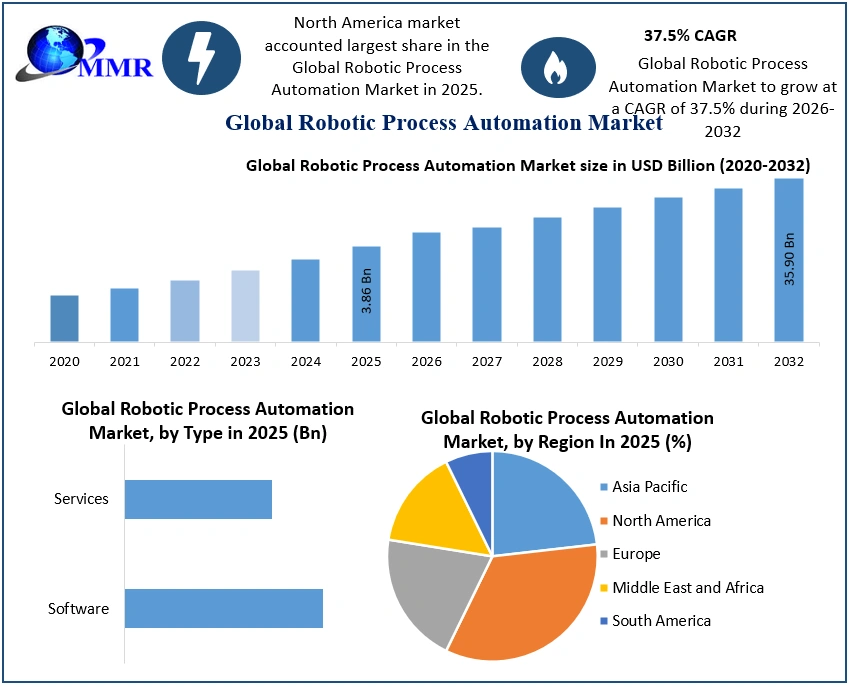
The Robotic Process Automation Market size was valued at USD 3.86 Billion in 2025 and the total Robotic Process Automation revenue is expected to grow at a CAGR of 37.5% from 2025 to 2032, reaching nearly USD 35.90 Billion by 2032.
Robotic Process Automation Market Overview
The Global Robotic Process Automation (RPA) Market was valued at USD 3.86 Billion in 2025 and is expected to reach USD 35.90 Billion by 2032, growing at a CAGR of 37.5%. The RPA market refers to the use of software robots (bots) to automate repetitive, rule-based business processes across industries such as BFSI, healthcare, IT, retail, and manufacturing.
The increasing adoption of business process automation solutions, intelligent automation platforms, and AI-powered RPA software is enabling enterprises to improve efficiency, reduce operational costs by 30–60%, and enhance accuracy. The integration of Artificial Intelligence (AI), Machine Learning (ML), Optical Character Recognition (OCR), and cloud-based RPA platforms is transforming traditional automation into hyperautomation ecosystems, driving enterprise-wide digital transformation.
To know about the Research Methodology:-Request Free Sample Report
Robotic Process Automation Market Dynamics
AI-Driven Trends in the Robotic Process Automation Market
The robotic process automation market is undergoing a significant transformation with the integration of Artificial Intelligence (AI) and intelligent automation technologies, enabling enterprises to move beyond rule-based automation toward cognitive and decision-driven processes. One of the key trends is the rise of AI-powered RPA solutions, where machine learning algorithms enhance bots’ ability to handle unstructured data, enabling use cases such as document processing, fraud detection, and customer service automation.
The adoption of Generative AI in RPA is further accelerating automation capabilities by enabling bots to generate insights, automate communication, and support complex workflows. Enterprises are increasingly investing in hyperautomation strategies, combining RPA with AI, analytics, natural language processing (NLP), and optical character recognition (OCR) to achieve end-to-end business process automation.
Additionally, the emergence of self-learning bots and autonomous enterprise systems is reducing human intervention, improving efficiency by 40–60%, and enhancing scalability across industries such as BFSI, healthcare, retail, and IT. The growing demand for low-code/no-code AI automation platforms is also enabling faster deployment, making AI-driven RPA adoption a critical growth driver in the global automation software market.
Driver: Rising Demand for Business Process Automation and Cost Efficiency
The growing need to automate high-volume, repetitive processes is driving the robotic process automation market growth. Enterprises are deploying RPA bots to handle tasks such as data entry, invoice processing, customer onboarding, and KYC verification, reducing manual errors and improving efficiency. Organizations implementing RPA report 30–50% cost savings and up to 40% reduction in service desk interactions, making RPA a critical component of enterprise automation strategies.
Driver: Integration of AI, Hyperautomation, and Intelligent Automation
The evolution of intelligent automation and hyperautomation is a key trend reshaping the RPA software market. The combination of RPA with AI, analytics, and cognitive technologies enables automation of complex decision-based processes. Enterprises are increasingly adopting AI-powered RPA solutions and low-code/no-code automation platforms, allowing faster deployment and scalability.
Restraint: Implementation Complexity and Organizational Resistance
Despite strong growth, the RPA market faces challenges such as:
- Resistance to change from manual processes
- Concerns over scalability and long-term maintenance
- Integration complexity with legacy IT systems
These factors slow adoption, particularly in traditional industries.
Opportunity: Expansion of Cloud-Based and SME-Focused RPA Solutions
The rise of cloud-based RPA platforms and RPA-as-a-Service (RPAaaS) is creating significant growth opportunities. SMEs are increasingly adopting automation software solutions due to lower upfront costs, scalability, and ease of deployment, expanding the global RPA market penetration.
Machine learning tops AI funding worldwide in 2025
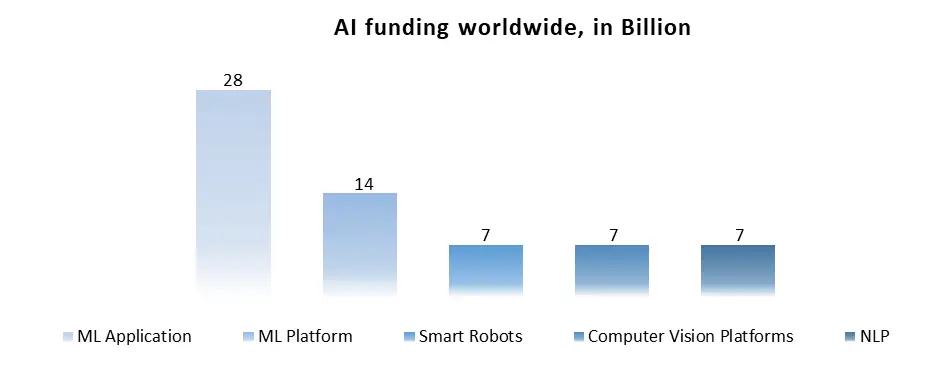
The surge in the demand for automating business processes stands out as a pivotal driver behind the escalating adoption of the Robotic Process Automation (RPA) technology. Notably, businesses are actively selecting RPA solutions that boast advanced features integrated with cutting-edge technologies, particularly Artificial Intelligence (AI). A noteworthy trend within the Robotic Process Automation Market involves strategic collaborations among companies, aimed at delivering enhanced RPA solutions to the market. A case in point is the partnership forged between Google and Automation Anywhere in March 2021, wherein the Automation Anywhere platform became available on Google Cloud. This collaboration not only facilitates mutual AI development but also contributes to the creation of RPA-powered solutions. Such concerted efforts in collaboration have significantly elevated the quality of available RPA solutions, fostering broader adoption within the Robotic Process Automation Market.
The integration of Artificial Intelligence (AI) technology into RPA solutions represents a notable advancement, yielding a spectrum of benefits such as enhanced business results, the creation of novel job roles, improved Return on Investment (ROI), and diminished wage costs. The expanded capabilities of RPA robots extend to the execution of activities across diverse systems, extracting information from digital platforms. In the finance industry, the adoption of RPA facilitates tasks like online account detail checks and Know Your Customer (KYC) verification for bank customers, contributing to reduced manual intervention and an elevated customer experience. Despite the expected substantial growth in the Robotic Process Automation Market during the forecast period, businesses exhibit a discernible reluctance to shift from manual to automated processes. This hesitation is rooted in concerns related to long-term sustainability, the potential amplification of errors, overarching risk considerations, and the ongoing maintenance demands associated with automated systems. While these factors currently impede market growth, the persistent momentum of the digitalization wave is expected to act as a counterforce, gradually alleviating these concerns during the forecast period.
UiPath is the leading force in the Robotic Process Automation (RPA) sector, surpassing Microsoft's market share by a substantial 10-fold margin.
UiPath has established itself as a frontrunner in the Robotic Process Automation (RPA) sector, securing an impressive 35.8% market share, as per MMR's latest Market Share Analysis study. The study underscores UiPath's significant lead in the Robotic Process Automation Market, with no other technology provider holding more than a ten percent share. The report attributes UiPath's market dominance to its robust performance, global brand recognition, an extensive customer and partner ecosystem boasting over 2.5 million members, and its influential narrative on AI-powered automation. UiPath's consistent leadership in the RPA market for the past four years.
In response to UiPath's prominence in the Robotic Process Automation Market, Microsoft has taken strategic measures to narrow the gap, including a 60 percent price reduction for Power Automate Desktop during its recent Microsoft Inspire event. Despite Microsoft's efforts, industry experts like Tim Olsen from Emposo caution that price reductions alone may not revolutionize the market, emphasizing that improvements in functionality are the key driver for market penetration. While acknowledging Microsoft's initiatives, the challenge remains significant, as UiPath continues to benefit from its reputation as the premier provider of a comprehensive business-level automation platform, akin to Salesforce's dominance in the CRM market, as highlighted in MMR's research.
Robotic Process Automation Market Segment Analysis:
Based on Type, the robotic process automation (RPA) service segment is poised to capture the largest market share in 2025 , estimated at 62.3%. This segment encompasses consulting, implementation, and training series, with enterprises witnessing heightened competition leading to continuous improvements by RPAA service providers. The intensifying demand for RPA as a service is propelled by ongoing enhancements in automation services, enabling high scalability and cost reduction. The adoption of RPA as a service facilitates organizations in identifying automation opportunities for optimization, building business cases, and strategically selecting vendors for pilot project deployment. The implementation of RPA as a service not only aids in recognizing automation optimization opportunities but also contributes to cost-effective and agile business operations through the swift automation of manual and back-office processes. RPA services play a pivotal role in enhancing accuracy and reducing the cost associated with establishing a virtual workforce. Market leaders tailor software/platform licenses to meet enterprise business needs and the specific rules required for automating designated processes. A notable development in this landscape occurred in June 2021 when Kofax Inc., a U.S.-based company, acquired PSIGEN Software, Inc., a prominent provider of content management, document capture, and workflow automation software. This strategic acquisition broadens Kofax's intelligent automation platform by integrating PSIGEN's solutions, including the easily deployable content management software, PSIsafe, and robust document capture software, PSIcapture.
Based on Deployment, the on-premises segment is expected to assert its dominance in the Robotic Process Automation Market, securing a substantial share of 78.9% in 2025. On-premise deployment stands out for businesses, providing them with the strategic advantage of aligning RPA access policies with internal protocols, thereby ensuring effective governance of customer RPA systems according to specific requirements. This preference is particularly notable among large-scale enterprises, driven by their heightened concerns about data privacy and security, reinforcing the inclination for on-premise RPA deployment to safeguard critical information.
Simultaneously, the cloud segment in the Robotic Process Automation Market is positioned for significant growth in the forecast period. RPA service providers play a pivotal role in this trajectory by acquiring and converting licenses for clients, facilitating the seamless deployment of RPA bots into processes. This strategic approach ensures immediate operational readiness when clients engage with RPA cloud services. The cloud-based delivery of RPA introduces distinct advantages, including reduced infrastructure costs, automatic upgrades, lower maintenance requirements, and simplified deployment processes, collectively contributing to the expected growth in this dynamic market segment.
Robotic Process Automation Market Regional Analysis
North America hold the highest share in the Robotic Process Automation Market in 2025, accounting for a significant 37.2%. The region is expected to maintain a steady Compound Annual Growth Rate (CAGR) throughout the forecast period. This notable penetration of RPA adoption in North America is primarily driven by the increased uptake among government agencies and enterprises. Furthermore, the implementation of RPA in Small and Medium-sized Enterprises (SMEs) within the North American region is notably focused on enhancing various business functions, including procurement details, data entry, and accounting/finance, contributing substantially to the overall market growth.
Looking towards Asia Pacific, it is expected to exhibit the highest CAGR during the forecast period. This growth is attributed to the rising adoption of RPA across diverse industries such as IT, pharmaceuticals, healthcare, telecom, manufacturing, and retail. RPA vendors are actively pursuing initiatives to attract SMEs on a global scale. For instance, UiPath's partnership with an American-based document workflow automation platform in May 2022 aims to empower SMEs globally in their digital transformation efforts, fostering easier and more efficient operations. These strategic global initiatives are expected to significantly impact countries like India, China, and Japan, ultimately driving the robust growth of the Asia Pacific region in the Robotic Process Automation Market.
Robotic Process Automation Market Scope: Inquire before buying
| Global Robotic Process Automation Market | |||
|---|---|---|---|
| Report Coverage | Details | ||
| Base Year: | 2025 | Forecast Period: | 2026-2032 |
| Historical Data: | 2020 to 2025 | Market Size in 2025: | USD 3.86 Bn. |
| Forecast Period 2026 to 2032 CAGR: | 37.5% | Market Size in 2032: | USD 35.90 Bn. |
| Segments Covered: | by Type | Software Services |
|
| by Operations | Rule Based Knowledge Based |
||
| by Enterprise Size | Large Enterprises Small and Medium Enterprises (SMEs) |
||
| by Deployment | Cloud On-premise |
||
| by Industry | BFSI Telecom & IT Retail and Consumer Goods Manufacturing |
||
Robotic Process Automation Market, by Region:
North America (United States, Canada, and Mexico)
Europe (UK, France, Germany, Italy, Spain, Sweden, Austria, and the Rest of Europe)
Asia Pacific (China, South Korea, Japan, India, Australia, Indonesia, Malaysia, Vietnam, Taiwan, Bangladesh, Pakistan, and the Rest of APAC)
Middle East and Africa (South Africa, GCC, Egypt, Nigeria, and the Rest of ME&A)
South America (Brazil, Argentina Rest of South America)
Robotic Process Automation Market, Key Players:
1. Enterprise RPA Platform Providers
These companies provide end-to-end robotic process automation platforms for enterprise-wide business process automation.
North America
1. UiPath Inc. – United States
2. Automation Anywhere, Inc. – United States
3. Microsoft Corporation – United States
4. Pegasystems Inc. – United States
5. IBM Corporation – United States
Europe
1. SS&C Blue Prism – United Kingdom
2. SAP SE – Germany
Asia Pacific
1. EdgeVerve Systems Limited (Infosys) – India
2. Intelligent Automation & AI-Driven RPA Companies
These companies combine RPA with artificial intelligence, machine learning, and cognitive automation technologies.
North America
1. WorkFusion, Inc. – United States
2. IBM Corporation – United States
3. ServiceNow, Inc. – United States
Europe
1. ABBYY – Germany
2. ElectroNeek – United Kingdom
Asia Pacific
1. Tata Consultancy Services (TCS) – India
2. Wipro Limited – India
3. Business Process Management & Workflow Automation Providers
These companies offer workflow orchestration, low-code automation, and business process management solutions integrated with RPA.
North America
1. Appian Corporation – United States
2. Oracle Corporation – United States
3. Pegasystems Inc. – United States
Europe
1. SAP SE – Germany
Asia Pacific
1. EdgeVerve Systems Limited (Infosys) – India
4. Intelligent Document Processing & Automation Companies
These companies specialize in document capture, intelligent data extraction, and automation of document-centric workflows.
North America
1. Kofax Inc. – United States
2. Automation Anywhere, Inc. – United States
Europe
1. ABBYY – Germany
Asia Pacific
1. Tata Consultancy Services (TCS) – India
5. Hyperautomation & Digital Workforce Solution Providers
These companies deliver integrated automation ecosystems combining RPA, AI, analytics, process mining, and workflow automation.
North America
1. Microsoft Corporation – United States
2. ServiceNow, Inc. – United States
3. NICE Ltd. – Israel/United States
Europe
1. SS&C Blue Prism – United Kingdom
2. SAP SE – Germany
3. ElectroNeek – United Kingdom
Asia Pacific
1. Wipro Limited – India
2. EdgeVerve Systems Limited (Infosys) – India
FAQs:
1. What is a Robotic Process Automation?
Ans: Robotic Process Automation, is a technology that uses software robots, also known as "bots," to automate repetitive, rule-based tasks that are typically performed by humans.
2. What are the types of Robotic Process Automation Market?
Ans: Software and Services.
3. How much does it cost to implement RPA?
Ans: The cost of RPA depends on several factors, including the software licenses, training, consulting services, and internal development resources involved. Generally, it's more cost-effective for large-scale projects with high volumes of repetitive tasks.
4. Is RPA secure?
Ans: RPA security depends on proper implementation and ongoing monitoring. Bots access the same systems and data as humans, so ensuring secure access controls and robust Cybersecurity practices is crucial.
5. How long does it take to implement RPA?
Ans: The time required for RPA implementation varies depending on the complexity of the tasks and the existing IT infrastructure. Simple tasks can be automated in a few weeks, while larger projects may take several months.