Rheumatology Therapeutics Market by Disease Type, Drug Type, Distribution Channel and Region – Global Market Size Estimation, Industry-Wide Analysis, Competitive Landscape Assessment & Long-Term Forecast to 2034

2.7%
CAGR (2026-2034)
51.72 USD Bn.
Forecast Market Size
328
Report Pages
153
Market Tables

Overview

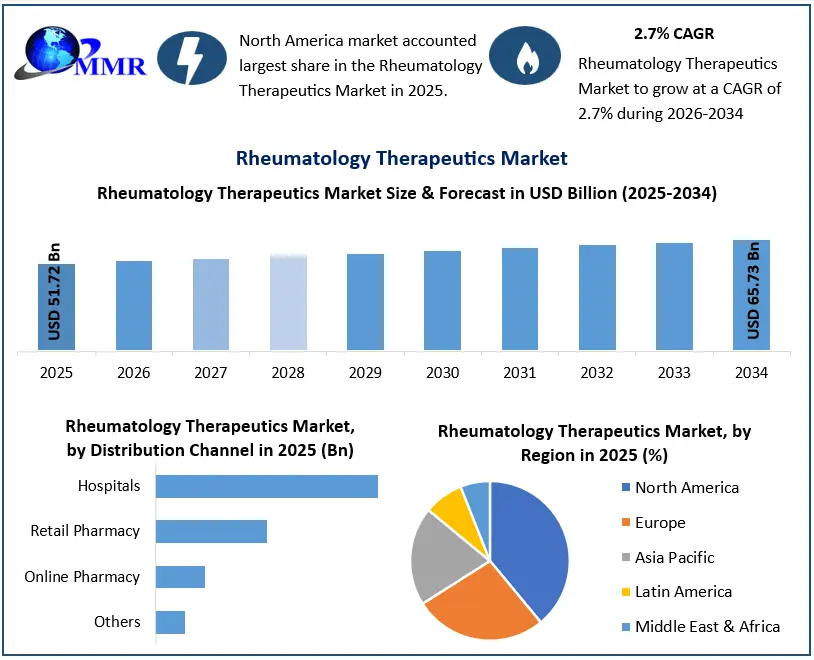
The Global Rheumatology Therapeutics Market was valued at USD 51.72 Billion in 2025 and is projected to reach USD 65.73 Billion by 2034, growing at a CAGR of 2.7% during 2026–2034.

Global Rheumatology Therapeutics Market Overview

Rheumatology Therapeutics refers to medicines and treatment products that are used to manage rheumatic and autoimmune diseases that affect the joints, bones, muscles, and connective tissues. The market comprises conventional medicines, disease-modifying antirheumatic drugs (DMARDs), biologics, biosimilars, targeted therapies, corticosteroids, NSAIDs, and other products to treat rheumatoid arthritis, psoriatic arthritis, osteoarthritis, lupus, and other inflammatory diseases. Growing disease awareness, aging populations, improved diagnostics, and the ongoing development of targeted medicines are driving the market growth. The increased need for long-term disease management is also contributing to the market potential and creating opportunities for pharmaceutical companies.

The Rheumatology Therapeutics Market is driven by the adoption of innovative biologic and targeted therapies, the availability of biosimilars, and improvements in patient diagnosis and treatment. Biopharmaceuticals and biologic therapies are an essential segment of the current market due to the targeted treatment approach for patients with moderate to severe inflammatory conditions. North America has the largest regional market share due to the sophisticated healthcare infrastructure, specialist care, high treatment rates, and greater access to innovative therapies. Europe is a significant market, while the Asia Pacific region has the potential to grow as the healthcare investment, disease awareness, diagnosis rates, and the availability of advanced treatment options continue to improve.

The Rheumatology Therapeutics Market has strong market potential due to continued research, new drug launches, growing use of biologics, and increasing adoption of biosimilars. Pharmaceutical companies are investing in targeted therapies that can provide more focused treatment and improve long-term disease management. The industry also has opportunities to expand treatment access in emerging markets where diagnosis and advanced therapies remain limited. However, high treatment costs, complex approval processes, and differences in healthcare access can create a market gap between advanced therapies and patient availability. These factors are expected to influence the market size, market growth, market share, and market forecast over the coming years.

Rheumatology Therapeutics Market Share Analysis
Rheumatology Therapeutics Market Growth

To know about the Research Methodology :- Request Free Sample Report

Global Rheumatology Therapeutics Market Dynamics

Rising Burden of Rheumatic Diseases Drives Market Growth

An increase in the number of patients diagnosed with rheumatoid arthritis, osteoarthritis, psoriatic arthritis, lupus, or other rheumatic conditions fuels the need for effective therapeutic solutions. The rising awareness about the importance of early diagnosis and disease management encourages patient engagement in the treatment process and regular monitoring of the disease stage. The expanding application of disease-modifying antirheumatic drugs, biologics, targeted therapies, corticosteroids, and other treatments supports the growing treatment demand. Moreover, the aging population and increased access to the care of specialists are key factors contributing to the growth of the Rheumatology Therapeutics Market Size and a positive outlook for the market.

High Treatment Costs and Access Barriers Limit Market Expansion

The high price of biologics, targeted therapies, and other rheumatology treatments can limit the drugs’ adoption in the population with low healthcare coverage. The cost of treatment is considered to be an essential factor affecting the growth of the rheumatology market in developing countries due to the decreased availability of specialist treatment, advanced pharmaceuticals, and reimbursement programs. Additionally, the continuous need for treatment can impose a significant economic burden on the patient and the healthcare system. Therefore, the discrepancy in coverage and access to medicines can create a gap in the market for innovative pharmaceutical companies that target the high-end segment and patients relying on traditional therapies.

Biologics, Biosimilars, and Targeted Therapies Create Market Opportunities

The growing development of biologics, biosimilars, and targeted therapies contributes to an increase in the overall treatment options for patients with rheumatic diseases. Advanced therapeutic solutions targeting specific disease mechanisms can complement the existing treatment options and offer additional hope to patients who are intolerant or unresponsive to conventional treatment options. An increase in the availability of biosimilars opens an opportunity to impact the treatment landscape in different regions. The active involvement of pharmaceutical companies in the development of new molecules, combination treatment options, and therapies for various rheumatic diseases supports the potential for market growth and opportunities for increasing the company’s presence in the market.

Complex Disease Management and Treatment Safety Challenge Market Development

The chronic nature of most rheumatic diseases and the requirement for continuous treatment course and disease monitoring pose a challenge to the management of these diseases. Variations in disease presentation, individual response to therapy and adverse event profile, and patient tolerability contribute to the complexity of treatment selection and ongoing disease management. Newer treatment options often require careful handling due to the need for special precautions and safety monitoring. Limited availability of rheumatology specialists and comprehensive treatment services in different geographic regions impacts the ability to expand the treatment offerings and ensure continued access to care. As a result, companies must address the issue of treatment safety and support the development of the relevant clinical evidence to strengthen the position of the company on the market. At the same time, providing affordable and accessible treatment options with appropriate monitoring and support services will be critical to impacting the high unmet need and promoting market growth.

Global Rheumatology Therapeutics Market Segment Analysis

By Disease Type, Rheumatoid Arthritis accounts for the largest share in the list of diseases featured by the report due to the significant need in disease management on a long-term basis and the common use of disease-modifying drugs, biologics and targeted therapies. Osteoarthritis is also represented by a considerable segment due to the number of patients and the need in managing the pain and inflammation. Lupus, Ankylosing Spondylitis and Gout have moderate shares due to the rising number of diagnosed cases and the use of specific treatments. The Other’s category also comprises a number of rheumatic and autoimmune diseases that can be addressed by pharmaceutical companies.

Rheumatology Therapeutics Market by Disease TypeBy Drug Type, Disease Modifying Anti-Rheumatic Drugs (DMARDs) have the largest share due to the significant role they play in managing the development of inflammatory rheumatic diseases and addressing their gradually progressive nature. Non-Steroidal Anti-Inflammatory Drugs (NSAIDs) and Analgesics are commonly used due to their proven effectiveness and affordability. Corticosteroids are used when a more aggressive reduction of inflammation is needed. Uric Acid therapeutics are specifically used for the management of gout, Whilst Other’s category comprises a number of different drugs used for treating various rheumatic conditions. The growing emphasis on developing targeted and disease-modifying drugs and therapeutics is expected to create new opportunities in the market.

Rheumatology Therapeutics Market by, Drug Type

Global Rheumatology Therapeutics Market Regional Insights

North America has the largest share in the Global Rheumatology Therapeutics Market due to the developed healthcare system, high levels of specialist care, an extended use of biologics and targeted therapies and well-established reimbursement mechanisms. Another significant region is Europe, which is characterized by a high level of rheumatology treatment and the growing use of advanced and bio-similar treatments. Asia Pacific is a region with a great market potential due to a large patient base, developing healthcare systems and an increasing emphasis on managing diseases on a long-term basis. South America, the Middle East and Africa comprise a small segment, but have the potential to grow due to the need in advanced diagnostic tools, therapies and treatments.

Key players operating in this market are Abbvie, Inc., Bristol-Myers Squibb Company, Pfizer, Inc., Merck & Co., Inc., Amgen, Inc., Novartis AG, Janssen Biotech, Inc., Sanofi, Genentech, Inc., and Takeda Pharmaceutical. Among them, the companies such as AbbVie, Inc. These players are adopting various organic and inorganic growth strategies such as merger & acquisition, Joint ventures, expansion, strategic alliances, new product launches etc. to enhance their regional presence and business operation.

The objective of the report is to present a comprehensive analysis of Global Rheumatology Therapeutics Market including all the stakeholders of the industry. The past and current status of the industry with forecasted market size and trends are presented in the report with the analysis of complicated data in simple language. The report covers all aspects of the industry with a dedicated study of key players that includes market leaders, followers and new entrants by region.

PORTER, SVOR, PESTEL analysis with the potential impact of micro-economic factors by region on the market are presented in the report. External as well as internal factors that are supposed to affect the business positively or negatively have been analysed, which will give a clear futuristic view of the industry to the decision-makers. The report also helps in understanding Global Rheumatology Therapeutics Market dynamics, structure by analysing the market segments and project the Global Market size. Clear representation of competitive analysis of key players By Type, Price, Financial position, Product Portfolio, Growth strategies, and Regional presence in the Global Rheumatology Therapeutics Market make the report investor’s guide.

Rheumatology Therapeutics Market Recent Development

Date Company Development Impact
30 January 2025 Celltrion The U.S. FDA approved AVTOZMA (tocilizumab-anoh) in both intravenous and subcutaneous formulations as a biosimilar referencing ACTEMRA for moderate-to-severe rheumatoid arthritis. Expands global market competition for IL-6 receptor antagonists and increases access to cost-effective targeted biologic therapies for adult rheumatology care.
16 February 2025 Bio-Thera Solutions Bio-Thera Solutions partnered with Intas Pharmaceuticals in an exclusive license agreement for BAT2506, a proposed biosimilar to Simponi (golimumab). Accelerates commercial supply and global distribution footprint for anti-TNF alpha therapies across target autoimmune disease indications.
06 August 2025 SetPoint Medical The U.S. FDA granted approval for The SetPoint System, marking the first bioelectronic neurostimulation implant authorized to treat moderate-to-severe rheumatoid arthritis. Establishes a non-pharmacological, targeted neural-modulation treatment class to lower persistent systemic inflammation in biologic-refractory patients.
15 May 2026 Accord BioPharma The U.S. FDA approved Immgolis and Immgolis Intri (golimumab-sldi) as the first interchangeable biosimilars to Simponi and Simponi Aria for moderate-to-severe rheumatoid arthritis. Unlocks pharmacy-level substitution rights for TNF-alpha inhibitor therapeutics, creating cost efficiencies across chronic healthcare distribution channels.

Rheumatology Therapeutics Market Scope: Inquire before buying

Global Rheumatology Therapeutics Market
Report Coverage Details
Base Year: 2025 Forecast Period: 2026-2034
Historical Data: 2020 to 2025 Market Size in 2025: USD 51.72 Bn.
Forecast Period 2026 to 2034 CAGR: 2.7% Market Size in 2034: USD 65.73 Bn.
Segments Covered: by Disease Type Rheumatoid Arthritis
Ankylosing Spondylitis
Osteoarthritis
Lupus
Gout
Others
by Drug Type Non-Steroidal Anti-Inflammatory Drugs (NSAIDs)
Analgesics
Disease Modifying Anti-Rheumatic Drugs (DMARDs)
Corticosteroids
Uric Acid
Others
by Distribution Channel Retail Pharmacy
Online Pharmacy
Hospitals
Others

Rheumatology Therapeutics Market, by Region

North America (United States, Canada and Mexico)
Europe (UK, France, Germany, Italy, Spain, Sweden, Austria and Rest of Europe)
Asia Pacific (China, South Korea, Japan, India, Australia, Indonesia, Malaysia, Vietnam, Taiwan, Bangladesh, Pakistan and Rest of APAC)
Middle East and Africa (South Africa, GCC, Egypt, Nigeria and Rest of ME&A)
South America (Brazil, Argentina Rest of South America)

Rheumatology Therapeutics Market Key Players

1. Abbvie, Inc.
2. Bristol-Myers Squibb Company,
3. Pfizer, Inc.
4. Merck & Co., Inc.
5. Amgen, Inc.
6. Novartis AG
7. Janssen Biotech, Inc.
8. Sanofi
9. Genentech, Inc.
10.Takeda Pharmaceutical
11.Johnson & Johnson Private Limited
12.F. Hoffmann-La Roche Ltd
13.UCB S.A.
14.Gilead Sciences, Inc.
15.Boehringer Ingelheim International GmbH
16.Regeneron Pharmaceuticals Inc.

Frequently Asked Questions:

1. Which region has the largest share in Global Rheumatology Therapeutics Market?
Ans: North America region held the highest share in 2025.

2. What is the growth rate of Global Rheumatology Therapeutics Market?
Ans: The Global Rheumatology Therapeutics Market is growing at a CAGR of 2.7% during forecasting period 2026-2034.

3. What is scope of the Global Rheumatology Therapeutics market report?
Ans: Global Rheumatology Therapeutics Market report helps with the PESTEL, PORTER, Recommendations for Investors & Leaders, and market estimation of the forecast period.

4. Who are the key players in Global Rheumatology Therapeutics market?
Ans: The important key players in the Global Rheumatology Therapeutics Market are – Abbvie, Inc., Bristol-Myers Squibb Company,, Pfizer, Inc., Merck & Co., Inc., Amgen, Inc., Novartis AG, Janssen Biotech, Inc., Sanofi, Genentech, Inc., Takeda Pharmaceutical, Johnson & Johnson Private Limited, F. Hoffmann-La Roche Ltd, UCB S.A., Gilead Sciences, Inc., Boehringer Ingelheim International GmbH, and Regeneron Pharmaceuticals Inc.

5. What is the study period of this market?
Ans: The Global Rheumatology Therapeutics Market is studied from 2020 to 2034.

Table of Contents

1. Rheumatology Therapeutics Market Introduction 1.1. Study Assumption and Market Definition 1.2. Scope of the Study 1.3. Executive Summary 2. Global Rheumatology Therapeutics Market: Competitive Landscape 2.1. MMR Competition Matrix 2.2. Competitive Landscape 2.3. Key Players Benchmarking 2.3.1. Company Name 2.3.2. Business Segment 2.3.3. End-user Segment 2.3.4. Revenue (2025) 2.3.5. Company Locations 2.4. Leading Rheumatology Therapeutics Market Companies, by market capitalization 2.5. Market Structure 2.5.1. Market Leaders 2.5.2. Market Followers 2.5.3. Emerging Players 2.6. Mergers and Acquisitions Details 3. Rheumatology Therapeutics Market: Dynamics 3.1. Rheumatology Therapeutics Market Trends by Region 3.1.1. North America Rheumatology Therapeutics Market Trends 3.1.2. Europe Rheumatology Therapeutics Market Trends 3.1.3. Asia Pacific Rheumatology Therapeutics Market Trends 3.1.4. Middle East and Africa Rheumatology Therapeutics Market Trends 3.1.5. South America Rheumatology Therapeutics Market Trends 3.2. Rheumatology Therapeutics Market Dynamics by Region 3.2.1. North America 3.2.1.1. North America Rheumatology Therapeutics Market Drivers 3.2.1.2. North America Rheumatology Therapeutics Market Restraints 3.2.1.3. North America Rheumatology Therapeutics Market Opportunities 3.2.1.4. North America Rheumatology Therapeutics Market Challenges 3.2.2. Europe 3.2.2.1. Europe Rheumatology Therapeutics Market Drivers 3.2.2.2. Europe Rheumatology Therapeutics Market Restraints 3.2.2.3. Europe Rheumatology Therapeutics Market Opportunities 3.2.2.4. Europe Rheumatology Therapeutics Market Challenges 3.2.3. Asia Pacific 3.2.3.1. Asia Pacific Rheumatology Therapeutics Market Drivers 3.2.3.2. Asia Pacific Rheumatology Therapeutics Market Restraints 3.2.3.3. Asia Pacific Rheumatology Therapeutics Market Opportunities 3.2.3.4. Asia Pacific Rheumatology Therapeutics Market Challenges 3.2.4. Middle East and Africa 3.2.4.1. Middle East and Africa Rheumatology Therapeutics Market Drivers 3.2.4.2. Middle East and Africa Rheumatology Therapeutics Market Restraints 3.2.4.3. Middle East and Africa Rheumatology Therapeutics Market Opportunities 3.2.4.4. Middle East and Africa Rheumatology Therapeutics Market Challenges 3.2.5. South America 3.2.5.1. South America Rheumatology Therapeutics Market Drivers 3.2.5.2. South America Rheumatology Therapeutics Market Restraints 3.2.5.3. South America Rheumatology Therapeutics Market Opportunities 3.2.5.4. South America Rheumatology Therapeutics Market Challenges 3.3. PORTER's Five Forces Analysis 3.4. PESTLE Analysis 3.5. Technology Roadmap 3.6. Regulatory Landscape by Region 3.6.1. North America 3.6.2. Europe 3.6.3. Asia Pacific 3.6.4. Middle East and Africa 3.6.5. South America 3.7. Key Opinion Leader Analysis For Rheumatology Therapeutics Industry 3.8. Analysis of Government Schemes and Initiatives For Rheumatology Therapeutics Industry 3.9. Rheumatology Therapeutics Market Trade Analysis 3.10. The Global Pandemic Impact on Rheumatology Therapeutics Market 4. Rheumatology Therapeutics Market: Global Market Size and Forecast by Segmentation (in USD Billion) 2025-2034 4.1. Rheumatology Therapeutics Market Size and Forecast, by Disease Type (2025-2034) 4.1.1. Rheumatoid Arthritis 4.1.2. Ankylosing Spondylitis 4.1.3. Osteoarthritis 4.1.4. Lupus 4.1.5. Gout 4.1.6. Others 4.2. Rheumatology Therapeutics Market Size and Forecast, by Drug Type (2025-2034) 4.2.1. Non-Steroidal Anti-Inflammatory Drugs (NSAIDs) 4.2.2. Analgesics 4.2.3. Disease Modifying Anti-Rheumatic Drugs (DMARDs) 4.2.4. Corticosteroids 4.2.5. Uric Acid 4.2.6. Others 4.3. Rheumatology Therapeutics Market Size and Forecast, by Distribution Channel (2025-2034) 4.3.1. Retail Pharmacy 4.3.2. Online Pharmacy 4.3.3. Hospitals 4.3.4. Others 4.4. Rheumatology Therapeutics Market Size and Forecast, by Region (2025-2034) 4.4.1. North America 4.4.2. Europe 4.4.3. Asia Pacific 4.4.4. Middle East and Africa 4.4.5. South America 5. North America Rheumatology Therapeutics Market Size and Forecast by Segmentation (in USD Billion) 2025-2034 5.1. North America Rheumatology Therapeutics Market Size and Forecast, by Disease Type (2025-2034) 5.1.1. Rheumatoid Arthritis 5.1.2. Ankylosing Spondylitis 5.1.3. Osteoarthritis 5.1.4. Lupus 5.1.5. Gout 5.1.6. Others 5.2. North America Rheumatology Therapeutics Market Size and Forecast, by Drug Type (2025-2034) 5.2.1. Non-Steroidal Anti-Inflammatory Drugs (NSAIDs) 5.2.2. Analgesics 5.2.3. Disease Modifying Anti-Rheumatic Drugs (DMARDs) 5.2.4. Corticosteroids 5.2.5. Uric Acid 5.2.6. Others 5.3. North America Rheumatology Therapeutics Market Size and Forecast, by Distribution Channel (2025-2034) 5.3.1. Retail Pharmacy 5.3.2. Online Pharmacy 5.3.3. Hospitals 5.3.4. Others 5.4. North America Rheumatology Therapeutics Market Size and Forecast, by Country (2025-2034) 5.4.1. United States 5.4.1.1. United States Rheumatology Therapeutics Market Size and Forecast, by Disease Type (2025-2034) 5.4.1.1.1. Rheumatoid Arthritis 5.4.1.1.2. Ankylosing Spondylitis 5.4.1.1.3. Osteoarthritis 5.4.1.1.4. Lupus 5.4.1.1.5. Gout 5.4.1.1.6. Others 5.4.1.2. United States Rheumatology Therapeutics Market Size and Forecast, by Drug Type (2025-2034) 5.4.1.2.1. Non-Steroidal Anti-Inflammatory Drugs (NSAIDs) 5.4.1.2.2. Analgesics 5.4.1.2.3. Disease Modifying Anti-Rheumatic Drugs (DMARDs) 5.4.1.2.4. Corticosteroids 5.4.1.2.5. Uric Acid 5.4.1.2.6. Others 5.4.1.3. United States Rheumatology Therapeutics Market Size and Forecast, by Distribution Channel (2025-2034) 5.4.1.3.1. Retail Pharmacy 5.4.1.3.2. Online Pharmacy 5.4.1.3.3. Hospitals 5.4.1.3.4. Others 5.4.2. Canada 5.4.2.1. Canada Rheumatology Therapeutics Market Size and Forecast, by Disease Type (2025-2034) 5.4.2.1.1. Rheumatoid Arthritis 5.4.2.1.2. Ankylosing Spondylitis 5.4.2.1.3. Osteoarthritis 5.4.2.1.4. Lupus 5.4.2.1.5. Gout 5.4.2.1.6. Others 5.4.2.2. Canada Rheumatology Therapeutics Market Size and Forecast, by Drug Type (2025-2034) 5.4.2.2.1. Non-Steroidal Anti-Inflammatory Drugs (NSAIDs) 5.4.2.2.2. Analgesics 5.4.2.2.3. Disease Modifying Anti-Rheumatic Drugs (DMARDs) 5.4.2.2.4. Corticosteroids 5.4.2.2.5. Uric Acid 5.4.2.2.6. Others 5.4.2.3. Canada Rheumatology Therapeutics Market Size and Forecast, by Distribution Channel (2025-2034) 5.4.2.3.1. Retail Pharmacy 5.4.2.3.2. Online Pharmacy 5.4.2.3.3. Hospitals 5.4.2.3.4. Others 5.4.3. Mexico 5.4.3.1. Mexico Rheumatology Therapeutics Market Size and Forecast, by Disease Type (2025-2034) 5.4.3.1.1. Rheumatoid Arthritis 5.4.3.1.2. Ankylosing Spondylitis 5.4.3.1.3. Osteoarthritis 5.4.3.1.4. Lupus 5.4.3.1.5. Gout 5.4.3.1.6. Others 5.4.3.2. Mexico Rheumatology Therapeutics Market Size and Forecast, by Drug Type (2025-2034) 5.4.3.2.1. Non-Steroidal Anti-Inflammatory Drugs (NSAIDs) 5.4.3.2.2. Analgesics 5.4.3.2.3. Disease Modifying Anti-Rheumatic Drugs (DMARDs) 5.4.3.2.4. Corticosteroids 5.4.3.2.5. Uric Acid 5.4.3.2.6. Others 5.4.3.3. Mexico Rheumatology Therapeutics Market Size and Forecast, by Distribution Channel (2025-2034) 5.4.3.3.1. Retail Pharmacy 5.4.3.3.2. Online Pharmacy 5.4.3.3.3. Hospitals 5.4.3.3.4. Others 6. Europe Rheumatology Therapeutics Market Size and Forecast by Segmentation (in USD Billion) 2025-2034 6.1. Europe Rheumatology Therapeutics Market Size and Forecast, by Disease Type (2025-2034) 6.2. Europe Rheumatology Therapeutics Market Size and Forecast, by Drug Type (2025-2034) 6.3. Europe Rheumatology Therapeutics Market Size and Forecast, by Distribution Channel (2025-2034) 6.4. Europe Rheumatology Therapeutics Market Size and Forecast, by Country (2025-2034) 6.4.1. United Kingdom 6.4.1.1. United Kingdom Rheumatology Therapeutics Market Size and Forecast, by Disease Type (2025-2034) 6.4.1.2. United Kingdom Rheumatology Therapeutics Market Size and Forecast, by Drug Type (2025-2034) 6.4.1.3. United Kingdom Rheumatology Therapeutics Market Size and Forecast, by Distribution Channel (2025-2034) 6.4.2. France 6.4.2.1. France Rheumatology Therapeutics Market Size and Forecast, by Disease Type (2025-2034) 6.4.2.2. France Rheumatology Therapeutics Market Size and Forecast, by Drug Type (2025-2034) 6.4.2.3. France Rheumatology Therapeutics Market Size and Forecast, by Distribution Channel (2025-2034) 6.4.3. Germany 6.4.3.1. Germany Rheumatology Therapeutics Market Size and Forecast, by Disease Type (2025-2034) 6.4.3.2. Germany Rheumatology Therapeutics Market Size and Forecast, by Drug Type (2025-2034) 6.4.3.3. Germany Rheumatology Therapeutics Market Size and Forecast, by Distribution Channel (2025-2034) 6.4.4. Italy 6.4.4.1. Italy Rheumatology Therapeutics Market Size and Forecast, by Disease Type (2025-2034) 6.4.4.2. Italy Rheumatology Therapeutics Market Size and Forecast, by Drug Type (2025-2034) 6.4.4.3. Italy Rheumatology Therapeutics Market Size and Forecast, by Distribution Channel (2025-2034) 6.4.5. Spain 6.4.5.1. Spain Rheumatology Therapeutics Market Size and Forecast, by Disease Type (2025-2034) 6.4.5.2. Spain Rheumatology Therapeutics Market Size and Forecast, by Drug Type (2025-2034) 6.4.5.3. Spain Rheumatology Therapeutics Market Size and Forecast, by Distribution Channel (2025-2034) 6.4.6. Sweden 6.4.6.1. Sweden Rheumatology Therapeutics Market Size and Forecast, by Disease Type (2025-2034) 6.4.6.2. Sweden Rheumatology Therapeutics Market Size and Forecast, by Drug Type (2025-2034) 6.4.6.3. Sweden Rheumatology Therapeutics Market Size and Forecast, by Distribution Channel (2025-2034) 6.4.7. Austria 6.4.7.1. Austria Rheumatology Therapeutics Market Size and Forecast, by Disease Type (2025-2034) 6.4.7.2. Austria Rheumatology Therapeutics Market Size and Forecast, by Drug Type (2025-2034) 6.4.7.3. Austria Rheumatology Therapeutics Market Size and Forecast, by Distribution Channel (2025-2034) 6.4.8. Rest of Europe 6.4.8.1. Rest of Europe Rheumatology Therapeutics Market Size and Forecast, by Disease Type (2025-2034) 6.4.8.2. Rest of Europe Rheumatology Therapeutics Market Size and Forecast, by Drug Type (2025-2034) 6.4.8.3. Rest of Europe Rheumatology Therapeutics Market Size and Forecast, by Distribution Channel (2025-2034) 7. Asia Pacific Rheumatology Therapeutics Market Size and Forecast by Segmentation (in USD Billion) 2025-2034 7.1. Asia Pacific Rheumatology Therapeutics Market Size and Forecast, by Disease Type (2025-2034) 7.2. Asia Pacific Rheumatology Therapeutics Market Size and Forecast, by Drug Type (2025-2034) 7.3. Asia Pacific Rheumatology Therapeutics Market Size and Forecast, by Distribution Channel (2025-2034) 7.4. Asia Pacific Rheumatology Therapeutics Market Size and Forecast, by Country (2025-2034) 7.4.1. China 7.4.1.1. China Rheumatology Therapeutics Market Size and Forecast, by Disease Type (2025-2034) 7.4.1.2. China Rheumatology Therapeutics Market Size and Forecast, by Drug Type (2025-2034) 7.4.1.3. China Rheumatology Therapeutics Market Size and Forecast, by Distribution Channel (2025-2034) 7.4.2. S Korea 7.4.2.1. S Korea Rheumatology Therapeutics Market Size and Forecast, by Disease Type (2025-2034) 7.4.2.2. S Korea Rheumatology Therapeutics Market Size and Forecast, by Drug Type (2025-2034) 7.4.2.3. S Korea Rheumatology Therapeutics Market Size and Forecast, by Distribution Channel (2025-2034) 7.4.3. Japan 7.4.3.1. Japan Rheumatology Therapeutics Market Size and Forecast, by Disease Type (2025-2034) 7.4.3.2. Japan Rheumatology Therapeutics Market Size and Forecast, by Drug Type (2025-2034) 7.4.3.3. Japan Rheumatology Therapeutics Market Size and Forecast, by Distribution Channel (2025-2034) 7.4.4. India 7.4.4.1. India Rheumatology Therapeutics Market Size and Forecast, by Disease Type (2025-2034) 7.4.4.2. India Rheumatology Therapeutics Market Size and Forecast, by Drug Type (2025-2034) 7.4.4.3. India Rheumatology Therapeutics Market Size and Forecast, by Distribution Channel (2025-2034) 7.4.5. Australia 7.4.5.1. Australia Rheumatology Therapeutics Market Size and Forecast, by Disease Type (2025-2034) 7.4.5.2. Australia Rheumatology Therapeutics Market Size and Forecast, by Drug Type (2025-2034) 7.4.5.3. Australia Rheumatology Therapeutics Market Size and Forecast, by Distribution Channel (2025-2034) 7.4.6. Indonesia 7.4.6.1. Indonesia Rheumatology Therapeutics Market Size and Forecast, by Disease Type (2025-2034) 7.4.6.2. Indonesia Rheumatology Therapeutics Market Size and Forecast, by Drug Type (2025-2034) 7.4.6.3. Indonesia Rheumatology Therapeutics Market Size and Forecast, by Distribution Channel (2025-2034) 7.4.7. Malaysia 7.4.7.1. Malaysia Rheumatology Therapeutics Market Size and Forecast, by Disease Type (2025-2034) 7.4.7.2. Malaysia Rheumatology Therapeutics Market Size and Forecast, by Drug Type (2025-2034) 7.4.7.3. Malaysia Rheumatology Therapeutics Market Size and Forecast, by Distribution Channel (2025-2034) 7.4.8. Vietnam 7.4.8.1. Vietnam Rheumatology Therapeutics Market Size and Forecast, by Disease Type (2025-2034) 7.4.8.2. Vietnam Rheumatology Therapeutics Market Size and Forecast, by Drug Type (2025-2034) 7.4.8.3. Vietnam Rheumatology Therapeutics Market Size and Forecast, by Distribution Channel (2025-2034) 7.4.9. Taiwan 7.4.9.1. Taiwan Rheumatology Therapeutics Market Size and Forecast, by Disease Type (2025-2034) 7.4.9.2. Taiwan Rheumatology Therapeutics Market Size and Forecast, by Drug Type (2025-2034) 7.4.9.3. Taiwan Rheumatology Therapeutics Market Size and Forecast, by Distribution Channel (2025-2034) 7.4.10. Rest of Asia Pacific 7.4.10.1. Rest of Asia Pacific Rheumatology Therapeutics Market Size and Forecast, by Disease Type (2025-2034) 7.4.10.2. Rest of Asia Pacific Rheumatology Therapeutics Market Size and Forecast, by Drug Type (2025-2034) 7.4.10.3. Rest of Asia Pacific Rheumatology Therapeutics Market Size and Forecast, by Distribution Channel (2025-2034) 8. Middle East and Africa Rheumatology Therapeutics Market Size and Forecast by Segmentation (in USD Billion) 2025-2034 8.1. Middle East and Africa Rheumatology Therapeutics Market Size and Forecast, by Disease Type (2025-2034) 8.2. Middle East and Africa Rheumatology Therapeutics Market Size and Forecast, by Drug Type (2025-2034) 8.3. Middle East and Africa Rheumatology Therapeutics Market Size and Forecast, by Distribution Channel (2025-2034) 8.4. Middle East and Africa Rheumatology Therapeutics Market Size and Forecast, by Country (2025-2034) 8.4.1. South Africa 8.4.1.1. South Africa Rheumatology Therapeutics Market Size and Forecast, by Disease Type (2025-2034) 8.4.1.2. South Africa Rheumatology Therapeutics Market Size and Forecast, by Drug Type (2025-2034) 8.4.1.3. South Africa Rheumatology Therapeutics Market Size and Forecast, by Distribution Channel (2025-2034) 8.4.2. GCC 8.4.2.1. GCC Rheumatology Therapeutics Market Size and Forecast, by Disease Type (2025-2034) 8.4.2.2. GCC Rheumatology Therapeutics Market Size and Forecast, by Drug Type (2025-2034) 8.4.2.3. GCC Rheumatology Therapeutics Market Size and Forecast, by Distribution Channel (2025-2034) 8.4.3. Nigeria 8.4.3.1. Nigeria Rheumatology Therapeutics Market Size and Forecast, by Disease Type (2025-2034) 8.4.3.2. Nigeria Rheumatology Therapeutics Market Size and Forecast, by Drug Type (2025-2034) 8.4.3.3. Nigeria Rheumatology Therapeutics Market Size and Forecast, by Distribution Channel (2025-2034) 8.4.4. Rest of ME&A 8.4.4.1. Rest of ME&A Rheumatology Therapeutics Market Size and Forecast, by Disease Type (2025-2034) 8.4.4.2. Rest of ME&A Rheumatology Therapeutics Market Size and Forecast, by Drug Type (2025-2034) 8.4.4.3. Rest of ME&A Rheumatology Therapeutics Market Size and Forecast, by Distribution Channel (2025-2034) 9. South America Rheumatology Therapeutics Market Size and Forecast by Segmentation (in USD Billion) 2025-2034 9.1. South America Rheumatology Therapeutics Market Size and Forecast, by Disease Type (2025-2034) 9.2. South America Rheumatology Therapeutics Market Size and Forecast, by Drug Type (2025-2034) 9.3. South America Rheumatology Therapeutics Market Size and Forecast, by Distribution Channel (2025-2034) 9.4. South America Rheumatology Therapeutics Market Size and Forecast, by Country (2025-2034) 9.4.1. Brazil 9.4.1.1. Brazil Rheumatology Therapeutics Market Size and Forecast, by Disease Type (2025-2034) 9.4.1.2. Brazil Rheumatology Therapeutics Market Size and Forecast, by Drug Type (2025-2034) 9.4.1.3. Brazil Rheumatology Therapeutics Market Size and Forecast, by Distribution Channel (2025-2034) 9.4.2. Argentina 9.4.2.1. Argentina Rheumatology Therapeutics Market Size and Forecast, by Disease Type (2025-2034) 9.4.2.2. Argentina Rheumatology Therapeutics Market Size and Forecast, by Drug Type (2025-2034) 9.4.2.3. Argentina Rheumatology Therapeutics Market Size and Forecast, by Distribution Channel (2025-2034) 9.4.3. Rest Of South America 9.4.3.1. Rest Of South America Rheumatology Therapeutics Market Size and Forecast, by Disease Type (2025-2034) 9.4.3.2. Rest Of South America Rheumatology Therapeutics Market Size and Forecast, by Drug Type (2025-2034) 9.4.3.3. Rest Of South America Rheumatology Therapeutics Market Size and Forecast, by Distribution Channel (2025-2034) 10. Company Profile: Key Players 10.1. Abbvie, Inc. 10.1.1. Company Overview 10.1.2. Business Portfolio 10.1.3. Financial Overview 10.1.4. SWOT Analysis 10.1.5. Strategic Analysis 10.1.6. Scale of Operation (small, medium, and large) 10.1.7. Details on Partnership 10.1.8. Regulatory Accreditations and Certifications Received by Them 10.1.9. Awards Received by the Firm 10.1.10. Recent Developments 10.2. Bristol-Myers Squibb Company, 10.3. Pfizer, Inc. 10.4. Merck & Co., Inc. 10.5. Amgen, Inc. 10.6. Novartis AG 10.7. Janssen Biotech, Inc. 10.8. Sanofi 10.9. Genentech, Inc. 10.10. Takeda Pharmaceutical 10.11. Johnson & Johnson Private Limited 10.12. F. Hoffmann-La Roche Ltd 10.13. UCB S.A. 10.14. Gilead Sciences, Inc. 10.15. Boehringer Ingelheim International GmbH 10.16. Regeneron Pharmaceuticals Inc. 11. Key Findings 12. Industry Recommendations 13. Rheumatology Therapeutics Market: Research Methodology 14. Terms and Glossary

Custom Market Research Services

We Will Customise The Research For You, In Case The Report Listed Above Does Not Meet With Your Requirements