
Revenue Cycle Management Market – Industry Structure Evaluation, Demand Drivers Analysis, Regional Growth Analysis and Identification, Competitive Positioning Review & Global Market Size Forecast to 2032
Overview
The Revenue Cycle Management Market size was valued at USD 654.77 Billion in 2025 and the total Revenue Cycle Management revenue is expected to grow at a CAGR of 45.8% from 2026 to 2032, reaching nearly USD 9170.47 Billion.
Revenue Cycle Management Market Overview:
The Revenue cycle management, which encompasses all clinical and administrative activities related to generating and collecting patient revenue, has grown in importance in today's competitive environment, as hospitals face stricter regulations and invoicing requirements, underpayments, and longer payment delays. Notwithstanding practitioners continuous interest, revenue cycle management has gained little attention in health care finance research. All clinical and administrative operations connected to the development, management, and collection of patient care revenue are included in hospital revenue cycle management. Although previously focused on back-end tasks such as payments and collections, clinic financial managers have recently shifted their focus to the front end of the revenue cycle, such as patient registration and filing, insurance verification, and prior authorization, as well as core revenue cycle tasks such as medical documentation and coding.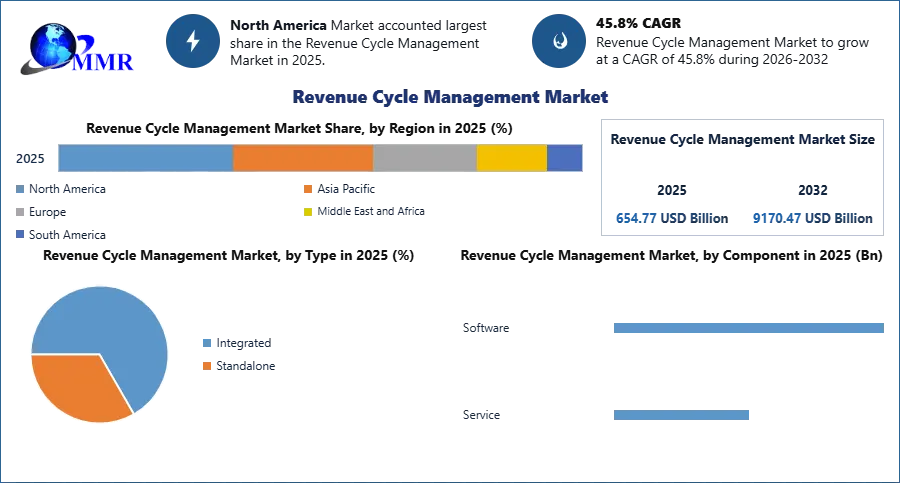 To know about the Research Methodology :- Request Free Sample Report
The bottom-up approach has been used to estimate the market size. Key Players in the Revenue Cycle Management market are identified through secondary research and their market revenues are determined through primary and secondary research. Secondary research included a review of annual and financial reports of leading manufacturers, while primary research included interviews with important opinion leaders and industry experts such as skilled front-line personnel, entrepreneurs, and marketing professionals. Some of the leading key players in the global Revenue Cycle Management market include Epic Systems Corporation, NXGN Management, LLC, CareCloud Corporation, and Quest Diagnostics, Inc.
Revenue Cycle Management Market Dynamics
The implementation of the R1 Professional revenue cycle management solution offers healthcare facilities and various stakeholders the capability to establish a standardized strategy for reimbursement and operations models within the Revenue Cycle Management (RCM) framework. Innovations in RCM solutions have been instrumental in advancing provider-patient relations, notably through the implementation of ICD-10 for classifying, coding, and reporting data on disease diagnosis and treatment procedures. This strategic integration directly contributes to healthcare systems enhancing care delivery. Recognizing the multiple advantages associated with outsourcing RCM software solutions, healthcare facilities are increasingly leveraging this approach. The benefits include easy access to trained professionals, compliance with required regulations, heightened efficiency, and cost-effectiveness.
The growing adoption trend is poised to drive Revenue Cycle Management Market growth during the forecast period. However, challenges persist in adopting and implementing RCM software solutions, particularly concerning the lack of proper reimbursement regulations related to insurance and other formalities. Existing policy gaps between public and private insurers present a notable constraint, impeding the growth potential of the Revenue Cycle Management Market.
The proliferation of hospitals is exerting a positive influence on the Revenue Cycle Management (RCM) Market in multiple ways. The growing number of healthcare facilities results in an expanded volume of healthcare services, generating a higher frequency of transactions and billing processes. This increased activity creates a favorable environment for the growth of the RCM market. The expanding hospital landscape also brings forth heightened regulatory and compliance challenges, driving the demand for robust RCM solutions to ensure adherence to evolving healthcare policies. The increasing presence of hospitals contributes to the expansion and innovation within the RCM market, enhancing its capabilities to meet the evolving needs of the healthcare industry.
Revenue Cycle Management Market Segment Analysis
The Software segment is estimated to grab larger market attention in the Revenue Cycle Management Market.
The software category dominated the revenue cycle management market in 2025, as a result of the digitalization of processes and streamlining for improved patient care, an increasing volume of data has led to the adoption of solutions; as a result, healthcare analytical software solutions are being used more frequently and are gaining traction. Healthcare businesses employ data and analytical software to improve quality and revenue cycle management.
The service segment, on the other hand, is likely to grow at the quickest rate during the forecast period, owing to an increase in the number of market participants Product outsourced services to healthcare facilities, which is expected to promote market growth during the forecast period. Furthermore, strategic initiatives done by players are expected to support the revenue cycle management market's growth over the forecast period.
Cerner, for example, announced the sale of Cerner RevWorks, its revenue cycle management outsourcing company, to R1 RCM, Inc. in. This aids in integrating both firms' technology platforms and expands R1's RCM capabilities.
The physician back-office segment is enhancing the growth of the Revenue Cycle Management Market.
The physician back-office sector dominated the worldwide revenue cycle management market in 2025, accounting for 34.8% of total revenue. The increased focus of various healthcare institutions and organizations on implementing these systems and increasing the number of physicians is expected to drive market growth. The Association of American Medical Colleges, for example, is one such organization working to increase the number of physicians in the region. Such occurrences are advantageous to the market's growth.
The Web-based segment is fueling the growth of the Revenue Cycle Management Market.
In 2025, the web-based segment asserted its dominance in the revenue cycle management market, commanding a significant revenue share of 46.7%. This segment is expected to maintain a steady growth trajectory during the forecast period. The future outlook suggests that the increasing adoption of web-based solutions will be a key driver for the overall market expansion. Notable web-based practice management options currently available include Advanced HIMS, Simplex HIMES, e-Hospital Systems, and Athena One. As the reliance on web-based solutions continues to rise, the market is poised for sustained growth in the coming years.
The integrated segment emerged as the market leader, capturing a substantial share of 70.1% in primarily driven by the escalating preference for volume-based payments over value-based payments. Integrated solutions present a unified and harmonized framework for diverse financial activities through a single platform, facilitating a standardized process for data collection and analysis. Integrated revenue cycle management brings forth numerous advantages, ranging from bolstering collections to strategizing alternative payment and reimbursement methodologies. Effective integration initiatives empower healthcare professionals to enhance productivity, reduce costs, augment collections, and improve net operating margins.
The integrated service category is poised to experience rapid growth, fueled by the increasing demand to enhance the efficiency of healthcare systems, the expansion of healthcare facilities, and the upward trajectory of healthcare costs. Additionally, the rising imperative to minimize or eliminate human errors and expedite administrative functions is expected to further propel the growth of integrated services in the market.
Revenue Cycle Management Market Regional Analysis
North America dominated the Revenue Cycle Management Market in 2025 and is expected to continue its dominance over the forecast period. Regulatory reforms, exemplified by amendments in ICD-10, instigated a profound digital transformation in healthcare systems, leading to a substantial surge in the demand for healthcare IT solutions, including Revenue Cycle Management (RCM) systems. This surge is propelled by the collective aim to enhance efficiency and elevate care delivery standards.
The region's landscape is further characterized by the prominence of large, renowned hospitals and well-established healthcare facilities, along with a growing imperative to minimize healthcare costs. Favorable regulations further contribute to the region's attractiveness, presenting lucrative growth opportunities for the Revenue Cycle Management Market.
In the Asia Pacific, the market is poised to register the fastest growth rate in the coming years. This estimate is underpinned by favorable government initiatives and support, a growing emphasis on enhancing the quality of care delivery, increasing digital literacy, rising adoption of healthcare IT solutions, advancing healthcare infrastructure, escalating healthcare IT spending, and the mounting unmet healthcare needs of emerging economies. Additionally, the Asia Pacific market offers the advantages of low manufacturing costs and the availability of a cost-effective workforce, thereby enhancing the ease of doing business in the region.
Recent Industry Developments (2025–2026)
| Exact Date | Company | Development | Impact |
|---|---|---|---|
| 25 March 2026 | Adonis | The company successfully raised $40 million in Series C funding to accelerate the development of its AI Orchestration platform for revenue cycle operations. | This investment enables the expansion of agentic AI capabilities to proactively detect vulnerabilities and automate complex claim resolutions for large health systems. |
| 18 March 2026 | Privia Health Group | Privia Health was recognized with the 2026 MAP Award by the Healthcare Financial Management Association (HFMA) for achieving 80% coding automation. | The milestone demonstrates the commercial viability of autonomous coding in reducing human intervention and stabilizing margins against rising labor costs. |
| 15 January 2026 | Edgemont Partners | The firm reported that private equity-backed M&A transactions in the RCM sector reached a record volume throughout 2025, driven by the acquisition of AI-specialized platforms. | This trend signals a shift toward consolidated, tech-enabled service models that prioritize predictive denial management over traditional manual workflows. |
| 01 January 2026 | Centers for Medicare & Medicaid Services (CMS) | New prior authorization regulations took effect, requiring Medicare Advantage plans to provide standard decisions within 7 days and expedited requests within 72 hours. | These mandates force RCM providers to adopt electronic prior authorization (ePA) systems to ensure compliance and prevent significant revenue delays. |
| 11 March 2025 | Knack RCM | Knack RCM announced the strategic acquisition of PPM Partners, a specialized provider of anesthesia billing and practice management services. | The acquisition strengthens Knack RCM’s global bench of 6,200 healthcare experts and expands its footprint in the niche ambulatory surgery center (ASC) market. |
Revenue Cycle Management Market Scope: Inquire before buying
| Revenue Cycle Management Market | |||
|---|---|---|---|
| Report Coverage | Details | ||
| Base Year: | 2025 | Forecast Period: | 2026-2032 |
| Historical Data: | 2020 to 2025 | Market Size in 2025: | 654.77 USD Billion |
| Forecast Period 2026-2032 CAGR: | 45.8% | Market Size in 2032: | 9170.47 USD Billion |
| Segments Covered: | by Component | Software Service |
|
| by Type | Integrated Standalone |
||
| by Function | Claims & Denial Management Medical Coding & Billing Clinical Documentation Improvement (CDI) Insurance Others |
||
| by Delivery Mode | Cloud On-premise |
||
| by End-User | Physician Offices Hospitals Diagnostic Laboratories Others |
||
Revenue Cycle Management Market by Region:
North America (United States, Canada, and Mexico)
Europe (UK, France, Germany, Italy, Spain, Sweden, Austria, and the Rest of Europe)
Asia Pacific (China, South Korea, Japan, India, Australia, Indonesia, Malaysia, Vietnam, Taiwan, Bangladesh, Pakistan, and the Rest of APAC)
Middle East and Africa (South Africa, GCC, Egypt, Nigeria, and the Rest of ME&A)
South America (Brazil, Argentina Rest of South America)
Key Players / Competitores Proflies Coverd Revenue Cycle Management Market Report in Strategic Perspective
North America:
1. Cerner Corporation(Missouri, USA)
2. Epic Systems Corporation (Wisconsin, USA)
3. McKesson Corporation(Texas, USA)
4. Allscripts Healthcare Softwares (Illinois, USA)
5. eClinicalWorks (Massachusetts, USA)
6. GE Healthcare (Illinois, USA)
7. Athenahealth (Massachusetts, USA)
8. Quest Diagnostics (New Jersey, USA)
9. Change Healthcare (Tennessee, USA)
10. Conifer Health Softwares (Texas, USA)
Europe:
1. Siemens Healthineers (Germany)
2. Agfa-Gevaert Group (Belgium)
3. Dräger (Germany)
4. Medtronic (Ireland)
5. Sectra AB (Sweden)
6. Nexus AG (Germany)
7. CompuGroup Medical AG (Germany)
8. Dedalus Group (Italy)
9. Orion Health Group Limited (New Zealand)
10. Philips Healthcare (Netherlands)
Asia Pacific:
1. Huawei Technologies Co., Ltd.( China)
2. Infosys Limited (India)
3. TCS (Tata Consultancy Services)( India)
4. Fujifilm Holdings Corporation (Japan)
5. Wipro Limited(India)