
Red Brick Market - Industry Structure Evaluation, Demand Drivers Analysis, Regional Growth Analysis and Identification, Competitive Positioning Review & Global Market Size Forecast to 2032
Overview
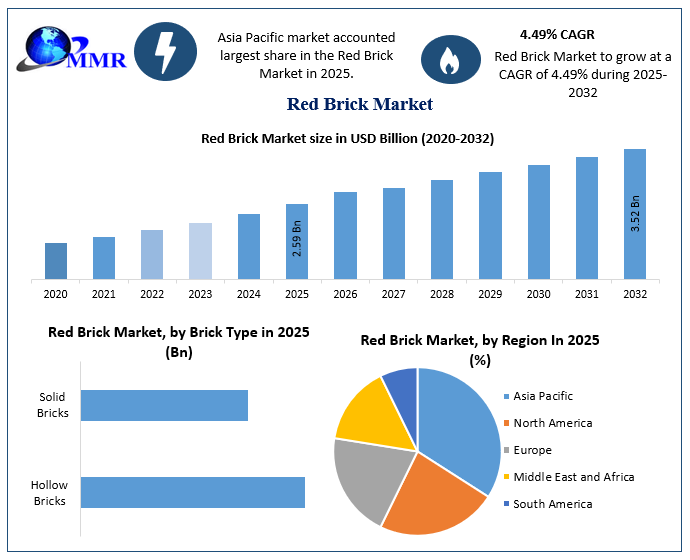
The Red Brick Market size was valued at USD 2.59 Billion in 2025 and the total Red Brick revenue is expected to grow at a CAGR of 4.49% from 2026 to 2032, reaching nearly USD 3.52 Billion by 2032.
Red Brick Market Overview:
Global Red Brick Market Overview
Red bricks are one of the most widely used construction materials, manufactured primarily from natural clay and shale through molding and kiln firing. They are valued for their high compressive strength, durability, thermal insulation, fire resistance, and cost-effectiveness, making them suitable for residential, commercial, and infrastructure construction projects.
The global red brick market is driven by rapid urbanization, increasing infrastructure development, and rising investments in residential and commercial construction, particularly in emerging economies. Growing government spending on affordable housing and smart city projects is further supporting market growth. Additionally, advancements in energy-efficient brick manufacturing and the adoption of sustainable production practices are expected to create new opportunities. Despite challenges such as environmental regulations on traditional brick kilns and competition from alternative building materials, the market is expected to witness steady growth throughout the forecast period.
 To know about the Research Methodology :- Request Free Sample Report
Global Red Brick Market Dynamics
Market Drivers
The global red brick market is primarily driven by the steady expansion of residential, commercial, and infrastructure construction across both developed and emerging economies. Rapid urbanization, population growth, and increasing government investments in affordable housing, transportation networks, and public infrastructure continue to support demand for conventional clay bricks. According to international infrastructure and urban development trends, Asia-Pacific, the Middle East, and parts of Africa are witnessing significant construction activity, creating sustained demand for durable and cost-effective masonry materials. Red bricks remain widely preferred due to their high compressive strength, thermal insulation properties, fire resistance, durability, and long service life, making them suitable for both structural and non-structural applications.
Market Restraints
Environmental concerns associated with traditional brick manufacturing are expected to restrain market growth during the forecast period. Conventional fired clay brick production consumes large quantities of topsoil and coal while generating significant greenhouse gas emissions and particulate matter. As governments strengthen environmental regulations and promote sustainable construction practices, many countries are imposing stricter emission standards and limiting the establishment of traditional brick kilns. In addition, increasing labor costs, rising energy prices, and competition from alternative walling materials such as autoclaved aerated concrete (AAC) blocks, fly ash bricks, and concrete blocks are creating challenges for conventional red brick manufacturers.
Market Opportunities
The transition toward cleaner and more energy-efficient brick manufacturing technologies presents significant opportunities for market participants. The adoption of modern kiln technologies, including zig-zag, vertical shaft brick kilns (VSBK), and tunnel kilns, is helping manufacturers improve fuel efficiency, reduce emissions, and comply with evolving environmental regulations. Growing investments in green buildings, sustainable urban development, and energy-efficient construction are also encouraging producers to manufacture higher-quality bricks with improved durability and lower environmental impact. Furthermore, increasing renovation and restoration activities involving heritage buildings and traditional architectural projects continue to generate demand for premium clay red bricks.
Market Trends
A key trend shaping the global red brick market is the modernization of manufacturing processes through automation, digital quality control, and energy-efficient kiln technologies.
Manufacturers are increasingly adopting sustainable production methods that reduce fuel consumption and carbon emissions while improving product consistency.
The market is also witnessing rising demand for aesthetically appealing exposed brick finishes in residential and commercial architecture, particularly in premium housing, hospitality, and landscape construction. In parallel, governments and industry stakeholders are promoting cleaner brick production technologies and resource-efficient manufacturing practices to align with global decarbonization and sustainable construction objectives, supporting the long-term evolution of the red brick market through 2032.
Red Brick Market Segment Analysis:
By Brick Type
The solid bricks segment is expected to account for the largest share of the global red brick market during the forecast period. Solid red bricks are the preferred choice for load-bearing walls, foundations, boundary walls, industrial structures, and infrastructure projects due to their high compressive strength, durability, fire resistance, and long service life. They are extensively used in residential housing, commercial buildings, educational institutions, and public infrastructure, particularly in developing economies where conventional brick masonry remains the dominant construction method. Their affordability, ease of installation, and widespread availability continue to support sustained market demand.
The hollow bricks segment is projected to register the fastest growth during the forecast period, supported by the increasing adoption of lightweight and energy-efficient construction materials. Hollow red bricks provide better thermal insulation, soundproofing, and reduced structural load compared to conventional solid bricks, making them suitable for modern residential and commercial buildings. Their lower material consumption and improved construction efficiency contribute to reduced project costs and faster installation.
By Application
Based on application the residential buildings segment is expected to dominate the global red brick market throughout the forecast period. Rapid urbanization, population growth, rising disposable incomes, and increasing government investments in affordable housing continue to drive residential construction worldwide. Red bricks remain one of the most widely used building materials for individual homes, apartment complexes, and low-rise housing projects due to their structural strength, thermal insulation, fire resistance, durability, and cost-effectiveness. Renovation and home improvement activities in mature markets also contribute to sustained demand for red bricks.

The commercial buildings segment is anticipated to witness steady growth between 2025 and 2032, supported by expanding investments in offices, retail complexes, hotels, educational institutions, healthcare facilities, and mixed-use developments. Developers continue to utilize red bricks for both structural applications and architectural facades owing to their durability, aesthetic appeal, low maintenance requirements, and excellent acoustic and thermal performance.
Regional Insights:
Red Brick Market Scope: Inquire before buying
| Red Brick Market | |||
|---|---|---|---|
| Report Coverage | Details | ||
| Base Year: | 2025 | Forecast Period: | 2026-2032 |
| Historical Data: | 2020 to 2025 | Market Size in 2025: | USD 2.59 Bn. |
| Forecast Period 2026 to 2032 CAGR: | 4.49% | Market Size in 2032: | USD 3.52 Bn. |
| Segments Covered: | By Brick Type | Solid Bricks Hollow Bricks |
|
| By Color Type | Traditional Red Bricks Dark Red / Burgundy Bricks Orange / Terracotta Bricks Brown / Rustic Bricks Others (Custom Shades) |
||
| By Application/End - User | Residential Buildings Commercial Buildings Industrial Buildings Infrastructure & Public Works |
||
Red Brick Market, by Region
North America (United States, Canada and Mexico)
Europe (UK, France, Germany, Italy, Spain, Sweden, Austria and Rest of Europe)
Asia Pacific (China, South Korea, Japan, India, Australia, Indonesia, Malaysia, Vietnam, Taiwan, Bangladesh, Pakistan and Rest of APAC)
Middle East and Africa (South Africa, GCC, Egypt, Nigeria and Rest of ME&A)
South America (Brazil, Argentina Rest of South America)
Key Players:
1. Belden Brick
2. Redland Brick
3. Brickhunter
4. PGH Bricks & Pavers
5. El-Khayyat Group
6. The Bespoke Brick Company
7. Red Industries Private Limited
8. Balana Bricks Company
9. Yashas Enterprises
10. Srinsagar Chamber Bricks
11. Ancient Stone Inc.
12. Ameron Structures Private Limited
13. DRP Infratech
14. Clay World Traders
15. R P C Construction Solutions
16. Hasan Buildcon
Frequently Asked Questions:
1] What segments are covered in Global Red Brick Market report?
Ans. The segments covered in Global Red Brick Market report are based on Brick Type, Color Type and Application.
2] Which region is expected to hold the highest share in the Global Red Brick Market?
Ans. Asia Pacific is expected to hold the highest share in the Global Red Brick Market.
3] Who are the top key players in the Global Red Brick Market?
Ans. Belden Brick, Redland Brick, Brickhunter, PGH Bricks & Pavers, and Hasan Buildcon are the top key players in the Global Red Brick Market.
4] Which segment holds the largest market share in the Global Red Brick market by 2032?
Ans. Hollow Bricks segment hold the largest market share in the Global Red Brick market by 2032.
5] What is the market size of the Global Red Brick market by 2032?
Ans. The market size of the Global Red Brick market is USD 3.52 Bn. by 2032.
6] What was the Global Red Brick Market size in 2025?
Ans: The Global Red Brick Market size was USD 2.59 Billion in 2025.