
Rayon Fibers Market Size – Industry Structure Evaluation, Demand Drivers Analysis, Regional Growth Analysis and Identification, Competitive Positioning Review & Global Market Size Forecast to 2032
Overview
Global Rayon Fibers Market size was valued at US$ 22.56 Bn in 2025 and the total revenue is expected to grow at 6.78% through 2026 to 2032 reaching nearly US$ 35.71 Bn. by 2032.
The Rayon Fibers market report is a comprehensive analysis of the industry, market, and key players. The report has covered the market by demand and supply-side by segments. The Global Rayon Fibers market report also provides trends by market segments, technology, and investment with a competitive landscape.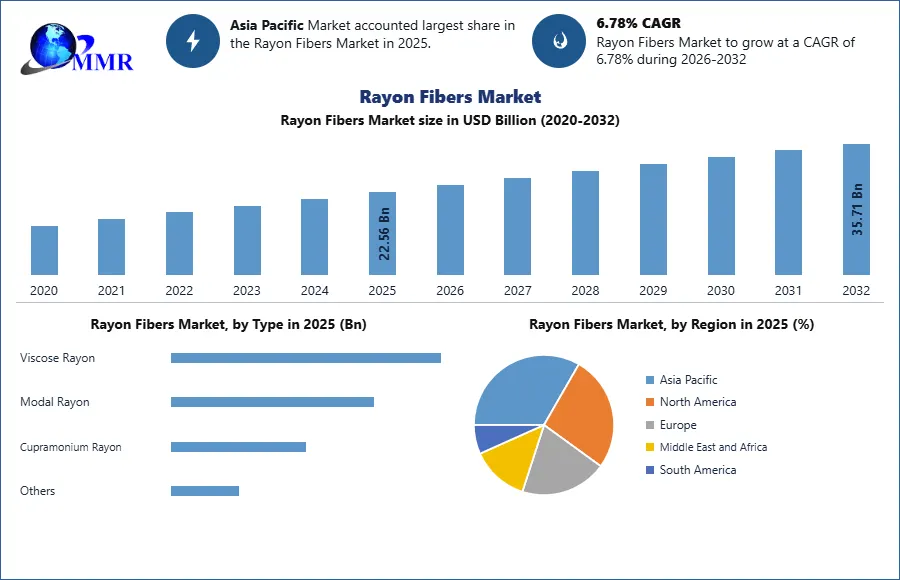 To know about the Research Methodology :- Request Free Sample Report
Rayon Fibers Market Overview:
The Rayon Fibers Market represents a significant segment within the global textile and fiber industry, driven by the increasing demand for semi-synthetic, biodegradable, and cost-effective alternatives to synthetic fibers. Rayon fibers, including viscose, modal, and lyocell, are derived from natural cellulose sources such as wood pulp and are widely used across apparel, home textiles, and industrial applications. Their key properties—such as softness, high absorbency, breathability, and versatility—make them a preferred choice in both fashion and functional textile segments.
Rayon Fibers Market Dynamics:
The Rayon Fibers Market is driven by the increasing demand for sustainable and biodegradable textile materials, particularly as consumers and manufacturers shift toward eco-friendly alternatives to synthetic fibers. Rayon fibers, especially viscose and lyocell, are widely used in apparel, home textiles, and hygiene products due to their softness, breathability, and cost-effectiveness. The expansion of the global textile and fashion industry, along with rising consumption in emerging economies such as China, India, and Southeast Asia, continues to support market growth. Additionally, growing applications in non-woven fabrics for personal care and medical use further strengthen demand.
However, the market faces several restraints, primarily related to environmental concerns associated with traditional viscose production, including high water consumption and chemical usage. Regulatory pressures and sustainability standards in regions such as Europe and North America are pushing manufacturers to adopt cleaner production processes, which can increase operational costs. Volatility in raw material supply, particularly wood pulp, also impacts pricing and production stability. Despite these challenges, opportunities are emerging through the development of closed-loop production technologies, such as lyocell processes, and increasing investments in sustainable fiber innovation. The market is also witnessing a shift toward circular economy practices, with recycling and bio-based alternatives gaining traction among key players.
Rayon Fibers Market Segment Analysis:
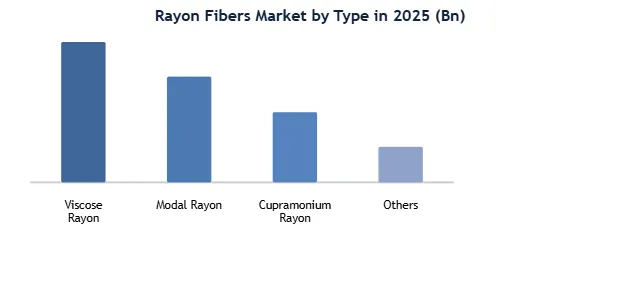
By Type, it is segmented into viscose rayon, modal rayon, Cupramonium rayon, and others. Viscose. Rayon fiber has dominated the market with a market share of more than 35% in 2025. Viscose fibers have properties parallel to that of cotton, thus replacing cotton fibers in several end-use industries. They are formed by reacting cellulose with sodium hydroxide to form alkali cellulose, which in turn, is reacted with carbon disulphide (CS2) to transform it to cellulose xanthate.
Viscose rayon fibers are soft are used for making dresses, ribbons, and decorations and are non-insulating fibers. Surging the use of viscose rayon in apparels, the material fabric is likely to aid the growth of the market.
By Application, it is segmented into automotive & transportation is further segmented into tire cords, automotive hoses, and brake lining hoses. Personal care is segmented into feminine hygiene products, wipes, diapers, aerospace and defence, manufacturing is divided into industrial hoses, conveyor belts, and industrial fabric. The textile segment is bifurcated into domestic textile and industrial textile and healthcare.
The personal care segment is projected to grow with the highest CAGR of 7.9% in the rayon fiber market during the forecast period. This growth is attributed to the flowing uses of rayon fiber in the hygiene products such as sanitary napkins, sanitary towels, tampons, baby diapers, and napkin liners. As the use of rayon fiber provides quick liquid absorption and also provides an outstanding dry surface.
Rayon Fibers Market Regional Insights:
In 2025, Asia-Pacific dominates the global rayon fibers market, accounting for xx% of total market share, making it the leading region in both production and consumption. This dominance is driven by the strong textile manufacturing base in countries such as China, India, Indonesia, and Bangladesh, along with the availability of low-cost labor and abundant raw materials like wood pulp. Rapid urbanization, increasing apparel demand, and export-oriented textile industries further strengthen the region’s position as the global hub for rayon fiber production.
Europe and North America represent mature markets with steady demand, primarily driven by sustainability trends and regulatory frameworks promoting eco-friendly fibers. North America holds a moderate share, supported by increasing consumer preference for biodegradable and sustainable textiles, along with a well-established apparel and home textile sector. Europe, on the other hand, is characterized by advanced manufacturing technologies and a strong focus on environmentally sustainable production processes such as closed-loop systems, particularly in countries like Austria and Germany.
Global Rayon Fibers Market Recent Developments:
| Exact Date | Company | Development | Impact |
|---|---|---|---|
| 31 March 2026 | Kelheim Fibres GmbH | The company officially terminated all business operations and phased out production following a failed investor process. | The closure removes a key European supplier of specialty viscose fibers, shifting market demand toward larger integrated Asian producers. |
| 05 February 2026 | Sappi Limited | Sappi reported a strategic reduction in capital expenditure to $260 million for FY2026 to preserve liquidity amid weak wood pulp pricing. | This cost-discipline phase prioritizes balance sheet strength over capacity expansion during a period of global macroeconomic uncertainty. |
| 26 January 2026 | Brave Search (Contextual Industry Tech) | Brave launched its Place Search API to provide AI-driven discovery for sustainable textile points of interest and global retail locations. | This enhances the digital traceability of rayon-based products by allowing consumers to find certified sustainable apparel outlets in real-time. |
| 29 September 2025 | Lenzing AG | Lenzing refined its 2025 strategy to focus exclusively on high-performance fibers and initiated a non-cash impairment of €100 million on assets. | The move aims to unlock €25 million in annual savings starting in 2026 by optimizing the group's global manufacturing footprint. |
| 01 August 2025 | Nanollose Ltd | The company secured $750,000 in funding to advance the commercialization of its Nullarbor™ tree-free lyocell fibers. | The capital infusion supports the scaling of pilot production runs in collaboration with Birla Cellulose to meet high-end sustainable fashion demand. |
| 15 May 2025 | Aditya Birla Group (Birla Cellulose) | The group launched Liva Reviva M, a next-generation circular fiber made using recycled textile waste. | This commercialization strengthens the circular economy in the rayon market, addressing growing regulatory pressure for sustainable material sourcing. |
The objective of the report is to present a comprehensive analysis of the global Rayon Fibers market to the stakeholders in the industry. The past and current status of the industry with the forecasted market size and trends are presented in the report with the analysis of complicated data in simple language. The report covers all the aspects of the industry with a dedicated study of key players that include market leaders, followers, and new entrants.
PORTER, SVOR, PESTEL analysis with the potential impact of micro-economic factors of the market have been presented in the report. External as well as internal factors that are supposed to affect the business positively or negatively have been analysed, which will give a clear futuristic view of the industry to the decision-makers.
The report also helps in understanding the global Rayon Fibers market dynamics, structure by analyzing the market segments and project the global Rayon Fibers market size. Clear representation of competitive analysis of key players by Grade, price, financial position, Grade portfolio, growth strategies, and regional presence in the global Rayon Fibers market make the report investor’s guide.
Global Rayon Fibers Market Scope: Inquire before buying
| Rayon Fibers Market | |||
|---|---|---|---|
| Report Coverage | Details | ||
| Base Year: | 2025 | Forecast Period: | 2026-2032 |
| Historical Data: | 2020 to 2025 | Market Size in 2025: | 22.56 USD Billion |
| Forecast Period 2026-2032 CAGR: | 6.78% | Market Size in 2032: | 35.71 USD Billion |
| Segments Covered: | by Type | Viscose Rayon Modal Rayon Cupramonium Rayon Others |
|
| by Application | Automotive & Transport Personal Care Aerospace & Defense Manufacturing Textile Healthcare Other |
||
Rayon Fibers Market, by Region
- Asia Pacific
- Europe
- North America
- Middle East and Africa
- South America
Rayon Fibers Market Key Players are:
- Lenzing AG
- Aditya Birla Group
- Sateri
- Zhejiang Fulida Holding Co. Ltd.
- Asia Pacific Rayon Limited
- Kelheim Fibres GmbH
- Eastman Chemical Company
- Toray Industries Inc.
- Rayonier Advanced Materials Inc.
- Sappi Limited
- Ahlstrom-Munksjö
- Solvay S.A.
- Nanollose Ltd.
- Goonvean Fibres Ltd
- Indo Rayon Utama Tbk
- Yibin Grace Group
- Aoyang Technology
- CHTC Helon Co. Ltd.
- Bohi Industry Group
- Zhong Tai International Development (HK) Limited
- Tembec Inc.
- Fulida Group Holdings Co. Ltd.
- Tangshan Sanyou Group
- Xinxiang Bailu Chemical Fiber Co. Ltd.
- Shandong Helon Textile Sci. & Tech. Co. Ltd.
Others