
Radiology Information Systems Market – Global Market Size, Strategic Growth Drivers, Risk Assessment Framework, Regulatory Landscape Review, Competitive Intensity Mapping & Long-Term Industry Outlook to 2032
Overview
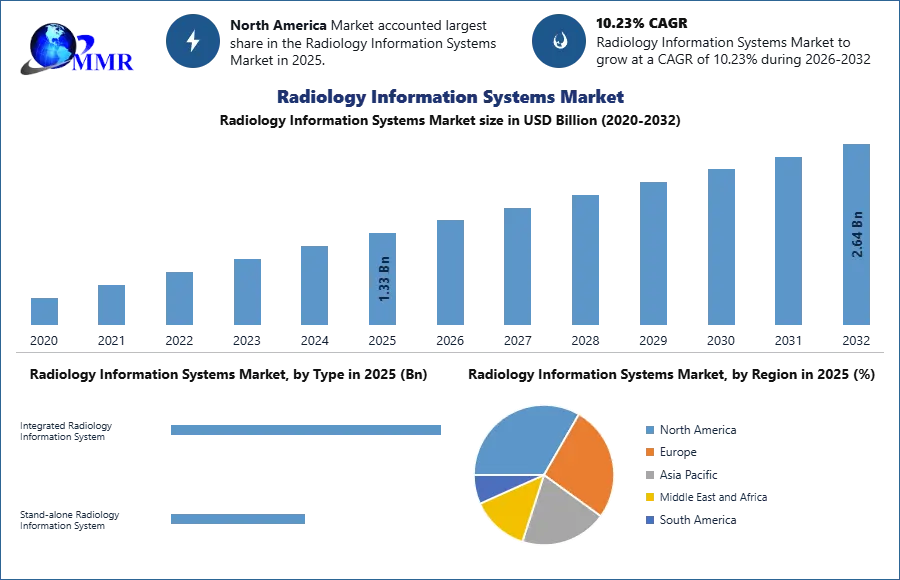
Radiology Information Systems Market size was valued at USD 1.21 Bn. in 2025 and the total Radiology Information Systems Market revenue is expected to grow at 10.23 % from 2026 to 2032, reaching nearly USD 2.64 Bn.
Radiology Information Systems Market Overview:
A networked software application used to manage medical data and images is called a radiology information system (RIS). Keeping track of radiological records and data is made easier by the system in numerous locations. Along with a photo archiving and communication system, it controls billing and workflow (PACS). A patient's whole journey through the radiology department is tracked by the system.
 To know about the Research Methodology :- Request Free Sample Report
Digital material is simpler to produce than printed content, which has higher manufacturing expenses. A wider user base merely translates and retrieves readily accessible digital literature in numerous languages. Additionally, students, especially those with physical restrictions, listen to the educational material in an audio version to grow their vocabulary and build superior interpretative reading skills.
Our research methodology started with gathering information on the main vendors' revenue through secondary research in order to estimate and forecast the market for unified monitoring. To divide the market into segments, by Type (Integrated Radiology Information System, Stand-alone Radiology Information System) by Deployment Mode (Cloud-based, On-premise) by Component (Software, Hardware, Services) vendors' offerings are taken into account. These segments were then confirmed through primary research by conducting in-depth interviews with important figures, including chief executive officers (CEOs), vice presidents (VPs), directors, and executives.
In order to estimate the market size, top-down and bottom-up methods are employed. Primary and secondary research are used to identify the major players in the Radiology Information Systems Market and to calculate their market revenues. In contrast to secondary research, which required examining the annual and financial reports of the leading manufacturers, primary research involved conducting interviews with major opinion leaders and business leaders in the industry, including CEOs and marketing executives. Allscripts , MedInformatix, Inc.,E pic Systems Corporation, Carestream Health, Shimadzu Corporation
Hologic, Inc. is a few of the top significant competitors in the global Radiology Information Systems Market For the duration of the forecast period, they are continually strategizing about mergers and acquisitions to increase their market shares and growth potential.
Covid-19 Impact:
The market for radiology information systems is significantly impacted by COVID-19. The demand for imaging services was declining as a result of the policy measures implemented to slow the spread of COVID-19, according to a research article titled "The Economic Impact of the COVID-19 Pandemic on Radiology Practices" that was published in the Journal of the Radiological Society of North America in April 2020.
The Centers for Disease Control and Prevention's recommendations to delay emergency outpatient visits during the peak of the pandemic had a significant impact on screening services like mammography and lung cancer screening, and the effect has been seen across the market, including interventional procedures. Given that radiology information systems are used to examine data from radiology units, this is likely to have an impact on demand for these systems. The market is expected to have a good trend in the forecast period thanks to the current relaxation of regulations and the launch of immunization programs.
Radiology Information Systems Market Dynamics:
Market drivers:
The global rate of the spread of chronic diseases among people of all ages has significantly increased, which is one of the key causes that fuel demand for radiology information system software. Some encouraging factors for the market include increased government support for funding cancer research and easier access to healthcare information technology systems.
Another element that boosts the likelihood of market growth is the fact that the aging population is growing along with it, as is the risk of illness contracting and the emergence of serious lifestyle conditions. The market for radiology information systems is expected to increase rapidly because of the rise of people with conditions including cancer, diabetes, cardiovascular disease, and arthritis that require the right facilities to treat them.
Market restraints:
The lack of funding in undeveloped and emerging countries is a crucial element that must be taken into account. Lack of knowledge is yet another element hampering the growth of the global market. In addition, people occasionally have a tendency to disregard their health and fail to schedule their tests in a timely manner, which worsens their health and further reduces demand until the problem becomes more serious.
Market Opportunities:
The global market for radiology information systems (RIS) is expected to increase rapidly as a result of technological development and rising healthcare IT spending, which presents favourable possibilities for market growth. Integration of artificial intelligence (AI) in RIS is probably going to open up attractive growth opportunities for market participants.
The addition of AI to RIS leads to improved patient care, more effective workflow, and reliable radiologist support. Additionally, the rise in the demand for computerized medical imaging and the number of emerging markets are creating a number of profitable chances that drive the radiology information systems (RIS) market ahead throughout the course of the forecast period.
Radiology Information Systems Market Segment Analysis:
Based on Type, The Integrated Radiology Information System segment is expected to grow at the highest CAGR during the forecast period. The integration of the reporting systems, Picture Archiving and Communication Systems (PACS), and Radiological Information Systems enables the automatic mapping of patient IDs and exam data into examination reports (RIS). The production, accuracy, and level of fatigue of radiologists all grow as a result of report automation.
Based on Deployment Mode, The Cloud-based segment is expected to grow at the highest CAGR during the forecast period. In comparison to direct purchase models, cloud-hosted services are extremely affordable. This is because, instead of buying the entire model, consumers can subscribe to the most recent version of a radiological information system at a lesser cost. Since data is stored on external servers, cloud-based systems may be simply accessed online and run effectively with just a computer and an internet connection. Healthcare professionals and patients can access information at any time thanks to cloud-based delivery.
Small to medium-sized hospitals, which cannot afford significant hardware expenses, are particularly suited to cloud-based radiological information systems because they are more cost-effective. Additionally, cloud-based radiology information systems let doctors and medical professionals manage who has access to private data.
Based on Component, The Software segment is expected to grow at the highest CAGR during the forecast period. Medical imaging ecosystems are being introduced to the market at an increasing rate. For instance, the Radiologex Foundation launched Radiologex in February 2020. This software ecosystem for the healthcare sector includes productivity tools, clinical information systems, processing and storage for medical images, complete payment settlement, and lending and finance systems.
Radiology Information Systems Market Regional Insights:
The market for radiology information systems is dominated by North America because of the region's increased prevalence of chronic diseases and rising healthcare costs.
Major radiology service providers are cooperating with local businesses to grow their markets. Along with the introduction of new products and technological advancement, other strategic efforts and milestones reached by significant players are expected to further propel the market in the area. For instance, in July 2021, FUJIFILM Medical Systems U.S.A, Inc. announced that United States Radiology Specialists had chosen the cutting-edge Synapse Enterprise Information System (EIS) to power effective and high-quality patient care across its network.
Synapse Radiology Information System (RIS) is a comprehensive workflow management tool created for the outpatient imaging industry to increase patient interaction, streamline physician communication, and lessen the aforementioned administrative burden. Owing to growing understanding of the value of workflow management at clinics, hospitals, and diagnostic laboratories as well as the rising number of outsourced services in this region, Asia-Pacific is expected to rise during the forecast period.
Recent Industry Developments (2025–2026)
| Exact Date | Company | Development | Impact |
|---|---|---|---|
| 11 March 2026 | Agfa-Gevaert | The company announced a full transition to cloud-enabled Enterprise Imaging and a new organizational structure effective in 2026. | This pivot accelerates the shift from legacy film to SaaS-based RIS, securing market share in North American health systems. |
| 09 March 2026 | GE HealthCare | The company received U.S. FDA 510(k) clearance for View, a next-generation diagnostic viewer for "anywhere-access" imaging. | The approval enhances remote radiology workflows, directly integrating portable diagnostic capabilities into the modern RIS environment. |
| 30 November 2025 | Fujifilm Healthcare | Fujifilm launched Synapse One, a unified enterprise imaging and RIS solution hosted on Amazon Web Services (AWS). | The launch reduces operational costs for outpatient centers by eliminating third-party integrations and physical data center overhead. |
| 01 October 2025 | Konica Minolta | Signed an MoU with FPT to conduct joint research on AI-powered automated medical report generation using Dynamic Digital Radiography (DDR). | This collaboration aims to automate clinical documentation, a key administrative bottleneck within traditional Radiology Information Systems. |
| 01 June 2025 | CIVIE | Launched RadPod, an AI-driven, on-demand radiology platform designed for real-time scan interpretation and compensation. | The platform introduces a gig-economy model to radiology, challenging traditional hospital-bound RIS workflow structures. |
| 12 March 2025 | RamSoft | Partnered with Alpha Nodus to integrate the Gravity AI platform into PowerServer RIS for automated scheduling and prior authorizations. | The integration streamlines front-end RIS operations, reducing administrative errors and improving patient throughput in imaging centers. |
The objective of the report is to present a comprehensive analysis of the Radiology Information Systems Market to the stakeholders in the industry. The past and current status of the industry with the forecasted market size and trends are presented in the report with the analysis of complicated data in simple language. The report covers all the aspects of the industry with a dedicated study of key players that include market leaders, followers, and new entrants.
PORTER, PESTEL analysis with the potential impact of micro-economic factors of the market have been presented in the report. External as well as internal factors that are supposed to affect the business positively or negatively have been analyzed, which will give a clear futuristic view of the industry to the decision-makers.
The report also helps in understanding the Radiology Information Systems Market dynamics, structure by analyzing the market segments and project the Radiology Information Systems Market size. Clear representation of competitive analysis of key players by product, price, financial position, product portfolio, growth strategies, and regional presence in the Radiology Information Systems Market make the report investor’s guide.
Radiology Information Systems Market Scope: Inquire before buying
| Radiology Information Systems Market | |||
|---|---|---|---|
| Report Coverage | Details | ||
| Base Year: | 2025 | Forecast Period: | 2026-2032 |
| Historical Data: | 2020 to 2025 | Market Size in 2025: | 1.33 USD Billion |
| Forecast Period 2026-2032 CAGR: | 10.23% | Market Size in 2032: | 2.64 USD Billion |
| Segments Covered: | by Type | Integrated Radiology Information System Stand-alone Radiology Information System |
|
| by Deployment Mode | Cloud-based On-premise |
||
| by Component | Hardware Software Services |
||
| by End User | Hospitals & Clinics Outpatient Department (OPD) Clinic Other End-Users |
||
Radiology Information Systems Market , by Region
Asia Pacific (China, South Korea, Japan, India, Australia, Indonesia, Malaysia, Vietnam, Taiwan, Bangladesh, Pakistan and Rest of APAC)
Europe (UK, France, Germany, Italy, Spain, Sweden, Austria and Rest of Europe)
North America (United States, Canada and Mexico)
Middle East and Africa (South Africa, GCC, Egypt, Nigeria and Rest of ME&A)
South America (Brazil, Argentina Rest of South America)
Key Players / Competitors Profiles Covered in Brief in Global Radiology Information Systems Market Report in Strategic Perspective:
- Koninklijke Philips N.V.
- Siemens Healthineers AG
- GE HealthCare
- Oracle
- McKesson Corporation
- Fujifilm Holdings Corporation
- Agfa-Gevaert Group
- Canon Medical Systems Corporation
- Cerner Corporation
- Epic Systems Corporation
- Allscripts Healthcare Solutions
- Carestream Health
- Sectra AB
- Hologic, Inc.
- Shimadzu Corporation
- INFINITT Healthcare
- MedInformatix, Inc.
- Pro Medicus Limited
- DeepHealth
- Merative
- Veradigm LLC
- EIZO Corporation
- eRAD, Inc.
- Alpha Nodus
- RamSoft, Inc.