
Global Quality Management Software Market-Industry Structure Evaluation, Demand Drivers Analysis, Regional Growth Analysis and Identification, Competitive Positioning / Landscape Review & Global Market Size Forecast to 2029
Overview
Quality Management Software Market was valued at US$ 5.21 Bn. in 2022 and is expected to reach US$ 9.91 Bn. by 2029, at a CAGR of 9.6% during a forecast period.
Quality Management Software Market Overview:
The global quality management software market was valued at US$ 5.21 bn. in 2022. The Quality management software is gaining traction in businesses all over the world since it helps to streamline corporate processes. Quality management software's numerous solutions enable firms to achieve operational efficiency while lowering overall expenses. Quality management software also aids firms in adhering to norms and laws, which is another factor driving market growth. The high installation cost of quality management software, on the other hand, is limiting market growth to some level.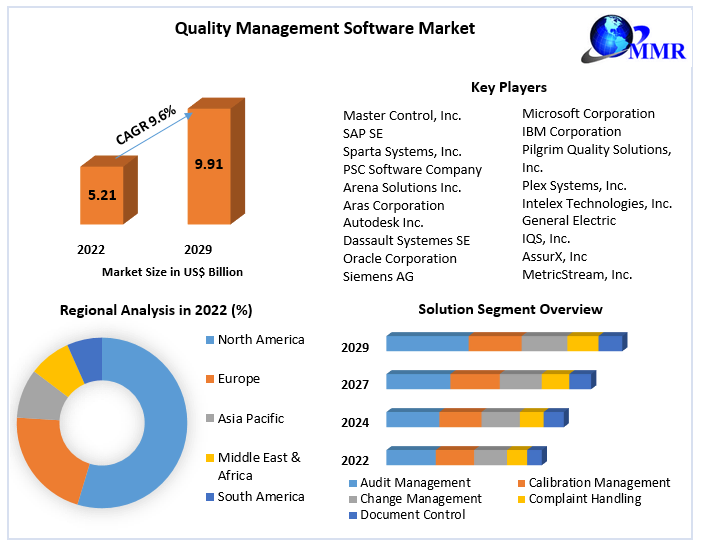 To know about the Research Methodology :- Request Free Sample Report
COVID-19 impact on global quality management software market:
COVID-19 has had a significant impact on a number of sectors around the world. It was impossible to travel anywhere due to the lockdown. As a result, transporting important materials to other locations was difficult. However, the market has seen a significant shift toward the online sector, which has fueled market growth. During the fragile period, it aided in improving market growth. Following the end of the pandemic, it is expected that the Market will resume its growth.
Quality Management Software Market Dynamics:
The growing demand for quality systems and services is one of the major drivers of the Market. The major players are concentrating their efforts on improving their products to meet international standards. Quality management systems aid in the enhancement of production. It improves quality by increasing the number of entry points for large businesses. It's also useful for connecting departments that aren't in the same building.
The rising demand for higher-quality systems is a major factor in the quality system market's demands. In addition, QMS systems can effectively manage and control the data quality. The increasing pressure to meet international standards and follow regulations will create a number of opportunities in the future. The growing competition among the key players is posing a significant challenge to the growth of the Market. It has the potential to have a low-cost impact on the quality of these systems. Finding the right products for the businesses will be difficult. As a result, increased competition may stifle growth.
The number of factors that could stifle the growth of the Market. The installation costs for quality management systems are expected to stifle market growth. This factor may have an impact on businesses, preventing them from using these systems.
Quality Management Software Market segment analysis:
The Global Quality Management Software Market is segmented into solution, deployment, enterprise size, and end-user.
Based on solution, in 2022, the complaint handling category had the greatest market share of almost 15%. Effective complaint handling aids in anticipating client expectations and boosting brand equity. To address consumer complaints more effectively and efficiently, businesses are implementing standard complaint handling tools and processes. These variables are projected to be the primary drivers of segment growth.
For regulated life science and high-tech environments, a calibration management solution provides critical links between related maintenance jobs and additional quality procedures. By minimizing the number of recalled items, such solutions help to extend the life of machinery while also saving the company money. According to Beamed Inc., a calibration software vendor, over 75% of organizations in the highly regulated pharmaceuticals sector perform more than 2,000 calibrations every year.
Based on enterprise size, in 2022, the large enterprise segment had a market share of more than 60%. The key motive for large businesses to implement QMS is to save money. Many QMS manufacturers offer separate software suites for large businesses and small and medium businesses. These suites are custom-made to meet the specific needs of the clients and hence play an important role in the selection process.
The mobility and flexibility of QMS are fueling demand among major businesses, resulting in the software's continual addition of new features. Organizations all across the world utilize a variety of software and systems to generate vast amounts of data. QMS solutions are expected to meet the growing needs of companies for boosting efficiency and productivity in their operations, thanks to the ever-increasing data and growing need for technologies such as artificial intelligence and machine learning.
Based on end-user, in 2022, the manufacturing sector had the biggest market share of almost 20%. The strict laws, as well as the complicated processes and linked business systems, are to blame for this increase. Manufacturing sectors can use QMS systems to increase quality through continuous improvement, avoid or respond swiftly to situations like product recalls, and maintain certification compliance. They also aid in prioritizing process improvement initiatives, comparing the competence of production lines, and verifying product conformance. Over the projection period, such elements are expected to act as key drivers of segment growth.
Regional Insight:
The Asia Pacific region is expected to grow at an xx% rate of CAGR during the forecast period, because of the adoption of QMS in manufacturing sector. The region is expected to witness a rapid growth rate during the forecast period. With the improvement in the efficiency of businesses, enterprises are focusing towards customer demands in the developing countries like China, India and Taiwan are increasing the adoption of quality management software among industries in the region. Some of the prominent QMS solutions key players are focusing more on enhancing sustainability practices, which assists key players in reducing waste and their carbon footprint. The use of QMS solutions are expected to help organizations reduce the human impact on the environment. The many end-use industries are adopting quality management solutions. On the other hand, integration with other systems, lack of collaboration, and misalignment with the latest trends and technologies are some of the challenges, which key players operating in the market are facing. Vendors are also trying to tackle problems, with the widespread acceptance of cloud-based deployment that is increasing the adoption of QMS solutions across industries.
The objective of the report is to present a comprehensive analysis of the global market to the stakeholders in the industry. The past and current status of the industry with the forecasted market size and trends are presented in the report with the analysis of complicated data in simple language. The report covers all the aspects of the industry with a dedicated study of key players that include market leaders, followers, and new entrants.
PORTER, PESTEL analysis with the potential impact of micro-economic factors of the market have been presented in the report. External as well as internal factors that are supposed to affect the business positively or negatively have been analyzed, which will give a clear futuristic view of the industry to the decision-makers.
The report also helps in understanding the global market dynamics, structure by analyzing the market segments and projects the global market size. Clear representation of competitive analysis of key players by product, price, financial position, product portfolio, growth strategies, and regional presence in the global Quality Management Software market make the report investor’s guide.
Global Quality Management Software Market Scope: Inquire before buying
| Global Quality Management Software Market | |||
|---|---|---|---|
| Report Coverage | Details | ||
| Base Year: | 2022 | Forecast Period: | 2023-2029 |
| Historical Data: | 2018 to 2022 | Market Size in 2022: | US $ 5.21 Bn. |
| Forecast Period 2023 to 2029 CAGR: | 9.6% | Market Size in 2029: | US $ 9.91 Bn. |
| Segments Covered: | by Solution | Audit Management Calibration Management Change Management Complaint Handling Document Control Employee Training Non-conformances/corrective & Preventative Supplier Quality Management Others |
|
| by Enterprise | Small & Medium Enterprise Large Enterprise |
||
| by Deployment Type | On-Premise On-Cloud |
||
| by End-User | IT & Telecom Transportation & Logistics Consumer Goods & Retail Defense & Aerospace Manufacturing Healthcare Others |
||
Global Quality Management Software Market, by Region
Asia Pacific (China, South Korea, Japan, India, Australia, Indonesia, Malaysia, Vietnam, Taiwan, Bangladesh, Pakistan and Rest of APAC)
Europe (UK, France, Germany, Italy, Spain, Sweden, Austria and Rest of Europe)
North America (United States, Canada and Mexico)
Middle East and Africa (South Africa, GCC, Egypt, Nigeria and Rest of ME&A)
South America (Brazil, Argentina Rest of South America)
Key Players
1. Master Control, Inc.
2. SAP SE
3. Sparta Systems, Inc.
4. PSC Software Company
5. Arena Solutions Inc.
6. Aras Corporation
7. Autodesk Inc.
8. Dassault Systemes SE
9. Oracle Corporation
10. Siemens AG
11. Parasoft Corporation
12. Hewlett-Packard Enterprise Co.
13. Microsoft Corporation
14. IBM Corporation
15. Pilgrim Quality Solutions, Inc.
16. Plex Systems, Inc.
17. Intelex Technologies, Inc.
18. General Electric
19. IQS, Inc.
20. AssurX, Inc
21. MetricStream, Inc.
22. QUMAS
Frequently Asked Questions:
1. Which region has the largest share in Global Quality Management Software Market?
Ans: Asia pacific region holds the highest share in 2022.
2. What is the growth rate of Global Quality Management Software Market?
Ans: The Global Quality Management Software Market is growing at a CAGR of 9.6 % during forecasting period 2023-2029.
3. What segments are covered in Global Quality Management Software market?
Ans: Global Quality Management Software Market is segmented into solution, deployment, enterprise size, end-user and region.
4. Who are the key players in Global Quality Management Software market?
Ans: The important key players in the Global Quality Management Software Market are – MasterControl, Inc., SAP SE, Sparta Systems, Inc., PSC Software Company, Arena Solutions Inc., Aras Corporation, Autodesk Inc., Dassault Systemes SE, Oracle Corporation, Siemens AG, Parasoft Corporation, Hewlett-Packard Enterprise Co., Microsoft Corporation, IBM Corporation.
What is the study period of this market?
Ans: The Global Quality Management Software Market is studied from 2022 to 2029.