
Propylene Glycol Market by Source, by Application, by End User Industry and Regional Insights 2034
Overview
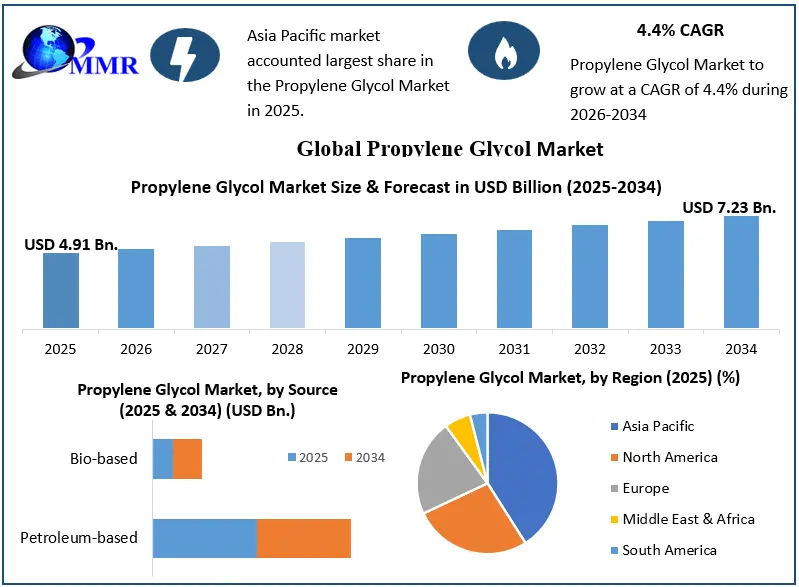
The Global Propylene Glycol Market was valued at USD 4.91 Billion in 2025 and is projected to reach USD 7.23 Billion by 2034, growing at a CAGR of 4.4% during the forecast period 2026–2034.
Propylene Glycol Market Overview:
Propylene glycol refers to a clear liquid, miscible with water and employed as a diluent, humectant, heat-transfer fluid and processing ingredient. The Global Propylene Glycol Market encompasses the propylene glycol used in food and beverages, pharmaceuticals, cosmetics, personal care, paints, coatings, plastics, resins and industrial liquids. The market size is continuously expanding due to the substance’s multifaceted applications across both consumer and industrial goods and the demand for the product is significant. The market is important since it provides a platform for a substance that controls moisture, improves product texture, enhances flavor, delivers active pharmaceutical ingredients, prevents freezing and ensures product stability. The substance is applied in diverse industries since it is versatile and relatively easy to handle and formulate.
The market is gas manufacturers shift towards higher-purity grades, bio-based propylene glycol substances, cleaner production approaches and products with enhanced quality, sustainability and compliance with stricter regulatory frameworks. The significant end-users of the substance are the food, pharmaceutical, cosmetics, personal care, chemical, automotive, construction and manufacturing industries. The former are the key buyers since they require reliable and consistent ingredients, whereas the latter groups utilize the product in producing resins, antifreeze, coolants, coatings, industrial liquids and other materials. The prime market opportunities are represented by the rising demand for personal care products, processed food items, pharmaceuticals, industrial coolants and sustainable chemical compounds. At the same time, the market gap is presented by the need for more cost-effective bio-based products and reduced reliance on traditional petroleum-based materials. For instance, propylene glycol production companies can enhance process efficiency, product purity and adopt sustainable sourcing strategies to meet market demands.
The Asia Pacific region leads the market as chemical manufacturing, pharmaceutical, personal care, construction activity and demand for industrial liquids are relatively high across China, India, Japan, Vietnam, South Korea and other countries. North America and Europe are also key areas for propylene glycol consumption due to the developed pharmaceutical, food, cosmetics, chemical, specialty chemical and manufacturing sectors. Dow, LyondellBasell, BASF, INEOS, Shell, SKC and others are the major manufacturers that offer propylene glycol across distinct applications and meet diversified industrial needs. MMR’s analysis indicates that the biggest drivers for market growth are rising downstream demand, broad industrial applications and increasing emphasis on sustainable production approaches. According to the market forecast, companies that invest in developing bio-based substances, higher-purity grades, rising Asian demand and innovative industrial applications will gain significant advantages as the market grows.
Propylene Glycols Market Growth Size, Growth & Share Analysis
To know about the Research Methodology :- Request Free Sample Report
Global Propylene Glycol Market Dynamics:
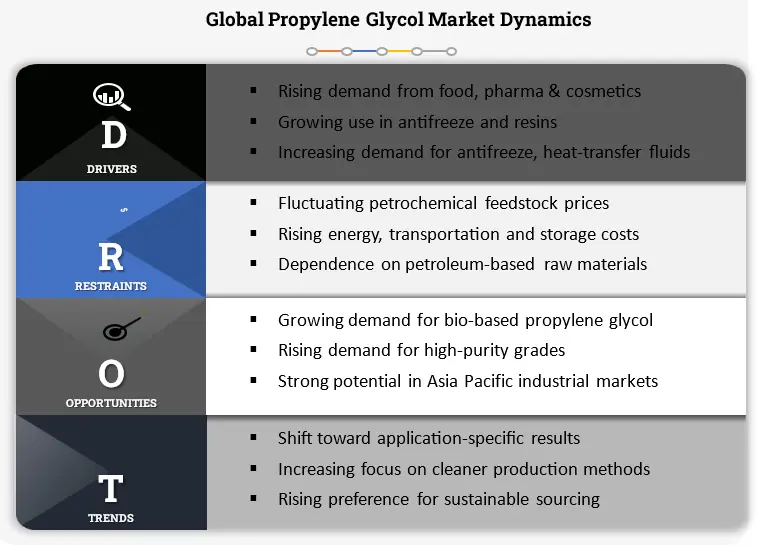
Expanding use across food, pharmaceuticals, personal care and industrial applications is accelerating Propylene Glycol Market growth.
Propylene glycol is a versatile product which serves a range of important functions such as retaining moisture, dissolving active ingredients, controlling viscosity, and facilitating heat transfer. Food and beverage producers apply the product in flavors, colors and processed foods, while manufacturers in the pharmaceutical sector make use of it in medicines, syrups and other formulations. Personal care producers utilize it in moisturizers, shampoos and cosmetics due to its ability to retain moisture and provide a desirable texture to the final formulation. Industrial firms apply propylene glycol in coolants, antifreeze solutions and various paints and resins. The breadth of customers ensures market size and stability while reducing the risk concentration in a particular end-use industry. Increasing consumer spending on processed food, healthcare and personal care products boosts material consumption and supports favorable market outlook, particularly as manufacturing activity expands in developing economies.
Changing raw material costs and dependence on petroleum-based feedstocks are limiting the smooth expansion of the Propylene Glycol Market.
Conventional propylene glycol is mainly produced from petrochemical feedstock, with production costs being highly dependent on petrochemical prices, refining costs and other related conditions. Rising feedstock prices put pressure on manufacturer margins and influence their ability to pass on increased costs to buyers, particularly in case of price-sensitive segments such as industrial applications. Energy, transportation and storage costs also constitute an additional cost pressure during production process, which could restrain suppliers’ efforts to penetrate new markets on the basis of lower prices. The challenge is more evident in markets where buyers have an option to choose between different suppliers, requiring consistent focus on sustainable sourcing and production cost optimization to support long-term market expansion.
Growing demand for bio-based and lower-impact propylene glycol is creating new market potential for manufacturers.
Chemical, cosmetics, food and other manufacturers are paying increased attention to sustainable sourcing and products with reduced environmental footprint, which constitutes an important market opportunity for suppliers of biobased or renewable feedstock rather than conventional petroleum-based products. Bio-based propylene glycol provides an opportunity to address customers which are looking to adjust purchasing policies, transform sustainability strategies and highlight product differentiation potential based on more sustainable production methods. The current gap between rising buyer interest in sustainable products and limited supply of affordable renewable feedstock in many countries creates an important opportunity for manufacturers who are able to scale production, reduce production costs and assure quality. Over the forecast period, the shift towards more sustainable production methods will also create opportunities for partnerships between chemical manufacturers, suppliers of renewable feedstock and consumer-product companies.
Maintaining product purity, regulatory compliance and consistent quality across different applications is increasing operating complexity in the Propylene Glycol Market.
Propylene glycol intended for use in food, pharmaceutical and personal care products necessitate much more rigorous quality control procedures than several industrial applications, requiring different production standards, testing, documentation and quality assurance measures according to the end-market application. The necessity to address the varying requirements across multiple industries and countries raises operational expenditure and creates additional challenges for manufacturers which target multiple markets with similar production output. Regulatory requirements for ingredients, pharmaceutical quality, chemical manufacturing and product labeling also vary between different markets, constraining the potential for global sales and complicating the supply chain management process. Limited financial and human resources prevent small manufacturers from continuous investment in testing, certification and production-process optimization. In parallel with growing emphasis on purity and traceability across multiple industries, such constraints could limit the ability of certain suppliers to participate in certain markets, creating a clear quality and compliance challenge which impacts market growth and attractiveness.
The move toward higher-purity and application-specific grades is changing the competitive direction of the Propylene Glycol Market.
Consumers are looking for products which are tailored to specific application rather than generic solutions, and this trend has significant implications for manufacturers of propylene glycol. Pharmaceutical and food manufacturers require products with highly controlled levels of purity, while cosmetics companies focus on functional characteristics such as performance in complex formulations and compatibility with skin. Industrial buyers seek products which are optimized for particular application such as coolants, heat transfer fluids and resins among others. The emphasis on product specialization encourages manufacturers to develop more focused product portfolios and build stronger relationships with customers. Higher value of specialized products enables manufacturers to differentiate on the basis of quality and performance criteria rather than price competition. As the trend gains ground, companies which offer technical support, reliable supply and specialized grades will be able to build strong market presence and increase the overall market potential by targeting areas which are underserved by generic commodity manufacturers.
Global Propylene Glycol Market Segment Analysis:
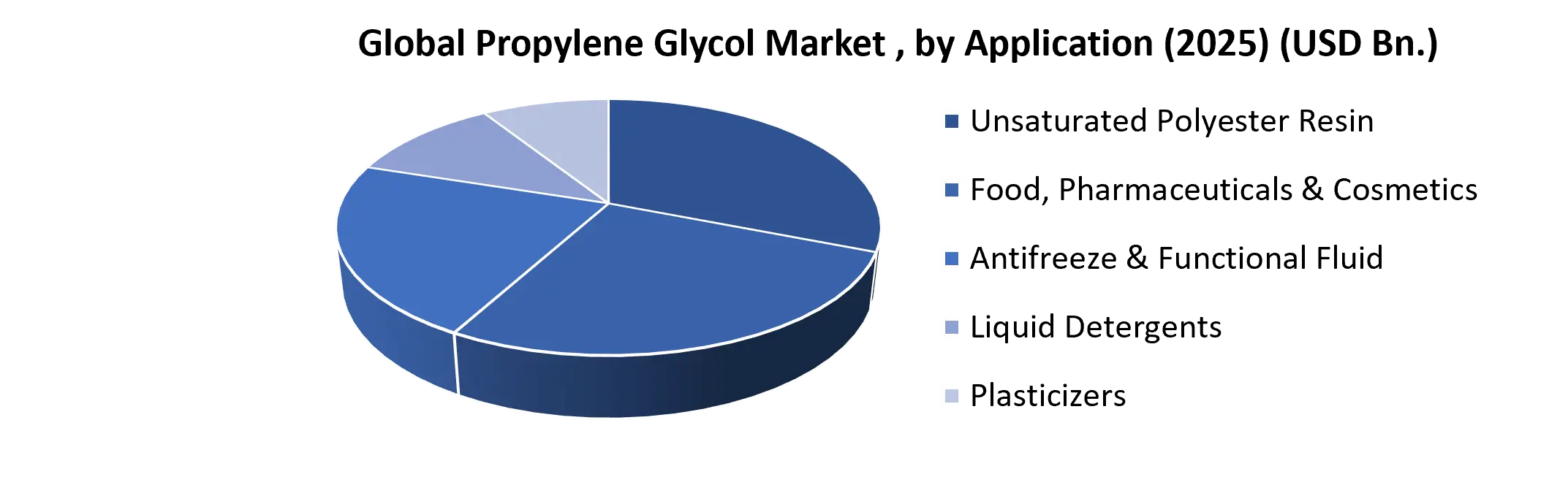
By Application, The Propylene Glycol Market is segmented into Unsaturated Polyester Resin, Food, Pharmaceuticals & Cosmetics, Antifreeze & Functional Fluid, Liquid Detergents, and Plasticizers. The application area of Unsaturated Polyester Resin influences the overall market size as propylene glycol supports the production of resins which are used in construction, automotive, marine, and industrial products. The Food, Pharmaceuticals & Cosmetics segment represents an important end use for propylene glycol as it is utilized as a carrier, moisture holder, and formulation ingredient in processed foods, medicines, creams, and personal care products. Antifreeze & Functional Fluid applications utilize propylene glycol in cooling, heat-transfer, and de-icing systems, particularly where low-toxicity fluid solutions are favored. Liquid Detergents make use of propylene glycol as a solvent and stabilizing ingredient that aids in enhancing product consistency, while Plasticizers incorporate it in chemical formulations that contribute to flexibility and processing performance. The market forecast remains positive for these application areas with growing demand from consumer products and industrial manufacturing. A key gap in the market is the availability of cost-effective high-purity and bio-based grades for specialized applications thus presenting a market opportunity for suppliers that can provide reliable quality, wider application support, and sustainable alternatives.
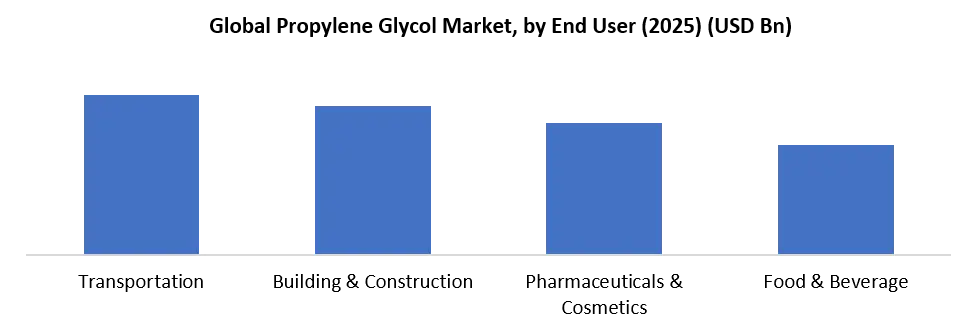
By End User, The Propylene Glycol Market is divided into Transportation, Building & Construction, Pharmaceuticals & Cosmetics, and Food & Beverage. Transportation makes use of propylene glycol in antifreeze, coolants, brake fluids, and other functional fluids thus contributing to the overall demand from automotive and mobility applications. Building & Construction incorporates it in unsaturated polyester resins, coatings, paints, and heat-transfer systems which add to the overall market size with increasing construction and infrastructure activity. Pharmaceuticals & Cosmetics represent a significant end user for propylene glycol as it serves as a solvent, moisture holder, and carrier in medicines, creams, lotions, and personal care products thus presenting a market potential for high-purity grades. Food & Beverage manufacturers incorporate it in flavors, colors, and processed food formulations with controlled quality and safe handling that influence its market demand. The market forecast remains positive as these end users continue to expand and the main gap is the limited supply of cost-effective bio-based and high-purity products which present a market opportunity for manufacturers that can offer reliable quality, specialized grades, and sustainable alternatives for these different end users.
Regional Insights:
Large Manufacturing Base Supports Strong Propylene Glycol Demand
Asia Pacific represents a significant part of the Propylene Glycol Market size due to strong chemical production, automotive activity, construction demand, and expansion of food, pharmaceutical, and cosmetics industries. This region encompasses China, India, Japan, and South Korea as important markets and the overall market forecast remains positive with increasing industrial production and consumer demand. It has strong potential for the market of high-purity and bio-based propylene glycol.
High Demand from Pharmaceuticals, Food and Functional Fluids
North America maintains a strong position in the Propylene Glycol Market due to its consistent use in pharmaceuticals, food & beverage, cosmetics, antifreeze, and industrial fluids. The United States represents a significant contributor to the regional market size due to its developed chemical and consumer-product industries. The overall market forecast remains stable while the rising interest in cleaner and sustainable formulations present additional market potential.
Sustainable and High-Purity Grades Drive Market Development
Europe exhibits steady demand for propylene glycol particularly in pharmaceuticals, cosmetics, food processing, and specialty chemical applications. Quality standards and increasing interest in sustainable materials contribute to the demand for high-purity and bio-based products which strengthen the regional market size. The market forecast is driven by cleaner production methods and specialized applications. Europe also has good potential for the market of premium and environmentally-focused grades.
Industrial and Consumer-Sector Expansion Creates New Opportunities
South America is an emerging region in the Propylene Glycol Market supported by the growth of construction, food processing, automotive, and personal care industries. It covers key markets such as Brazil and Argentina where rising industrial activity supports the gradual expansion of the market size. The regional market forecast remains positive as local manufacturing develops and limited availability of specialized grades present additional market potential for global and regional suppliers.
Construction and Industrial Growth Support Future Demand
The Middle East & Africa Propylene Glycol Market is developing as construction, industrial production, food processing, and healthcare activities increase across the region. Demand for coatings, resins, antifreeze fluids, and pharmaceutical products contribute to the gradual growth in market size. The market forecast improves as countries invest in manufacturing and infrastructure where limited local production presents strong market potential for suppliers that expand the distribution and availability of products.
Propylene Glycols Market Recent Development
| Date | Recent Development |
| September-2026 | BASF and UPC Technology Corporation have signed a strategic LoI to collaborate on LowPCF products. The agreement sets the grounds for the application of BASF LowPCF offerings in the plasticizer industry and therefore contributes to a lower-carbon future. While not PG-specific, this alliance further strengthens the role of BASF in sustainable intermediates that feature PG-related value chains. |
| September-2026 | INEOS Oxide has completed its USD 699.3M acquisition of LyondellBasell’s Ethylene Oxide & Derivatives (EO&D) business, including the Bayport, Texas site, adding significant manufacturing capacity for ethylene glycols and glycol ethers to INEOS Oxide’s global glycol portfolio. While INEOS Oxide has tapered its direct production of propylene glycol at some of its sites (e.g., Cologne in 2025), this acquisition enhances the company’s glycols and derivatives proposition. |
| May-2026 | Dow announced that its PG manufacturing facility in Map Ta Phut, Thailand, has received ISCC PLUS certification, enabling the launch of two new sustainable PG products in the Asia Pacific region: |
| January-2026 | Oleon NV has completed a merger by acquisition of Oleon Biodiesel N.V. While Oleon is primarily an oleochemicals producer (i.e., using natural fats and oils as feedstock), this merger strengthens the company’s feedstock position and therefore supports Oleon’s potential bio-based glycol initiatives, which follow industry trends to develop renewable PG alternatives. |
| September-2026 | CSPC, the joint venture between Shell and CNOOC, has taken the final investment decision for its petrochemical complex expansion in Daya Bay, Huizhou, China. The project’s integrated facilities will contribute to glycol and derivative production chains. While not PG-specific, this JV expansion supports Shell’s footprint in the glycols market, including propylene oxide and downstream derivatives. |
Global Propylene Glycol Market Scope :Inquire before buying
| Propylene Glycol Market | |||
|---|---|---|---|
| Report Coverage | Details | ||
| Base Year: | 2025 | Forecast Period: | 2026-2034 |
| Historical Data: | 2020 to 2025 | Market Size in 2025: | 4.91 USD Billion |
| Forecast Period 2026-2034 CAGR: | 4.4% | Market Size in 2034: | 7.23 USD Billion |
| Segments Covered: | by Source | Petroleum-based Propylene Glycol Bio-based Propylene Glycol |
|
| by Application | Unsaturated Polyester Resin Food, Pharmaceuticals & Cosmetics Antifreeze & Functional Fluid Liquid Detergents Plasticizers Others |
||
| by End User Industry | Transportation Building & Construction Pharmaceuticals & Cosmetics Food & Beverage Others |
||
Global Propylene Glycol Market, by Region
North America (United States, Canada and Mexico)
Europe (UK, France, Germany, Italy, Spain, Sweden, Austria and Rest of Europe)
Asia Pacific (China, South Korea, Japan, India, Australia, Indonesia, Malaysia, Vietnam, Taiwan, Bangladesh, Pakistan and Rest of APAC)
Middle East and Africa (South Africa, GCC, Egypt, Nigeria and Rest)
South America (Brazil, Argentina Rest of South America)
Propylene Glycol Market Key Players
1. Dow Inc.
2. LyondellBasell Industries N.V.
3. BASF SE
4. INEOS Oxide
5. Shell plc
6. Archer Daniels Midland Company (ADM)
7. Huntsman Corporation
8. SK picglobal Co., Ltd.
9. Repsol S.A.
10. Manali Petrochemicals Limited
11. ADEKA Corporation
12. Sumitomo Chemical Co., Ltd.
13. AGC Inc.
14. Cargill, Incorporated
15. Oleon NV
16. Global Bio-Chem Technology Group Co., Ltd.
17. Sinopec Group
18. PetroChina Company Limited
19. Reliance Industries Limited
20. LG Chem Ltd.
21. Asahi Kasei Corporation
22. Mitsui Chemicals, Inc.
23. Formosa Plastics Corporation
24. Eastman Chemical Company
25. Indorama Ventures Public Company Limited
26. Mitsubishi Chemical Group Corporation
27. SABIC
28. Sasol Limited
29. Evonik Industries AG
30. Dairen Chemical Corporation
31. Shandong Shida Shenghua Chemical Group
32. HaiKe Chemical Group
33. Zibo Haijie Chemical Co., Ltd.
34. Lihong Fine Chemicals Co., Ltd.
35. Qingdao Shida Chemical Co., Ltd.
36. KLK Temix
37. Lonza
38. Merck KGaA
39. Ashland Inc.
40. Innospec Inc.
FAQ
1. What is the current size of the Global Propylene Glycol Market?
The Global Propylene Glycol Market was valued at USD 4.91 Billion in 2025 and is projected to reach USD 7.23 Billion by 2034, growing at a CAGR of 4.4% during the forecast period 2026–2034.
2. What are the key factors driving the Global Propylene Glycol Market?
Key factors of Propylene Glycol Market are Rising use in food, pharmaceuticals, cosmetics, antifreeze, coatings and resins.
3. Which application segment holds the largest share of the Global Propylene Glycol Market?
Unsaturated Polyester Resin Application segment holds the largest share of the Global Propylene Glycol Market
4. Which region dominates the Global Propylene Glycol Market?
Asia Pacific dominated the Global Propylene Glycol Market
5. Who are the major players operating in the Global Propylene Glycol Market?
Key Players are, Dow Inc., LyondellBasell Industries N.V., BASF SE, INEOS Oxide, Shell plc, Mitsubishi Chemical Group Corporation, SABIC, Sasol Limited, Evonik Industries AG, Dairen Chemical Corporation and Other.