Pressure Control Equipment Market - Industry Structure Evaluation, Demand Drivers Analysis, Regional Growth Analysis and Identification, Competitive Positioning Review & Global Market Size Forecast to 2034

5.83%
CAGR (2026-2034)
7.56 USD Bn.
Forecast Market Size
315
Report Pages
124
Market Tables

Overview

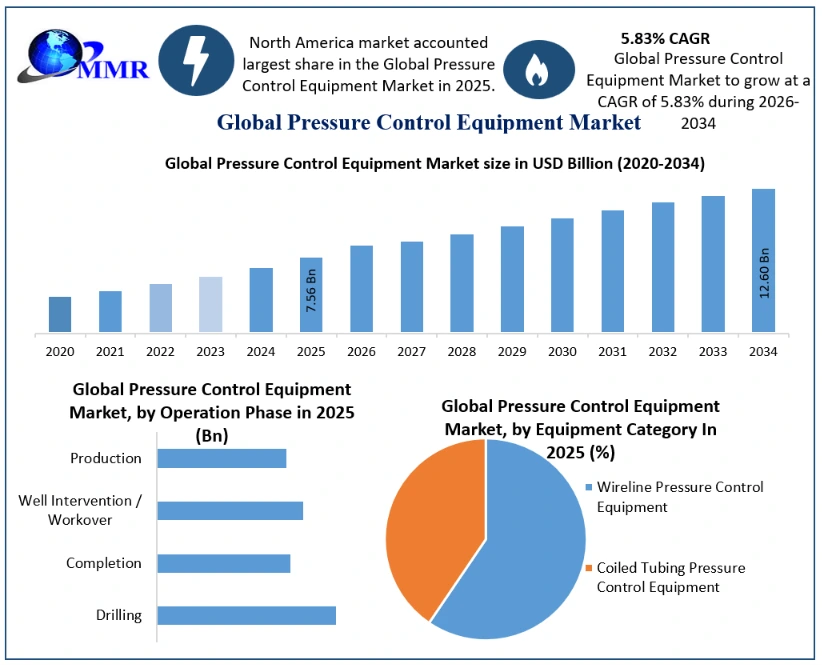
The Pressure Control Equipment Market size was valued at USD 7.56 Billion in 2025 and the total Pressure Control Equipment revenue is expected to grow at a CAGR of 5.83% from 2026 to 2034, reaching nearly USD 12.60 Billion.

Pressure Control Equipment Market Growth Outlook
Pressure Control Equipment Market Growth

To know about the Research Methodology:-Request Free Sample Report

Pressure Control Equipment Market Dynamics

Pressure Control Equipment is an equipment that supports in maintaining the ideal pressure levels inside a wellbore when any healthy intervention actions are accomplished by an operator in an easy or arduous situation. Pressure control is the simplest and most instant method of dropping leakage. But, without electronic control, a PRV (Pressure Reducing Valve) must be set up to confirm a guaranteed minimum pressure to the dangerous (usually highest) point in the network below worst-case maximum flow conditions.

Pressure control equipment is used for limiting the pressure and monitoring the flow of healthy fluids during the drilling and manufacture phase. This equipment limits the healthy fluids and gasses within the well, and its pressure mass so that they break out of possibly dangerous wellbore fluids and gases is prohibited.

The growth of this market is being powered by the technological advancement in oil field equipment, rise in global investments in examination and production (E&P), an increase in unconventional hydrocarbon production in North America. Refactoring activities in the US, besides growing actions in the offshore segment, produce new openings for pressure control equipment companies.

The pressure control equipment is contrived by following the API standard to endure high-pressure conditions. As companies are aiming at high-pressure drilling, the market for high-pressure control equipment is anticipated to grow at the highest CAGR in the forecast period.

Deficiency of expertise and limited exposure to technologies are the major issues of unease in the market. But, factors such as adapted demands by drillers, failure in drilling activities and rig total delay the market progress. Also, high-pressure and high-temperature shafts need special tools and materials. They also want extra preventive measures and knowledge as they are measured in unstable reservoir environments.

The market for offshore applications is projected to grow at a higher CAGR during the forecast period due to the demand for pressure control equipment for offshore applications is anticipated to increase. Offshore activities want progressive technology. The South China Sea, the West Australian Coast, and the Gulf of Thailand are the main hubs for offshore E&P actions in APAC.

The onshore application segment is expected to dominate in the forecast period because the occurrence of vast onshore shale investments in the US and Australia is expected to boost the demand for onshore oil fields. In the onshore rig count in North America was nearly 92%, in the Middle East it was almost 85%, and the inclination was similar for other regions as well. This has led to the employment of pressure control equipment for onshore applications, and this trend is anticipated to continue during the forecast period.

Pressure Control Equipment Market Regional Analysis

North America is expected to continue to hold the largest share of the pressure control equipment market, in terms of value. The region is the new swing manufacturer in the global oil markets owing to the efficiency in production from both shale operation and deep-water examination and invention in the Gulf of Mexico.

In June , Baker Hughes, a GE company, was awarded a united well services agreement to support a huge proportion of Equinox's drilling and healthy construction activities in the Norwegian sector of the North Sea for an unusual period of 4 years with options to spread up to 10 years. In March ,

Schlumberger and Weatherford International, PLC (Switzerland) entered into a contract to form a joint venture called OneStim. This joint scheme will offer customers in the US and Canada products and services for progressive resource plays.

Pressure Control Equipment Market Key Highlights

1. Global Pressure Control Equipment Market analysis and forecast, in terms of value.

2. Comprehensive study and analysis of market drivers, restraints and opportunities influencing the growth of the Global Pressure Control Equipment Market

3. Global Pressure Control Equipment Market segmentation on the basis of type, source, end-user, and region (country-wise) has been provided.

4. Global Pressure Control Equipment Market strategic analysis with respect to individual growth trends, future prospects along with the contribution of various sub-market stakeholders have been considered under the scope of study.

5. Global Pressure Control Equipment Market analysis and forecast for five major regions namely North America, Europe, Asia Pacific, the Middle East & Africa (MEA) and Latin America along with country-wise segmentation.

6. Profiles of key industry players, their strategic perspective, market positioning and analysis of core competencies are further profiled.

7. Competitive developments, investments, strategic expansion and competitive landscape of the key players operating in the Global Pressure Control Equipment Market are also profiled.

Pressure Control Equipment Market Recent Developments:

Date Company Development Impact
03 June 2025 Baker Hughes Baker Hughes entered into a definitive agreement with Cactus, Inc. to form a joint venture combining its surface pressure control product line with Cactus operational management. The strategic alliance expands deployment of advanced wellhead and pressure control equipment while optimizing manufacturing efficiency across North American onshore basins.
25 September 2025 SLB SLB secured a major contract from Petrobras for high-spec completion systems and integrated subsea pressure control valves across 35 pre-salt ultra-deepwater wells in Brazil. The deployment accelerates the commercial adoption of 20 kpsi-rated safety valves and digital control heads designed for extreme reservoir pressures.
01 April 2026 Halliburton Company Halliburton completed the acquisition of Sekal AS from Sumitomo Corporation to integrate dynamic managed pressure drilling (MPD) automation software into its LOGIX platform. The acquisition enhances real-time control of downhole pressure influxes, enabling automated tripping and reducing non-productive well construction time by up to 25%.
05 May 2026 Weatherford International Weatherford was awarded a multi-region contract by Noble Corporation to deploy its Victus Intelligent Managed Pressure Drilling (MPD) control systems. The agreement significantly increases global adoption of automated pressure control heads and rotating control devices across deepwater drillships.

Pressure Control Equipment Market Scope: Inquire before buying

Pressure Control Equipment Market
Report Coverage Details
Base Year: 2025 Forecast Period: 2026-2034
Historical Data: 2020 to 2025 Market Size in 2025: USD 7.56 Bn.
Forecast Period 2026 to 2034 CAGR: 5.83% Market Size in 2034: USD 12.60 Bn.
Segments Covered: by Equipment Category Wireline Pressure Control Equipment
Coiled Tubing Pressure Control Equipment
by Component Valves
  Ball Valves
  Gate Valves
  Choke Valves
  Check Valves
Blowout Preventers (BOP)
Control Heads
Wellhead Equipment
Christmas Trees / Flow Tees
Adapter FlangesQuick Unions
Flexible Hoses
Lubricators & Pack-Off Systems
Others
by Pressure Rating Low Pressure (<10,000 PSI)
High Pressure (10,000–20,000 PSI)
Ultra-High Pressure (>20,000 PSI)
by Operation Phase Drilling
Completion
Well Intervention / Workover
Production
by Sales Type New Purchase
Rental
Services
Spares & Aftermarket
by Distribution Channel Direct Sales
Indirect Sales
by Application Onshore
  Conventional Wells
  Shale & Tight Reservoirs
Offshore
  Shallow Water
  Deepwater
  Ultra-Deepwater

Pressure Control Equipment Market, by Region

North America (United States, Canada and Mexico)
Europe (UK, France, Germany, Italy, Spain, Sweden, Austria and Rest of Europe)
Asia Pacific (China, South Korea, Japan, India, Australia, Indonesia, Malaysia, Vietnam, Taiwan, Bangladesh, Pakistan and Rest of APAC)
Middle East and Africa (South Africa, GCC, Egypt, Nigeria and Rest of ME&A)
South America (Brazil, Argentina Rest of South America)

Pressure Control Equipment Market Key Players

North America:
1. SLB
2. Halliburton Company
3. Baker Hughes Company
4. NOV Inc.
5. Weatherford International plc
6. Dril-Quip, Inc.
7. Cactus, Inc.
8. Oil States International, Inc.
9. Forum Energy Technologies, Inc.
10. Curtiss-Wright Corporation
11. Brace Tool Inc.
12. BOP Products LLC
13. Control Flow Inc.
14. Lee Specialties Inc.
15. FHE USA LLC
Others

Europe:
16. TechnipFMC plc
17. Aker Solutions ASA
18. Hunting PLC
19. The Weir Group PLC
20. Proserv Group
21. IKM Pressure Control AS
22. Expro Group
23. Plexus Holdings plc
24. HydraWell AS
25. TIS Manufacturing Ltd.
26. Advanced Pressure Systems Ltd.
27. Delta Pressure Control
28. Score Group plc
29. Hunting Energy Services
30. Petrofac plc
Others

Asia-Pacific:
31. Worldwide Oilfield Machine (WOM)
32. Jiangsu Xinde Petroleum Machinery Co., Ltd.
33. CCSC Petroleum Equipment Co., Ltd.
34. Yantai Jereh Petroleum Equipment & Technologies Co., Ltd.
35. Shenkai Petroleum & Chemical Equipment Co., Ltd.
36. Shanghai Shenkai Petroleum Equipment Co., Ltd.
37. Jiangsu Rutong Petro-Machinery Co., Ltd.
38. Kerui Petroleum Equipment Co., Ltd.
39. Hilong Group
40. Honghua Group
others

Rest of World:
41. National Energy Services Reunited (NESR)
42. National Petroleum Services (NPS)
43. Al Mansoori Specialized Engineering
44. Tiger Safety Rentals
45. Gulf Energy SAOC
46. TAQA
47. Emirates Industrial Panel LLC
48. ADNOC Drilling
49. Arabian Drilling Company
50. Rawabi Oil & Gas
51. Oilexec International
52. Target Energy Solutions
53. Emirates Technical & Safety Development Centre
54. Al Shirawi Equipment Company
55. PetrolValves Middle East
Others

Frequently Asked Questions:

1. Which region has the largest share in Global Pressure Control Equipment Market?
Ans: North America region held the highest share in 2025.

2. What is the growth rate of Global Pressure Control Equipment Market?
Ans: The Global Pressure Control Equipment Market is growing at a CAGR of 5.83% during forecasting period 2026-2034.

3. What is scope of the Global Market report?
Ans: Global Market report helps with the PESTEL, PORTER, COVID-19 Impact analysis, Recommendations for Investors & Leaders, and market estimation of the forecast period.

4. Who are the key players in Global Market?
Ans: The important key players in the Global Market are – Schlumberger, National Oilwell Varco, Baker Hughes, Lee Specialties, Control Flow, Brace Tool, FHE USA Hubbell Inc., GKD Industries, Hunting, Integrated Equipment, IoT Group, Lee specialties, The IKM Group, The Weir Group, TIS Manufacturing, and Weatherford International.

5. What was the Global Pressure Control Equipment Market size in 2025?
Ans:
The Global Pressure Control Equipment Market size was USD 7.56 Billion in 2025.

Table of Contents

1. PRESSURE CONTROL EQUIPMENT MARKET FOR OIL & GAS INDUSTRY INTRODUCTION 1.1. Executive Market Landscape and Industry Overview 1.1.1. Pressure Control Equipment Market for Oil & Gas Industry size (Value USD Mn & Volume 000'Units) estimation and growth outlook (2025–2034) 1.1.2. Comprehensive definition of the Pressure Control Equipment industry ecosystem 1.1.3. Scope boundaries covering production technologies, infrastructure, and end-use applications 1.1.4. Competitive Landscape Overview: Brands, Participants, Regional Specialists, and New Entrants in the Global Pressure Control Equipment Market for Oil & Gas Industry 1.2. Pressure Control Equipment Market for Oil & Gas Industry Dynamics 1.2.1. Pressure Control Equipment Market for Oil & Gas Industry Trends 1.2.2. Pressure Control Equipment Market for Oil & Gas Industry 1.2.3. Drivers 1.2.4. Restraints 1.2.5. Opportunities 1.2.6. Challenges 1.2.7. PORTER’s Five Forces Analysis 1.2.8. Supplier power 1.2.9. Buyer power 1.2.10. Threat of substitutes 1.2.11. Threat of new entrants 1.2.12. Competitive rivalry 1.2.13. PESTLE Analysis 1.3. Design Engineering and System Configuration Assessment 1.3.1. Pressure Control Equipment Design Architecture Analysis 1.3.2. System Configuration Assessment by Application (Onshore vs Offshore) 1.3.3. Wireline Pressure Control Equipment Design Benchmarking 1.3.4. Coiled Tubing Pressure Control Equipment Configuration Analysis 1.3.5. Wellhead and Christmas Tree Integration Assessment 1.3.6. Blowout Preventer (BOP) System Design Evaluation 1.4. Regulatory Framework and Compliance Requirements Overview 1.4.1. Well Control and Pressure Containment Regulatory Framework Assessment 1.4.2. Offshore Safety and Environmental Compliance Requirements Analysis 1.4.3. Blowout Preventer (BOP) Certification and Testing Standards Assessment 1.4.4. Regional Regulatory Compliance Analysis (North America, Europe, Middle East & Asia Pacific) 1.4.5. Equipment Inspection, Recertification and Integrity Management Requirements 1.4.6. HSE (Health, Safety and Environment) Compliance Framework Assessment 1.4.7. Material Traceability and Documentation Requirements Analysis 1.5. Onshore vs. Offshore Pressure Control Equipment Demand Analysis 1.5.1. Conventional, Shale & Tight Reservoir Equipment Demand 1.5.2. Shallow Water, Deepwater & Ultra-Deepwater Equipment Demand 1.5.3. Onshore vs. Offshore Market Share Comparison 1.5.4. Equipment Demand by Drilling, Completion, Production & Well Intervention 1.5.5. Pressure Rating Requirement Comparison (Low, High & Ultra-High Pressure) 1.5.6. Offshore Floating Rigs vs. Land Rig Equipment Utilization 1.5.7. Average Equipment Requirement per Well 1.5.8. CAPEX Comparison Between Onshore & Offshore Projects 1.5.9. Regional Demand Hotspots by Basin & Country 1.6. Pricing Analysis and Cost Structure Evaluation (2025) 1.6.1. Pressure Control Equipment Pricing Analysis by Equipment Category 1.6.2. Wireline vs Coiled Tubing Equipment Price Benchmarking 1.6.3. Blowout Preventer (BOP) Pricing Assessment 1.6.4. Wellhead Equipment and Christmas Tree Pricing Analysis 1.6.5. Component-Level Price Benchmarking (Valves, Control Heads, Flanges, Quick Unions) 1.6.6. Equipment Manufacturing Cost Structure Analysis (%) 1.7. Investment and Funding Trends in Pressure Control Equipment Sector 1.7.1. Investment Trends in Pressure Control Equipment Manufacturing 1.7.2. Funding for Design Engineering and Process Project Development 1.7.3. Capital Allocation for Well Control and Intervention Equipment 1.7.4. Oilfield Service Company Investment in Pressure Control Systems 1.7.5. EPC and Commissioning Project Investment Assessment 1.7.6. Mergers, Acquisitions and Strategic Partnership Activity 1.7.7. Regional Investment Hotspots in Onshore and Offshore Projects 1.8. Innovation Trends Shaping Future Pressure Control Equipment Development 1.8.1. Smart Pressure Control Equipment Development Trends 1.8.2. Digital Monitoring and Remote-Controlled System Innovation 1.8.3. High-Pressure and Ultra-High-Pressure Equipment Advancements 1.8.4. HPHT-Compatible Equipment Design Innovation 1.8.5. Predictive Maintenance and Condition Monitoring Technologies 1.8.6. Material Innovation for Corrosion and Wear Resistance 1.8.7. Automation in Testing, Validation and Commissioning 1.9. Sustainability Trends and Environmental Impact Analysis 1.9.1. Environmental Safety Standards in Pressure Control Operations 1.9.2. Emission Reduction and Leak Prevention Technology Assessment 1.9.3. ESG Compliance in Well Control and Pressure Management Systems 1.9.4. Sustainable Material Selection and Equipment Lifecycle Assessment 1.9.5. Waste Reduction in Manufacturing and Field Operations 1.9.6. Energy-Efficient Hydraulic and Control System Design 1.9.7. Decommissioning and Equipment Recycling Practices 1.10. Demand and Consumption Pattern Analysis (2025) 1.10.1. Global Pressure Control Equipment Demand Assessment 1.10.2. Demand by Equipment Category: Wireline and Coiled Tubing 1.10.3. Component-wise Demand Analysis: Valves, BOPs, Control Heads and Wellhead Equipment 1.10.4. Onshore vs Offshore Demand Pattern Assessment 1.10.5. Demand by Operation Phase: Drilling, Completion, Intervention and Production 1.10.6. Pressure Rating-wise Consumption Pattern Analysis 1.11. Import Export Trade Flow Analysis (2025) 1.11.1. Pressure Control Equipment Import-Export Trade Flow Assessment 1.11.2. Major Exporting Regions and Manufacturing Hub Analysis 1.11.3. Wireline and Coiled Tubing Pressure Control Equipment Trade Assessment 1.11.4. Regional Trade Dependency and Supply Source Evaluation 1.11.5. Customs, Tariff and Trade Policy Impact Analysis 1.11.6. Cross-Border Logistics and Lead Time Assessment 1.11.7. Import Dependency for HPHT and Offshore Pressure Control Systems 1.11.8. Future Trade Flow Outlook and Localization Opportunities 1.12. Risk Assessment and Market Challenges Overview 1.12.1. Raw Material Price Volatility Risk 1.12.2. Supply Chain Disruption and Component Availability Challenges 1.12.3. High Equipment Cost and CAPEX Pressure 1.12.4. Regulatory Compliance and Certification Risk 1.12.5. Equipment Failure, Safety and Operational Risk 1.12.6. Project Delay and Commissioning Timeline Risk 1.12.7. Skilled Workforce and Technical Expertise Shortage 1.12.8. Oil Price Volatility Impact on Drilling Activity 1.12.9. Offshore and HPHT Operational Complexity 1.12.10. Competitive Pressure and Margin Erosion Risk 1.13. Process Project Pipeline Analysis 1.13.1. Upcoming Oil & Gas Pressure Control Projects 1.13.2. Onshore and Offshore Project Pipeline Assessment 1.13.3. Drilling, Completion and Well Intervention Project Mapping 1.13.4. EPC Contractor and Oilfield Service Project Participation 1.13.5. Design-to-Commissioning Project Timeline Assessment 1.13.6. New Installation vs Retrofit Project Pipeline 1.13.7. Deepwater and HPHT Project Opportunity Assessment 1.13.8. Regional Project Investment and Deployment Outlook 1.13.9. Equipment Demand Linked to Project Pipeline 1.13.10. Future Project Execution and Commissioning Outlook 1.14. Pressure Control Operation Phase Demand: Market Share and YoY Growth (2025–2034) 1.14.1. Drilling in Global Pressure Control Equipment Market for Oil & Gas Industry Share (%) By Region 2025 1.14.2. North America 1.14.3. Europe 1.14.4. Asia Pacific 1.14.5. Middle East and Africa 1.14.6. South America 1.14.7. Well Intervention / Workover Global Pressure Control Equipment Market for Oil & Gas Industry YoY Growth Rate (%) 2025–2034 1.14.8. Region wise Consumption of Pressure Control Equipment By Operation Phase 1.15. Growth of Pressure Control Equipment By Sales Type (2025–2034) 1.15.1. New Equipment Purchase Market Growth 1.15.2. Rental Equipment Market Growth 1.15.3. Services (Installation, Inspection & Maintenance) Growth 1.15.4. Spares & Aftermarket Parts Growth 1.15.5. Sales Type-wise Market Share (2025 vs. 2034) 1.15.6. Sales Type-wise CAGR Analysis (2025–2034) 1.15.7. Aftermarket Revenue Opportunity Assessment 1.15.8. Future Sales Mix Outlook and Growth Opportunities 1.16. Adoption & Deployment Trends 1.16.1. Onshore vs Offshore Deployment Trend Analysis 1.16.2. Wireline Pressure Control Equipment Adoption Trends 1.16.3. Coiled Tubing Pressure Control Equipment Deployment Assessment 1.16.4. High-Pressure and Ultra-High-Pressure Equipment Adoption 1.16.5. Rental vs New Purchase Deployment Trends 1.16.6. Deepwater and HPHT Equipment Deployment Analysis 1.16.7. Installation and Commissioning Deployment Patterns 1.17. Consumer Preference and Buying Behavior Analysis 1.17.1. End-User Equipment Selection Criteria 1.17.2. Preference for Rental vs New Equipment Purchase 1.17.3. Demand for High-Pressure and HPHT-Capable Equipment 1.17.4. Preference for Certified and API-Compliant Equipment 1.17.5. Buying Behavior by Oilfield Service Companies and EPCs 1.17.6. Preference for Integrated Pressure Control Systems 1.18. Digitalization Impact on Pressure Control Equipment Market for Oil & Gas Industry 1.18.1. Smart Pressure Control Equipment Adoption 1.18.2. IoT-Based Pressure Monitoring and Data Capture 1.18.3. Remote Monitoring and Control System Integration 1.18.4. Predictive Maintenance and Asset Integrity Management 1.18.5. Digital Twin Applications in Pressure Control Systems 1.18.6. Automation in Testing, Validation and Commissioning 1.19. Installation, Testing and Commissioning Assessment 1.19.1. Pressure Control Equipment Installation Process Assessment 1.19.2. Site Preparation and Infrastructure Readiness Analysis 1.19.3. Equipment Integration with Wellhead and Surface Systems 1.19.4. Installation Challenges in Onshore and Offshore Environments 1.19.5. Factory Acceptance Testing (FAT) and System Validation Assessment 1.19.6. Site Acceptance Testing (SAT) and Performance Verification Analysis 1.19.7. Pressure Testing and Leak Integrity Validation Requirements 1.19.8. Commissioning Procedures and Operational Readiness Assessment 1.20. ESG & Sustainability Assessment 1.20.1. ESG Adoption Trends in Pressure Control Equipment Industry 1.20.2. Environmental Impact Assessment of Pressure Control Operations 1.20.3. Emission Reduction and Leak Prevention Technologies Analysis 1.20.4. Equipment Safety and Operational Risk Mitigation Assessment 1.20.5. Sustainable Manufacturing and Material Sourcing Evaluation 1.20.6. Energy-Efficient Pressure Control System Design Assessment 1.20.7. Waste Management and Equipment Lifecycle Sustainability Analysis 1.20.7.1 A21 Rental vs New Purchase Market Assessment 1.20.8. Rental vs New Purchase Market Share Analysis 1.20.9. Equipment Procurement Preferences by End User 1.20.10. CAPEX vs OPEX Comparison Assessment 1.20.11. Cost-Benefit Analysis of Rental and Ownership Models 1.20.12. Rental Demand Trends in Drilling and Well Intervention Projects 1.20.13. New Equipment Purchase Trends Across Onshore and Offshore Operations 1.20.14. Fleet Availability and Equipment Utilization Assessment 1.22. Comparative Analysis: Application in Global Pressure Control Equipment Market for Oil & Gas Industry 1.22.1. Onshore vs Offshore Pressure Control Equipment Market for Oil & Gas Industry Share Analysis 1.22.2. Equipment Demand Comparison by Drilling, Completion, Intervention and Production Operations 1.22.3. Wireline vs Coiled Tubing Application Benchmarking Assessment 1.22.4. Conventional Well vs Shale Well Application Analysis 1.22.5. Offshore Shallow Water vs Deepwater vs Ultra-Deepwater Deployment Comparison 1.22.6. Pressure Rating Utilization Comparison Across Applications 1.23. Future Technology Roadmap and Innovation Assessment 1.23.1. Smart Pressure Control Equipment Development Roadmap 1.23.2. Digital Well Control and Automated Pressure Management Systems 1.23.3. AI-Based Monitoring and Predictive Maintenance Technology Assessment 1.23.4. IoT-Enabled Pressure Control Equipment Integration Trends 1.23.5. Advanced Sensor Technology and Real-Time Data Analytics Development 1.23.6. HPHT (High Pressure High Temperature) Equipment Innovation Assessment 1.23.7. Remote Operations and Autonomous Well Control System Development 1.23.8. Material Innovation for Corrosion and Wear Resistance Applications 1.23.8.1 A24 Qualification, Certification and Time-to-Market Impact 1.23.9. API Qualification and Certification Requirements Assessment 1.23.10. ASME and ISO Compliance Standards Evaluation 1.23.11. Equipment Testing, Validation and Qualification Procedures Analysis 1.23.12. Pressure Control Equipment Certification Timeline Assessment 1.23.13. Blowout Preventer (BOP) Qualification and Approval Requirements 1.23.14. Offshore Safety Certification and Regulatory Approval Analysis 1.23.15. Third-Party Inspection and Verification Requirements Assessment 1.25. Long-Term Market Evolution and Structural Shifts 1.25.1. Evolution of Pressure Control Technologies and Market Structure 1.25.2. Shift from Conventional to Smart Pressure Control Systems 1.25.3. Onshore to Offshore and Deepwater Demand Transition Analysis 1.25.4. Growth of HPHT and Complex Well Intervention Applications 1.25.5. Digitalization and Automation-Driven Industry Transformation 1.25.6. Rental Model Expansion vs Equipment Ownership Trends 1.25.7. Consolidation Trends Among OEMs and Oilfield Service Providers 1.25.8. Regional Manufacturing Localization and Supply Chain Shifts 1.26. Pressure Control Equipment Market for Oil & Gas Industry: Market size and Forecast by Segmentation (by Value USD Billion and Volume in 000'Units) (2025-2034) 1.26.1. Pressure Control Equipment Market for Oil & Gas Industry Size and Forecast, By Equipment Category 1.26.2. Wireline Pressure Control Equipment 1.26.3. Coiled Tubing Pressure Control Equipment 1.26.4. Pressure Control Equipment Market for Oil & Gas Industry Size and Forecast, By Component 1.26.5. Valves 1.26.5.2. Ball Valves 1.26.5.3. Gate Valves 1.26.5.4. Choke Valves 1.26.5.5. Check Valves 1.26.5.6. Blowout Preventers (BOP) 1.26.5.7. Control Heads 1.26.5.8. Wellhead Equipment 1.26.5.9. Christmas Trees / Flow Tees 1.26.5.10. Adapter Flanges 1.26.5.11. Quick Unions 1.26.5.12. Flexible Hoses 1.26.5.13. Lubricators & Pack-Off Systems 1.26.5.14. Others 1.26.6. Pressure Control Equipment Market for Oil & Gas Industry Size and Forecast, By Pressure Rating 1.26.7. Low Pressure (<10,000 PSI) 1.26.8. High Pressure (10,000–20,000 PSI) 1.26.9. Ultra-High Pressure (>20,000 PSI 1.26.10. Pressure Control Equipment Market for Oil & Gas Industry Size and Forecast, By Operation Phase 1.26.11. Drilling 1.26.12. Completion 1.26.13. Well Intervention / Workover 1.26.14. Production 1.26.15. Pressure Control Equipment Market for Oil & Gas Industry Size and Forecast, By Sales Type 1.26.16. New Purchase 1.26.17. Rental 1.26.18. Services 1.26.19. Spares & Aftermarket 1.26.20. Pressure Control Equipment Market for Oil & Gas Industry Size and Forecast, By Distribution Channel 1.26.21. Direct Sales 1.26.22. Indirect Sales 1.26.23. Pressure Control Equipment Market for Oil & Gas Industry Size and Forecast, By Application 1.26.24. Onshore 1.26.24.2. Conventional Wells 1.26.24.3. Shale & Tight Reservoirs 1.26.24.4. Offshore 1.26.24.5. Shallow Water 1.26.24.6. Deepwater 1.26.24.7. Ultra-Deepwater 1.26.25. Pressure Control Equipment Market for Oil & Gas Industry Size and Forecast, By Region 1.26.26. North America 1.26.27. United States 1.26.28. Canada 1.26.29. Mexico 1.26.30. Europe 1.26.31. United Kingdom 1.26.32. France 1.26.33. Germany 1.26.34. Italy 1.26.35. Spain 1.26.36. Sweden 1.26.37. Russia 1.26.38. Rest of Europe 1.26.39. Asia Pacific 1.26.40. China 1.26.41. S. Korea 1.26.42. India 1.26.43. Japan 1.26.44. Australia 1.26.45. Indonesia 1.26.46. Philippines 1.26.47. Malaysia 1.26.48. Vietnam 1.26.49. Thailand 1.26.50. Rest of Asia Pacific 1.26.51. Middle East and Africa 1.26.52. South Africa 1.26.53. Bahrain 1.26.54. Kuwait 1.26.55. Oman 1.26.56. Qatar 1.26.57. Saudi Arabia 1.26.58. United Arab Emirates (UAE) 1.26.59. Turkey 1.26.60. Egypt 1.26.61. Nigeria 1.26.62. Rest of ME&A 1.26.63. South America 1.26.64. Brazil 1.26.65. Argentina 1.26.66. Chile 1.26.67. Colombia 1.26.68. Rest Of South America 2. COMPETITIVE INTELLIGENCE & INDUSTRIAL ECOSYSTEM 2.1. Company Profiles: Key Players 2.1.1. Overview 2.1.2. Business Portfolio 2.1.3. Financial Overview 2.1.4. SWOT Analysis 2.1.5. Strategic Analysis 2.1.6. Recent Developments 2.1.6.1 North America: 2.1.1. SLB 2.1.2. Halliburton Company 2.1.3. Baker Hughes Company 2.1.4. NOV Inc. 2.1.5. Weatherford International plc 2.1.6. Dril-Quip, Inc. 2.1.7. Cactus, Inc. 2.1.8. Oil States International, Inc. 2.1.9. Forum Energy Technologies, Inc. 2.1.10. Curtiss-Wright Corporation 2.1.11. Brace Tool Inc. 2.1.12. BOP Products LLC 2.1.13. Control Flow Inc. 2.1.14. Lee Specialties Inc. 2.1.15. FHE USA LLC 2.1.15.1 Others 2.1.15.2 Europe: 2.1.1. TechnipFMC plc 2.1.2. Aker Solutions ASA 2.1.3. Hunting PLC 2.1.4. The Weir Group PLC 2.1.5. Proserv Group 2.1.6. IKM Pressure Control AS 2.1.7. Expro Group 2.1.8. Plexus Holdings plc 2.1.9. HydraWell AS 2.1.10. TIS Manufacturing Ltd. 2.1.11. Advanced Pressure Systems Ltd. 2.1.12. Delta Pressure Control 2.1.13. Score Group plc 2.1.14. Hunting Energy Services 2.1.15. Petrofac plc 2.1.15.1 Others 2.1.15.2 Asia-Pacific: 2.1.1. Worldwide Oilfield Machine (WOM) 2.1.2. Jiangsu Xinde Petroleum Machinery Co., Ltd. 2.1.3. CCSC Petroleum Equipment Co., Ltd. 2.1.4. Yantai Jereh Petroleum Equipment & Technologies Co., Ltd. 2.1.5. Shenkai Petroleum & Chemical Equipment Co., Ltd. 2.1.6. Shanghai Shenkai Petroleum Equipment Co., Ltd. 2.1.7. Jiangsu Rutong Petro-Machinery Co., Ltd. 2.1.8. Kerui Petroleum Equipment Co., Ltd. 2.1.9. Hilong Group 2.1.10. Honghua Group 2.1.11. TSC Group Holdings Ltd. 2.1.12. SPM Oil & Gas 2.1.13. Jereh Oilfield Equipment 2.1.14. Kirloskar Brothers Limited 2.1.15. Jereh Grou 2.1.15.1 Others 2.1.15.2 Rest of World: 2.1.1. National Energy Services Reunited (NESR) 2.1.2. National Petroleum Services (NPS) 2.1.3. Al Mansoori Specialized Engineering 2.1.4. Tiger Safety Rentals 2.1.5. Gulf Energy SAOC 2.1.6. TAQA 2.1.7. Emirates Industrial Panel LLC 2.1.8. ADNOC Drilling 2.1.9. Arabian Drilling Company 2.1.10. Rawabi Oil & Gas 2.1.11. Oilexec International 2.1.12. Target Energy Solutions 2.1.13. Emirates Technical & Safety Development Centre 2.1.14. Al Shirawi Equipment Company 2.1.15. PetrolValves Middle East 2.1.15.1 Others 2.2. Competitive Landscape Overview of Key Market Participants 2.2.1. Competitive Positioning and Strategic Benchmarking Assessment 2.2.2. Product Portfolio Comparison by Equipment Category 2.2.3. Wireline vs Coiled Tubing Pressure Control Equipment Capability Benchmarking 2.2.4. BOP, Valves, Control Heads and Wellhead Equipment Technology Comparison 2.2.5. Regional Presence and Manufacturing Footprint Assessment 2.2.6. Revenue Performance and Financial Strength Comparison 2.3. Company Business Strategy and Expansion Approaches 2.3.1. Product Portfolio Expansion and Diversification Strategies 2.3.2. Pressure Control Equipment Capacity Expansion Initiatives 2.3.3. Wireline and Coiled Tubing Equipment Growth Strategies 2.3.4. Regional Expansion and Market Penetration Approaches 2.3.5. Offshore, Deepwater and HPHT Market Development Strategies 2.3.6. Strategic Partnerships, Joint Ventures and Collaboration Analysis 2.3.7. Mergers, Acquisitions and Technology Integration Strategies 2.3.8. Rental Services and Aftermarket Business Expansion Approaches 2.4. Product Portfolio Analysis of Leading Market Players 2.4.1. Product Portfolio Assessment by Equipment Category 2.4.2. Wireline Pressure Control Equipment Portfolio Benchmarking 2.4.3. Coiled Tubing Pressure Control Equipment Portfolio Analysis 2.4.4. Blowout Preventer (BOP) Product Portfolio Evaluation 2.4.5. Valves and Pressure Management Solutions Portfolio Assessment 2.4.6. Control Heads, Lubricators and Pack-Off Systems Portfolio Analysis 2.4.7. Wellhead Equipment and Christmas Tree Product Portfolio Review 2.4.8. High-Pressure and Ultra-High-Pressure Equipment Portfolio Benchmarking 2.5. Revenue Performance and Financial Analysis Overview 2.5.1. Historical Revenue Growth Trend Assessment (2020–2025) 2.5.2. Revenue Contribution Analysis by Equipment Category 2.5.3. Wireline vs Coiled Tubing Equipment Revenue Benchmarking 2.5.4. Product Sales vs Rental Revenue Distribution Assessment 2.5.5. Service and Aftermarket Revenue Contribution Analysis 2.5.6. Offshore vs Onshore Revenue Performance Comparison 2.5.7. Regional Revenue Distribution and Market Penetration Assessment 2.6. Future Strategic Outlook of Leading Market Players 2.6.1. Product Portfolio Expansion and Diversification Outlook 2.6.2. Pressure Control Equipment Capacity Expansion Roadmap 2.6.3. Wireline and Coiled Tubing Equipment Growth Strategy Assessment 2.6.4. Offshore, Deepwater and HPHT Market Penetration Outlook 2.6.5. Digital Pressure Control and Smart Well Technology Roadmap 2.6.6. AI, IoT and Remote Monitoring Integration Strategy Assessment 2.6.7. Fleet and Asset Integrity Management Solution Expansion Outlook 2.6.8. Strategic Partnerships, Joint Ventures and Collaboration Trends 3. STRATEGIC RECOMMENDATION 3.1. Key Findings 3.2. Analyst Recommendation 3.3. Research Methodology

Custom Market Research Services

We Will Customise The Research For You, In Case The Report Listed Above Does Not Meet With Your Requirements