
Prescription Drug Market – Global Market Size, Strategic Growth Drivers, Risk Assessment Framework, Regulatory Landscape Review, Competitive Intensity Mapping & Long-Term Industry Outlook to 2032
Overview
Prescription Drug Market size was valued at USD 1546.25 Bn in 2025 and the total Global Prescription Drug Market size is expected to grow at a CAGR of 6.76% from 2026 to 2032, reaching nearly USD 2444.22 Bn by 2032.
Prescription Drug Market Overview:
A prescription drug is a medication that requires a doctor's authorization for purchase and use, ensuring safe and controlled consumption for treating specific medical conditions. The global prescription drug market is expanding due to rising chronic diseases, an aging population, and increased healthcare spending, with a strong focus on innovative therapies like biologics and specialty drugs. Demand remains high, particularly for treatments related to diabetes, cardiovascular diseases, and cancer, while availability is influenced by regulatory approvals, supply chain efficiency, and pharmaceutical R&D investments.
Telemedicine and digital prescriptions are reshaping distribution, boosting online pharmacy growth post-pandemic. Government initiatives (e.g., Medicare in the U.S., Ayushman Bharat in India) and insurance coverage expansions significantly influence affordability and demand. North America dominates the market, with the U.S., Canada, and Mexico leading in consumption. Key players include Pfizer, Novartis, Roche, Johnson & Johnson, and Merck, who drive growth through drug development and strategic acquisitions. End users such as hospitals, retail pharmacies, and individual patients contribute significantly, with hospitals being the largest consumers due to high inpatient and outpatient prescription volumes. 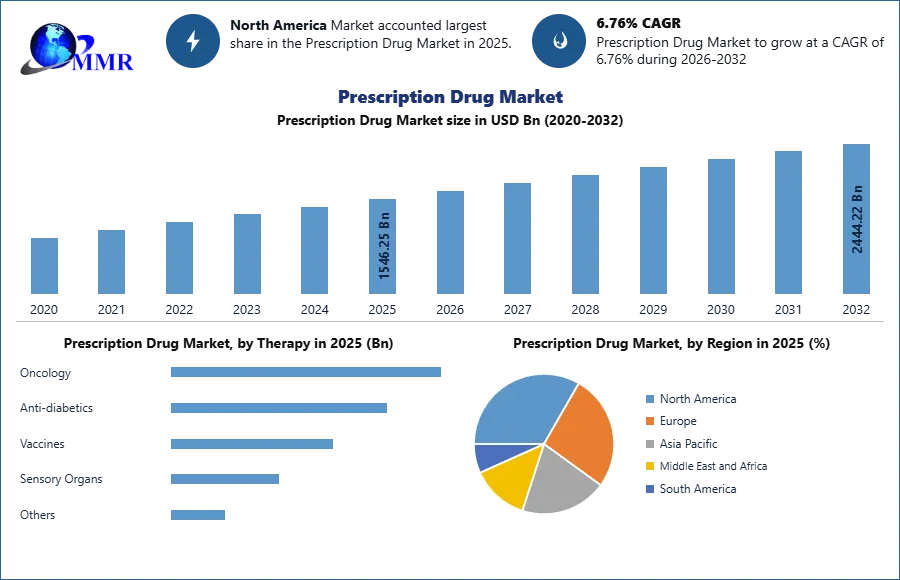 To know about the Research Methodology :- Request Free Sample Report
Prescription Drug Market Dynamics:
Increasing Investment in R&D to Boost Prescription Drug Market
An important trend in the market for prescription pharmaceuticals is the rise in R&D expenditures by well-known corporations for the creation of novel Drugs. This is largely due to the rising incidence of various chronic diseases on a worldwide scale. Due to their unmet clinical demands and desire for favourable clinical outcomes, this has increased patient demand. Many of these chronic illnesses are frequently resistant, thus administering severe prescription therapy is necessary. Major pharmaceutical corporations have been compelled by this to regularly participate in clinical studies for the development and, eventually, the approval of new drugs. A growing number of significant manufacturers are turning their attention to the creation of medicines to treat uncommon illnesses. This is expected to accelerate market growth even more. This is expected to further increase the market growth of these drugs during the forecast period.
Increasing demand for a Generic Drug to Drive the Prescription Drug Market
A fundamental element propelling the market for prescription drugs is the rise in the number of generic versions of various important drugs being introduced in developed nations like the U.S. The rise in the use of these generic substitutes is mostly attributable to the fact that they are frequently just as effective as their brand-name counterparts and can frequently be obtained by patients for a fraction of the price. Due to financial restrictions, patients frequently use these Drugs and have better clinical results than those who have access to more expensive prescription treatments.
High Cost Associated with some Prescription Drugs to Restrain the Prescription Drug Market
Despite the rising frequency of serious diseases like cancer and cardiovascular disease worldwide and their high prevalence in emerging nations like Africa, North America, and Asia, there are several constraints preventing the development of drugs that are adaptable to these situations. High costs linked with particular prescription drugs are one of the main reasons limiting the market's growth. Most patients reported having difficulty paying for prescription drugs, it has been discovered. The price of prescription medicine ranges from US$100,000 to US$500,000 in certain cases. Thus, throughout the forecast period, the growth of the prescription market may be restrained by rising prescription drug costs.
Expansion into Biosimilars to Create Opportunities in the Prescription Drug Market
The biosimilars market presents a compelling opportunity, with 120+ FDA-approved biosimilars as of 2025 and $100 billion in biologic patents expiring by 2026, creating massive substitution potential. Adoption is accelerating, with biosimilar penetration reaching 70% in Europe for drugs like infliximab, while the U.S. market is catching up rapidly—biosimilar use grew 45% year-over-year in 2023 due to payer mandates. These copycat biologics deliver 30-50% cost savings versus originators, with projections suggesting $250 billion in cumulative healthcare savings globally by 2032. Emerging markets like India and China are driving volume growth, with domestic biosimilar manufacturers capturing 60% market share in price-sensitive regions. The segment also benefits from expanded FDA approval pathways, with 90% of new biosimilar applications receiving priority review in 2025.
Prescription Drug Market Segment Analysis:
Based on Type, the Prescription Drug Market is segmented into Generic, Orphan, and other drugs. Generic drugs dominate the prescription market by volume, accounting for 90% of all dispensed medications globally while representing just 20% of total pharmaceutical spending (USD 150 billion of USD 1.1 trillion in 2024). This dominance stems from massive cost savings (80-95% cheaper than branded drugs), widespread patent expirations (180+ blockbusters losing protection by 2026), and government policies mandating generic substitution.
Based on the Distribution Channels, the Prescription Drug Market is segmented into Hospital Pharmacies, Retail Pharmacies & Drug Stores, and Online Pharmacies. Hospital Pharmacies dominates the distribution channel segment in 2024. One of the main factors contributing to the hospital pharmacy segment's dominance is the fact that the therapies listed under prescription pharmaceuticals are frequently only able to be prescribed in a hospital environment under the supervision of qualified medical personnel. Additionally, several drugs for the treatment of serious illnesses including cancer and orphan diseases can only be given intravenously by qualified medical personnel. Improved clinical results are frequently the result of such efficient therapeutic delivery, which frequently enables the successful management and treatment of serious illnesses.
Prescription Drug Market Regional Insights:
North America dominated the Prescription Drug Market. In 2024, North America, particularly the United States, continues to dominate the global prescription drug market, accounting for 48% of global pharmaceutical R&D spending (over 100 billion annually) and housing 9 of the world’s top 20 pharma companies (e.g., Pfizer, Merck, J&J). The region’s dominance is reinforced by its high drug pricing (U.S. drug costs are 2.5x higher than other OECD nations) and FDA approvals, which accounted for 55% of global new drug launches in 2023.
Additionally, biologic drugs (70% of U.S. prescription spending) and specialty medicines (e.g., GLP-1 agonists like Ozempic) drive revenue, with the U.S. alone representing 80% of global GLP-1 sales. Patent protections and orphan drug designations (50% of global orphan drugs are U.S.-developed) further cement its lead, while Canada’s public-private healthcare system sustains steady demand. Meanwhile, pharmacy benefit managers (PBMs) like CVS Caremark control ~80% of U.S. prescription distribution, amplifying market influence.
Prescription Drug Market Competitive landscape
In 2025, Johnson & Johnson (J&J) remains a dominant force in the global prescription drug market, leveraging its pharmaceutical segment (Johnson & Johnson Innovative Medicine) to compete with rivals like Pfizer, Roche, and Novartis. J&J’s key growth drivers include its oncology portfolio (e.g., Darzalex for multiple myeloma, with USD 12B+ projected 2025 sales) and immunology blockbusters like Stelara (ustekinumab), which generated USD 11B in 2023 and faces biosimilar competition post-patent expiry. The company is investing USD 15B+ annually in R&D, focusing on cell/gene therapies and cardiometabolic drugs (e.g., Invokana).
Key trends in the Prescription Drug Market
• Rise of GLP-1 Agonists & Obesity Drugs – Drugs like Ozempic (semaglutide) and Zepbound (tirzepatide) dominate growth, with the anti-obesity market projected to exceed USD 100B by 2026.
• Biosimilar Boom & Patent Cliffs – USD 100B+ in biologics face biosimilar competition (e.g., Humira, Stelara), driving cost reductions and market shifts.
• AI & Precision Medicine – AI-driven drug discovery accelerates R&D, while personalized therapies (e.g., CAR-T, gene editing) gain FDA approvals.
Recent Industry Developments (2025–2026)
| Exact Date | Company | Development | Impact |
|---|---|---|---|
| 24 February 2026 | Sanofi | Sanofi and Regeneron received FDA approval for Dupixent as the first and only medicine for allergic fungal rhinosinusitis. | The approval expands the therapeutic reach of the blockbuster drug into underserved immunology markets. |
| 03 February 2026 | Pfizer Inc. | Pfizer confirmed plans to start 20 key pivotal clinical trials in 2026, including ten trials for ultra-long-acting obesity assets. | This aggressive R&D roadmap strengthens Pfizer's competitive position in the high-growth metabolic disorder segment. |
| 29 January 2026 | Sanofi | Sanofi announced the acquisition of Dynavax to bolster its vaccine and immunology portfolio. | The deal enhances Sanofi's market share in specialty therapeutics and long-term pipeline sustainability. |
| 16 October 2025 | Merck KGaA | Merck signed a definitive agreement to acquire the chromatography business of JSR Life Sciences to expand purification solutions for monoclonal antibodies. | The integration will accelerate biomanufacturing efficiency for critical oncology and autoimmune prescription drugs. |
| 30 September 2025 | Pfizer Inc. | Pfizer reached a landmark agreement with the U.S. government to lower drug costs while committing $70 billion to domestic R&D and capital projects. | This strategic shift balances regulatory compliance with massive investment to secure innovation leadership in the U.S. market. |
| 22 April 2025 | F. Hoffmann-La Roche Ltd. | Roche announced a $50 billion investment in the United States over five years for new R&D hubs and manufacturing facilities. | The expansion establishes a robust supply chain infrastructure for next-generation gene therapies and weight-loss medicines. |
Prescription Drug Market Scope: Inquiry Before Buying
| Prescription Drug Market | |||
|---|---|---|---|
| Report Coverage | Details | ||
| Base Year: | 2025 | Forecast Period: | 2026-2032 |
| Historical Data: | 2020 to 2025 | Market Size in 2025: | 1546.25 USD Bn |
| Forecast Period 2026-2032 CAGR: | 6.76% | Market Size in 2032: | 2444.22 USD Bn |
| Segments Covered: | by Type | Generics Orphan Other Prescription Drugs |
|
| by Therapy | Oncology Anti-diabetics Vaccines Sensory Organs Others |
||
| by Distribution Channels | Hospital Pharmacies Retail Pharmacies & Drug Stores Online Pharmacies Other |
||
Prescription Drug Market, by region
North America (United States, Canada and Mexico)
Europe (UK, France, Germany, Italy, Spain, Sweden, Austria and Rest of Europe)
Asia Pacific (China, South Korea, Japan, India, Australia, Indonesia, Malaysia, Vietnam, Taiwan, Bangladesh, Pakistan and Rest of APAC)
Middle East and Africa (South Africa, GCC, Egypt, Nigeria and Rest of ME&A)
South America (Brazil, Argentina Rest of South America)
Key players/ competitors profile covered in brief in Prescription Drug Market report in strategic perspective
- Mylan N.V.
- Pfizer Inc.
- Merck & Co., Inc.
- Bristol-Myers Squibb Company
- Gilead Sciences, Inc.
- Johnson & Johnson Private Limited
- Amgen Inc.
- Eli Lilly and Company
- F. Hoffmann-La Roche Ltd.
- Teva Pharmaceutical Industries Ltd.
- Sanofi
- Novartis AG
- AstraZeneca
- GlaxoSmithKline plc
- AbbVie Inc.
- Bayer AG
- Boehringer Ingelheim International GmbH
- Dr. Reddy's Laboratories Ltd.
- Hikma Pharmaceuticals PLC
- Lupin
- Sun Pharmaceutical Industries Ltd.
- Takeda Pharmaceutical Company Limited
- Novo Nordisk A/S
- Biogen Inc.
- Merck KGaA