
Global Pre-Insulated Pipes Market Size by By Material, By Pipe Configuration, By Installation, By End-User, by Region and Forecast 2034
Overview
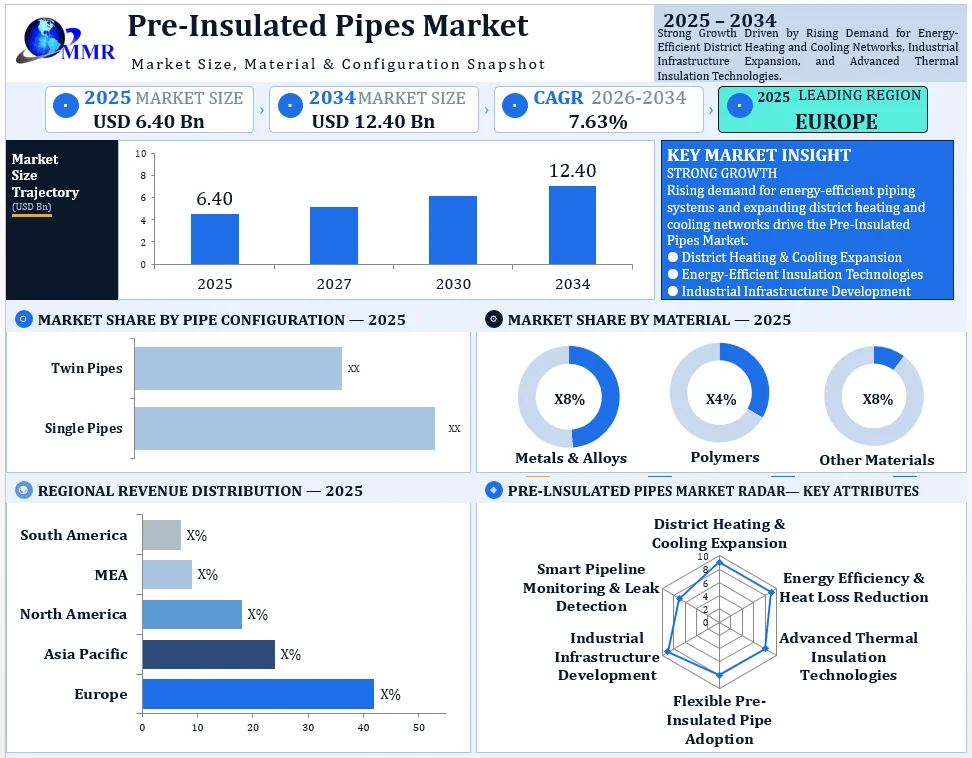
The Global Pre-Insulated Pipes Market was valued at USD 6.40 billion in 2025 and is projected to reach USD 12.40 billion by 2034, growing at a CAGR of 7.63% during the forecast period 2026–2034.
|
Parameter |
Value |
|
Market |
USD 6.40 billion |
|
Market |
USD 12.40 |
|
CAGR |
7.63% |
|
Historical |
2020 to 2025 |
|
Forecast |
2026 to |
Global Pre-Insulated Pipes Market Overview:
The Global Pre-Insulated Pipes Market comprises the manufacturing, distribution and installation of insulated piping systems designed to transport hot and cold fluids while minimizing heat transfer and energy losses. These systems generally consist of an inner carrier pipe, a thermal insulation layer and an external protective jacket, providing durability, temperature stability and efficient fluid transportation across different operating environments. Pre-insulated pipes are widely used in district heating and cooling networks, oil and gas infrastructure, industrial processing, residential buildings and commercial facilities. The global market was valued at USD 6.40 billion in 2025 and is projected to reach USD 12.40 billion by 2034, registering a CAGR of 7.63% during 2026–2034. This forecast reflects the increasing adoption of energy-efficient pipeline infrastructure, growing demand for thermal insulation solutions and investments in modern utility networks.
The Global Pre-Insulated Pipes Market is experiencing steady growth as governments, utility providers and industrial operators increasingly prioritize energy conservation, infrastructure modernization and sustainable heating and cooling solutions. Rising investments in district heating and cooling networks, expanding urban infrastructure, industrial energy-efficiency requirements and the replacement of conventional pipeline systems are creating favourable market opportunities. Asia Pacific represents a leading regional market, supported by extensive urban development, expanding district heating infrastructure and increasing investments in energy-efficient utility systems across China, India and other developing economies. Europe also maintains strong demand due to its established district energy infrastructure and focus on reducing thermal energy losses. Furthermore, technological improvements in polyurethane insulation, flexible piping systems, corrosion protection and advanced pipeline monitoring are strengthening product performance and supporting the long-term expansion of the pre-insulated pipes industry
The Maximize Market Research report on the Global Pre-Insulated Pipes Market provides a comprehensive assessment of industry performance, market size, growth trends and future opportunities across major geographical regions. The study examines key market segments based on product type, pipe material, application, installation type and end-use industry to identify revenue contributions, demand patterns and emerging growth areas. It also evaluates important market dynamics, including growth drivers, restraints, challenges, technological developments and investment opportunities influencing the global pre-insulated piping industry. In addition, the report provides regional market assessments covering North America, South America, Europe, Asia Pacific, and the Middle East & Africa, along with competitive landscape analysis, market positioning, strategic developments and future demand forecasts.
Global Pre-Insulated Pipes Market Key Highlights:
1. Market Size and Growth: The Global Pre-Insulated Pipes Market was valued at USD 6.40 billion in 2025 and is projected to reach USD 12.40 billion by 2034, registering a CAGR of 7.63% during 2026–2034.
2. Flexible Pipes Segment: Flexible pre-insulated pipes accounted for 72.2% of the global market in 2024, supported by their installation flexibility, reduced labour requirements and suitability for residential and commercial heating networks.
3. Commercial End-Use Segment: The commercial segment held 43.8% market share in 2024, driven by increasing demand for energy-efficient heating and cooling infrastructure in offices, hospitals, hotels and commercial buildings.
4. Regional Market Leadership: Asia Pacific dominated the global pre-insulated pipes industry with a 39.96% revenue share in 2024, supported by urbanization, infrastructure development and expanding district heating networks.
5. District Heating and Cooling Demand: Growing investments in centralized heating and cooling infrastructure are strengthening demand for pre-insulated piping systems, particularly for efficient thermal energy distribution and reduced pipeline heat losses.
6. Technological Advancements: Developments in polyurethane insulation, high-density polyethylene protective jackets, corrosion-resistant carrier pipes and flexible piping technologies are improving thermal performance, operational reliability and product durability.
7. Industrial Infrastructure Expansion: Increasing investments in oil and gas facilities, chemical processing plants, power generation infrastructure and industrial pipeline networks are creating additional opportunities for pre-insulated pipe manufacturers.
To know about the Research Methodology:-Request Free Sample Report
Global Pre-Insulated Pipes Market Dynamics:
Market Drivers: Rising Demand for Energy-Efficient Heating and Cooling Infrastructure Is Driving Market Growth
Increasing demand for energy-efficient district heating and cooling networks is driving the Global Pre-Insulated Pipes Market. Growing urbanization, industrial development and smart city projects are encouraging the adoption of advanced piping systems that minimize thermal losses during hot and chilled water transportation. District heating networks already serve more than 600 million people worldwide, creating demand for efficient pipeline infrastructure. Pre-insulated pipes offer improved thermal performance, reduced energy wastage and lower maintenance requirements, making them suitable for residential, commercial and industrial applications.
Market Restraints: High Installation Costs and Raw Material Price Fluctuations Are Restricting Market Expansion
High initial investment and fluctuating raw material prices remain major restraints in the Global Pre-Insulated Pipes Market. The manufacturing of these systems requires steel carrier pipes, polyurethane insulation and protective polymer jackets, increasing production costs compared with conventional piping solutions. Additionally, expenses associated with excavation, welding, joint insulation and installation can increase overall project budgets. Volatility in steel and petrochemical-based material prices also creates cost pressures for manufacturers and limits adoption among budget-sensitive infrastructure developers.
Market Opportunities: Expansion of District Energy Networks Is Creating New Growth Opportunities
Increasing investments in district heating and cooling infrastructure, renewable energy integration and industrial modernization are creating attractive opportunities in the Global Pre-Insulated Pipes Market. The expansion of geothermal heating, solar thermal systems, industrial waste heat recovery and large-scale heat pumps is increasing demand for efficient thermal transportation solutions. Emerging economies, particularly across Asia Pacific, are offering growth potential through urban development and infrastructure expansion. Demand for flexible pre-insulated pipes, advanced insulation materials and smart pipeline monitoring systems is further strengthening future market opportunities.
Market Challenges: Technical Installation Requirements and Quality Standards Are Creating Industry Challenges
Maintaining insulation performance, pipeline durability and installation quality remains a key challenge in the Global Pre-Insulated Pipes Market. Improper joint insulation, moisture penetration and damage to protective jackets can reduce thermal efficiency and increase maintenance requirements. Manufacturers must also comply with stringent international quality and safety standards while maintaining consistent product performance. Additionally, large-scale pipeline projects require skilled labour, specialized installation equipment and effective engineering coordination, which can increase project complexity and affect implementation timelines.
Global Pre-Insulated Pipes Market Trends:
|
Key Market Trends |
Product and Technology Insights |
Market Impact and Growth Opportunities |
|
Growing Adoption of District Heating and Cooling Networks |
Increasing use of pre-insulated steel pipes and polyurethane |
Creates demand for energy-efficient pipeline infrastructure |
|
Development of Advanced Insulation Materials |
Improvements |
Supports |
|
Rising Demand for Flexible Pre-Insulated Pipes |
Flexible piping solutions are gaining attention for underground |
Reduces installation complexity and creates opportunities in |
|
Integration of Renewable Energy Systems |
Pre-insulated |
Expands |
|
Increasing Adoption of Smart Pipeline Monitoring |
Advanced leak detection, temperature sensors and digital |
Encourages predictive maintenance, operational efficiency and |
|
Expansion of Industrial Thermal Networks |
High-performance |
Strengthens |
Global Pre-Insulated Pipes Market Segment Analysis:
By Installation
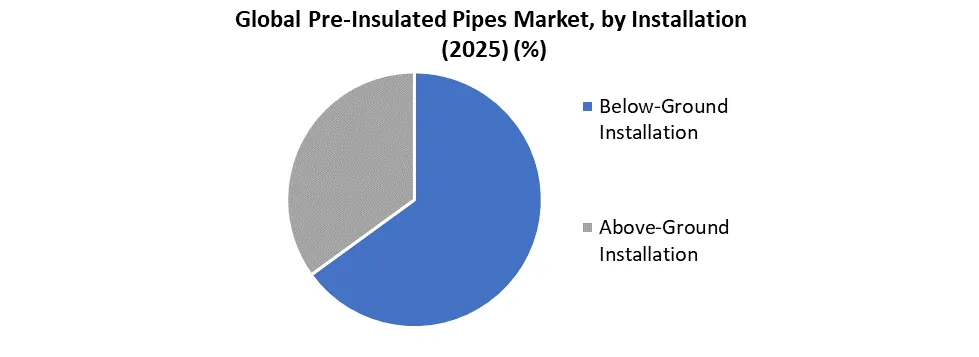
The pre-insulated pipes market is segmented into below-ground and above-ground installations based on pipeline deployment methods and application requirements. Below-ground installation is widely used in district heating and cooling networks, underground utility distribution, and industrial pipeline systems, where pre-insulated pipes help minimise heat loss, protect carrier pipes from soil moisture and external environmental conditions, and improve long-term thermal efficiency. Growing investments in underground energy infrastructure, urban utility networks, and energy-efficient district heating systems are supporting segment demand. Above-ground installation is commonly adopted across industrial facilities, power generation plants, oil and gas infrastructure, and processing units where pipelines require easy inspection and maintenance access. These pre-insulated piping systems help maintain fluid temperatures, reduce energy losses, and improve operational efficiency, supported by industrial modernisation and expansion of processing infrastructure.
By End-Use Industry
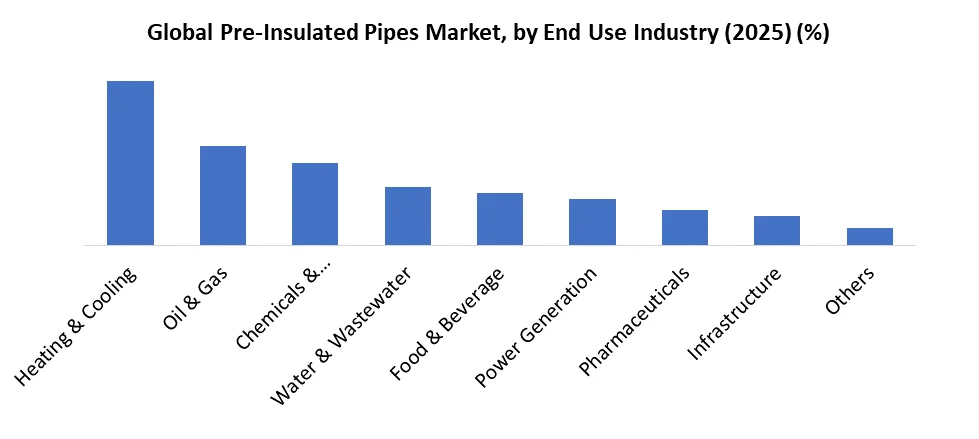
The pre-insulated pipes market is segmented by end-use industry into District Heating & Cooling, Oil & Gas, Chemicals & Petrochemicals, Food & Beverage Processing, Pharmaceuticals, Water & Wastewater Treatment, Power Generation, General Infrastructure, and Other Industries. District heating and cooling networks use pre-insulated pipes to distribute hot and chilled water efficiently between central energy plants and buildings while minimising thermal losses. The oil and gas industry relies on insulated piping for temperature-sensitive fluid transportation across production and processing facilities. Chemicals and petrochemicals use these systems to maintain process temperatures and improve thermal efficiency, while food and beverage processing facilities require reliable temperature control for hygienic production and fluid handling. Pharmaceutical manufacturing adopts pre-insulated pipes to support controlled processing conditions and consistent fluid temperatures. Water and wastewater treatment facilities use them in heated water distribution and thermal treatment applications. Power generation plants require insulated piping for thermal fluid transportation and auxiliary operations. General infrastructure covers building utility networks, commercial developments, and institutional facilities outside the separately classified industries, while other industries include mining, marine, and specialised manufacturing applications. Growing investments in energy-efficient infrastructure, industrial modernisation, and advanced thermal management systems are supporting demand across these end-use segments.
Global Pre-Insulated Pipes Market Reginal Insights:
Europe holds a leading position in the global pre-insulated pipes market, supported by established district heating and cooling networks, energy-efficiency regulations, and continuous modernisation of thermal infrastructure. Countries such as Germany, Denmark, Sweden, Finland, and Poland demonstrate strong demand for pre-insulated piping systems used in residential heating, commercial buildings, and industrial facilities. The region's focus on reducing heat losses, integrating renewable energy sources, and developing low-carbon heating networks is encouraging the adoption of advanced insulation materials and durable pipeline solutions. Replacement of ageing district energy infrastructure and investments in sustainable urban development continue to create opportunities for the European pre-insulated pipes industry.
Asia Pacific represents a major growth market for pre-insulated pipes, driven by rapid urbanisation, industrial expansion, infrastructure development, and increasing investments in energy-efficient pipeline systems. China plays a significant role through its extensive district heating networks and urban utility infrastructure, while India is witnessing rising demand from industrial facilities, commercial developments, and expanding urban infrastructure. Japan, South Korea, and Australia also contribute through investments in advanced building services, industrial thermal management, and efficient energy distribution. Growing adoption of district heating and cooling systems, expansion of manufacturing facilities, and increasing awareness of thermal insulation benefits are strengthening the Asia Pacific pre-insulated pipes market.
North America maintains steady demand in the pre-insulated pipes market, supported by infrastructure modernisation, energy-efficiency initiatives, and the development of district heating and cooling systems. The United States represents a key market due to investments in institutional campuses, commercial buildings, industrial processing facilities, and oil and gas infrastructure. Canada contributes through district energy networks, sustainable construction projects, and heating infrastructure suited to colder climatic conditions. Mexico offers additional opportunities through industrial development and utility infrastructure expansion. Increasing demand for energy-efficient piping solutions, reliable thermal insulation, reduced heat loss, and long-lasting pipeline systems is supporting the adoption of pre-insulated pipes across the region.
South America is an emerging market for pre-insulated pipes, supported by infrastructure development, industrial expansion, and increasing demand for efficient fluid transportation systems. Brazil represents a significant opportunity through its oil and gas industry, food processing facilities, industrial infrastructure, and urban utility projects. Argentina and Chile are also contributing through investments in energy infrastructure, mining operations, and industrial processing facilities. Although district heating and cooling adoption remains less established than in Europe, growing interest in energy-efficient pipeline systems and improved thermal management is creating new market opportunities. Infrastructure modernisation, industrial development, and demand for durable insulation solutions are expected to support the South American pre-insulated pipes market.
The Middle East & Africa pre-insulated pipes market is gaining traction through investments in district cooling networks, oil and gas infrastructure, industrial facilities, and large-scale urban development projects. Saudi Arabia and the United Arab Emirates are important markets due to expanding commercial developments, district cooling systems, and energy-efficient infrastructure initiatives. Qatar also contributes through investments in cooling networks and industrial infrastructure, while South Africa and Egypt offer opportunities in water infrastructure, industrial processing, and utility development. Growing demand for thermal insulation, efficient chilled-water distribution, reduced energy losses, and reliable pipeline performance is supporting the adoption of pre-insulated piping systems across the region.
Global Pre-Insulated Pipes Market Recent Developments:
|
Date |
Company / |
Recent |
Market |
|
November 2026 |
Romont |
An |
Supports |
|
October 2026 |
Grobbendonk Heating |
A flexible heating pipe |
Highlights the benefits of |
|
September 2026 |
European |
An |
Strengthens |
|
May 2026 |
Flexible Pipe System Manufacturer |
A flexible pre-insulated pipe solution was |
Expands product applications and supports demand |
|
February 2026 |
Flexible Pipe |
A reinforced |
Highlights product |
Global Pre-Insulated Pipes Market Competitive Landscape:
The global pre-insulated pipes market is characterised by competition among established pipe manufacturers, specialised insulation solution providers, and regional infrastructure suppliers. Market participants are strengthening their competitive positions through product innovation, manufacturing expansion, strategic partnerships, and acquisitions. Competition is largely influenced by product quality, thermal insulation performance, pipe durability, corrosion resistance, installation flexibility, and project execution capabilities. Companies are increasingly focusing on advanced polyurethane insulation, flexible pre-insulated piping systems, twin-pipe configurations, and protective outer jackets to address the requirements of district heating and cooling networks, oil and gas infrastructure, and industrial applications. Growing demand for energy-efficient pipeline systems and reduced heat-loss solutions is encouraging manufacturers to expand their product portfolios and strengthen distribution networks across international markets.
The competitive landscape is also being shaped by strategic acquisitions, joint ventures, and manufacturing investments. In September 2026, Elydan Group acquired Radpol Pipes, a Polish manufacturer of pre-insulated piping systems for district heating and cooling networks, strengthening its European product portfolio and manufacturing capabilities. In November 2026, Perma-Pipe International Holdings announced an agreement to acquire a 51% stake in Welspun Special Coating Private Limited to expand its coating capabilities and strengthen its Indian market presence. Although the latter transaction focuses on pipeline coatings rather than pre-insulated pipe manufacturing, it reflects broader competition in engineered piping and infrastructure solutions.
Global Pre-Insulated Pipes Market Future Outlook:
The global pre-insulated pipes market is expected to offer attractive growth opportunities, supported by increasing investments in district heating and cooling networks, industrial infrastructure, energy-efficient buildings, and sustainable energy distribution systems. Growing demand for thermal insulation, reduced heat loss, durable pipeline infrastructure, and efficient fluid transportation will encourage manufacturers to develop advanced polyurethane insulation, flexible pre-insulated pipes, and smart pipeline monitoring solutions. Asia Pacific and Europe are expected to remain important investment destinations due to infrastructure expansion and district energy network development. From an investor perspective, opportunities are particularly promising in flexible pipe manufacturing, advanced insulation materials, pipeline modernisation, and renewable heat distribution projects. Companies with strong manufacturing capabilities, innovative product portfolios, and regional distribution networks are well positioned to benefit from the evolving pre-insulated pipes industry.
Investors' Takeaways And Future Opportunity
|
Investment Area |
Future Opportunity |
|
District Heating & Cooling |
Expansion of energy-efficient |
|
Advanced Insulation |
Demand for high-performance polyurethane insulation |
|
Flexible Pre-Insulated Pipes |
Growing preference for easier |
|
Industrial Infrastructure |
Increasing demand from oil and gas, chemicals, and |
|
Renewable Energy Integration |
Opportunities in geothermal, |
|
Smart Pipeline Monitoring |
Adoption of leak detection and pipeline performance |
|
Regional Expansion |
Manufacturing and |
Pre-Insulated Pipes Market Scope: Inquire before buying
| Pre-Insulated Pipes Market | |||
|---|---|---|---|
| Report Coverage | Details | ||
| Base Year: | 2025 | Forecast Period: | 2026-2034 |
| Historical Data: | 2020 to 2025 | Market Size in 2025: | 6.4 USD Billion |
| Forecast Period 2026-2034 CAGR: | 7.63% | Market Size in 2034: | 12.4 USD Billion |
| Segments Covered: | by Material | Metals & Alloys Polymers Other Materials |
|
| by Pipe Configuration | Single Pipes Twin Pipes |
||
| by Installation | Below-Ground Installation Above-Ground Installation |
||
| by End-User | District Heating & Cooling Oil & Gas Chemicals & Petrochemicals Food & Beverage Processing Pharmaceuticals Water & Wastewater Treatment Power Generation General Infrastructure Other Industries |
||
Pre-Insulated Pipes Market, by Region
North America (United States, Canada and Mexico)
Europe (UK, France, Germany, Italy, Spain, Sweden, Austria and Rest of Europe)
Asia Pacific (China, South Korea, Japan, India, Australia, Indonesia, Malaysia, Vietnam, Taiwan, Bangladesh, Pakistan and Rest of APAC)
Middle East and Africa (South Africa, GCC, Egypt, Nigeria and Rest of ME&A)
South America (Brazil, Argentina Rest of South America)
Pre-Insulated Pipes Market Key Players
1. LOGSTOR
2. ISOPLUS Group
3. BRUGG Pipes
4. Perma-Pipe International Holdings, Inc.
5. Thermaflex
6. REHAU Group
7. GF Piping Systems
8. KE KELIT GmbH
9. aquatherm GmbH
10. Rovanco Piping Systems, Inc.
11. Thermal Pipe Systems, Inc.
12. CPV Ltd.
13. Zeco Aircon Ltd.
14. KC Polymers Pvt. Ltd.
15. Set Pipes GmbH
16. Ecoline S.r.l.
17. Genuit Group plc
18. Watts Water Technologies, Inc.
19. Muovitech International AB
20. Durotan Ltd.
21. Pipelife International GmbH
22. Smith Fibercast
23. Insul-Pipe Systems
24. FlexEnergy Solutions
25. Rubitherm Technologies GmbH
26. Alaska PUF Industries
27. Seven Star Aircon Ancillaries Pvt. Ltd.
28. ZPU Międzyrzecz Sp. z o.o.
29. SIA Poliurs
30. Termo-Izol LLC
31. First Pipe Plant
32. Yalçın Boru Jeotermal A.Ş.
33. IZO-EKOMONT DOO
34. Amenduni Group
35. RK Infra GmbH
36. Radpol Pipes Sp. z o.o.
37. Empower Insulated Pipe Systems LLC
38. Emirates Pre-Insulated Pipes Industries LLC
39. Insul-Tek Piping Systems, LLC
40. RPR Products, Inc.
Frequently Asked Questions:
Q1. What are pre-insulated pipes?
Pre-insulated pipes are specialised piping systems consisting of a carrier pipe, thermal insulation layer, and protective outer jacket. They are designed to minimise heat loss and maintain fluid temperatures during transportation.
Q2. What is the global pre-insulated pipes market size?
The global pre-insulated pipes market was valued at USD 6.40 billion in 2025 and is projected to reach USD 12.40 billion by 2034, growing at a CAGR of 7.63% during the forecast period.
Q3. What are the major factors driving the pre-insulated pipes market?
Growing investments in district heating and cooling networks, increasing demand for energy-efficient infrastructure, industrial expansion, urbanisation, and the need to reduce thermal energy losses are key market drivers.
Q4. Which region dominates the global pre-insulated pipes market?
Europe is considered the leading region, supported by established district heating networks, energy-efficiency initiatives, infrastructure modernisation, and increasing adoption of sustainable heating solutions.
Q5. Which are the major end-use industries in the pre-insulated pipes market?
Major end-use industries include district heating and cooling, oil and gas, chemicals and petrochemicals, food and beverage processing, pharmaceuticals, water and wastewater treatment, power generation, general infrastructure, and other industries.
Q6. What are the key trends shaping the pre-insulated pipes market?
Major market trends include the adoption of flexible pre-insulated pipes, advanced polyurethane insulation, twin-pipe configurations, smart pipeline monitoring, corrosion-resistant materials, and energy-efficient district heating and cooling systems.
Q7. What is the future outlook for the global pre-insulated pipes market?
The market is expected to experience sustained growth through increasing infrastructure investments, expansion of district energy networks, renewable heat integration, industrial modernisation, and technological advancements in thermal insulation and pipeline monitoring systems.